
Tag Archives: Feminist Theory

New study: feminism pressures women into unwanted sex

This Yahoo News article explains, citing the research of Mark Regnerus. Notice that they use the phrase “gender equality” as a euphemism for feminism. The idea that men and women have no innate differences and no differing roles is the core feminist belief.

Excerpt:

In his presentation, “Sexual Economics: A Research-Based Theory of Sexual Interactions, or Why the Man Buys Dinner,” Baumeister, a psychologist, explained how applying economic principles helps understand people’s sexual decision-making, especially when they’re just beginning a relationship.

“Women’s sexuality has a kind of value that men’s sexuality does not,” he says. “Men will basically exchange other resources with women to have sex, but the reverse doesn’t work. Women … can trade sex for attention, for grades, for a promotion, for money, as in prostitution or sex with a celebrity.”

The idea, he says, is that men want sex more than women do (on average) and that sex in a relationship begins when women decide it’s time. Supply and demand rule, so whichever sex is more scarce has more power. The theory focuses on heterosexual interactions only.

When women outnumber men (as on many college campuses today) there’s more competition among women for those guys, says Mark Regnerus, an associate professor of sociology at the University of Texas-Austin. He addressed that in the book he co-wrote, Premarital Sex in America, out earlier this year.

Regnerus says Baumeister’s theory of sexual economics was a key element. “It’s a perspective through which to understand sexual relationships and sexual behavior,” he says.

Regnerus’ research attributes the rise of the “hookup” culture on campus to the fact that there are so many more women in college. He says Baumeister and Kathleen Vohs “wrote the key work on the subject” in 2004. Because a woman’s sexuality has a value to men, a man who wanted sex typically had to give her something of value, such as a marriage proposal.

Notice that marriage proposals don’t just come out of the blue. They need supporting evidence and accomplishments, or they look ridiculous.

Traditionally, a man would have to show a woman his suitability for the traditional roles of husband and father. He would have to demonstrate that to the woman, and to her father. He would have to declare his intentions, produce his “prospects”, including his degree transcripts, work history and financial holdings. That was before feminism. After feminism, women decided that men don’t have any special roles to fill, so there was no need for men to “apply for the job”, so to speak.

After feminism, we also had no-fault divorce made into law. This was done to accommodate women who had made poor choices when they married. No-fault divorce led to a massive exodus of fathers from the home. So now many women are growing up without fathers. We have also witnessed the rise of single motherhood by choice. With sex education, and the free availability of contraception and abortion, men have been taught to assume that sex is no big deal, and they are able to avoid committing and just get sex from the women who are giving it away for free. The remaining women who want a commitment quickly lower their expectations in order to avoid being passed up entirely. Consequently, many women have decided to get pregnant without a man, just so that they can have a relationship with someone who will not leave them. And this fatherless procreation is all taxpayer subsidized, often including free IVF for childless single women who put recreational sex and careers above marriage and child-bearing for the first 40 years of their lives.

Fatherlessness causes women to have sex at earlier and earlier ages, without any guarantee that the man can fulfill traditional roles or hold to a commitment. Feminism denies that men have distinct male roles, so women are giving up sex to men based solely on the man’s appearance and based on the approval of their peers, which is determined by a pop culture that denigrates chastity, courtship and marriage.

Fathers matter to daughters. In order to make a good choice of a man, a woman needs to see her father’s husband/father behavior to use as a measure. She needs to have a father to help her to moderate her emotions and to make romantic decisions based on practical demands of marriage and parenting. She needs to employ means/ends reasoning to evaluate a man for those roles. But feminism ejected fathers from the home, reducing the male role to sperm donor and taxpayer for welfare programs. Today, we have a generation of women who are basically giving away sex for free, with no romance or commitment in sight.

The feminist idea that “a woman needs a man like a fish needs a bicycle” sounded good to a generation of feminists who had been mistreated by the “bad boys” whom they freely chose, but now we can see the result of that policy for their daughters. Oral sex on the first date is not uncommon for many teens, with no expectation of a follow-up phone call. That’s what feminism got women. All this raving about rape epidemics… and it turns out that feminism is itself largely responsible for the epidemic of forced/coerced sex. Surprise!

It looks like all those bossy, controlling, judgmental, logical, exclusive, intolerant, Christian fundamentalism men were actually more concerned with women’s happiness than feminists were all along. Maybe those boundaries were there for a reason? Maybe the Bible knows what it is talking about when it speaks about marriage, courting, family and chastity? Maybe.
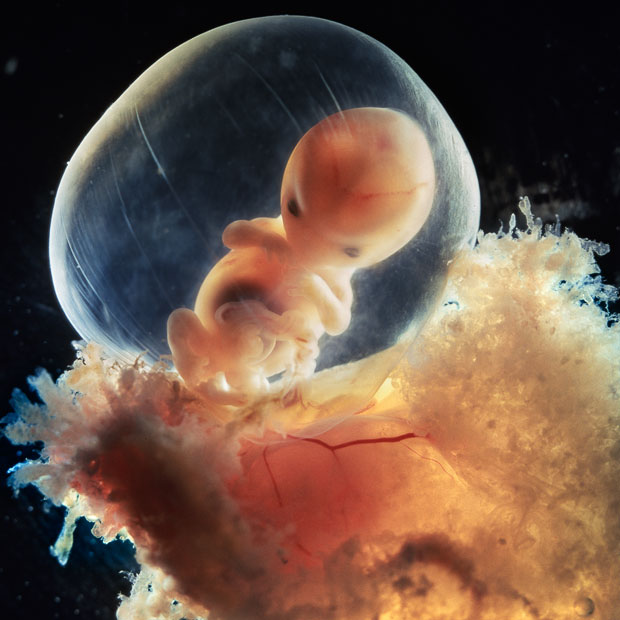
A secular case against abortion rights

Unborn baby scheming about being only two months old

Note: this post has a twin! Its companion post on a secular case against gay marriage is here.

Now, you may think that the view that the unborn deserve protection during pregnancy is something that you either take on faith or not. But I want to explain how you can make a case for the right to life of the unborn, just by using reason and evidence.

To defend the pro-life position, I think you need to sustain 3 arguments:

  1. The unborn is a living being with human DNA, and is therefore human.
  2. There is no morally-relevant difference between an unborn baby, and one already born.
  3. None of the justifications given for terminating an unborn baby are morally adequate.

Now, the pro-abortion debater may object to point 1, perhaps by claiming that the unborn baby is either not living, or not human, or not distinct from the mother.

Defending point 1: Well, it is pretty obvious that the unborn child is not inanimate matter. It is definitely living and growing through all 9 months of pregnancy. (Click here for a video that shows what a baby looks like through all 9 months of pregnancy). Since it has human DNA, that makes it a human. And its DNA is different from either its mother or father, so it clearly not just a tissue growth of the father or the mother. More on this point at Christian Cadre, here. An unborn child cannot be the woman’s own body, because then the woman would have four arms, four legs, two heads, four eyes and two different DNA signatures. When you have two different human DNA signatures, you have two different humans.

Secondly, the pro-abortion debater may try to identify a characteristic of the unborn that is not yet present or developed while it is still in the womb, and then argue that because the unborn does not have that characteristic, it does not deserve the protection of the law.

Defending point 2: You need to show that the unborn are not different from the already-born in any meaningful way. The main differences between them are: size, level of development, environment and degree of dependence. Once these characteristics are identified, you can explain that none of these differences provide moral justification for terminating a life. For example, babies inside and outside the womb have the same value, because location does not change a human’s intrinsic value. More at Stand to Reason, here.

Additionally, the pro-abortion debater may try to identify a characteristic of the already-born that is not yet present or developed in the unborn, and then argue that because the unborn does not have that characteristic, that it does not deserve protection, (e.g. – sentience). Most of the these objections that you may encounter are refuted in this essay by Francis Beckwith. Usually these objections fall apart because they assume the thing they are trying to prove, namely, that the unborn deserves less protection than the already born.

Finally, the pro-abortion debater may conceded your points 1 and 2, and admit that the unborn is fully human. But they may then try to provide a moral justification for terminating the life of the unborn, regardless.

Defending point 3: I fully grant that it is sometimes justifiable to terminate an innocent human life, if there is a moral justification. One of the best known justifications is Judith Jarvis Thomson’s “violinist” argument. This argument is summarized by Paul Manata, one of the experts over at Triablogue:

Briefly, this argument goes like this: Say a world-famous violinist developed a fatal kidney ailment and the Society of Music Lovers found that only you had the right blood-type to help. So, they therefore have you kidnapped and then attach you to the violinist’s circulatory system so that your kidneys can be used to extract the poison from his. To unplug yourself from the violinist would be to kill him; therefore, pro-lifers would say a person has to stay attached against her will to the violinist for 9 months. Thompson says that it would be morally virtuous to stay plugged-in. But she asks, “Do you have to?” She appeals to our intuitions and answers, “No.”

Manata then goes on to defeat Thomson’s proposal here, with a short, memorable illustration, which I highly recommend that you check out. More info on how to respond to similar arguments is here.

The best book for beginners on the pro-life view is this book:

For those looking for advanced resources, Francis Beckwith, a professor at Baylor University, published the book Defending Life, with Cambridge University Press, 2007.

Learn about the pro-life case

And some posts motivating Christians and conservatives to take abortion seriously:

If you favor abortions, then you favor sex-selection abortions

Unborn baby scheming about banning sex-selection abortions

This article from the Wall Street Journal discusses the unintended consequencs of sex-selection abortions. (H/T Joy McCann)

Excerpt:

Mara Hvistendahl is worried about girls. Not in any political, moral or cultural sense but as an existential matter. She is right to be. In China, India and numerous other countries (both developing and developed), there are many more men than women, the result of systematic campaigns against baby girls. In “Unnatural Selection,” Ms. Hvistendahl reports on this gender imbalance: what it is, how it came to be and what it means for the future.

In nature, 105 boys are born for every 100 girls. This ratio is biologically ironclad. Between 104 and 106 is the normal range, and that’s as far as the natural window goes. Any other number is the result of unnatural events.

Yet today in India there are 112 boys born for every 100 girls. In China, the number is 121—though plenty of Chinese towns are over the 150 mark. China’s and India’s populations are mammoth enough that their outlying sex ratios have skewed the global average to a biologically impossible 107. But the imbalance is not only in Asia. Azerbaijan stands at 115, Georgia at 118 and Armenia at 120.

What is causing the skewed ratio: abortion. If the male number in the sex ratio is above 106, it means that couples are having abortions when they find out the mother is carrying a girl. By Ms. Hvistendahl’s counting, there have been so many sex-selective abortions in the past three decades that 163 million girls, who by biological averages should have been born, are missing from the world. Moral horror aside, this is likely to be of very large consequence.

In the mid-1970s, amniocentesis, which reveals the sex of a baby in utero, became available in developing countries. Originally meant to test for fetal abnormalities, by the 1980s it was known as the “sex test” in India and other places where parents put a premium on sons. When amnio was replaced by the cheaper and less invasive ultrasound, it meant that most couples who wanted a baby boy could know ahead of time if they were going to have one and, if they were not, do something about it. “Better 500 rupees now than 5,000 later,” reads one ad put out by an Indian clinic, a reference to the price of a sex test versus the cost of a dowry.

[…]Ms. Hvistendahl argues that such imbalances are portents of Very Bad Things to come. “Historically, societies in which men substantially outnumber women are not nice places to live,” she writes. “Often they are unstable. Sometimes they are violent.”

[…]There is indeed compelling evidence of a link between sex ratios and violence. High sex ratios mean that a society is going to have “surplus men”—that is, men with no hope of marrying because there are not enough women. Such men accumulate in the lower classes, where risks of violence are already elevated. And unmarried men with limited incomes tend to make trouble. In Chinese provinces where the sex ratio has spiked, a crime wave has followed. Today in India, the best predictor of violence and crime for any given area is not income but sex ratio.

I think that it is a good idea, when talking to someone who is female and pro-abortion, to them about sex-selection abortions. It seems to me that it is impossible for someone who is pro-abortion to make a principled argument against aborting unborn children just because they are women. If abortion is morally permissible, then sex-selection abortions are morally permissible. After all, it’s the born woman’s body – it’s her choice. Right? Well, maybe not right. Maybe we need to think about this some more.

Note that the Republicans have been trying to ban sex-selection abortions in some states – but the Democrats are opposing them. Democrats favor sex-selection abortions – and in very liberal countries, they are openly permitted.

Learn about the pro-life case