Tag Archives: Feminism

New study: virgins have happiest marriages, more sex partners means more unhappiness

Although we live in a culture that is dominated by the thoughts and opinions of secular leftists, science provides useful information for those who want defend Biblical morality. Consider the issue of sexuality and marriage. Secular leftists claim that sex outside of marriage is natural, and produces happiness. Bible believing Christians and Jews say chastity is best. Who is right?

Here is the latest study authored by Dr. Nicholas Wolfinger, a sociologist at the University of Utah. His previous book on relationships was published by Oxford University Press. In his analysis of the data, Wolfinger controlled for divorce rates, religiosity, and socioeconomic status.

Here’s the most important graph:

Study: virgins have the happiest marriages, more partners means less happiness

Other factors that increased marital happiness: having a 4-year college degree (5%), having a salary > 78K (5%), regular church attendance (6%). Notice that women are more dissatisfied with marriage (in general) than men are, and they tend to blame the spouse they freely chose for that unhappiness.

The Federalist also reported on previous research relevant to this study:

Psychologists Galena K. Rhoades and Scott M. Stanley found that women who have had sex with someone other than their husband report statistically significant drops in marital quality over those who don’t. A 2004 study by sociologist Jay Teachman showed that intimate premarital activities such as cohabitation and intercourse increased the rate of marital dissolution by anywhere between 28 and 109 percent, depending on the activity.

Wolfinger also noted in a previous study that only 5% of women were virgins when they married.

Wolfinger noted that a possible explanation for the link between promiscuity and unhappiness is that people look back on their past partners and compare their spouse unfavorably to them. This is especially the case with women. My concern about this is that feminism has taught women to try to increase their social standing by having hook-up sex with attractive bad boys. If those women ever marry, they do it when they are older, less fertile, and less attractive. The husband they eventually “settle” for will (in their minds) always compare unfavorably to the hot bad boys they had sex with when they were younger and prettier. This, I believe, is what leads to their unhappiness with the man they chose to marry.

More partners also means more marital instability

In a previous post, I blogged about several studies linking virginity to marital stability. Couples who don’t have sex before marriage, or even who delayed it, reported better communication, higher satisfaction, better quality sex, and a lower chance of divorce.

Men ought to be aware of this research when they are choosing a spouse. Women initiate 69% of divorces, and the most common reason given is “unhappiness”. Well, now we know what’s causing that unhappiness – a high number of sexual partners prior to marrying. Smart men should prefer a virgin, for the increased happiness and increased stability. A large number of past sexual partners teaches women that relationships are engines for them to be happy, not commitments that are permanent and exclusive. They’ll have internalized the view that relationships are not commitments to invest in self-sacrificially. The pattern will be: “if it doesn’t make me feel happy right now, then it should be ended”. It will be seen as the man’s fault that she is unhappy, even if the study I talked about above shows the real reason is her past promiscuity. Men who aren’t serious about evaluating the character of the women for the marriage enterprise are running the risk of divorce, it’s that simple.

The best way to make sure that you have a clear head when evaluating a woman is to stay sober, and keep her hands off of you. When a man refuses to let a woman cloud his judgment with sex, then she is forced to learn how to love him in marriage-oriented ways, e.g. – help him, support him, and submit to his leadership. Male chastity encourages women who have been influenced by feminism to abandon selfishness, fun-seeking, and thrill-seeking, so that they learn to care for others. Male chastity also helps a man to resist older women who chose bad boys in their teens and 20s and want to get married to a good provider in their 30s. The studies discussed above clearly show that such women are more likely to be unhappy, and their future marriages are more likely to be unstable. Avoid them. You don’t want to be in a marriage to someone who isn’t very good at it, because she never prepared herself for it.


If unborn babies don’t have consciousness or don’t feel pain, may we kill them?

Was having a conversation by e-mail yesterday with a pro-abortion atheist, and he gave two reasons why he supported abortion in the first and second trimester. First, he said that unborn babies can’t feel pain, so it’s OK to kill them. Second, he said that unborn babies don’t have consciousness, so it’s OK to kill them. I thought it might be useful to link to something that answers both of these objections.

Frank Beckwith is the author of “Defending Life: A Moral and Legal Case Against Abortion Choice“, which was published by Cambridge University Press, a top academic press. But before Cambridge University Press, Beckwith wrote four easy-to-understand essays for the Christian Research Journal. Part IV is the one that has the response to the two questions raised by my atheist friend.

Part I. The Appeal to Pity

Part II. Arguments from Pity, Tolerance, and Ad Hominem

Part III. Is The Unborn Human Less Than Human?

Part IV. When Does a Human Become a Person?

Excerpt:

Some ethicists argue that the unborn becomes fully human sometime after brain development has begun, when it becomes sentient: capable of experiencing sensations such as pain. The reason for choosing sentience as the criterion is that a being that cannot experience anything (i.e., a presentient unborn entity) cannot be harmed. Of course, if this position is correct, then the unborn becomes fully human probably during the second trimester and at least by the third trimester. Therefore, one does not violate anyone’s rights when one aborts a nonsentient unborn entity. [13]

There are several problems with this argument. First, it confuses harm with hurt and the experience of harm with the reality of harm. [14] One can be harmed without experiencing the hurt that sometimes follows from that harm, and which we often mistake for the harm itself. For example, a temporarily comatose person who is suffocated to death “experiences no harm,” but he is nevertheless harmed. Hence, one does not have to experience harm, which is sometimes manifested in hurt, in order to be truly harmed.

Second, if sentience is the criterion of full humanness, then the reversibly comatose, the momentarily unconscious, and the sleeping would all have to be declared nonpersons. Like the presentient unborn, these individuals are all at the moment nonsentient though they have the natural inherent capacity to be sentient. Yet to countenance their executions would be morally reprehensible. Therefore, one cannot countenance the execution of some unborn entities simply because they are not currently sentient.

Someone may reply that while these objections make important points, there is a problem of false analogy in the second objection: the reversibly comatose, the momentarily unconscious, and the sleeping once functioned as sentient beings, though they are now in a temporary state of nonsentience. The presentient unborn, on the other hand, were never sentient. Hence, one is fully human if one was sentient “in the past” and will probably become sentient again in the future, but this cannot be said of the presentient unborn.

There are at least three problems with this response. First, to claim that a person can be sentient, become nonsentient, and then return to sentience is to assume there is some underlying personal unity to this individual that enables us to say that the person who has returned to sentience is the same person who was sentient prior to becoming nonsentient. But this would mean that sentience is not a necessary condition for personhood. (Neither is it a sufficient condition, for that matter, since nonhuman animals are sentient.) Consequently, it does not make sense to say that a person comes into existence when sentience arises, but it does make sense to say that a fully human entity is a person who has the natural inherent capacity to give rise to sentience. A presentient unborn human entity does have this capacity. Therefore, an ordinary unborn human entity is a person, and hence, fully human.

Second, Ray points out that this attempt to exclude many of the unborn from the class of the fully human is “ad hoc and counterintuitive.” He asks us to “consider the treatment of comatose patients. We would not discriminate against one merely for rarely or never having been sentient in the past while another otherwise comparable patient had been sentient….In such cases, potential counts for everything.” [15]

Third, why should sentience “in the past” be the decisive factor in deciding whether an entity is fully human when the presentient human being “is one with a natural, inherent capacity for performing personal acts?” [16] Since we have already seen that one does not have to experience harm in order to be harmed, it seems more consistent with our moral sensibilities to assert that what makes it wrong to kill the reversibly comatose, the sleeping, the momentarily unconscious, and the presentient unborn is that they all possess the natural inherent capacity to perform personal acts. And what makes it morally right to kill plants and to pull the plug on the respirator-dependent brain dead, who were sentient “in the past,” is that their deaths cannot deprive them of their natural inherent capacity to function as persons, since they do not possess such a capacity.

These four essays are a very good introduction to common responses to pro-abortion arguments. I recommend that people get familiar with this, as once you look into it, you will see that the abortion issue can be debated with as much confidence as William Lane Craig defends Christian theism. You will have the same access to scientific evidence and rational arguments on this topic, and so you will have the upper hand. And that’s fun.

The best introductory book on the abortion / right to life issue is “The Case for Life” by pro-life debater Scott Klusendorf. The best comprehensive book is a tie between “The Ethics of Abortion” by Christopher Kaczor, and Frank Beckwith’s “Defending Life: A Moral and Legal Case Against Abortion Choice“.

New study: women who have fewer premarital sex partners have lower risk of divorce

Consider this article from Family Studies that talks about how the number of pre-marital sex partners that a woman has increases her risk of divorce.

It says:

American sexual behavior is much different than it used to be. Today, most Americans think premarital sex is okay, and will have three or more sexual partners before marrying. What, if anything, does premarital sex have to do with marital stability?

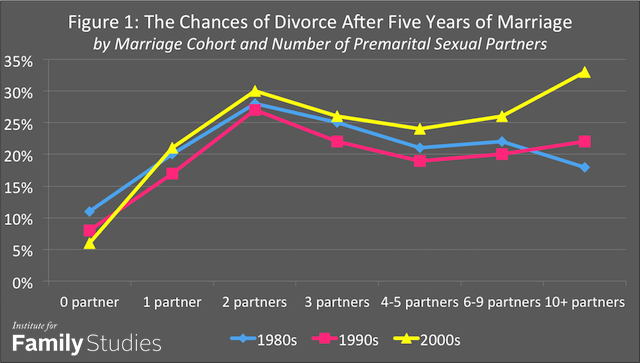
This research brief shows that the relationship between divorce and the number of sexual partners women have prior to marriage is complex. I explore this relationship using data from the three most recent waves of the National Survey of Family Growth (NSFG) collected in 2002, 2006-2010, and 2011-2013. For women marrying since the start of the new millennium:

  • Women with 10 or more partners were the most likely to divorce, but this only became true in recent years;
  • Women with 3-9 partners were less likely to divorce than women with 2 partners; and,
  • Women with 0-1 partners were the least likely to divorce.

Earlier research found that having multiple sex partners prior to marriage could lead to less happy marriages, and often increased the odds of divorce.

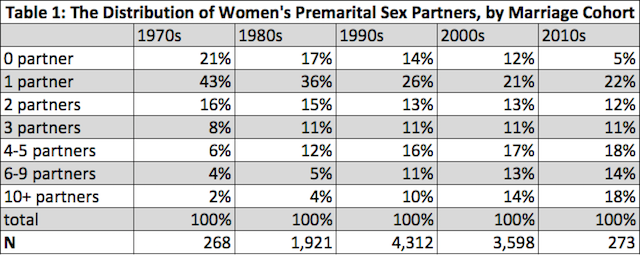
[…]Even more noteworthy has been the decline in the proportion of women who get married having had only one sex partner (in most cases, their future husbands). Forty-three percent of women had just one premarital sex partner in the 1970s.

[…]By the 2010s, only 5 percent of new brides were virgins. At the other end of the distribution, the number of future wives who had ten or more sex partners increased from 2 percent in the 1970s to 14 percent in the 2000s, and then to 18 percent in the 2010s. Overall, American women are far more likely to have had multiple premarital sex partners in recent years (unfortunately, the NSFG doesn’t have full data on men’s premarital sexual behavior, and in any event they recall their own marital histories less reliably than do women).

Here’s the change:

Women have freely chosen to dismiss the Bible and the moral law

And the problem with this, of course, is that more premarital sex partners means a higher risk of divorce:

Even one non-husband premarital sex partner raises risk of divorce

Why is the 2-partner number so high?

In most cases, a woman’s two premarital sex partners include her future husband and one other man. That second sex partner is first-hand proof of a sexual alternative to one’s husband. These sexual experiences convince women that sex outside of wedlock is indeed a possibility. The man involved was likely to have become a partner in the course of a serious relationship—women inclined to hook up will have had more than two premarital partners—thereby emphasizing the seriousness of the alternative.

The Christian Post had an article about some recent numbers from the Centers for Disease Control about virgins.

Excerpt:

A new Centers for Disease Control study examines teenage health behaviors in connection to their self-reported sexual activity and shows those who remain abstinent are much healthier on many fronts than their sexually active peers.

The report, titled “Sexual Identity, Sexual Contacts, and Health-Related Behaviors Among Students in Grades 9-12, United States and Selected Sites,” showcased the results from a 2015 survey that monitored several categories of health-related behaviors like tobacco usage, drug and alcohol use, sexual habits, unhealthy dietary behaviors, and behaviors that contribute to unintentional injuries and violence.

The report concludes “that students who had no sexual contact have a much lower prevalance of most health-risk behaviors compared with students” who had sexual contact.

The article quotes Dr. Jennifer Roback Morse, who I have featured on this blog many times:

In a Monday interview with The Christian Post, Jennifer Roback Morse, founder and president of the Ruth Institute, said, “this study is remarkable because it asks questions and reports the answers, rather than avoiding questions or assuming answers.”

As Glenn Stanton noted last week in The Federalist, the results from those questions and answers are remarkable.

With regard to smoking, teenage virgins are 3,300 percent less likely to smoke daily than their peers who are sexually involved with someone of the opposite sex, Stanton computed from the report’s data. Teen virgins are 9,500 percent less likely to smoke daily than their peers who are sexually involved with someone of the same sex or in a bisexual relationship, he added. Chaste young people are also extremely less likely to use indoor tanning beds, binge drink, smoke marijuana, ride in cars as passengers with a drunk driver, and get into physical fights than their sexually active peers. Abstinent youth are also more likely to get a solid eight hours of sleep every night and eat breakfast daily.

[…]The CDC report also included findings from 25 state surveys, and 19 large, urban school district surveys conducted among students in grades 9–12 which took place between December of 2014 and September of 2015.

Now, many pro traditional marriage people will tell young men “feminism and the sexual revolution change nothing about a woman’s suitability for marriage, so go out there and get married to these women anyway”. In my experience, no one is telling women NOT to follow their hearts, and explaining to them the harm that they do by allowing their feelings to determine who they will engage in relationships.

I would like to see women make better decisions with men before they marry, rather than be influenced by their peers and culture to give themselves to men who are not marriage-minded. Maybe a little skepticism should be shown to “follow your heart”? Women need to understand what they are losing when they choose to have premarital sex.

In my group of friends, the men are aware of the Biblical prohibition on premarital sex. My friends know about the research on marriage, and what it takes to make a marriage work. We don’t follow our hearts, because we do what we know will work to achieve the results we want. We don’t listen to the culture, and we don’t listen to radical feminists. Men generally take an engineering approach to marriage – we want to know what the best practices and tradeoffs are, and then we plan and act to succeed.