Tag Archives: Feminism

A lesson about men for marriage-minded women from the movie “High Noon”

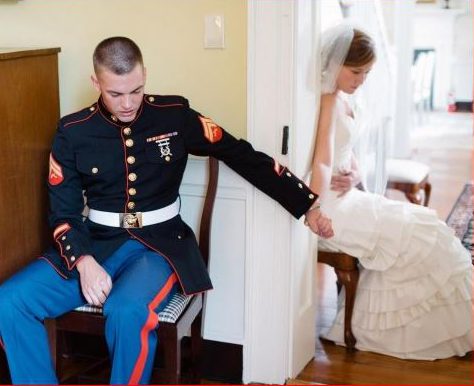
Marine prays with his wife on their wedding day

One of my favorite movies for explaining the differences between men and women is “High Noon” (1952).

Here’s the summary from IMDB:

Former marshal Will Kane (Gary Cooper) is preparing to leave the small town of Hadleyville, New Mexico, with his new bride, Amy (Grace Kelly), when he learns that local criminal Frank Miller has been set free and is coming to seek revenge on the marshal who turned him in. When he starts recruiting deputies to fight Miller, Kane is discouraged to find that the people of Hadleyville turn cowardly when the time comes for a showdown, and he must face Miller and his cronies alone.

The main theme of the film concerns Amy’s decision to break her wedding vows the very day that she makes them. She tells her new husband that he must bow to her will, and give up his male role as protector. When he explains his reasons for standing his ground to her practically (Miller will hunt them down) and morally (he has a duty protect the town), she dismisses both. She tells him that if he doesn’t run away from Miller and his gang with her, that she will get on the train and leave town by herself.

The intro of film shows the member’s of Miller’s gang assembling, and the words of the song explain the central conflict between husband and wife:

Here’s the part of the lyrics we care about:

The noonday train will bring Frank Miller.
If I’m a man I must be brave
And I must face that deadly killer
Or lie a coward, a craven coward,
Or lie a coward in my grave.

O to be torn ‘twixt love and duty!
S’posin’ I lose my fair-haired beauty!
Look at that big hand move along
Nearin’ high noon.

He made a vow while in State’s Prison,
Vow’d it would be my life or his’n
I’m not afraid of death, but O,
What will I do if you leave me?

Do not forsake me O my darlin’
You made that promise when we wed.
Do not forsake me O my darlin’
Although you’re grievin’, I can’t be leavin’
Until I shoot Frank Miller dead.

What’s interesting is that his new wife Amy apparently does not understand the meaning of wedding vows or the natural roles of good men as protectors of the weak, and fighters against evil. Although she vowed to stick by him and help him, the minute anything threatening appears that makes her feel unhappy, she abandons her vows and abandons her man. Let’s break down her mistakes now, using actual conversations from the movie.

First, she doesn’t understand or respect the man she married as a man:

Kane: [while riding out of town] It’s no good. I’ve got to go back, Amy.

Amy: Why?

Kane: This is crazy. I haven’t even got any guns.

Amy: Then let’s go on. Hurry.

Kane: No, that’s what I’ve been thinkin’. They’re making me run. I’ve never run from anybody before.

Amy: I don’t understand any of this.

Kane: [after looking at his vest watch] Well, I haven’t got time to tell ya.

Amy: Then don’t go back, Will.

Kane: I’ve got to. That’s the whole thing. [He turns the buggy around and rides back into town]

Her feelings and her desires for the world to be a happy place for her are so strong that they cloud her judgment.

Second, she doesn’t understand the threat posed by evil men:

More:

Kane: I sent a man up five years ago for murder. He was supposed to hang. But up North, they commuted it to life and now he’s free. I don’t know how. Anyway, it looks like he’s coming back.

Amy: I still don’t understand.

Kane: He was always wild and kind of crazy. He’ll probably make trouble.

Amy: But that’s no concern of yours, not anymore.

Kane: I’m the one who sent him up.

Amy: Well, that was part of your job. That’s finished now. They’ve got a new marshal.

Kane: He won’t be here until tomorrow. Seems to me I’ve got to stay. Anyway, I’m the same man with or without this. [He pins his badge on his vest]

Amy: Oh, that isn’t so.

Kane: I expect he’ll come lookin’ for me. Three of his old bunch are waiting at the depot.

Amy: That’s exactly why we ought to go.

Kane: They’ll just come after us, four of ’em, and we’d be all alone on the prairie.

Amy: We’ve got an hour.

Kane: What’s an hour?…What’s a hundred miles? We’d never be able to keep that store, Amy. They’d come after us and we’d have to run again, as long as we live.

Amy: No we wouldn’t, not if they didn’t know where to find us. Oh Will! Will, I’m begging you, please let’s go.

Kane: I can’t.

Amy: Don’t try to be a hero. You don’t have to be a hero, not for me.

Kane: I’m not trying to be a hero. If you think I like this, you’re crazy.

Instead of recognizing how her feelings are deceiving her about the threat and trusting her husband, she tries to force him to accept her mistaken view of reality by threatening to abandon him.

One of Kane’s ex-girlfriends has a talk with Amy, which helps her to understand who Kane is, and what is expected of her:

Amy: That man downstairs, the clerk, he said things about you and Will. I’ve been trying to understand why he wouldn’t go with me, and now all I can think of is that it’s got to be because of you…Let him go, he still has a chance. Let him go.

Helen: He isn’t staying for me. I haven’t spoken to him for a year – until today. I am leaving on the same train you are…What kind of woman are you? How can you leave him like this? Does the sound of guns frighten you that much?

Amy: I’ve heard guns. My father and my brother were killed by guns. They were on the right side but that didn’t help them any when the shooting started. My brother was nineteen. I watched him die. That’s when I became a Quaker. I don’t care who’s right or who’s wrong. There’s got to be some better way for people to live. Will knows how I feel about it.

Helen: I hate this town. I always hated it – to be a Mexican woman in a town like this.

Amy: I understand.

Helen: You do? That’s good. I don’t understand you. No matter what you say. If Kane was my man, I’d never leave him like this. I’d get a gun. I’d fight.

Amy: Why don’t you?

Helen: He is not my man. He’s yours.

Helen understands the need for a wife to stand by her man. But Amy’s response to evil is to shut her eyes and focus on feeling good and being happy. Notice that her “better way” is unspecified – it’s just a feeling she has that pacificism and no-violence will somehow “work” to stop evil. But in reality, pacifism is not a “better way” of dealing with evil – it does not work. Her pacifist response not only does not make evil go away, it actually encourages more evil. Weakness emboldens evildoers, and laying down your arms provokes them to do more evil. Will Kane knows this, but she won’t listen to him.

You can watch the final gunfight here, as well as Amy’s final decision:

So, this is why I really recommend this movie as a discussion-starter when you like a girl and are thinking of marrying her. It clarifies the essential problem with many young women today not being ready for marriage. To be fair, most women come around to respect their husbands and his different roles after they get married. However, the risk of divorce is so dangerous that it makes sense to bring it up for discussion before the marriage happens. Marriage is supposed to be an engine to serve God, and the success of that enterprise cannot be left to chance. You can’t just rely on the fact that she says the words of the vow, you have to check to see if she has a habit of keeping her promises when it goes against her own self-interest.

Ask yourself: Who are you, as a man? And does your woman accept that you have obligations to stand up to evil and do good ? Will she support you in your battle against evil, or will the marriage just be about her feelings and desires? I would especially beware of women who think that God is speaking to them through their feelings and desires. Look at her friends: are they practical and successful? Or are they irresponsible, unaccountable and reckless? Look at her father: does he have a plan for her, and does he lead her to be practical, frugal and hard-working? If you are not going to get an ally and a supporter in a wife, then you will not be able to serve God well, as a married man. Think about it.

Can feminism be defended with reason and evidence? Jordan Peterson vs Cathy Newman

Can radical feminism be defended rationally and evidentially?

There was a short discussion recently on UK Channel 4 between Canadian university professor named Jordan Peterson, and a radical feminist with an undergraduate degree in English named Cathy Newman. While you watch, imagine that she is teaching some non-STEM course that you’ve enrolled in. Would you dare to disagree with her?

First, the video, which has over 33 million views:

And here is an article from the UK Spectator: (paywalled)

Whatever else anybody might think of him, Professor Peterson is a man of remarkable learning and experience, and does not appear to have arrived at any of his views by the now common means of ‘I reckon’. Yet Newman, who approaches the interview with the trademark sourness she employs for everyone she expects to disagree with, treats this is just another chance to burnish her own social justice credentials and expose her guest as a bigot. Big mistake.

Storming straight in with the differences between the sexes, in the opening minutes it is clear that Professor Peterson is willing to back up all his views with references, data and calm analysis. 

By 11 minutes in she is saying ‘I think I take issue with (that)’, before demonstrating that she can’t. Soon she is reduced to dropping the bombshell observation that ‘all women are different’. By 16.45 there is a palpable win, as Peterson points out that Newman has exactly the disagreeable and aggressive qualities that allow certain types of people to succeed. By 19.30 she is having to throw out things to him that he hasn’t even said, such as ‘You’re saying women aren’t intelligent enough to run top companies’. A minute later and she is reduced to countering empirical evidence with anecdote. Peterson presents the data about men in general and Newman responds with the ‘I know plenty of men who aren’t (like that)’ card. Shortly after that (at 22.25) Newman is reduced to spluttering and then silence. She tries to pull herself together. But she can think of nothing to say.

To be honest, Cathy Newman is nothing like the women I’m friends with. All of my closest friends are Christian women. All of them are anti-feminist to some degree, with the most successful one professionally (Dina) being the wisest and most anti-feminist of all. When I think of my panel of wise Christian women advisors – each with one or more STEM degrees – I don’t recognize Cathy Newman in them. But Cathy Newman does remind me of the radical feminists I encountered when I was doing my BS and MS degrees in computer science at the university.

In my experience, radical feminists debate using six tactics:

  1. Deny facts or evidence because men were involved in researching them or discovering them
  2. Countering empirical data with anecdotes and personal experiences
  3. Taking arguments and evidence as if they are personal attacks
  4. Becoming hysterical and crying
  5. Claiming that disagreement with feminism will produce violence against women and women committing suicide, etc.
  6. Trying to get you expelled, fired or silenced – often by making false accusations or faking hate crimes against themselves

It’s important for everyone to understand the views of others in order to know how defensible our own views are. In order to get the best scholarly case for radical feminism, I like to read feminist academics like Christina Hoff Sommers, Camille Paglia, Jennifer Roback Morse, etc. who evaluate and critique radical feminist scholarship. That’s how I encounter the ideas of those I disagree with (as well as listening to and watching debates).

Here’s a short Factual Feminist video:

I understand the claims that are made by radical feminists, but I am also aware of what the evidence says. I don’t try to stop feminists from making claims, I just study how to refute their claims.

But what about the radical feminists? Do they do a good job of understanding those who disagree with them? Let’s take a look at an example which I think is representative of feminist tolerance and open-mindedness.

The Toronto Sun reports on a sociology professor who gave her students an assignment – an assignment with some very peculiar constraints.

Excerpt:

A Ryerson University student who wanted to write a paper on the “myth” of the male-female wage gap was told by her prof that not only was she wrong, she should only rely on feminist journals for her assignment instead of business sources which “blame women,” her sister says.

Josephine Mathias, 21, a fourth-year political science student at University of Toronto, took to YouTube Wednesday to criticize the assignment given her twin Jane for a sociology class.

[…]After Jane sent an email describing her intention to write about the wag gap, her instructor replied that her premise was wrong, Josephine said.

Here’s what the professor said:

“Perhaps you want to write your paper on the glass ceiling. You need to look at feminist sources on this issue…Do NOT use business sources. They blame women. The reality is patriarchy,” says the instructor’s email, posted online.

In a copy of the assignment provided to the Toronto Sun by Josephine, the instructor also notes that Ontario and Canada government websites and Statistics Canada will not be considered scholarly sources.

“Government websites state government policy that is devoid of analysis, and usually reproduces mainstream stereotypes, assumptions and misconceptions,” the assignment says.

What is interesting is that the professor makes about $167,000 a year – higher than the average professor’s salary. And she’s not teaching computer science or petroleum engineering. I find it interesting that another Canadian university reprimanded a grad student for showing a debate clip that offered both sides of the transgenderism debate. Leftist tolerance. Leftist open-mindedness.

Once you’ve paid your tuition, and the leftist has the grading pen, you lose every argument. Either you get an F, or you get expelled. If you’re in the workplace, you get fired. False charges are often made. Hate crimes are faked. Anything to play the victim, rather than address the arguments and evidence. This is how people on the left “debate”.

As I wrote previously, the more women embrace radical feminism, the more toxic they become to men. Not just in the classroom or the workplace, but in relationships. Who wants to marry someone whose only response to reason is fury? Men might be OK with temporary arrangements with abusive women. At least while those women have youth and beauty. But men don’t marry abusive women. At least, not if they have any wisdom.

(Image source: Independent Man)

Men on strike: the social changes that caused men to opt out of marriage

Painting: "Courtship", by Edmund Blair Leighton (1888)
Painting: “Courtship”, by Edmund Blair Leighton (1888)

I read and enjoyed Dr. Helen Smith’s book “Men on Strike” a few years back. The book explains a few of the developments that have led to men underperforming in school and in the workplace, and opting out of marriage and fatherhood.

Dr. Helen comes to this problem as a secular libertarian, not as a Christian conservative.

A review of Dr. Helen’s book appeared in Salvo magazine. The review is written by Terrell Clemmons, who has the best Christian worldview of any woman I know – I frequently rely on her advice.

Terrell writes:

While the feminist movement may originally have been about equal respect for both sexes, what it has morphed into, she argues, is female privilege. From rape laws that empower women but not the men they may falsely accuse, to divorce laws tilted in favor of the wife, to the feminization of the U.S. education system, men have become the sex under the gun, while women enjoy the status of a protected class.

But unlike their mothers or grandmothers, men today are not taking to the streets burning their undergarments and shrieking demands (thank God). They’re doing just the opposite, which is far worse. They’re going on strike. The strike zones are manifold:

Higher Education.In addition to the enrollment imbalance, which is approaching a 60/40 ratio of women to men, college has become, in the words of one professor, “a hostile working environment [in which] males increasingly feel emasculated.” Smith quotes a student named John, who had this to say about his college experience: “I had already been cautious around women, having grown up with Tawana Brawley in my backyard and daily stories of sexual harassment; I played it safe and passive every time. But it doesn’t matter. The only way not to lose is to not play. So I’m out.”

Work,including community involvement. With higher female graduation rates and salaries, men today are falling behind their fathers economically and professionally. Consequently, their efforts to prove themselves worthy mates through hard work and higher earnings don’t win female attention the way they used to. Discouraged, too many retreat to a man cave, and inertia sets in from there.

Marriage.Marriage rates are down, and honest men opting out will tell you why. Smith cites a Rutgers University study of single heterosexual men which turned up the top reasons they hadn’t married. They can get sex and the companionship of cohabitation without marriage more easily than in times past, and they don’t want to open themselves up to the risk of divorce and financial loss. It really isn’t that complicated a decision. In fact, it’s often not an actual decision at all. It just happens.

The simplest explanation for the difficulties that boys face in an education system that is dominated by women (teachers and administrators) is discrimination. And in the workplace, the government requires employers to report on male and female head counts, and promote women who are not qualified. I have seen receptionists with tattoos and no college degrees promoted to six-figure manager jobs in companies where I worked.

There is one more which to me was the most surprising one in the book – paternity fraud, and the laws that support paternity fraud:

Take the following cases of nonconsensual insemination: Nathaniel from California, age 15, had sex with 34-year-old Ricci, which, due to his age, was legally considered nonconsensual. Emile from Louisiana was visiting his parents in the hospital when a nurse offered him oral sex, if he wore a condom, which she conveniently offered to dispose of for him afterward. S. F. from Alabama passed out drunk at the home of a female friend and awoke undressed the following morning. In all three cases, including the one involving the minor, a woman got sperm and, nine months later, a child, and the man got ordered by a court of law to pay support for eighteen years.

Less devious, but similarly amiss, are those cases in which a man, having been betrayed by his wife or girlfriend, was nevertheless held financially responsible for a child genetically proven to be another man’s offspring. While not as sensational as sperm-jacking, it is another form of paternity extortion.

In each of those cases, the man was found liable to pay child support – including the case of the 15-year-old boy, who was forced to pay child support to his statutory rapist when he turned 18. This is how the court system works, and more and more men are understanding the risks.

I often encounter “pro-marriage” people while gathering stories for the blog. These pro-marriage people come in two varieties.

On the one end of the spectrum are people like Terrell Clemmons and Jennifer Roback Morse, who understand marriage, but who also understand the social changes that have made marriage unattractive for men. Both Clemmons and Morse have a background in STEM fields, so they are able to understand incentives and tradeoffs. They understand that society has to rollback the changes to education, divorce laws, etc. if they expect men to be interested in marriage again. They understand that men are not just accessories of women, but instead have their own desires, feelings and reasons for marrying.

On the other end of the spectrum are feminist men, who are not able to understand the changing incentives that face men in a world that has evolved under the influence of radical feminism. It is just simpler (less thinking) for these men to accept the radical feminism as a given, and then urge men to “man up”. I think a much better idea would be for the “man up” crowd to realize how marriage has changed, and how the schools and the workplace have changed, then make all of these things more attractive to men. It doesn’t do any good to try to “dare” men into jumping off a cliff. Men aren’t stupid, and they do what is in their own best interests. If the man-up crowd wants younger men to marry, then they need to change the incentives offered to men. And that means changing women first.