

Tag Archives: Feminism

Stephen Baskerville: five myths about no-fault divorce

Marriage and family
Marriage and family

From the Catholic News Agency.

Introduction:

Almost four decades after the “no-fault” divorce revolution began in California, misconceptions abound. Even the many books about divorce, including myriad self-help manuals, are full of inaccurate and misleading information. No public debate preceded the introduction of no-fault divorce laws in the 1970s, and no debate has taken place since.

Yet divorce-on-demand is exacting a devastating toll on our children, our social order, our economy, and even our constitutional rights. A recent study estimates the financial cost of divorce to taxpayers at $112 billion annually. Recent demands to legitimize same-sex marriage almost certainly follow from the divorce revolution, since gay activists readily acknowledge that they only desire to marry under the loosened terms that have resulted from the new divorce laws. Divorce also contributes to a dangerous increase in the power of the state over private life.

Here are the five myths about no-fault divorce:

  • No-fault divorce permitted divorce by mutual consent, thus making divorce less acrimonious
  • We cannot force people to remain married and should not try
  • No-fault divorce has led men to abandon their wives and children
  • When couples cannot agree or cooperate about matters like how the children should be raised, a judge must decide according to “the best interest of the child”
  • Divorce must be made easy because of domestic violence

And the details about number three:

Myth 3: No-fault divorce has led men to abandon their wives and children.

Fact: This does happen (wives more often than children), but it is greatly exaggerated. The vast majority of no-fault divorces — especially those involving children — are filed by wives. In fact, as Judy Parejko, author of Stolen Vows, has shown, the no-fault revolution was engineered largely by feminist lawyers, with the cooperation of the bar associations, as part of the sexual revolution. Overwhelmingly, it has served to separate large numbers of children from their fathers. Sometimes the genders are reversed, so that fathers take children from mothers. But either way, the main effect of no-fault is to make children weapons and pawns to gain power through the courts, not the “abandonment” of them by either parent.

Al Mohler wrote about the history of no-fault divorce a while back, and I think it’s worth reviewing why we have this lousy law.

The story behind America’s love affair with no-fault divorce is a sad and instructive tale. As Baskerville documents, no-fault divorce laws emerged in the United States during the 1970s and quickly spread across the nation. Even though only nine states had no-fault divorce laws in 1977, by 1995, every state had legalized no-fault divorce.

Behind all this is an ideological revolution driven by feminism and facilitated by this society’s embrace of autonomous individualism. Baskerville argues that divorce “became the most devastating weapon in the arsenal of feminism, because it creates millions of gender battles on the most personal level.” As far back as 1947, the National Association of Women Lawyers [NAWL] was pushing for what we now know as no-fault divorce. More recently, NAWL claims credit for the divorce revolution, describing it as “the greatest project NAWL has ever undertaken.”

The feminists and NAWL were not working alone, of course. Baskerville explains that the American Bar Association “persuaded the National Conference of Commissioners on Uniform State Laws [NCCUSL] to produce the Uniform Marriage and Divorce Act.” Eventually, this led to a revolution in law and convulsions in society at large. This legal revolution effectively drove a stake into the heart of marriage itself, with inevitable consequences. In effect, no-fault divorce has become the catalyst for one of the most destructive cultural shifts in human history. Now, no-fault divorce is championed by many governments in the name of human rights, and America’s divorce revolution is spreading around the world under the banner of “liberation.”

And note that Democrats oppose any effort to reform laws that make it easy to break up marriages:

A basic dishonesty on the question of divorce pervades our political culture. Baskerville cites Michigan governor Jennifer Granholm as referring to divorce as a couple’s “private decision.” Granholm’s comments came as she vetoed a bill intended to reform divorce law in her state. The danger and dishonesty of referring to divorce as a couple’s “private decision” is evident in the fact that this supposedly private decision imposes a reality, not only on the couple, but also on children and the larger society. Indeed, the “private decision” is really not made by a couple at all–but only by any spouse demanding a divorce.

So, no-fault was pushed by two groups: feminists and trial lawyers.

There’s a lot of talk these days about gay marriage and how it undermines marital norms and normalizes raising children without either their biological father or biological mother. But before there was gay marriage, there was no-fault divorce, which deprives children of their biological father. There is no provision for no-fault divorce in the Bible, so it seems to me that Christians should be against frivolous divorce just like we are against same-sex marriage.
Woman invents hunky man character for her book, then leaves her husband for him

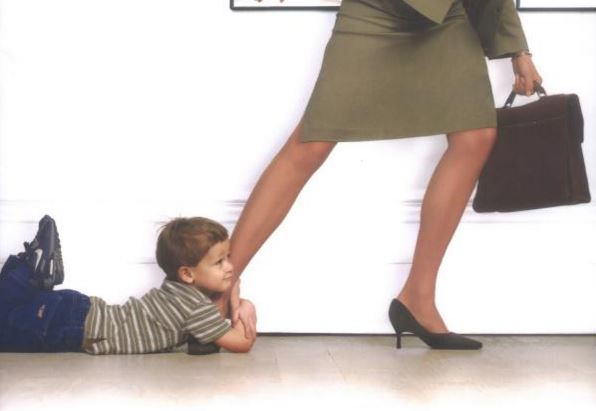
Child grabs for his mom, who is leaving for work

My good friend Dina sent me this article about a very crazy, irrational woman who does not value marriage at all.

Excerpt:

Her steamy, bestselling novels and strong male characters have seduced hundreds of thousands of female readers worldwide.

But Jodi Ellen Malpas has revealed she has split from her own Mr Right – because he no longer lives up to the fantasy she created.

The 34-year-old, whose This Man trilogy has sold more than 500,000 copies, has left her husband of ten years after ‘falling in love’ with one of her characters.

Ms Malpas, from Northampton, says: ‘All my fictional men are strong, successful, sophisticated and enigmatic. I guess it’s hard for any living, breathing man to live up to such a fantasy.

‘In This Man I created Jesse Ward, whose forceful personality was appealing to me. There is no denying I fell in love with him.

‘After all, I created him and I made him the way he is for a reason. Every woman needs some fantasy lover to spice up the dull reality of her real life. I wanted to create my perfect love story.

‘But the success of my books and the popularity of my male character led to the breakdown of my marriage. Sadly it was not solid enough to withstand the changes success has brought to my life.’

The mother of two, whom many believe is the new E. L. James, the housewife who wrote the Fifty Shades Of Grey trilogy, became a self-publishing sensation last year, swiftly rising to the top of the New York Times Best Seller List.

The This Man trilogy explores the love affair between young interior designer Ava O’Shea and playboy Jesse Ward. The second part of her new trilogy, One Night, has just been published by Orion.

‘I was 23 when Aaron and I got married, so we were both very young,’ she says. ‘I didn’t really know who I was. I got on with being a wife and mother.

‘But over time I started to feel that something was missing – my normal everyday life had become a routine. I was bored. I guess that is what couples mean when they say they’ve grown apart. Aaron couldn’t understand why I wanted to write my fiction and I couldn’t understand why he didn’t understand.’

The couple have two children, Alfie, 14, and Patrick, ten. But although they divorced in August last year, Ms Malpas says their relationship remains amicable. She is currently single and insists that she has no time to get involved in a relationship.

‘My children and my writing are enough for the moment,’ she adds. ‘In any case, I suspect some men might be a little intimidated by my independence and my success.’

And she insists she has no regrets. ‘It’s been crazy, but I’m loving the stronger more liberated me,’ she says.

They are “her” children. Not her husband’s and hers. And they don’t need a father – because children don’t have needs distinct from her own needs. Her husband doesn’t have needs distinct from her own needs. In her own mind, men are “intimidated” by her success. But that’s not true – they are intimidated because she is insane and irrational and self-centered. She is not capable of relationships, and that’s the main thing that a man wants from a woman. They avoid her because she divorced her husband of 10 years (with children) for a fictional character!!!!! 

Good Lord. What have women come to under the influence of feminism? The feministy ones seem to place no value on what a married couple can do together. They place no value on the needs of children. Everything is about getting their own fulfillment through worldy “success” and experiences; traveling, feeling good and taking pointless risks. When I think of the men that these feministy women seem to really want (at least when they are in their teens, 20s and 30s) it really scares me. I used to think that most young, unmarried women were sensible and thought that being a wife and mother was a good way to make a difference. Now so many of them are influenced by feminism and they seem to be avoiding it in favor of making lots of money. As if that were an end in itself.

What is so boring about marriage that women no longer find it fulfilling? I go to work every day and damned if I think that is more fulfilling that loving a wife and fathering children. I don’t think any man would think that. We work because that’s how we relate to our wives and children, by providing for them and leading them. And work is not meant to be fun or fulfilling. It’s WORK. Nowadays, I am seeing a lot of men who are interested in the idea of marriage and becoming a father. But I also see more and more women more interested in careers and travel than they are in marriage and becoming a mother. Men avoid women like that – we don’t want to be accessories to a self-centered career woman, we want a partnership and a home and children raised by a mother.

UK woman explains why she chose a man who savagely attacked her

Is this man a good candidate for father/husband roles?

Trina sent me this astonishing post about a woman whose boyfriend literally gouged her eyes out. The article is written by one of my favorite authors, Dr. Theodore Dalrymple. It appears in City Journal, the famous journal of the centrist Manhattan Institute.

There are no graphic images in the article, but there is very vulgar and violent language in some parts. The author of the article is sympathetic with her suffering, but we can learn a lot from her story about how to choose a good man.

Fatherless

First, we learn that Ms. Nash grew up fatherless and the bills were paid by the state – she had no idea that women should prefer men who work hard, self-sacrificially, to be able to provide for a family:

Nash was born in Cornwall, one of six children to a mother whose relationships with men were tumultuous. “I’d seen my mum go through hundreds of break-ups and be badly treated by men,” she tells us. The mother’s complex love life left little time for her children, for, as Nash observes, “I was much closer to [my grandmother] than my mum, who never seemed to have time for us.” How many of the six children shared the same father we never learn, and indeed Nash makes no mention of a father of any of them, including her own. It appears that she came into a radically fatherless world, and though she does not say so, it is likely that at least some of her brothers and sisters were half-siblings; and again, though she does not say so, it is likely that the principal economic support of the family was the state, whose paid-out benefits meant that it was, in effect, father to the children. Nash grew up in public housing and seems to have lived in such subsidized housing all her life.

Not seeing her father providing for the family and loving her mother left her with no way to tell good men apart from bad men:

She tells us early in the book that she is a single mother of two children. Speaking of her first child, she says, “I may have had [him] when I was very young but my kids mean the world to me and not for one moment did I regret becoming a mum at sixteen.”

[…]The next sentence reads: “My choice in men, however, left a lot to be desired.” And when she reaches the beginning of the narrative of her blinding, she writes, “I had [moved back to my town of birth] with two sons by different dads and a series of dead-end relationships.” It is obvious that the suitability of men to be fathers to her children arose for her neither before nor after their births, because she deemed fathers inessential or even useless, as economically they obviously were, given her likely financial support from the state. That is why her choice in men “left a lot to be desired”: nothing of long-term significance for her hung on it, or seemed to hang on it, so that the only criterion of choice was immediate attraction—commonly known as lust. 

This is the problem with feminism that I am always warning you all about. If women are taught that there are no specific behaviors that men are responsible for, (because that’s sexist), then they will prefer men solely on surface  criteria like appearance, feelings and peer-approval. They will not choose men who can actually do the jobs that men do: protect, provide, lead on moral and spiritual issues.

Alcohol

Drinking too much contributed to her poor choices with men:

We arrive now at her choice of Jenkin as consort. As it happened, Nash had met him at a party some years previously, just following his release from prison after serving four and a half years “for stomping on a guy’s head and giving him brain damage,” as her best friend put it—adding that “he’s a bloody psycho.” And Nash’s first experience of him was not altogether favorable: after they spent hours talking about music and “our mutual love of rapper 2pac,” he tried to force himself sexually upon her. It was not love at first sight, therefore: it was love at second sight.

That second sight came when “I’d had a few glasses of wine” at a restaurant and a “few shots of tequila” at a nightclub, where she ran into him again, so that she “could barely hear in my head those words of warning [about Jenkin by her best friend years earlier] for all the alcohol I had knocked back.”

[…]When he asked for her telephone number, “I didn’t hesitate for a second. I felt I could trust him.

She felt (feelings) that she could trust him. But there was no evidence that he could be a good father and husband.

Lust

So, why did she feel she could trust him?

What was so attractive about Jenkin? It was his size and muscles. He was six feet, four inches tall, and “his chest was so big his T-shirt clung to him like cellophane, highlighting his pectoral muscles. His blue jeans molded to his thighs, showing off his pert bum.” Nash’s subsequent rationalizations for staying with him were but a smokescreen for the rawness of her desire.

[…]But Jenkin struck Nash as a “great big teddy bear” with “puppy-dog eyes.” On waking up after her first night of sex with him, however, she noticed the tattoos on his chest and arms: “Down his right arm was an image of a hooded executioner raising his sword like he was about to slaughter someone. . . . On his left chest was a tattoo of a tiger ripping someone’s head off. Down his left arm was OUTLAW in big bold black letters.” Still, though she knew he had served a long prison sentence for seriously injuring someone, she “chuckled at the thought that Shane fancied himself as a bit of an outlaw.” His night of love with her resulted in him failing to get up in the morning, whereupon he lost his job as a painter and decorator, and he never found, or sought, another.

No woman who believed in traditional gender roles could ever think that this man would make a good husband. He is unemployed, unchaste, a convicted violent criminal, a drunkard and a brute.

Violence

The article then talks for a while about the drinking, partying and domestic violence between Nash and Jenkin. He accuses her of cheating, spits in her face repeatedly, throws a brick through her car window.

There were plenty of signs:

Jenkin exhibits almost every conceivable warning sign of vicious future violence. He takes anabolic steroids. He arrives one day with a crossbow—a formidable weapon—claiming that some Lithuanians with whom he has had a dispute want to kill him. He spends his days playing violent video games and his nights watching horror films of terrible sadism, including some that graphically depict people having their eyes gouged out with bare hands—scenes that obviously excite him and that he demands Nash watch with him. Nash learns that Jenkin had stabbed his own dog to death—a Rottweiler, needless to say—when he grew tired of it.

Jenkin actually attacked her before the eyes were gouged out. And she lied in court saying he was innocent and that she fallen down the stairs. And she took him back after he was acquitted of the first attack. The second time he attacked, it cost her her eyes. And all was done in front of her children.

The article ends with this:

In her book, Tina Nash describes how she tried bravely to get on with life after being blinded. After she finished the book, she found a new boyfriend. He has just been sent to prison for assaulting her.

Here’s a news story about the new boyfriend.

The point of me posting this is as a warning to those who believe that there are no differences between men and women – no specific things that men are supposed to do for a woman that she should choose him for. A man has to be able to work in order to provide. He should be protective and gentle with women, children and animals. He should be loving and caring. He should know God and be prepared to defend God. He should have strong convictions about theology and the moral law.

A woman learns about the qualities of good men by reading stories about good men, e.g. – Austen, Dickens, Elizabeth Gaskell, etc., and also from watching her father be a protector, provider and moral/spiritual leader in the home. It is very important that her father perform the standard male roles for her mother in front of her. That’s how daughters learn what it means to be a good man, and how men are supposed to love women well. It doesn’t mean letting a woman be spoiled and selfish all the time. But she should always feel safe and loved, no matter what she does.

By the way, you can read Dalrymple’s first book for free online. All the chapters are linked in this post.