Tag Archives: Federal Government

GAO report finds that Obama’s massive spending is not sustainable

The Government Accountability Office is a federal government agency that audits the finances of the federal government. They report to Obama and they are part of his administration. So what do they think about his plans to fix the economy?

Take a look at this article from Breitbart.

Excerpt:

The Government Accountability Office (GAO)—the personal auditor of President Obama and the federal government—released its assessment of the federal government on January 17, 2013. The report’s findings illuminate just how dire America’s spending problem is and, therefore, how little the current cuts debated by Congress do to fix it.

The findings of the paper include these excerpts (emphasis added):

  • “The projections in this Report indicate that current policy is not sustainable… Preventing the debt-to-GDP ratio from rising over the next 75 years is estimated to require some combination of spending reductions and revenue increases that amount to 2.7 percent of GDP over the period.”
  • “It is estimated that running primary surpluses that average 1.0 percent of GDP over the next 75 years would result in the 2087 debt-to-GDP ratio equaling its level in fiscal year 2012, which compares with primary deficits that average 1.7 percent of GDP under current policies.”
  • “It is noteworthy that preventing the debt-to-GDP ratio from rising over the next 75 years requires that primary surpluses be substantially positive on average. This is true because projected GDP growth is on average smaller than the projected government borrowing rate over the next 75 years.”
  • “If the primary surplus was precisely zero in every year, then debt would grow at the rate of interest in every year, which would be faster than GDP growth.”
  • “The differences between the primary surplus boost starting in 2023 and 2033 (3.2 and 4.1 percent of GDP, respectively) and the primary surplus boost starting in 2012 (2.7 percent of GDP) is a measure of the additional burden policy delay would impose on future generations. Future generations are harmed by a policy delay of this sort, because the higher the primary surplus is during their lifetimes the greater the difference is between the taxes they pay and the programmatic spending from which they benefit.”

[…]This is the reality: when President Obama’s personal auditor says the federal government has a spending problem, it indeed has a spending problem—and one that is growing rapidly.

Something to think about during the debate on sequestration. We can’t stay on the course that we’re on. Things will not be OK.
Fraud and waste in government’s program to distribute “free” cell phones

From CBS Atlanta. (H/T Wes)

Excerpt:

Georgians pay the federal government more than $262 million a year in mandatory universal service charges. That’s the hidden fee you pay on your cell phone bill every single month.

That fund is supposed to help the government pay for free phones for the poor.

But CBS Atlanta News found multiple phones being given away to people who already had a free phone, and to people who don’t need them or even want them. And the more phones these companies give away, the more money you pay.

[…]”Get your free government cell phones today, sign up today, get your free phone today,” a Life Wireless contractor yelled out the door of his car.

The pitch the salesman is making is for people to get something for nothing – a free cell phone. In some cases, they receive the phones whether they need them or not.

“I signed up for two already, I got like two of them,” one woman said.

The woman was in line to get her third free phone. In some cases, the people lining up for free phones admitted they already had three or four government-supported phones.

[…]But the bigger problem is that the FCC has no database where companies can check if a person has received one, two, three or even four cell phones from various companies. All someone has to do is show they are on government assistance, show their I.D. and they can get a free phone.

This is nothing but wealth distribution – an effort to equalize life outcomes for all regardless of prudence, thrift and hard work.

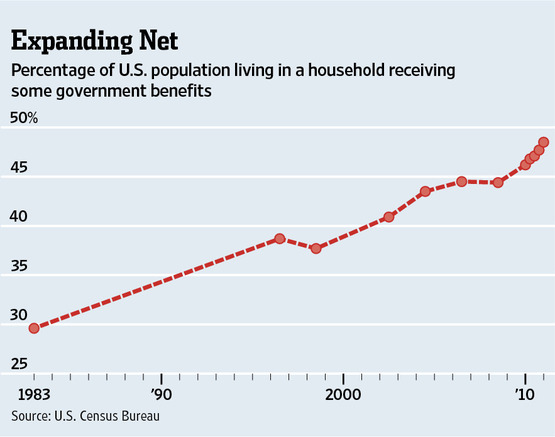
Nearly half of U.S. households are receiving some government benefits

Percentage of households receiving some government benefits

(Click for larger image)

This is the top story on the Wall Street Journal at the time I am writing this (Thursday at midnight).

Excerpt:

Families were more dependent on government programs than ever last year.

Nearly half, 48.5%, of the population lived in a household that received some type of government benefit in the first quarter of 2010, according to Census data. Those numbers have risen since the middle of the recession when 44.4% lived households receiving benefits in the third quarter of 2008.

The share of people relying on government benefits has reached a historic high, in large part from the deep recession and meager recovery, but also because of the expansion of government programs over the years. (See a timeline on the history of government benefits programs here.)

Means-tested programs, designed to help the needy, accounted for the largest share of recipients last year. Some 34.2% of Americans lived in a household that received benefits such as food stamps, subsidized housing, cash welfare or Medicaid (the federal-state health care program for the poor).

Another 14.5% lived in homes where someone was on Medicare (the health care program for the elderly). Nearly 16% lived in households receiving Social Security.

High unemployment and increased reliance on government programs has also shrunk the nation’s share of taxpayers. Some 46.4% of households will pay no federal income tax this year, according to the nonpartisan Tax Policy Center. That’s up from 39.9% in 2007, the year the recession began.

A plan like Herman Cain’s 9-9-9 plan would make sure that everybody is paying their fair share of taxes, and maybe then people who collect these benefits without paying their fair share would have a reason to want to cut government spending.