Tag Archives: Faith

How the presence and quality of fathers affects belief in God

Here’s an article by Paul Copan which points out how father presence/absence and father quality affects belief and disbelief in God.

Excerpt:

Seventh, the attempt to psychologize believers applies more readily to the hardened atheist.It is interesting that while atheists and skeptics often psychoanalyze the religious believer, they regularly fail to psychoanalyze their ownrejection of God. Why are believers subject to such scrutiny and not atheists? Remember another feature of Freud’s psychoanalysis — namely, an underlying resentment that desires to kill the father figure.

Why presume atheism is the rational, psychologically sound, and default position while theism is somehow psychologically deficient? New York University psychology professor Paul Vitz turns the tables on such thinking. He essentially says, “Let’s look into the lives of leading atheists and skeptics in the past. What do they have in common?” The result is interesting: virtually all of these leading figures lacked a positive fatherly role model — or had no father at all.11

Let’s look at some of them.

  • Voltaire(1694–1778): This biting critic of religion, though not an atheist, strongly rejected his father and rejected his birth name of François-Marie Arouet.
  • David Hume(1711–76): The father of this Scottish skeptic died when Hume was only 2 years old. Hume’s biographers mention no relatives or family friends who could have served as father figures.
  • Baron d’Holbach(1723–89): This French atheist became an orphan at age 13 and lived with his uncle.
  • Ludwig Feuerbach (1804–72): At age 13, his father left his family and took up living with another woman in a different town.
  • Karl Marx(1818–83): Marx’s father, a Jew, converted to being a Lutheran under pressure — not out of any religious conviction. Marx, therefore, did not respect his father.
  • Friedrich Nietzsche(1844–1900): He was 4 when he lost his father.
  • Sigmund Freud(1856–1939): His father, Jacob, was a great disappointment to him; his father was passive and weak. Freud also mentioned that his father was a sexual pervert and that his children suffered for it.
  • Bertrand Russell(1872–1970): His father died when he was 4.
  • Albert Camus(1913–60): His father died when he was 1 year old, and in his autobiographical novel The First Man, his father is the central figure preoccupation of his work.
  • Jean-Paul Sartre(1905–80): The famous existentialist’s father died before he was born.12
  • Madeleine Murray-O’Hair (1919–95): She hated her father and even tried to kill him with a butcher knife.
  • We could throw in a few more prominent contemporary atheists not mentioned by Vitz with similar childhood challenges:
  • Daniel Dennett (1942–): His father died when he was 5 years of age and had little influence on Dennett.13
  • Christopher Hitchens (1949–): His father (“the Commander”) was a good man, according to Hitchens, but he and Hitchens “didn’t hold much converse.” Once having “a respectful distance,” their relationship took on a “definite coolness” with an “occasional thaw.” Hitchens adds: “I am rather barren of paternal recollections.”14
  • Richard Dawkins (1941–): Though encouraged by his parents to study science, he mentions being molested as a child — no insignificant event, though Dawkins dismisses it as merely embarrassing.15

Moreover, Vitz’s study notes how many prominent theists in the past — such as Blaise Pascal, G.K. Chesterton, Karl Barth, and Dietrich Bonhoeffer — have had in common a loving, caring father in their lives.16

Not only is there that anecdotal evidence, but there is also statistical evidence.

Excerpt:

In 1994 the Swiss carried out an extra survey that the researchers for our masters in Europe (I write from England) were happy to record. The question was asked to determine whether a person’s religion carried through to the next generation, and if so, why, or if not, why not. The result is dynamite. There is one critical factor. It is overwhelming, and it is this: It is the religious practice of the father of the family that, above all, determines the future attendance at or absence from church of the children.

If both father and mother attend regularly, 33 percent of their children will end up as regular churchgoers, and 41 percent will end up attending irregularly. Only a quarter of their children will end up not practicing at all. If the father is irregular and mother regular, only 3 percent of the children will subsequently become regulars themselves, while a further 59 percent will become irregulars. Thirty-eight percent will be lost.

If the father is non-practicing and mother regular, only 2 percent of children will become regular worshippers, and 37 percent will attend irregularly. Over 60 percent of their children will be lost completely to the church.

Let us look at the figures the other way round. What happens if the father is regular but the mother irregular or non-practicing? Extraordinarily, the percentage of children becoming regular goesupfrom 33 percent to 38 percent with the irregular mother and to 44 percent with the non-practicing, as if loyalty to father’s commitment grows in proportion to mother’s laxity, indifference, or hostility.

[…]In short, if a father does not go to church, no matter how faithful his wife’s devotions, only one child in 50 will become a regular worshipper. If a father does go regularly, regardless of the practice of the mother, between two-thirds and three-quarters of their children will become churchgoers (regular and irregular). If a father goes but irregularly to church, regardless of his wife’s devotion, between a half and two-thirds of their offspring will find themselves coming to church regularly or occasionally.

A non-practicing mother with a regular father will see a minimum of two-thirds of her children ending up at church. In contrast, a non-practicing father with a regular mother will see two-thirds of his children never darken the church door. If his wife is similarly negligent that figure rises to 80 percent!

The results are shocking, but they should not be surprising. They are about as politically incorrect as it is possible to be; but they simply confirm what psychologists, criminologists, educationalists, and traditional Christians know. You cannot buck the biology of the created order. Father’s influence, from the determination of a child’s sex by the implantation of his seed to the funerary rites surrounding his passing, is out of all proportion to his allotted, and severely diminished role, in Western liberal society.

Basically, anyone who doesn’t have a benevolent, involved father is going to have an enormously difficult time believing that moral boundaries set by an authority are for the benefit of the person who is being bounded. The best way to make moral boundaries stick is to see that they apply to the person making the boundaries as well – and that these moral boundaries are rational, evidentially-grounded and not arbitrary. It is therefore very important to children to be shepherded by a man who has integrity and who has studied moral issues like chastity, abortion and same-sex marriage in order to know how to be persuasive to others, using real-world evidence and non-religious arguments.

I think from a practical point of view, it’s also important for women to think carefully about men they choose to have sex with and to marry. The relationship with the child with the man who raises them is vital to belief in God. Judging from the evidence above, one can make a case that any woman who participates in men who are not capable of life-long commitment, providing and protecting, etc. and who are not capable of leading on moral spiritual issues is basically risking her ability to present her child to God as a Christian.

A child’s relationship with God begins with his/her mother’s ability to control herself and choose the right man for the job of being a father. Note that superficial qualities like “deep voice”, “broad shoulders”, “expensive shoes”, “likes dogs” and “makes me laugh” have no bearing on a man’s ability to commit and lead on moral/spiritual issues. We don’t really do a good job of showing evidence of choices and outcomes to women in the church, which is why there are so many fatherless children being conceived by women who go to church. Christian women are following their feelings to premarital sex, missionary cohabitation, and abortions under the supervision of ignorant, man-blaming pastors who don’t want to judge the delicate women by offering them facts.
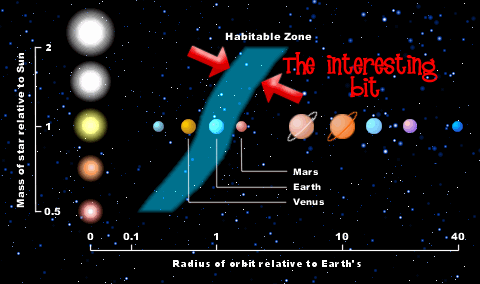
New study on tidal heating strengthens stellar habitability argument

Circumstellar Habitable Zone

Note: If you need a refresher on the habitability argument, click here.

Here’s an article entitled “Tidal heating shrinks the ‘goldilocks zone’: Overlooked factor suggests fewer habitable planets than thought”. It appeared in Nature, the most prestigious peer-reviewed science journal.

The gist of it is that tidal forces can alter orbits so that planets don’t spend all of their orbit in the habitable zone. If planets go outside the habitable zone, it damages their supply of liquid water, and any life chemistry going on in there is disrupted.

Excerpt:

A previously little-considered heating effect could shrink estimates of the habitable zone of the Milky Way’s most numerous class of stars — ‘M’ or red dwarfs — by up to one half, says Rory Barnes, an astrobiologist at the University of Washington in Seattle. That factor — gravitational heating via tides — suggests a menagerie of previously undreamt-of planets, on which tidal heating is a major source of internal heat. Barnes presented the work yesterday at a meeting of the American Astronomical Society’s Division on Dynamical Astronomy in Timberline Lodge, Oregon.

The habitable zone is the orbital region close enough to a star for a planet to have liquid water, but not so close that all of the water evaporates. For our Sun, the zone extends roughly from the inner edge of the orbit of Mars to the outer edge of that of Venus. For smaller, cooler stars, such as M-class dwarfs, the zone can be considerably closer to the star than Mercury is to the Sun. And because close-in planets are easier to spot than more distant ones, such stars have been a major target for planet hunters seeking Earth-like worlds.

There’s just one problem with finding habitable planets around such stars, says Barnes. Because tidal forces vary dramatically with the distance between a planet and its star, closer orbits also result in massively larger tidal forces.

Since planets do not have perfectly circular orbits, these tidal forces cause the planet to flex and unflex each time it moves closer to or further from its star; kneading its interior to produce massive quantities of frictional heat. Substantial heat can be produced, he added, with even slight deviations from a perfectly circular orbit. And, Barnes notes, other factors — such as the rate of the planet’s rotation and its axial tilt — can also influence heat production.

A similar tidal process makes Jupiter’s moon Io the most volcanic body in the Solar System. “I’m just scaling that Io–Jupiter system up by a factor of 1,000 in mass,” Barnes said at the meeting. “It’s the same process, on steroids.”

So, stars that are smaller and cooler will have a habitable zone that is closer to the star, exposing them to more tidal forces. More tidal forces makes their orbits less likely to stay circular – within the habitable zone around the star. These variations cause an increase in heat production on the planet. Too much heat means that the planet is unable to support liquid water on the surface, making it inhospitable for life. Therefore, solar systems with less massive stars can be ruled out as possible sites for life, because of these tidal forces.

Lawrence Krauss debates “A Universe From Nothing” with an astrophysicist

Dina sent me news of Saturday’s episode of Unbelievable, which features Lawrence Krauss, who debated William Lane Craig. Krauss’ book was also reviewed in the New York Times.

The MP3 file is here.

Details:

Lawrence Krauss is a Cosmologist at Arizona State University who describes himself as an “anti-theist”. His latest book “A Universe From Nothing” has received both acclaim and criticism for its attempt to answer the question “Why is there something rather than nothing?” Debating the issue with Krauss is Rodney Holder, Course director at the Faraday Institute, Cambridge. An astrophysicist and priest by background. In a lively exchange they debate whether Krauss’ “nothing” is “nothing”, fine tuning and multiverses, scientific knowledge, miracles and the usefulness of theology and philosophy.

This debate is quite entertaining, and do not be intimidated if your don’t understand science. You can understand pretty easily who is arguing based on facts and who is speculating about unobservable, untestable entities. At one point, Krauss actually denies that there is any fine-tuning in the universe, so please see this link to refute that claim as well as this podcast which explains some examples of fine-tuning. Krauss gets a bit angry at the beginning, but calms down.

Quotation marks are for direct quotes, italics is for made-up snark. See below the summary for more posts that are related to this one.

Summary of the discussion: (picked up at 9:30 when they start talking about the book)

Brierley:

  • explain your theory of how the universe can come into being from nothing

Krauss:

  • the nothing that preceded the universe is “no space, no time, no universe”
  • theists say that God is responsible for creating the universe out of this nothing
  • but the laws of nature can create the universe uncaused out of nothing

Holder:

  • Krauss sometimes writes that the nothing is really a quantum vacuum, but that is not nothing
  • He even acknowledges in his book that a quantum vacuum is not nothing
  • He thinks that the nothing has properties, even though it has no being
  • It has the property of being unstable
  • It has the property of being acted on by quantum fields
  • It has the property of being acted on by gravity

Krauss:

  • But nothing can have the potential to do things inside it
  • For example suppose you have an electron, which is not nothing
  • If it jumps from one level to another, it emits light
  • There was no potential for the light in the electron, but it was there as part of atomic structure

Holder:

  • But in cases like that, there is something physical that has the potential
Krauss:
  • Well, how did God makes the universe then if it had no potential?

Holder:

  • God existed, and the potential for creating the universe in himself

Brierley:

Krauss:
  • It was written by a philosopher, so I dismissed it

Brierley:

Krauss:
  • These book reviewers have not even read my book!

Krauss:

  • Science will be able to figure out how to make something from nothing in the future
  • We are even now speculating about interesting questions, like is there a multiverse?

Brierley:

  • Consider the critical review of your book in the New York Times
  • The author of the review claims that you equivocate on the term “nothing”
  • In order to get things to pop into being, you have to make “nothing” mean “something”
  • Reviewer: none of Krauss’ theories explain how something can come from actual nothingness

Krauss:

  • In physics, something and nothing are not that different
  • The reviewer doesn’t understand the physics
  • He doesn’t understand quantum field theory
  • You could call a quantum vacuum “nothing”, (this is the vacuum fluctuation model, refuted by William Lane Craig in a peer-reviewed publication in an astrophysics journal – get the full text of the article here)
  • Maybe there is an eternally existing multiverse that we can’t observe or test scientifically
  • Maybe it has laws that we don’t know about which allow our universe to pop into being
  • Maybe this popping into being is uncaused
  • (alarmed) Who made God? Who made God?

Holder:

  • God is eternal and necessary

Krauss:

  • (interrupting, angry) What does it mean for something to be necessary?

Holder:

  • Basically, you have to decide whether there is more evidence that the necessary being God or a multiverse

Brierley:

  • So Dr. Krauss are you willing to say that the universe is a brute fact, in some sense, and requires no explanation

Krauss:

  • (angry) Religious people are stupid because they just assume brute facts, not like me and my unobservable, untestable multiverse
  • (angry) Religious people are against the progress of science, they don’t want to figure out how things work

Brierley:

  • But isn’t it possible that naturalists can be opposed to the progress of science?
  • What about the way the Fred Hoyle opposed the Big Bang because he wanted an eternal universe

Krauss:

  • (angry) But naturalists like me let the facts determine our beliefs, like the facts about the eternal unobservable, untestable multiverse
  • (angry, shouting) Philosophers are stupid, they know nothing!

=== Break ===

Brierley:

  • Do you see any evidence of purpose in the universe?

Krauss:

  • Well maybe I would believe if the stars lined up to spell out a message from God

Brierley:

  • Actually no, that wouldn’t be evidence for God on your multiverse view
  • if there an infinite number of universes existing for an infinite amount of time, then anything can happen no matter how unlikely it is
  • therefore, no evidence could convince you that God exists, since the unobservable, untestable, eternal multiverse can make anything it wants

Krauss:

  • That’s a true statement, and very convenient for atheists who don’t want to be accountable to God, don’t you think?
Brierley:
  • Back to the multiverse, how does it solve the fine-tuning?

Krauss:

  • “We have no idea if the universe is fine-tuned for life”, even though the atheist Martin Rees who endorsed Krauss’ book wrote his own book about the fine-tuning of the universe called “Just Six Numbers”
  • Inflationary theory does suggest a way to create multiple universes, (this is the chaotic inflationary model, refuted by William Lane Craig in a peer-reviewed publication in an astrophysics journal – get the full text of the article here)

Brierley:

  • But this theory is still very much a hypothesis, isn’t it? We can’t observe or test this hypothesis can we?

Krauss:

  • “No, and that is really important to state”
  • “I’m an empiricist, so if you can’t falsify it and if you can’t test it then it’s not science”
  • In my book, I speculate about a way that we could test the multiverse theory

Holder:

  • Yes, in principle, the multiverse would be scientific if you could test it through other theories like inflationary theory
  • There are a lot of speculations about multiverse theory, but no evidence from predictions that were validated in the lab

Krauss:

  • “I agree completely with everything you just said”

Brierley:

  • Roger Penrose agrees with Holder that the multiverse theory is too speculative
  • (To Holder) Isn’t the multiverse theory better than positing a completely different kind of being, which is God?

Holder:

  • The multiverse theory is extremely speculative
  • Even if the multiverse were true, you would still need to explain the multiverse

Krauss:

  • People don’t oppose my book because it’s full of self-contradictory speculations
  • People oppose my book because they are stupid and ignorant

Holder:

  • There are things that exist that science cannot measure, like objective morality
  • It’s possible to give explanations for moral behavior by appealing to evolution
  • But that does not ground self-sacrificial morality, such as what occurs in the Christian life

Brierley:

  • Dawkins says there is no purpose or morality in in the universe, do you agree?

Krauss:

  • “There is certainly no evidence of any of that”

Brierley:

  • In the book, you talk about how we live in a special time in the universe’s history to be able to do science, (i.e. – The Privileged Planet hypothesis)
  • You also write about how all the discoveries were are making will not be communicated to anyone in other places in the universe
  • So what is the meaning of doing science on your view? And why are you sad at the knowledge that will not be available to people in the future?
  • Are you longing for some kind of purpose?

Krauss:

  • No, I just get enjoyment from studying the universe with science to gain understanding

Holder:

  • What do you make of Einstein’s statement about the unexpected comprehensibility of the universe
  • Theists would say that this is because God wanted us to study and understand and gain knowledge

Krauss:

  • “It is remarkable that the universe is comprehensible”

Brierley:

  • Why is the universe comprehensible?

Krauss:

  • Well, maybe the universe just has to be that way

Brierley:

  • What do you make of the heat death of the universe, when all life in the universe will die out?

Krauss:

  • That’s the way the universe is
=== BREAK ===

Krauss:

  • I wouldn’t want to live in a universe where there was a God
  • God is a cosmic Saddam Hussein
  • “Religious people turn their minds off” and believe in God for consolation

Holder:

  • First, Jesus is the revelation of God and he is no Saddam Hussein
  • Second, the Christian life is anything but easy, we are facing some persecution already in the UK
  • Third, there is also the problem of being accountable to God when we die
  • It’s very much like science – Christianity is the way it is, not the way we want it to be

Krauss:

  • “If you don’t believe in him, you don’t get any of the benefits, so you have to believe”
  • “And then if you’ve done something wrong, you’re going to be judged for it”
  • “So I don’t want to be judged by God, I want to be… that’s the bottom line”

Holder:

  • Well, Jesus has died to pay the price for those things we’ve done wrong
  • Although we will have to face the charges for what we’ve done, believers will ultimately be forgiven

UPDATE: Peter Sean Bradley note that Krauss is now walking back his rhetoric in response to criticisms from people like atheist John Horgan.

Related posts