Tag Archives: Eye

Convergence detected in the genetic structure of bats and dolphins

We have to start this post with the definition of convergence in biology.

In evolutionary biology, convergent evolution is the process whereby organisms not closely related (not monophyletic), independently evolve similar traits as a result of having to adapt to similar environments or ecological niches.

It is the opposite of divergent evolution, where related species evolve different traits.

On a molecular level, this can happen due to random mutation unrelated to adaptive changes; see long branch attraction. In cultural evolution, convergent evolution is the development of similar cultural adaptations to similar environmental conditions by different peoples with different ancestral cultures. An example of convergent evolution is the similar nature of the flight/wings of insects, birds, pterosaurs, and bats.

All four serve the same function and are similar in structure, but each evolved independently.

Jonathan Wells explains the problem that convergence poses for naturalistic evolution:

Human designers reuse designs that work well. Life forms also reuse certain structures (the camera eye, for example, appears in humans and octopuses). How well does this evidence support Darwinian evolution? Does it support intelligent design more strongly?

Evolutionary biologists attribute similar biological structures to either common descent or convergence. Structures are said to result from convergence if they evolved independently from distinct lines of organisms. Darwinian explanations of convergence strain credulity because they must account for how trial-and-error tinkering (natural selection acting on random variations) could produce strikingly similar structures in widely different organisms and environments. It’s one thing for evolution to explain similarity by common descent—the same structure is then just carried along in different lineages. It’s another to explain it as the result of blind tinkering that happened to hit on the same structure multiple times. Design proponents attribute such similar structures to common design (just as an engineer may use the same parts in different machines). If human designers frequently reuse successful designs, the designer of nature can surely do the same.

I’m a software engineer, and we re-use components all the time for different programs that have no “common ancestor”. E.g. – I can develop my String function library and use it in my web application and my Eclipse IDE plug-in, and those two Java programs have nothing in common. So you find the same bits in two different programs because I am the developer of both programs. But the two programs don’t extend from a common program that was used for some other purpose – they have no “common ancestor” program.

Now with that in mind, take a look at this recent article from Science Daily, which Mysterious Micah sent me.

Excerpt:

The evolution of similar traits in different species, a process known as convergent evolution, is widespread not only at the physical level, but also at the genetic level, according to new research led by scientists at Queen Mary University of London and published in Nature this week.

The scientists investigated the genomic basis for echolocation, one of the most well-known examples of convergent evolution to examine the frequency of the process at a genomic level.

Echolocation is a complex physical trait that involves the production, reception and auditory processing of ultrasonic pulses for detecting unseen obstacles or tracking down prey, and has evolved separately in different groups of bats and cetaceans (including dolphins).

The scientists carried out one of the largest genome-wide surveys of its type to discover the extent to which convergent evolution of a physical feature involves the same genes.

They compared genomic sequences of 22 mammals, including the genomes of bats and dolphins, which independently evolved echolocation, and found genetic signatures consistent with convergence in nearly 200 different genomic regions concentrated in several ‘hearing genes’.

[…]Consistent with an involvement in echolocation, signs of convergence among bats and the bottlenose dolphin were seen in many genes previously implicated in hearing or deafness.

“We had expected to find identical changes in maybe a dozen or so genes but to see nearly 200 is incredible,” explains Dr Joe Parker, from Queen Mary’s School of Biological and Chemical Sciences and first author on the paper.

“We know natural selection is a potent driver of gene sequence evolution, but identifying so many examples where it produces nearly identical results in the genetic sequences of totally unrelated animals is astonishing.”

Nature is the most prestigious peer-reviewed science journal. This is solid material.

There is an earlier article from 2010 in New Scientist that talked about one of the previous genes that matched for hearing capability.

Excerpt:

Bats and dolphins trod an identical genetic path to evolve a vital component of the complex sonar systems they use to pursue and catch prey.

The finding is unusual, because although many creatures have independently evolved characteristics such as eyes, tusks or wings, they usually took diverse genetic routes to get there.

Analysis of a specific gene has now demonstrated that although bats live in air and dolphins in water, where sound travels five times faster, they independently evolved a near-identical gene that allows them to accept high-frequency sound in the ear – vital for sonar.

The gene makes prestin, a protein in hair cells of the cochlea, which is the organ in the inner ear where sonar signals are accepted and amplified. Prestin changes shape when exposed to high-frequency sound, and this in turn deforms the fine hair cells, setting off an electrical impulse to the brain. So the protein has the important jobs of detecting and selecting high-frequency sounds for amplification.

When researchers examined the molecular structure of the prestin gene from a range of animals, they found that the variants in echolocating bats and dolphins were virtually indistinguishable.

Indistinguishable genes in animals that don’t share a common ancestor? Maybe a better explanation for the evidence we have is – common designer.
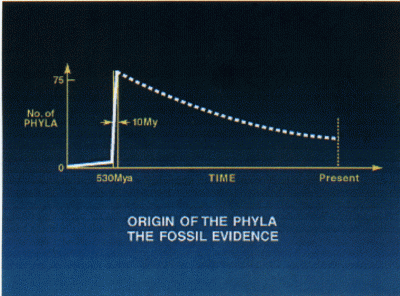
Bad news for believers in naturalistic explanations of the Cambrian explosion

Before we see the new discovery, let’s review what the Cambrian explosion is all about.

Video 1:

Video 2:

Casey Luskin explains the new discovery at Evolution News.

Excerpt:

A recent article in Science begins by observing that the lack of evolutionary ancestors for the animal phyla that appear abruptly in the Cambrian explosion has been troubling to many evolutionary scientists:

Ever since Darwin there has been a disturbing void, both paleontological and psychological, at the base of the Phanerozoic eon. If his theory of gradualistic evolution be true, then surely the pre-Phanerozoic oceans must have swarmed with living animals — despite their conspicuous absence from the early fossil record.

(N. J. Butterfield, “Terminal Developments in Ediacaran Embryology,” Science, Vol. 334:1655-1656 (December 23, 2011).)

The articles goes on to explain that in 1998, tiny fossil animal embryos were reported that offered “palpable relief” to those evolutionary scientists worried about the lack of Precambrian ancestors.

However, new analyses of these microfossils now strongly suggest that they were not multicellular animals, and thus could not be Precambrian multicellular metazoa that have long been the holy grail for evolutionary paleontologists. Rather, they likely represent single-celled amoeba-like organisms.

[…]A Science Daily article on the study explains that many Darwinian scientists will be dismayed by the results of this study:

Professor Philip Donoghue said: “We were very surprised by our results — we’ve been convinced for so long that these fossils represented the embryos of the earliest animals — much of what has been written about the fossils for the last ten years is flat wrong. Our colleagues are not going to like the result.”

How did the investigators determine the nature of these ancient organisms? The fossils were exceptionally well preserved, such that, as the lead author on the paper stated, “the fossils are so amazing that even their nuclei have been preserved.” These allowed the authors to determine that these were in fact eukaryotic organisms, but not multicellular animals.

Casey goes on to answer the response by naturalists that “the fossil record is incomplete”.

I think it’s important, when deciding whether naturalistic evolution happened, to be aware of these problem areas. So often when discussing Darwinian evolution, people like journalists and philosophers and economists, etc. will just accept the theory because they trust in what experts tell them. There can be a lot of pressure in the university to not be seen as a dumb person, so that people will just go along with whatever their professor tells them to believe. And, that’s not necessarily a bad policy when time is short. However, that is taking evolution on blind faith. It’s a good thing, as we get older, to go back and revisit these things to see if they are really true.

For example, a really educated Darwinian should be able to finish a sentence like this: “People who doubt fully naturalistic evolution do so because of the following pieces of scientific evidence…” If you meet someone who cannot finish this statement, but who still espouses Darwinian evolution, then you know that you are dealing with someone who has jumped to the answer without really working through the problem by themselves. It can be very tempting, especially for artsy types, to just try to jump to the answer that all the smart people believe without really working through the problem. But that’s not a good way to decide what’s true. Everyone has to work through these problems themselves, and listening to the best people on both sides is the way to do that. People who question evolution nowadays don’t question that the universe is billions of years old or that scientific methods have to be used to answer scientific questions. By all means, let’s decide how we got here by appealing to science.

If you would like to see a nice hour-long video on the Cambrian explosion, then click here.

By the way, if you missed my previous post on the new discovery of oxygen in the early Earth’s environment, and the challenge it represents to naturalistic scenarios for the origin of life, then do check that out.

The Cambrian explosion: biology’s Big Bang

Consider this article by Jonathan Wells.

First, let’s re-cap the challenge to evolution from the phenomenon of the Cambrian explosion.

The newly released film “Darwin’s Dilemma” argues that the geologically abrupt appearance of the major groups of animals (the “phyla”) in the Cambrian Explosion posed a serious problem for Charles Darwin’s theory of evolution (as he himself knew), and that subsequent fossil discoveries—far from solving the problem—have made it worse.

Basically, all the major body plans we have today appear in the fossil record in a 2-3 million period about 543 million years ago. There are no precursors in the fossil record showing the gradual evolution of these major body plans.

The Cambrian Explosion: 0 to 60 in a few million years

Darwin expected to discover lots and lots of fossils leading up to the Cambrian explosion period that would show how all these phyla came into existence slowly over time. Unfortunately for the naturalistic evolutionists, the discoveries we’ve been making haven’t shown any hint of precursor fossils leading up the Cambrian explosion.

Since 1859, however, many Precambrian fossils have been found, including microfossils of single-celled bacteria in rocks more than three billion years old. In addition, multicellular Precambrian fossils have been found in the Ediacara Hills of Australia, though there is continuing debate over whether any—or how many—of the Ediacaran fossils were animals, or what relationship—if any—they had to the Cambrian phyla. In 1998, Cambridge University paleobiologist Simon Conway Morris (who is featured in the film “Darwin’s Dilemma”) wrote, “Apart from the few Ediacaran survivors… there seems to be a sharp demarcation between the strange world of Ediacaran life and the relatively familiar Cambrian fossils” (Crucible of Creation, 30).

But wait! Maybe we can’t find the precusor fossils required by Darwinism because they are too small or too soft to have survived for so long?

Since 1859, however, many Precambrian fossils have been found, including microfossils of single-celled bacteria in rocks more than three billion years old. In addition, multicellular Precambrian fossils have been found in the Ediacara Hills of Australia… In 1998, Cambridge University paleobiologist Simon Conway Morris… wrote, “Apart from the few Ediacaran survivors… there seems to be a sharp demarcation between the strange world of Ediacaran life and the relatively familiar Cambrian fossils” (Crucible of Creation, 30).

So there is now no shortage of Precambrian fossils. Not only do we have fossils of bacteria, but we also have many fossils of soft-bodied Multicellular organisms. “In the Ediacaran organisms there is no evidence for any skeletal hard parts,” wrote Conway Morris in 1998. “Ediacaran fossils look as if they were effectively soft-bodied” (Crucible of Creation, 28). The same is true of many of the organisms fossilized in the Cambrian explosion.

But wait! Scientists have discovered lots of exceptionally preserved microbes just before the Cambrian explosion. Don’t microbes count as precursors to the Cambrian explosion phyla?

Richard Callow and Martin Brasier reported in the January 2009 issue of the Journal of the Geological Society, London “a variety of exceptionally preserved microbes” from late Precambrian rocks in England that address “the paradox known as ‘“Darwin’s dilemma’.”

[…]Callow and Brasier didn’t solve Darwin’s dilemma. Instead, they put one more nail in the coffin of Darwin’s attempt to salvage his theory from it. The truth is that “exceptionally preserved microbes” from the late Precambrian actually deepen Darwin’s dilemma, because they suggest that if there had been ancestors to the Cambrian phyla they would have been preserved.

I am willing to believe in evolution. But in order to get me to believe it, I insist on seeing a fossil record that shows the gradual emergence of phyla, one or two at a time, over hundreds of millions of years. That is what Darwinism predicts. We now have a solid record of what came before the Cambrian explosion. So where are the precursors? Where is the record of gradual emergence? Where is my evidence?

What does the peer-reviewed research say?

Story from the Discovery Institute.

A new peer-reviewed paper has been published that concludes that there is no material explanation for the massive amounts of information introduced during the Cambrian explosion, when all of the phyla came into being in the blink of an eye, geologically speaking, with no fossilized precursors.

Excerpt:

Thus, elucidating the materialistic basis of the Cambrian explosion has become more elusive, not less, the more we know about the event itself, and cannot be explained away by coupling extinction of intermediates with long stretches of geologic time, despite the contrary claims of some modern neo-Darwinists.

Once again, the progress of science brings light.

The DI post goes on to cite another passage from the paper:

Beginning some 555 million years ago the Earth’s biota changed in profound and fundamental ways, going from an essentially static system billions of years in existence to the one we find today, a dynamic and awesomely complex system whose origin seems to defy explanation. Part of the intrigue with the Cambrian explosion is that numerous animal phyla with very distinct body plans arrive on the scene in a geological blink of the eye, with little or no warning of what is to come in rocks that predate this interval of time. The abruptness of the transition between the ‘‘Precambrian’’ and the Cambrian was apparent right at the outset of our science with the publication of Murchison’s The Silurian System, a treatise that paradoxically set forth the research agenda for numerous paleontologists — in addition to serving as perennial fodder for creationists. The reasoning is simple — as explained on an intelligent-design t-shirt.

Fact: Forty phyla of complex animals suddenly appear in the fossil record, no forerunners, no transitional forms leading to them; ‘‘a major mystery,’’ a ‘‘challenge.’’ The Theory of Evolution – exploded again (idofcourse.com).

Although we would dispute the numbers, and aside from the last line, there is not much here that we would disagree with. Indeed, many of Darwin’s contemporaries shared these sentiments, and we assume — if Victorian fashion dictated — that they would have worn this same t-shirt with pride.

Here is the reference for the paper:

(Kevin J. Peterson, Michael R. Dietrich and Mark A. McPeek, “MicroRNAs and metazoan macroevolution: insights into canalization, complexity, and the Cambrian explosion,” BioEssays, Vol. 31 (7):736 – 747 (2009).)

I linked before to a bunch of easy-to-understand videos that explain the Cambrian explosion. Here’s another peer-reviewed research paper on the Cambrian explosion written by Stephen C. Meyer, on the Cambrian explosion. This is the paper that got evolutionary biologist Richard Sternberg fired by secular leftists. He has two earned Ph.Ds in biology. I would expect that the people who fired him had never seen the inside of a biology lab. That’s the way it goes – science (intelligent design) vs. religion (materialism).

Videos on intelligent design