Tag Archives: Evolution

Is belief in a Creator / Designer compatible with belief in Darwinian evolution?

Sherlock Holmes and John Watson: let's take a look at the facts
Sherlock Holmes and John Watson: let’s take a look at the facts

What should we make of theistic evolutionists telling us that you can believe in God, while still knowing that matter, law and chance fully explain the development of all of biological life?

Consider this quotation from Phillip E. Johnson.

Quote:

The National Academy’s way of dealing with the religious implications of evolution is akin to the two-platoon system in American football. When the leading figures of evolutionary science feel free to say what they really believe, writers such as Edward O. Wilson, Richard Dawkins, Daniel Dennett, Carl Sagan, Steven Pinker, Stephen Jay Gould, Richard Lewontin and others state the “God is dead” thesis aggressively, invoking the authority of science to silence any theistic protest. That is the offensive platoon, and the National Academy never raises any objection to its promoting this worldview.

At other times, however, the scientific elite has to protect the teaching of the “fact of evolution” from objections by religious conservatives who know what the offensive platoon is saying and who argue that the science educators are insinuating a worldview that goes far beyond the data. When the objectors are too numerous or influential to be ignored, the defensive platoon takes the field. That is when we read those spin-doctored reassurances saying that many scientists are religious (in some sense), that science does not claim to have proved that God does not exist (but merely that he does not affect the natural world), and that science and religion are separate realms which should never be mixed (unless it is the materialists who are doing the mixing). Once the defensive platoon has done its job it leaves the field, and the offensive platoon goes right back to telling the public that science has shown that “God” is permanently out of business.

(Phillip E. Johnson: “The Wedge of Truth”, IVP 2000, pp. 88-89).

So what naturalistic scientists believe is that God didn’t do anything to create the diversity of life – that nature does all of its own creating without God. In fact, it doesn’t matter if the best naturalistic explanation is improbable or implausible – naturalists must bitterly cling to materialistic explanations of natural phenomena. Any doubts about the efficacy of naturalistic mechanisms get met by “theistic evolutionists” – scientists who think that science shows that God didn’t do anything in the history of life.

When it comes to discussing origins, you have to be very careful with theistic evolutionists. The one question they want to avoid is whether science, done in the ordinary naturalistic way, can discover evidence of intelligent agency in the history of the development of life. And that’s why you have to ask them that question first. “Is there any scientific evidence that intelligent causes were active during the history of the development of life on this planet?” Their answer to that is the same as atheists, namely: “there is no scientific evidence that intelligent causes are responsible for the effects we see in the history of life on Earth”. Theistic evolutionists and atheists agree on that: as far as pure scientific evidence is concerned, nature can do its own creating without any intelligence writing genetic code or engineering animal body plans.

Now, take a look at this article by Jay Richards. He cites some theistic evolutionists.

Excerpt:

Biologist Ken Miller:

For his part, [Ken] Miller, a biologist, has no qualms about telling us what God would do: “And in Catholicism, he said, God wouldn’t micromanage that way. ‘Surely he can set things up without having to violate his own laws.'”

I am unaware of any tenet of Catholic theology that requires God not to micromanage. It is, however, a tenet of deism.

Got that? What really happened is that God didn’t do anything. How does he know that? From the science? No. Because he assumes naturalism. Oh, it’s true that he says that God is lurking somewhere behind the material processes that created life. But God’s agency is undetectable by the methods of science. And he is hoping that you will accept his subjective pious God-talk as proof that a fundamentally atheistic reality is somehow reconcilable with a robust conception of theism.

More from Richards:

Then we get Stephen Barr offering his private definition of “chance.”

It is possible to believe simultaneously in a world that is shaped by chance and one following a divine plan. “God is in charge and there’s a lot of accident,” said Barr, also a Catholic. “It’s all part of a plan. . . . God may have known where every molecule was going to move.”

What does Barr really believe? He believes that what science shows is that nature created life without any interference by an intelligent agent. Barr then offers believers his subjective pious God-talk to reassure them that evolution is compatible with religion. He has a personal belief – NOT BASED ON SCIENCE – that the material processes that created all of life are “all part of a plan”. He cannot demonstrate that from science – it’s his faith commitment. And more speculations: “God may have known…”. He can’t demonstrate that God did know anything from science. He is just offering a personal opinion about what God “could have” done. The purpose of these subjective opinions is to appease those who ask questions about what natural mechanisms can really create. Can natural causes really account for the development of functional proteins? Never mind that – look at my shiny spiritual-sounding testimony!

That’s theistic evolution. What really happened is that no intelligent causes are needed to explain life. What they say is “God could” and “God might” and “I pray” and “I attend this church” and “I received a Christian award” and “I sing praise hymns in church”. None of these religious opinions and speculations are relevant to the science – they are just opinions, speculations and biographical trivia. Atheists and theistic evolutionists agree on what science shows about the diversity of life – intelligent causes didn’t do anything.

Front-loading?

One of the ways that theistic evolutionists try to affirm design is by insisting that the design is “front-loaded”. The design for all the information and body plans is somehow embedded in matter.

Here is Stephen C. Meyer to assess that:

It’s very important to understand that there is no scientific evidence for design (information) being front-loaded. So although the theistic evolutionists are talking about design, it’s still in the realm of faith – not detectable to scientific investigation. And as Dr. Meyer explained, it doesn’t work to explain design anyway.

I attended a Wheaton College philosophy conference where Dr. Michael Murray read a paper advocating for this front-loaded view of design. I raised my hand to ask him a question, “hey, philosophy guy, did God front-load the information in that paper you’re reading, or did you write it yourself?” But the philosophy moderators must have known that I was an engineer, and would talk sense into him, because they never called on me. However, I did e-mail him later and asked him if he had any evidence for this front-loading theory, and couldn’t God write sequence information in time the same way he had sequenced information in his essay. He replied and said that front-loading was more emotionally satisfying for him. That’s philosophy, I guess. Thank goodness an engineer wrote his e-mail program so that he could at least come clean about his silly view.

The quickest way to disarm a theistic evolutionist is to ask them for a naturalistic explanation of the origin of life. And for a naturalistic explanation of the Cambrian explosion. And so on. Focus on the science – don’t let them turn the conversation to their personal beliefs, or to the Bible, or to religion. No one cares about the psychology of the theistic evolutionist. We only care what science can show.

Stephen C. Meyer lectures on intelligent design and the origin of life

Christianity and the progress of science

A MUST-SEE lecture based on Dr. Stephen C. Meyer’s book “Signature in the Cell“.

I highly recommend watching the lecture, and looking at the slides. The quality of the video and the content is first class. There is some Q&A (9 minutes) at the end of the lecture.

Topics:

  • intelligent design is concerned with measuring the information-creating capabilities of natural forces like mutation and selection
  • Darwinists think that random mutations and natural selection can explain the origin and diversification of living systems
  • Darwinian mechanisms are capable of explaining small-scale adaptive changes within types of organisms
  • but there is skepticism, even among naturalists, that Darwinian mechanisms can explain the origin of animal designs
  • even if you concede that Darwinism can account for all of the basic animal body plans, there is still the problem of life’s origin
  • can Darwinian mechanisms explain the origin of the first life? Is there a good naturalistic hypothesis to explain it?
  • there are at least two places in the history of life where new information is needed: origin of life, and Cambrian explosion
  • overview of the structure of DNA and protein synthesis (he has helpful pictures and he uses the snap lock blocks, too)
  • the DNA molecule is composed of a sequence of bases that code for proteins, and the sequence is carefully selected to have biological function
  • meaningful sequences of things like computer code, English sentences, etc. require an adequate cause
  • it is very hard to arrive at a meaningful sequence of a non-trivial length by randomly picking symbols/letters
  • although any random sequence of letters is improbable, the vast majority of sequences are gibberish/non-compiling code
  • similarly, most random sequences of amino acids are lab-proven (Doug Axe’s work) to be non-functional gibberish
  • the research showing this was conducted at Cambridge University and published in the Journal of Molecular Biology
  • so, random mutation cannot explain the origin of the first living cell
  • however, even natural selection coupled with random mutation cannot explain the first living cell
  • there must already be replication in order for mutation and selection to work, so they can’t explain the first replicator
  • but the origin of life is the origin of the first replicator – there is no replication prior to the first replicator
  • the information in the first replicator cannot be explained by law, such as by chemical bonding affinities
  • the amino acids are attached like magnetic letters on a refrigerator
  • the magnetic force sticks the letters ON the fridge, but they don’t determine the specific sequence of the letters
  • if laws did determine the sequence of letters, then the sequences would be repetitive
  • the three materialist explanations – chance alone, chance and law, law alone – are not adequate to explain the effect
  • the best explanation is that an intelligent cause is responsible for the biological explanation in the first replicator
  • we know that intelligent causes can produce functional sequences of information, e.g. – English, Java code
  • the structure and design of DNA matches up nicely with the design patterns used by software engineers (like WK!)

There are some very good tips in this lecture so that you will be able to explain intelligent design to others in simple ways, using everyday household items and children’s toys to symbolize the amino acids, proteins, sugar phosphate backbones, etc.

Proteins are constructed from a sequence of amino acids:

A sequence of amino acids forming a protein

Proteins sticking onto the double helix structure of DNA:

Some proteins sticking onto the sugar phosphate backbone

I highly, highly recommend this lecture. You will be delighted and you will learn something.

Here is an article that gives a general overview of how intelligent design challenges. If you want to read something more detailed about the material that he is covering in the lecture above related to the origin of life, there is a pretty good article here.

There is a good breakdown of some of the slides with helpful flow charts here on Uncommon Descent.

Positive arguments for Christian theism

Is the presupposition of naturalism in science good for the pursuit of truth?

I have a key that will unlock a puzzling mystery

This topic came up recently in a discussion, and I wanted to be sure that all my readers were aware of how to think about the work that the presupposition of naturalism does in supporting naturalistic views of science. When I was little, way back in the 1990s, Phillip E. Johnson’s work on the definitions of science, evolution and creation were very important stuff. He was everywhere, doing lectures on university campuses and debates on the radio with Eugenie Scott. I was able to get a bunch of this audio from Access Research Network on AUDIO CASSETTES, but now that’s all obsolete.

Thankfully, I was able to find an old column written by Johnson in the Wall Street Journal, and preserved by Access Research Network.

Excerpt:

A Chinese paleontologist lectures around the world saying that recent fossil finds in his country are inconsistent with the Darwinian theory of evolution. His reason: The major animal groups appear abruptly in the rocks over a relatively short time, rather than evolving gradually from a common ancestor as Darwin’s theory predicts. When this conclusion upsets American scientists, he wryly comments: “In China we can criticize Darwin but not the government. In America you can criticize the government but not Darwin.”

That point was illustrated last week by the media firestorm that followed the Kansas Board of Education’s vote to omit macro-evolution from the list of science topics which all students are expected to master. Frantic scientists and educators warned that Kansas students would no longer be able to succeed in college or graduate school, and that the future of science itself was in danger. The New York Times called for a vigorous counteroffensive, and the lawyers prepared their lawsuits. Obviously, the cognitive elites are worried about something a lot more important to themselves than the career prospects of Kansas high school graduates.

The root of the problem is that “science” has two distinct definitions in our culture. On the one hand, science refers to a method of investigation involving things like careful measurements, repeatable experiments, and especially a skeptical, open-minded attitude that insists that all claims be carefully tested. Science also has become identified with a philosophy known as materialism or scientific naturalism. This philosophy insists that nature is all there is, or at least the only thing about which we can have any knowledge. It follows that nature had to do its own creating, and that the means of creation must not have included any role for God. Students are not supposed to approach this philosophy with open-minded skepticism, but to believe it on faith.

[…]All the most prominent Darwinists proclaim naturalistic philosophy when they think it safe to do so. Carl Sagan had nothing but contempt for those who deny that humans and all other species “arose by blind physical and chemical forces over eons from slime.” Richard Dawkins exults that Darwin “made it possible to be an intellectually fulfilled atheist,” and Richard Lewontin has written that scientists must stick to philosophical materialism regardless of the evidence, because “we cannot allow a Divine Foot in the door.”

So, if you’re having a discussion with a person who believes in naturalism – that everything in nature can be explained by material forces alone – then they will give you a stock response to all of your evidence for something outside of nature.

  • Origin of the universe? That’s not science
  • Cosmic fine-tuning? That’s not science
  • Origin of life? That’s not science
  • Cambrian explosion? That’s not science
  • Habitability-discoverability? That’s not science

It’s not that the people who did the science around these discoveries invoked God, and that’s why it’s not science. On the contrary, the mainstream scientists who made these discoveries scrupulously left God out of their microscopes and telescopes. These discoveries – which have only gotten worse for the naturalists as more details emerge – do not have easy naturalistic explanations. If you ask the naturalist for an explanation, they will resort to various sorts of speculations:

  • future science will undermine all our current knowledge
  • we are in an unobservable multiverse that exists eternally
  • aliens seeded the Earth with life, and THEY evolved
  • there are lots of fossils we haven’t discovered yet
  • there are lots of stars and planets we haven’t discovered yet

What’s the answer to this arguing from ignorance?

I think ridicule is best. You need to start by telling the full story about how these discoveries were made. Name the scientists, state the dates. Tell the whole story of how the science was done. Do this for each discovery. Then, at the end, ask them which of these scientific discoveries they deny. Ask them for naturalistic explanations of the ones they accept. Pretend to be confused, then concerned about their sanity. Finally, you should be as condescending as possible, and just explain that we can’t believe in fairies and unicorns. Explain things to them as if they were a child: we have to base our worldview on what science has revealed. We can’t hold out for Santa Claus to come down the chimney with new science that undermines all we have discovered. We have to go with the science we have today, and the science we have today says Creator and Designer. That is the best explanation of the what we know right now. And the trend is that these discoveries are becoming even MORE difficult for naturalism to account for. I guarantee you that the average rank-and-file atheist knows more about Star Wars and Star Trek lore than they do about actual scientific discoveries that threaten their beloved religion of naturalism.

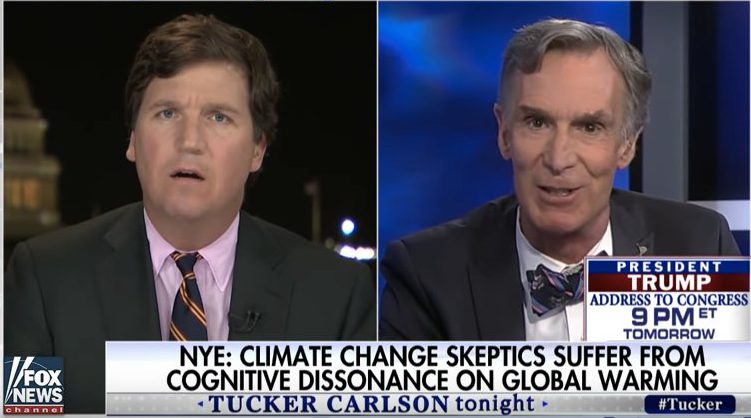
Try to make your face look like Tucker Carlson:

When dealing with a naturalist fundamentalist, make the Tucker Carlson face
The Tucker Carlson face conveys a mix of confusion, disappointment and horror

For God’s sake, even Richard Dawkins admitted in his debate with John Lennox that a good case can be made for a deistic God from the science we have now. If Dawkins can admit this, then you need to be extremely harsh to the village atheists.

If the word “naturalism” is all new to you, you should probably read the whole article and this longer article as well. The longer article really explains the different definitions of the words that are used in these debates. Johnson’s an excellent writer, and you will learn a lot.