Tag Archives: Employment

Which policies have caused our low labor force participation rate?

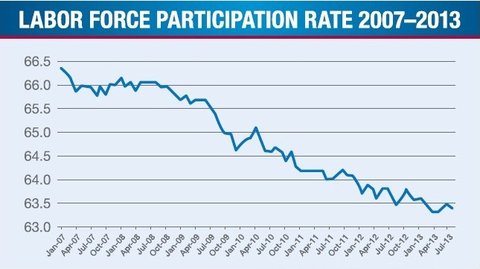
Labor Force Participation Rate from 2007 (Pelosi/Reid) to 2013

Jay Richards tweeted this article from the Wall Street Journal. The article is an interview with a business owner named Bob Funk whose job it is to match job seekers to job creators.

Hiring is down because of increased regulation of employers and fear of interventionism:

Here’s something you don’t often see in Washington: a businessman trying to repeal a law that helps his company. That’s Bob Funk’s latest mission in life. He’s the president and founder of Express Employment Services, the fifth-largest employment agency in America, with annual sales of $2.5 billion and more than 600 franchises across the country. This year he will place nearly half a million workers in jobs.

“ObamaCare has been an absolute boon for my business,” he says as we sit in his new office headquarters near downtown Oklahoma City. “I’m making a lot of money thanks to that law. We’re up 8% this year. But it’s just terrible for the country. I see that firsthand every day.”

Why is the health-care law good for Express but bad for the country? “Firms are just very reluctant to hire full-time workers,” Mr. Funk says. “So they are taking on more temporary help, which is what we do.” ObamaCare imposes new mandates and penalties on companies with more than 50 full-time employees—and even those working 30 hours a week are considered full-time.

He quickly adds: “The problem isn’t just ObamaCare, though. It’s the entire regulatory assault on employers coming out of Washington—everything from the EEOC”—the Equal Employment Opportunity Commission hits companies hard when employees claim age, race or sex discrimination—”to the Dodd-Frank monstrosity. Employers are living in a state of fear.”

So let’s take a look at what is causing a record low labor force participation rate.

The younger generation does not have a good work ethic:

The primary jobs problem today, Mr. Funk says, is that too many workers are functionally unemployable because of attitude, behavior or lack of the most basic work skills. One discouraging statistic is that only about one of six workers who comes to Express seeking employment makes the cut. He recites a company statistic that about one in four applicants can’t even pass a drug test.

“In my 40-some years in this business, the biggest change I’ve witnessed is the erosion of the American work ethic. It just isn’t there today like it used to be,” Mr. Funk says. Asked to define “work ethic,” he replies that it’s fairly simple but vital on-the-job behavior, such as showing up on time, being conscientious and productive in every task, showing a willingness to get your hands dirty and at times working extra hours. These attributes are essential, he says, because if low-level employees show a willingness to work hard, “most employers will gladly train them with the skills to fill higher-paying jobs.”

He fears that too many of the young millennials who come knocking on his door view a paycheck as a kind of entitlement, not something to be earned. He is also concerned that the trendy concept of “life-balancing” is putting work second behind leisure.

Welfare spending discourages people from working:

When pressed to explain what Washington can do to get Americans back on the job, Mr. Funk says the first step would be to start shrinking the “vast social welfare state programs that have become a substitute for work. There’s a prevalent attitude of a lot of this generation of workers that the government will always be there to take care of them. It’s hard to get people to take entry-level jobs when they can get unemployment benefits, health care, food stamps and the rest.”

This week during the food-stamp debate in Congress, Democrats voted unanimously against work requirements and ridiculed Republicans who suggested that the expansion of food stamps to 47 million Americans has discouraged working. The Democrats are living in a fantasy world, according to Mr. Funk. He points to Congress’s decision in 2009 to increase unemployment-insurance benefits to 90 weeks or more as “a policy that held a lot of people out of the workforce until the checks stopped coming. We saw that here very clearly.”

Disability makes people less inclined to get a job:

The most abused government program, he says, is disability insurance and the 14 million Americans who now collect these benefits. Express has found that over half of the disability claims brought by its workers have turned out to be fraudulent. “We win 90% of the disability cases that we challenge in court,” Mr. Funk says.

Skills deficit makes people less employable:

Another big hurdle is the widening skills deficit. At any given time, Mr. Funk says, Express has as many as 20,000 jobs the company can’t fill because workers don’t have the skills required. His advice to young people who are looking for a solid career is to get training in accounting (thanks to Dodd-Frank’s huge expansion of paperwork), information technology, manufacturing-robotics programming, welding and engineering. He’s mystified why Express has so much trouble filling thousands of information-technology jobs when so many young, working-age adults are computer literate.

Public schools and universities don’t prepare people for work:

He blames public schools and universities for the skills mismatch. Young people looking for a financially secure future might want to heed one of his favorite pieces of cautionary advice: “If you’ve got a college degree in psych, poly-sci or sociology, sorry, I can’t help you find a job.” He urges greater emphasis on vocational and practical skills training in schools, universities and junior colleges.

With so many ideas about how to help get the country on track, Mr. Funk might seem ripe to enter politics, but he already made one electoral foray—he was a local school-board member for 11 years—and found it an exercise in pure frustration. Bringing his pay-for-performance values to the board, he spent years futilely trying to get rid of bad teachers and to reward “the 30% that are really good.”

He says “teacher tenure is by far the most corrupt social institution in our time, because it doesn’t reward excellence or weed out bad teachers.” The teachers union had operational control of the school board, and Mr. Funk couldn’t get them to budge. He says the union celebrated when he left the board.

I think that this shows the important of having private sector experience in a President. When you are looking to hire a President, you want to hire someone who has already done what he claims he wants to do, at a smaller level. If you want someone to fix health care, pick someone like Bobby Jindal who has already done it in his state. If you want someone to make schools accountable, pick Scott Walker. If you want someone to cut spending, pick Rick Scott. If you want someone to create jobs, pick Rick Perry. If you want someone to balance the budget, pick John Kasich. Pick a candidate who can do the work. Not someone who passionately speaks about how he wants to do the work. Pick someone who has been fabulously successful at actually doing what he says he wants to do.

Our current President knew nothing about running a business or how jobs are created when he was elected. He was just a community organizer. Never did a thing in the private sector. Maybe he could get lucky at making policies that would create jobs, but “lucky” our best option? Next time, let’s not take chances. Pick someone who has proved that he can do the work based on past performance. Not speeches.

Feminist Hanna Rosin debunks the myth of a gender pay gap caused by discrimination

In the far-left Slate, of all places.

Excerpt:

The official Bureau of Labor Department statistics show that the median earnings of full-time female workers is 77 percent of the median earnings of full-time male workers. But that is very different than “77 cents on the dollar for doing the same work as men.” The latter gives the impression that a man and a woman standing next to each other doing the same job for the same number of hours get paid different salaries. That’s not at all the case. “Full time” officially means 35 hours, but men work more hours than women. That’s the first problem: We could be comparing men working 40 hours to women working 35.

How to get a more accurate measure? First, instead of comparing annual wages, start by comparing average weekly wages. This is considered a slightly more accurate measure because it eliminates variables like time off during the year or annual bonuses (and yes, men get higher bonuses, but let’s shelve that for a moment in our quest for a pure wage gap number). By this measure, women earn 81 percent of what men earn, although it varies widely by race. African-American women, for example, earn 94 percent of what African-American men earn in a typical week. Then, when you restrict the comparison to men and women working 40 hours a week, the gap narrows to 87 percent.

But we’re still not close to measuring women “doing the same work as men.” For that, we’d have to adjust for many other factors that go into determining salary. Economists Francine Blau and Lawrence Kahn did that in a recent paper, “The Gender Pay Gap.”.”They first accounted for education and experience. That didn’t shift the gap very much, because women generally have at least as much and usually more education than men, and since the 1980s they have been gaining the experience. The fact that men are more likely to be in unions and have their salaries protected accounts for about 4 percent of the gap. The big differences are in occupation and industry. Women congregate in different professions than men do, and the largely male professions tend to be higher-paying. If you account for those differences, and then compare a woman and a man doing the same job, the pay gap narrows to 91 percent. So, you could accurately say in that Obama ad that, “women get paid 91 cents on the dollar for doing the same work as men.”

I believe that the remainder of the gap can be accounted for by looking at other voluntary factors that differentiate men and women.

The Heritage Foundation says that a recent study puts the number at 95 cents per dollar.

Excerpt:

Women are more likely than men to work in industries with more flexible schedules. Women are also more likely to spend time outside the labor force to care for children. These choices have benefits, but they also reduce pay—for both men and women. When economists control for such factors, they find the gender gap largely disappears.

A 2009 study commissioned by the Department of Labor found that after controlling for occupation, experience, and other choices, women earn 95 percent as much as men do. In 2005, June O’Neil, the former director of the Congressional Budget Office, found that “There is no gender gap in wages among men and women with similar family roles.” Different choices—not discrimination—account for different employment and wage outcomes.

A popular article by Carrie Lukas in the Wall Street Journal agrees.

Excerpt:

The Department of Labor’s Time Use survey shows that full-time working women spend an average of 8.01 hours per day on the job, compared to 8.75 hours for full-time working men. One would expect that someone who works 9% more would also earn more. This one fact alone accounts for more than a third of the wage gap.

[…]Recent studies have shown that the wage gap shrinks—or even reverses—when relevant factors are taken into account and comparisons are made between men and women in similar circumstances. In a 2010 study of single, childless urban workers between the ages of 22 and 30, the research firm Reach Advisors found that women earned an average of 8% more than their male counterparts. Given that women are outpacing men in educational attainment, and that our economy is increasingly geared toward knowledge-based jobs, it makes sense that women’s earnings are going up compared to men’s.

When women make different choices about education and labor that are more like what men choose, they earn just as much or more than men. What does it mean that people on the left keep pushing pseudo-science on us to try to punish men and reward women? Why are men so awful that they need to be denigrated like this? And how will men respond to social expectations when they have to face being told that they are “bad”? It seems to me that putting men down is going to lower their level of engagement.

Niall Ferguson argues that government is making it harder to run a business

In the Wall Street Journal.

Excerpt:

Seven years of data suggest that most of the world’s countries are successfully making it easier to do business: The total number of days it takes to carry out the seven procedures has come down, in some cases very substantially. In only around 20 countries has the total duration of dealing with “red tape” gone up. The sixth-worst case is none other than the U.S., where the total number of days has increased by 18% to 433. Other members of the bottom 10, using this metric, are Zimbabwe, Burundi and Yemen (though their absolute numbers are of course much higher).

Why is it getting harder to do business in America? Part of the answer is excessively complex legislation. A prime example is the 848-page Wall Street Reform and Consumer Protection Act of July 2010 (otherwise known as the Dodd-Frank Act), which, among other things, required that regulators create 243 rules, conduct 67 studies and issue 22 periodic reports. Comparable in its complexity is the Patient Protection and Affordable Care Act (906 pages), which is also in the process of spawning thousands of pages of regulation. You don’t have to be opposed to tighter financial regulation or universal health care to recognize that something is wrong with laws so elaborate that almost no one affected has the time or the will to read them.

[…]Each year, the World Economic Forum publishes its Global Competitiveness Index. Since it introduced its current methodology in 2004, the U.S. score has declined by 6%. (In the same period China’s score has improved by 12%.) An important component of the index is provided by 22 different measures of institutional quality, based on the WEF’s Executive Opinion Survey. Typical questions are “How would you characterize corporate governance by investors and boards of directors in your country?” and “In your country, how common is diversion of public funds to companies, individuals, or groups due to corruption?” The startling thing about this exercise is how poorly the U.S. fares.

In only one category out of 22 is the U.S. ranked in the global top 20 (the strength of investor protection). In seven categories it does not even make the top 50. For example, the WEF ranks the U.S. 87th in terms of the costs imposed on business by “organized crime (mafia-oriented racketeering, extortion).” In every single category, Hong Kong does better.

At the same time, the U.S. has seen a marked deterioration in its World Governance Indicators. In terms of “voice and accountability,” “government effectiveness,” “regulatory quality” and especially “control of corruption,” the U.S. scores have all gone down since the WGI project began in the mid-1990s. It would be tempting to say that America is turning Latin, were it not for the fact that a number of Latin American countries have been improving their governance scores over the same period.

Whatever the root causes of the deterioration of American institutions, smart people are starting to notice it. Last year Michael Porter of Harvard Business School published a report based on a large-scale survey of HBS alumni. Among the questions he asked was where the U.S. was “falling behind” relative to other countries. The top three lagging indicators named were: the effectiveness of the political system, the K-12 education system and the complexity of the tax code. Regulation came sixth, efficiency of the legal framework eighth.

Asked to name “the most problematic factors for doing business” in the U.S., respondents to the WEF’s most recent Executive Opinion Survey put “inefficient government bureaucracy” at the top, followed by tax rates and tax regulations.

The troubling thing to me is that the private sector has to make a profit in order to fund government, and I don’t see that the private sector will be able to producing the profits needed to fund our government’s lavish spending. Nothing that I see about the next generation causes me to believe that they understand economics enough to vote to improve the business climate. They seem to be very much anti-business. One wonders where they expect to find jobs.