Tag Archives: Economics

Graduate students with non-STEM degrees increasingly dependent on welfare programs

From the Chronicle of Higher Education.

Excerpt:

Melissa Bruninga-Matteau, a medieval-history Ph.D. and adjunct professor who gets food stamps: “I’ve been able to make enough to live on. Until now.”

“I am not a welfare queen,” says Melissa Bruninga-Matteau.

That’s how she feels compelled to start a conversation about how she, a white woman with a Ph.D. in medieval history and an adjunct professor, came to rely on food stamps and Medicaid. Ms. Bruninga-Matteau, a 43-year-old single mother who teaches two humanities courses at Yavapai College, in Prescott, Ariz., says the stereotype of the people receiving such aid does not reflect reality. Recipients include growing numbers of people like her, the highly educated, whose advanced degrees have not insulated them from financial hardship.

“I find it horrifying that someone who stands in front of college classes and teaches is on welfare,” she says.

Ms. Bruninga-Matteau grew up in an upper-middle class family in Montana that valued hard work and saw educational achievement as the pathway to a successful career and a prosperous life. She entered graduate school at the University of California at Irvine in 2002, idealistic about landing a tenure-track job in her field. She never imagined that she’d end up trying to eke out a living, teaching college for poverty wages, with no benefits or job security.

Ms. Bruninga-Matteau always wanted to teach. She started working as an adjunct in graduate school. This semester she is working 20 hours each week, prepping, teaching, advising, and grading papers for two courses at Yavapai, a community college with campuses in Chino Valley, Clarkdale, Prescott, Prescott Valley, and Sedona. Her take-home pay is $900 a month, of which $750 goes to rent. Each week, she spends $40 on gas to get her to the campus; she lives 43 miles away, where housing is cheaper.

Ms. Bruninga-Matteau does not blame Yavapai College for her situation but rather the “systematic defunding of higher education.” In Arizona last year, Gov. Jan Brewer, a Republican, signed a budget that cut the state’s allocation to Yavapai’s operating budget from $4.3-million to $900,000, which represented a 7.6 percent reduction in the college’s operating budget. The cut led to an 18,000-hour reduction in the use of part-time faculty like Ms. Bruninga-Matteau.

“The media gives us this image that people who are on public assistance are dropouts, on drugs or alcohol, and are irresponsible,” she says. “I’m not irresponsible. I’m highly educated. I have a whole lot of skills besides knowing about medieval history, and I’ve had other jobs. I’ve never made a lot of money, but I’ve been able to make enough to live on. Until now.”

She’s irresponsible, because she expects the people who choose to study rather difficult and unpleasant subjects like nursing and computer science and economics to pay for her lifestyle through taxation and “higher education funding”. I do think it’s important to point out that the main driver of higher tuition is increasing government funding of education, and that this increasing funding of higher education is nothing but corporate welfare.

Excerpt:

The most obvious way that colleges might capture federal student aid is by raising tuition. Research to date has been inconclusive, but Stephanie Riegg Cellini of George Washington University and Claudia Goldin of Harvard have provided compelling new analysis. Cellini and Goldin looked at for-profit colleges, utilizing the key distinction that only some for-profit schools are eligible for federal aid. Riegg and Goldin find that that aid-eligible institutions “charge much higher tuition … across all states, samples, and specifications,” even when controlling for the content and quality of courses. The 75 percent difference in tuition between aid-eligible and ineligible for-profit colleges — an amount comparable to average per-student federal assistance — suggests that “institutions may indeed raise tuition to capture the maximum grant aid available.”

Here are some of the comments that I posted in a Facebook discussion about the CHE story:

I know that some may disagree with me, but this is why people need to focus on STEM fields and stay away from artsy stuff and Ph.Ds in general. We are in a recession. Trade school and STEM degrees only until things improve.

Also, no single motherhood by choice. Get married before you have children, and make sure you vet the husband carefully for his ability to protect, provide, commit and lead on moral and spiritual issues. This woman is not a victim. She chose her life, and the rest of us are paying for it. Nice tattoos by the way – that will really help when she’s looking for a job.

I am actually better at English than computer science, but I find myself with a BS and MS in computer science. We don’t get to do what we like. We do what we have to in order to be effective as Christians. According to the Bible, men have an obligation to not engage in premarital sex, and to marry before having children, and to provide for their families, or they have denied the faith. I would like to have studied English, but the Bible says no way.

I have no problem with people who can make a career out of the arts, like a Robert George or a William Lane Craig. But you can’t just go crazy. And I think men have a lot less freedom than women to choose their major, we have the obligation to be providers and we have to be selected by women based on whether we can fulfill that role (among other roles).

Women have more freedom because they are not saddled with the provider role like men are. However, I think that the times now are different than before. There is more discrimination against conservatives on campus in non-STEM fields and fewer non-STEM jobs in a competitive global economy. The safest fields are things like petroleum engineering, software engineering, etc.

If [people who major in the humanities] can make a living and support a family without relying on government-controlled redistribution of wealth, then I salute and encourage you. If you rely on the government, know that this money is being taken away from those who are doing things they don’t like at all in order to be independent and self-reliant. It is never good to be dependent on government. That money comes from people like me.

In response to an artsy challenger:

I am happy to be scorned by those who make poor choices so long as I can have my money back from them so that I can pursue my dreams. I didn’t see any of these artsy people in the lab at 4 AM completing their operating system class assignments, nor do I see them here working overtime on the weekend in the office. They can say anything and feel anything they want, and write plays and poetry all about their feelings, too. Just give me the money I earned back first. It’s not their money. They have no right to it.

One person asked why I was “always winter, never Christmas, and I replied:

It is Christmas for the Christians who I send books and DVDs to, as well as for the Christian scholars I support, and the Christian conferences, debates and lectures I underwrite across the world. Unfortunately, every dollar taken from me is a dollar less for that Ph.D tuition of a Christian debater, a dollar less for the flight of that Christian apologetics speaker, a dollar less for that textbook for that Christian biology student, and a dollar less for the flowers being sent to that post-abortive woman who I counseled who is now in law school. I have a need for the money I earn, and when it’s sent to Planned Parenthood to pay for abortions by the government, my plan to serve God suffers. And finally, should I ever get married, I would like my wife to have the option of staying home with the children and even homeschooling them. That costs money. Somehow, I feel that given the choice between my homeschooling wife and the public school unions, the government will choose to give my money to the unions. Just a hunch.

I think that people should go into the humanities when they are serious about making a career of it and can get the highest grades. But if they are coasting and only getting Bs and Cs and not paying attention in class, then drop out and go to trade school. Don’t complain later when you can’t find a job. STEM careers pay the most.

Top-earning degrees / college majors

Here’s my previous post on the woman who accumulated $185,000 of student debt studying the humanities and is likewise demanding handouts and claiming not to be responsible.
526 economists, including 5 Nobel prize winners, grade Romney and Obama plans

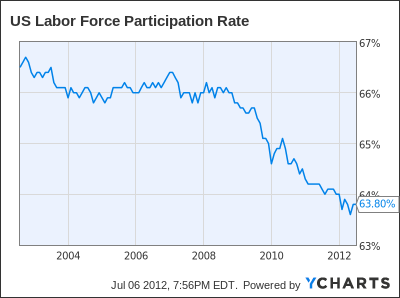
Labor Force Participation Rate

From the Daily Caller:

The 526 economists — including Nobel laureates Gary Becker, Robert Lucas, Robert Mundell, Edward Prescott, and Myron Scholes — point to six facets of Romney’s economic approach that they see as beneficial to future economic success.

  • Reduce marginal tax rates on business and wage incomes and broaden the tax base to increase investment, jobs, and living standards.
  • End the exploding federal debt by controlling the growth of spending so federal spending does not exceed 20 percent of the economy.
  • Restructure regulation to end “too big to fail,” improve credit availability to entrepreneurs and small businesses, and increase regulatory accountability, and ensure that all regulations pass rigorous benefit-cost tests.
  • Improve our Social Security and Medicare programs by reducing their growth to sustainable levels, ensuring their viability over the long term, and protecting those in or near retirement.
  • Reform our healthcare system to harness market forces and thereby reduce costs and increase quality, empowering patients and doctors, rather than the federal bureaucracy.
  • Promote energy policies that increase domestic production, enlarge the use of all western hemisphere resources, encourage the use of new technologies, end wasteful subsidies, and rely more on market forces and less on government planners.

Seven of the signatories are from Harvard University and five from Columbia University — two of President Barack Obama’s alma maters.

The economists’ statement of support pillories Obama’s economic record, claiming that his expansion of the federal government has resulted in “anemic economic recovery and high unemployment,” which will continue if his future plans are implemented.

Among the Obama policies with which the 526 economists take issue include:

  • Relied on short-term “stimulus” programs, which provided little sustainable lift to the economy, and enacted and proposed significant tax increases for all Americans.
  • Offered no plan to reduce federal spending and stop the growth of the debt-to-GDP ratio.
  • Failed to propose Social Security reform and offered a Medicare proposal that relies on a panel of bureaucrats to set prices, quantities, and qualities of healthcare services.
  • Favored a large expansion of economic regulation across many sectors, with little regard for proper cost-benefit analysis and with a disturbing degree of favoritism toward special interests.
  • Enacted health care legislation that centralizes health care decisions and increases the power of the federal bureaucracy to impose one-size-fits-all solutions on patients and doctors, and creates greater incentives for waste.
  • Favored expansion of one-size-fits-all federal rulemaking, with an erosion of the ability of state and local governments to make decisions appropriate for their particular circumstances.

We can’t afford four more years of incompetence and failure. We need to ask ourselves what economists like Thomas Sowell and Walter Williams would do. And they wouldn’t give Obama four more years. We need a change.

Left-wing Newsweek’s cover story recommends dumping Barack Obama

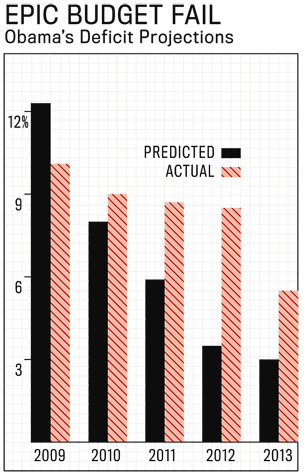
Epic Budget Fail
Epic Budget Fail

From the radically left-wing Newsweek, of all places. (H/T Defeating Obama)

Excerpt:

[T]he total number of private-sector jobs is still 4.3 million below the January 2008 peak. Meanwhile, since 2008, a staggering 3.6 million Americans have been added to Social Security’s disability insurance program. This is one of many ways unemployment is being concealed.

In his fiscal year 2010 budget—the first he presented—the president envisaged growth of 3.2 percent in 2010, 4.0 percent in 2011, 4.6 percent in 2012. The actual numbers were 2.4 percent in 2010 and 1.8 percent in 2011; few forecasters now expect it to be much above 2.3 percent this year.

Unemployment was supposed to be 6 percent by now. It has averaged 8.2 percent this year so far. Meanwhile real median annual household income has dropped more than 5 percent since June 2009. Nearly 110 million individuals received a welfare benefit in 2011, mostly Medicaid or food stamps.

Welcome to Obama’s America: nearly half the population is not represented on a taxable return—almost exactly the same proportion that lives in a household where at least one member receives some type of government benefit. We are becoming the 50–50 nation—half of us paying the taxes, the other half receiving the benefits.

And all this despite a far bigger hike in the federal debt than we were promised. According to the 2010 budget, the debt in public hands was supposed to fall in relation to GDP from 67 percent in 2010 to less than 66 percent this year. If only. By the end of this year, according to the Congressional Budget Office (CBO), it will reach 70 percent of GDP. These figures significantly understate the debt problem, however. The ratio that matters is debt to revenue. That number has leapt upward from 165 percent in 2008 to 262 percent this year, according to figures from the International Monetary Fund. Among developed economies, only Ireland and Spain have seen a bigger deterioration.

Not only did the initial fiscal stimulus fade after the sugar rush of 2009, but the president has done absolutely nothing to close the long-term gap between spending and revenue.

His much-vaunted health-care reform will not prevent spending on health programs growing from more than 5 percent of GDP today to almost 10 percent in 2037. Add the projected increase in the costs of Social Security and you are looking at a total bill of 16 percent of GDP 25 years from now. That is only slightly less than the average cost of all federal programs and activities, apart from net interest payments, over the past 40 years. Under this president’s policies, the debt is on course to approach 200 percent of GDP in 2037—a mountain of debt that is bound to reduce growth even further.

And even that figure understates the real debt burden. The most recent estimate for the difference between the net present value of federal government liabilities and the net present value of future federal revenues—what economist Larry Kotlikoff calls the true “fiscal gap”—is $222 trillion.

[…][T]he Patient Protection and Affordable Care Act (ACA) of 2010 did nothing to address the core defects of the system: the long-run explosion of Medicare costs as the baby boomers retire, the “fee for service” model that drives health-care inflation, the link from employment to insurance that explains why so many Americans lack coverage, and the excessive costs of the liability insurance that our doctors need to protect them from our lawyers.

[…]The president pledged that health-care reform would not add a cent to the deficit. But the CBO and the Joint Committee on Taxation now estimate that the insurance-coverage provisions of the ACA will have a net cost of close to $1.2 trillion over the 2012–22 period.

The president just kept ducking the fiscal issue. Having set up a bipartisan National Commission on Fiscal Responsibility and Reform, headed by retired Wyoming Republican senator Alan Simpson and former Clinton chief of staff Erskine Bowles, Obama effectively sidelined its recommendations of approximately $3 trillion in cuts and $1 trillion in added revenues over the coming decade. As a result there was no “grand bargain” with the House Republicans—which means that, barring some miracle, the country will hit a fiscal cliff on Jan. 1 as the Bush tax cuts expire and the first of $1.2 trillion of automatic, across-the-board spending cuts are imposed. The CBO estimates the net effect could be a 4 percent reduction in output.

The failures of leadership on economic and fiscal policy over the past four years have had geopolitical consequences. The World Bank expects the U.S. to grow by just 2 percent in 2012. China will grow four times faster than that; India three times faster. By 2017, the International Monetary Fund predicts, the GDP of China will overtake that of the United States.

This is a must-read article, and please share it with your friends, as well. It does cover Obama’s disastrous foreign policy as well, but the focus is on fiscal policy. The article ends with an assessment of Paul Ryan’s ability to fix the economic crisis that Obama created.

UPDATE: Niall Ferguson responds to a critique of this piece by Paul Krugman.

UPDATE: Niall Ferguson responds to critiques by shrill-shrieking left-wing bloggers.