
Tag Archives: Economics

How changing prices signal buyers and sellers in a free market economy

Here’s a lesson in capitalism from the New York Times. (H/T ECM)

Excerpt:

The oil industry has been on a hot streak this year, thanks to a series of major discoveries that have rekindled a sense of excitement across the petroleum sector, despite falling prices and a tough economy.

These discoveries, spanning five continents, are the result of hefty investments that began earlier in the decade when oil prices rose, and of new technologies that allow explorers to drill at greater depths and break tougher rocks.

“That’s the wonderful thing about price signals in a free market — it puts people in a better position to take more exploration risk,” said James T. Hackett, chairman and chief executive of Anadarko Petroleum.

And what do we learn from this? Do oil prices go up because of greed? No.

When supply is low or uncertain, but demand is high, then prices must rise. Rising oil prices signal consumers to curtail their consumption, and they signal producers to invest more and take more risks to find more oil.

The government must not interfere to set prices lower when prices rise due to a shortage. Lower prices means that producers will not invest or take risks in order to find more oil for consumers. We have to let producers have their profits in order to for them to invest and take risks to find more oil. And when more oil is found, the price of oil will go down naturally, without the government having to get involved. The more government gets involved, the more opportunity there is for corruption.

Share

Obama’s naive trade policy angers Canada, China, France, Mexico, etc.

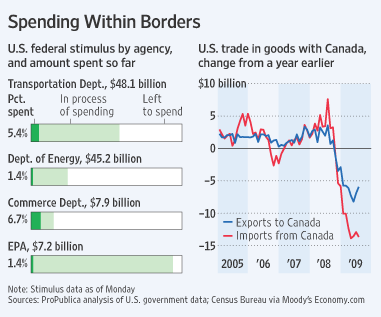
The economic effects of massive government waste and naive protectionism

(Source: Wall Street Journal)

The Wall Street Journal explains the high costs of economic ignorance.

Excerpt:

The smell of trade war is suddenly in the air. Mr. Obama slapped a 35% tariff on Chinese tires Friday night, and China responded on the weekend by threatening to retaliate against U.S. chickens and auto parts. That followed French President Nicolas Sarkozy’s demand on Thursday that Europe impose a carbon tariff on imports from countries that don’t follow its cap-and-trade diktats. “We need to impose a carbon tax at [Europe’s] border. I will lead that battle,” he said.

Mr. Sarkozy was following U.S. Energy Secretary Steven Chu, who has endorsed a carbon tax on imports, and the U.S. House of Representatives, which passed a carbon tariff as part of its cap-and-tax bill. This in turn followed the “Buy American” provisions of the stimulus, which has incensed much of Canada; Congress’s bill to ban Mexican trucks from U.S. roads in direct violation of Nafta, prompting Mexico to retaliate against U.S. farm and kitchen goods; and the must-make-cars-in-America provisions of the auto bailouts. Meanwhile, U.S. trade pacts with Colombia, Panama and South Korea languish in Congress.

The article goes on to explain how the Smoot-Hawley tariff helped cause the Great Depression. This is exactly the path that President Teleprompter is treading. He is taking us head-first into the next Great Depression because he knows less about economic policy than my keyboard. He did legal work for ACORN, for God’s sake – have you seen who ACORN hires? I’m sure that woman can read a Teleprompter, too.

What do economists think of Obama’s economic policies?

I noticed this post on Greg Mankiw’s blog, where links to a survey of economists.

Click here to read the results of a new survey of AEA members. This updates previous survey results, summarized in Chapter 2 of my favorite textbook.

Note that 83 percent agree that “the United States should eliminate remaining tariffs and other barriers to trade.” I presume that would apply to tariffs on Chinese tires.

Greg Mankiw is a Harvard University professor of economics.

UPDATE: New Michele Bachmann video!

Wow, is she ever pretty when she’s explaining free trade! Sigh.

Twenty-one reasons why marriage matters

From the National Marriage Coalition in New Zealand. (H/T Jennifer Roback Morse)

Summary:

FAMILY

1. Marriage increases the likelihood that fathers have good relationships with their children
2. Cohabitation is not the functional equivalent of marriage
3. Growing up outside an intact marriage increases the likelihood that children themselves divorce or become unwed parents
4. Marriage is a virtually universal human institution.

ECONOMICS

5. Divorce and unmarried childbearing increase poverty for both children and mothers
6. Married couples seem to build more wealth on average than singles or cohabiting couples
7. Married men earn more money than do single men with similar education and job histories
8. Parental divorce (or failure to marry) appears to increase children’s risk of school failure
9. Parental divorce reduces the likelihood that children will graduate from college and achieve high-status jobs

PHYSICAL HEALTH AND LONGEVITY

10.Children who live with their own two married parents enjoy better physical health, on average, than do children in other family forms
11.Parental marriage is associated with a sharply lower risk of infant mortality
12.Marriage is associated with reduced rates of alcohol and substance abuse for both adults and teens
13.Married people, especially married men, have longer life expectancies than do otherwise similar singles
14.Marriage is associated with better health and lower rates of injury, illness, and disability for both men and women

MENTAL HEALTH AND EMOTIONAL WELL-BEING

15.Children whose parents divorce have higher rates of psychological distress and mental illness
16.Divorce appears significantly to increase the risk of suicide
17.Married mothers have lower rates of depression than do single or cohabiting mothers

CRIME AND DOMESTIC VIOLENCE

18.Boys raised in single-parent families are more likely to engage in delinquent and criminal behaviour
19.Marriage appear to reduce the risk that adults will be either perpetrators or victims of crime
20.Married women appear to have a lower risk of experiencing domestic violence than do cohabiting or dating women
21.A child who is not living with his or her own two married parents is at greater risk of child abuse

This is fun to read! You can learn to defend marriage, even if you favor lifelong chastity over marriage like I do.

The full PDF is here.