Tag Archives: Economics

Two black economists explain how to end poverty in America

Economist Walter Williams

Walter Wiliams is one of my two favorite economists, the other being Thomas Sowell.

Here is his article on wealth and poverty on Creators written by Dr. Williams.

First, real poverty is not common in America:

There is no material poverty in the U.S. Here are a few facts about people whom the Census Bureau labels as poor. Dr. Robert Rector and Rachel Sheffield, in their study “Understanding Poverty in the United States: Surprising Facts About America’s Poor”, report that 80 percent of poor households have air conditioning; nearly three-quarters have a car or truck, and 31 percent have two or more. Two-thirds have cable or satellite TV. Half have one or more computers. Forty-two percent own their homes. Poor Americans have more living space than the typical non-poor person in Sweden, France or the U.K. What we have in our nation are dependency and poverty of the spirit, with people making unwise choices and leading pathological lives aided and abetted by the welfare state.

Second, the “poverty” is not caused by racism, but by poor choices:

The Census Bureau pegs the poverty rate among blacks at 35 percent and among whites at 13 percent. The illegitimacy rate among blacks is 72 percent, and among whites it’s 30 percent. A statistic that one doesn’t hear much about is that the poverty rate among black married families has been in the single digits for more than two decades, currently at 8 percent. For married white families, it’s 5 percent. Now the politically incorrect questions: Whose fault is it to have children without the benefit of marriage and risk a life of dependency? Do people have free will, or are they governed by instincts?

There may be some pinhead sociologists who blame the weak black family structure on racial discrimination. But why was the black illegitimacy rate only 14 percent in 1940, and why, as Dr. Thomas Sowell reports, do we find that census data “going back a hundred years, when blacks were just one generation out of slavery … showed that a slightly higher percentage of black adults had married than white adults. This fact remained true in every census from 1890 to 1940”? Is anyone willing to advance the argument that the reason the illegitimacy rate among blacks was lower and marriage rates higher in earlier periods was there was less racial discrimination and greater opportunity?

Third, avoiding poverty is the result of good choices:

No one can blame a person if he starts out in life poor, because how one starts out is not his fault.

If he stays poor, he is to blame because it is his fault. Avoiding long-term poverty is not rocket science. First, graduate from high school. Second, get married before you have children, and stay married. Third, work at any kind of job, even one that starts out paying the minimum wage. And finally, avoid engaging in criminal behavior. It turns out that a married couple, each earning the minimum wage, would earn an annual combined income of $30,000. The Census Bureau poverty line for a family of two is $15,500, and for a family of four, it’s $23,000. By the way, no adult who starts out earning the minimum wage does so for very long.

Fourth, what stops people from making good choices is big government:

Since President Lyndon Johnson declared war on poverty, the nation has spent about $18 trillion at the federal, state and local levels of government on programs justified by the “need” to deal with some aspect of poverty. In a column of mine in 1995, I pointed out that at that time, the nation had spent $5.4 trillion on the War on Poverty, and with that princely sum, “you could purchase every U.S. factory, all manufacturing equipment, and every office building. With what’s left over, one could buy every airline, trucking company and our commercial maritime fleet. If you’re still in the shopping mood, you could also buy every television, radio and power company, plus every retail and wholesale store in the entire nation”. Today’s total of $18 trillion spent on poverty means you could purchase everything produced in our country each year and then some.

Regarding those last two points, here is Thomas Sowell:
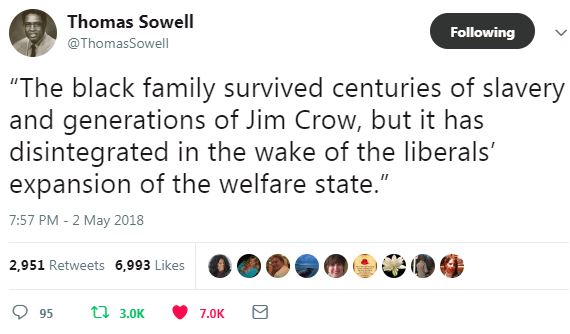
Economist Thomas Sowell blames welfare for killing the black family

To illustrate this point, here’s a graph with some helpful data taken from the U. S. Census.

Black women were more likely to be married before welfare programs

In fact, there is a whole video featuring Thomas Sowell to go with this graph:

And an article to go with it:

If we wanted to be serious about evidence, we might compare where blacks stood a hundred years after the end of slavery with where they stood after 30 years of the liberal welfare state. In other words, we could compare hard evidence on “the legacy of slavery” with hard evidence on the legacy of liberals.

Despite the grand myth that black economic progress began or accelerated with the passage of the civil rights laws and “war on poverty” programs of the 1960s, the cold fact is that the poverty rate among blacks fell from 87 percent in 1940 to 47 percent by 1960. This was before any of those programs began.

Over the next 20 years, the poverty rate among blacks fell another 18 percentage points, compared to the 40-point drop in the previous 20 years. This was the continuation of a previous economic trend, at a slower rate of progress, not the economic grand deliverance proclaimed by liberals and self-serving black “leaders.”

Ending the Jim Crow laws was a landmark achievement. But, despite the great proliferation of black political and other “leaders” that resulted from the laws and policies of the 1960s, nothing comparable happened economically. And there were serious retrogressions socially.

Nearly a hundred years of the supposed “legacy of slavery” found most black children being raised in two-parent families in 1960. But thirty years after the liberal welfare state found the great majority of black children being raised by a single parent.

The rest of the article points out how even crime rates among blacks were caused by the implementation of soft law enforcement policies by progressives. Just look at the big cities if you want to know what it is like for blacks to be ruled by Democrats. It sucks!

If everybody started to read more Thomas Sowell books, we would be much better off as a country! Only good things happen when people stop watching TV and listening to music and watching movies, and instead settle down in a chair with a Thomas Sowell book. I recommended a bunch of them in a previous post.

Tad Hopp accumulated $100,000 of college debt, now he wants a taxpayer bailout

Brain vs Heart, from: theawkwardyeti.com

Here’s an interesting editorial from a “Christian” left blog. (H/T Acton Institute)

The author, Tad Hopp is graduating a PCUSA seminary – an extremely liberal, left-wing denomination.

He writes:

I graduated college in 2007.

[…] I majored in English, not exactly what most people consider a ‘marketable’ or ‘practical’ degree…

[…]I went to a somewhat expensive private school…

[…]I did what many students in their last year of high school do: I went to the school where I felt I was being called…

[…]I do not regret my four years at my undergraduate institution one bit.

[….]When I graduated college, I owed nearly $50,000 in student loan debt and was unemployed for almost six months before I finally found a low-paying office job.

[…]“Can’t find a job? Well, you should have majored in something more ‘practical’, like economics or business or medicine.” Yeah, that would be great…if those were the subjects where my skills and passions lie. They’re not.

[…]I felt called to go to seminary.

[…]I will graduate seminary with close to six figures worth of student loan debt.

Let’s take stock of what he’s said so far:

  • he studied English, a language that he already spoke, which has one of the lowest employment rates
  • he was warned by people who knew something about earning and saving money not to study English
  • he went to a school he couldn’t afford to go to, and he graduated with $50,000 in debt
  • he went to seminary, another subject that doesn’t pay, and added another $50,000 or so of debt
  • he says that he doesn’t have to study subjects that lead to a career because he isn’t “passionate” about them
  • he “followed his heart” by going to the school that he had mystical, emotional, intuitions about = “calling”

My advice to Tad at this point would be for him to take the Bible seriously when it says this:

2 Thessalonians 3:10:

10 For even when we were with you, we used to give you this order: if anyone is not willing to work, then he is not to eat, either.

And 1 Timothy 5:8:

8 But if anyone does not provide for his own, and especially for those of his household, he has denied the faith and is worse than an unbeliever.

The Bible is giving us the goal of working. So what should we do to be able to reach that goal? Why should anyone hire us? What is working really about? It’s those kinds of questions that should guide what we study in school, and what jobs we pursue.

We know what careers have the highest starting salaries and mid-career salaries:

Starting and Mid-Career salaries by profession (click for larger image)

(Source)

Why do some people get paid more than others? The answer is supply and demand. Prices are a way of determining what is most valued by your fellow man. Business owners pay more to people who offer their customers more value. If you really want to serve your neighbor, you have to learn something they really want, but can’t easily obtain. And then you will be paid more. You can’t do what makes you happy. You have to do what makes customers happy. That’s how the free market works – you make money when you provide something of value to others. You make money when you serve others. This is something that is very hard for self-centered, feelings-driven young progressives to grasp. But it’s something older Americans all know.

More Tad:

Is the PCUSA doing anything to address this crisis?

[…]What has our government done to address this issue?

[…]I, like so many in my generation, voted for Obama…

[…]It seems to me that we’ve bought into the lie that student loan debt is brought on by the individual person…

[…]You know what I think might stimulate the economy? Automatically cancelling every single outstanding student loan!

He insists that the results of his own choices aren’t his fault. But didn’t he make the choices about what to study? Didn’t he make the choice to follow his heart? Didn’t he disregard the advice of people who urged him to be practical? Who is to blame, if not he, himself?

Tad needs to push away all his friends who told him to “follow his heart” and stick close by his friends who told him to focus on providing value to others. Don’t look for advice from dreamers, look for advice from doers. Dreamers talk. But doers have demonstrated the ability to create plans that work to achieve results.

By the way, some of you might be wondering how serious this person was about his Christianity. Well, in another post, he comes out as gay. So clearly the Bible is being interpreted in a way where feelings are overturning the plain meanings of words. People who read the Bible closely never come away with the message that they should follow their hearts.

Five reasons why Christians ought to care about economics

Does God expect us to make plans and achieve goals?

This is from the Acton Institute blog.

The five:

  1. The Bible Deals with Economic Issues
  2. Economics Helps Us Understand the Public Square
  3. It Expands Our Model of Discipleship
  4. It Enhances Our Theology of Work
  5. It Illuminates the Theological Implications of Politics

I want to choose just one of these, but I have to choose two, because they rock my socks off:

2. Economics Helps Us Understand the Public Square

Second, an understanding of economics and especially of political economy can help us understand what is going on in the world around us. The general election…is impossible to follow without some understanding of the implications of Obamacare and its impact on Medicare, the federal deficit, and the long-term effects of continued deficit spending. The posturing on the part of Republicans and Democrats sometimes seems like little more than rhetoric, but the one who understands what is really at stake can help lead people to a better understanding of their responsibility in the public square.

3. It Expands Our Model of Discipleship

Third, an understanding of economics can help us pastor our people more effectively by pointing to the need for a more comprehensive model of Christian discipleship. Many people in our churches just don’t grasp that wealth is produced through work, how that in itself is a blessing to others, and then what God calls them to do with their wealth, even if they have very little of it. Taking a money management course is important to becoming a mature steward, but what most need more than that is a framework for understanding how politics, economics, and citizenship responsibilities fit into a broader discipleship model of life stewardship. In other words, they need an introduction to biblical oikonomia (“the law of the house”). And this applies to pastors and seminary professors every bit as much as it does to members of the congregation. A good place to start is by imparting some understanding of supply and demand, of fruitfulness and pay, and of how investments work (just to give a small sampling), because this will help God’s people to grasp better the role they play every day in the broad sweep of God’s mission in the world.

And now a comment from me about 2 and 3:

I wasn’t raised in the church and I don’t think of God the way that church people do. I think of God as my boss. I don’t expect God to micromanage according to some mysterious plan that I can only sense through my emotions. What he does is communicate his character and his goals in the Bible, and then he leaves it up to me to decide how to steward my resources in order to produce a return on his investment. That’s why economics, business and investing are all important to me. If I can understand how the world works, then I know how to make decisions that will help me to achieve good results, like mentoring people and supporting Christian scholars. It’s just like fixing a car or building a house. The more you know about how things work, the better it is. Feelings and intuitions have no place in decision-making, it’s knowledge all the way.

Here’s Matthew 25:14-30.

Look:

14 “For it will be like a man going on a journey, who called his servants and entrusted to them his property.

15 To one he gave five talents, to another two, to another one, to each according to his ability. Then he went away.

16 He who had received the five talents went at once and traded with them, and he made five talents more.

17 So also he who had the two talents made two talents more.

18 But he who had received the one talent went and dug in the ground and hid his master’s money.

19 Now after a long time the master of those servants came and settled accounts with them.

20 And he who had received the five talents came forward, bringing five talents more, saying, ‘Master, you delivered to me five talents; here I have made five talents more.’

21 His master said to him, ‘Well done, good and faithful servant. You have been faithful over a little; I will set you over much. Enter into the joy of your master.’

22 And he also who had the two talents came forward, saying, ‘Master, you delivered to me two talents; here I have made two talents more.’

23 His master said to him, ‘Well done, good and faithful servant. You have been faithful over a little; I will set you over much. Enter into the joy of your master.’

24 He also who had received the one talent came forward, saying, ‘Master, I knew you to be a hard man, reaping where you did not sow, and gathering where you scattered no seed,

25 so I was afraid, and I went and hid your talent in the ground. Here you have what is yours.’

26 But his master answered him, ‘You wicked and slothful servant! You knew that I reap where I have not sown and gather where I scattered no seed?

27 Then you ought to have invested my money with the bankers, and at my coming I should have received what was my own with interest.

28 So take the talent from him and give it to him who has the ten talents.

29 For to everyone who has will more be given, and he will have an abundance. But from the one who has not, even what he has will be taken away.

30 And cast the worthless servant into the outer darkness. In that place there will be weeping and gnashing of teeth.’

He’s the boss, and we are here to freely decide what we are going to do about it. If you want to do a good job, then it makes sense to do what everyone else does – learn how things work so that you can make good decisions. If I could give one other piece of advice, it would be to not put mysticism and feelings on the same level as reason and evidence. It doesn’t work in the normal workday world, and it doesn’t work when you are planning out the overall course of your life, either. Cautious works. Cautious gets results.