Tag Archives: Economic Growth

Will raising taxes on the rich help the economy and create more jobs?

The presidents of my two favorite think tanks, Arthur Brooks (AEI) and Edwin Feulner (Heritage) explain in this USA Today editorial.

Excerpt: (links removed)

First, there is no evidence that tax increases will actually solve our troubles. On the contrary, years of data from around the world show that when nations try to solve a fiscal crisis primarily by raising tax revenues, they tend to fail. In contrast, fiscal approaches based on entitlement reform and spending cuts tend to succeed.

American Enterprise Institute economists Kevin Hassett, Andrew Biggs and Matthew Jensen examined the experiences of 21 Organization for Economic Cooperation and Development (OECD) countries between 1970 and 2007. They found that countries with successful fiscal reforms, on average, closed 85% of their budget gaps with spending cuts. The countries with failed reforms, on average, relied at least 50% on tax increases. President Obama’s strategy falls firmly in the latter camp. After discounting the accounting tricks that create fictitious spending cuts, the president’s plan would impose about $3 in tax hikes for every $1 in spending cuts.

That is, his approach would probably land America in the “failed attempt” column. Five years down the line, we would be in the same fiscal mess we are in today, just with higher taxes and a bigger government.

Second, tax hikes aimed at small segments of the population wouldn’t raise much in revenues. Consider the “Buffett Rule” that the president spent many months promoting. According to the Joint Committee on Taxation, it would raise about $47 billion over a decade. The federal government currently spends about $4 billion more per day than it takes in. The Buffett Rule, then, would raise about enough next year to cover 28 hours of government overspending. Heritage Foundation economist Curtis Dubay finds that closing the deficit solely by raising the two highest tax brackets would require hiking them to 159% and 166%, respectively.

Third, as economists and business executives have noted repeatedly, raising taxes on families earning over $250,000 per year is effectively a massive tax hike on small businesses. Most small businesses today organize as S-corporations or other pass-through entities; their income is taxed as personal income. A study by Ernst and Young shows that Obama’s proposed tax hike would force these small businesses to eliminate about 710,000 jobs. Moreover, these households already bear a great deal of tax liability. According to the most recent Internal Revenue Service data, those earning $250,000 and above — roughly 2% of all taxpayers — earn 22% of income, but pay 45% of all federal income taxes.

Simply put, increasing tax rates on the wealthy is not a serious approach to solving America’s fiscal woes. The problem is purely one of excessive spending, not inadequate taxing.

Revenues haven’t changed substantially over the last decade, but government spending is way, way up. That’s what’s causing us to go into debt – massive government spending on turtle tunnels and Solyndra. We can do better than socialism.

New report: welfare spending hits record $1 trillion, up 32% in Obama’s first term

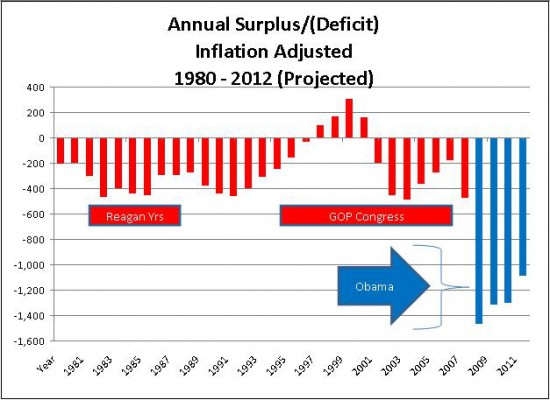
Democrats control the House and Senate in 2007

Dad sent me this excellent article from the Daily Caller.

Excerpt:

The government spent approximately $1.03 trillion on 83 means-tested federal welfare programs in fiscal year 2011 alone — a price tag that makes welfare that year the government’s largest expenditure, according to new data released by the Republican side of the Senate Budget Committee.

The total sum taxpayers spent on federal welfare programs was derived from a new Congressional Research Service (CRS) report on federal welfare spending — which topped out at $745.84 billion for fiscal year 2011 — combined with an analysis from the Republican Senate Budget Committee staff of state spending on federal welfare programs (based on “The Oxford Handbook of State and Local Government Finance”), which reached $282.7 billion in fiscal year 2011.

[…]According to the CRS report, which focused solely on federal spending for federal welfare programs, spending on federal welfare programs increased $563.413 billion in fiscal year 2008 to $745.84 billion in fiscal year 2011 — a 32 percent increase.

[…]The total federal spending on federal welfare programs vastly outpaced fiscal year 2011 spending on such federal expenditures as non-war defense ($540 billion), Social Security ($725 billion), Medicare ($480 billion), and departments such as Justice ($30.5 billion), Transportation ($77.3 billion) and Education ($65.486 billion) — a fact that alarmed the ranking member of the Senate Budget Committee, Alabama Sen. Jeff Sessions, who requested the report from CRS.

“These astounding figures demonstrate that the United States spends more on federal welfare than any other program in the federal budget,” Sessions wrote The Daily Caller in an email. “It is time to restore — not retreat from — the moral principles of the 1996 welfare reform. Such reforms, combined with measures to promote growth, will help both the recipient and the Treasury.”

When state spending on federal welfare programs — specifically Medicaid and the Children’s Health Insurance Program — was thrown into the mix, the amount spent on federal welfare increased 28 percent, from $798.813 billion in fiscal year 2008 to $1.028.54 trillion in fiscal year 2011.

“No longer should we measure compassion by how much money the government spends, but by how many people we help to rise out of poverty,” Sessions continued. “Welfare assistance should be seen as temporary whenever possible, and the goal must be to help more of our fellow citizens attain gainful employment and financial independence. This is about more than rescuing our finances. It’s about creating a more optimistic future for millions of struggling Americans.”

With food assistance spending increasing the most out of every category, Sessions, who has been sounding the alarm on the expanding food stamp rolls, noted that the Obama administration has allowed for the food stamp increase through misleading promotion and a disregard for self-reliance.

“The administration ludicrously argues that every five dollars in food stamp spending results in nearly 10 dollars in economic benefit. They insist that communities ‘lose out’ when more people don’t sign up for benefits,” Sessions noted. “[The United States Department of Agriculture] even awarded a recruitment worker for overcoming people’s ‘mountain pride.’ Is this a hopeful vision for the future? Do these priorities make our country stronger and our economy more secure?”

Do these numbers surprise you, because of what you hear from Obama and his allies in the media? Well, Democrats are always lying about how the Bush tax cuts caused the deficits. The truth is that revenues went up after the tax cuts because more wealthy invested their savings since they stood to keep more of the gains if their risks panned out. People invest more when they are allowed to keep more of the profit, if they get a profit. That’s how investing works – when you stand to gain more for the same risk, you risk more. And risking money in a business venture means MORE JOBS, since people get hired to take the risk, and do the work.

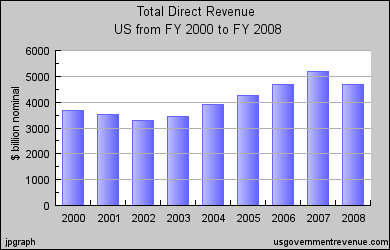
Bush’s tax cuts were passed in 2001 and 2003, and look what happened to revenues:

Did the Bush tax cuts make revenues decrease? No!

Not only that, but the unemployment rate went down to just over 4% after the tax cuts. The two wars cost about $550 billion, and we actually got national security out of it. What do we get for paying people not to work? Is it government’s job to pay people not to work? I think that charity is best done by individuals, businesses and especially churches, where we can expect some moral accountability from the recipient – some improved decision-making and personal responsibility. That’s simply lacking when government mails out checks paid for by working families and their employers.

Not every Republican is good on cutting spending, but Jeff Sessions is one of the Republican majority who opposes spending. We just just need to keep getting rid of the RINOs and Democrats, and this problem will get solved. We are never going to turn this economy around when people who think that more dependency and fewer jobs cause economic growth. They are wrong about the facts and they need to go in November.

A critical evaluation of Obama’s economic narrative, using evidence

This article is currently the most popular one on Investors Business Daily.

Excerpt:

In making his case for re-election in the face of historically high unemployment and sluggish growth, President Obama has a simple and straightforward argument.

Things were terrible when I arrived, he says, thanks to Bush-era policies of tax cuts and deregulation. We stopped the decline, but the ditch was so deep that it will take time to get out. Still, we are making progress, even if it isn’t as fast as everyone would like.

So the last thing we want to do is return to the failed Bush policies that, he says, drove us into the ditch.

That argument appears to be working. More people continue to blame Bush than Obama for the current poor state of affairs, and some surveys show that consumer confidence has recently increased.

But each part of Obama’s argument is based on claims that are not accurate…

The article lists 5 claims made by Obama, and assesses each claim against the evidence.

Here are the 5 claims:

  1. Bush tax cuts and deregulation caused the recession.
  2. I stopped a second Great Depression.
  3. My policies are working.
  4. A slow recovery was inevitable.
  5. Nobody could have done any better.

And here’s the critique of point number one: (links removed)

At a campaign rally, Obama said Romney is “just churning out the same ideas that we saw in the decade before I took office . . . the same tax cuts and deregulation agenda that helped get us into this mess in the first place.”

It’s a standard Obama talking point. But it’s not true. Bush’s tax cuts did not cause the last recession.

In fact, once they were fully in effect in 2003, they sparked stronger growth — generating more than 8 million new jobs over the next four years, and GDP growth averaging close to 3%.

Those tax cuts didn’t explode the deficit, either, as Obama frequently claims. Deficits steadily declined after 2003, until the recession hit.

Nor was Bush a deregulator. Conservative Heritage Foundation’s regulation expert James Gattuso concluded, after reviewing Bush’s record, that “regulation grew substantially during the Bush years.”

Even the Washington Post’s fact-checker, Glenn Kessler, gave Obama’s claim three out of four “Pinocchios,” saying “it is time for the Obama campaign to retire this talking point, no matter how much it seems to resonate with voters.”

What did cause the economic crisis? The housing bubble. And that, in turn, was the result of a determined federal effort to boost homeownership by, among other things, pressuring banks to lower lending standards.

Now I know that some people (like Jerry) who get their policy news from the Comedy Channel think that the Bush tax cuts made the deficits explode, but of course, deficits were shrinking until the two spendthrifts Nancy Pelosi and Harry Reid got hold of the purse strings after taking the House and Senate in 2007.

Look:

Barack Obama: Budget Deficits
Barack Obama: Budget Deficits – last GOP budget was 2007

Similarly, Obama clowns on the Comedy Channel and MSNBC also think that the Bush tax cuts made revenues go down.

Ooops:

Did the Bush tax cuts make revenues decrease? No!

You can tune into MSNBC and the Comedy Channel on any given night and see the clowns there claiming that Bush’s $160 billion deficit in 2007 is actually higher than the $450 billion deficit in 2004, after the 2.2 trillion of tax cuts were passed.

Read the whole thing, it will help you to be persuasive when discussing Obama’s rhetoric. People aren’t saying that Romney won the debate because he had “zingers”. People are saying that Romney won the debate because he had facts and evidence. 

My prescription for voters in this election is more economics, and cut back on the Comedy Channel. Democrats must all buy Thomas Sowell’s “Basic Economics” and read that all the way through. I know that graphs aren’t as entertaining as Rachel Madclown, but we all must make an effort for the sake of the prosperity of our children, and our children’s children.