Tag Archives: Economic Growth

Social conservative hero James Dobson endorses Ted Cruz

Republican Senate candidate Ted Cruz

Remember how I was freaking out about Marco Rubio from the day he announced his candidacy for the Florida Senate seat? Well, I think that Ted Cruz is another Marco Rubio. He may even eclipse Marco Rubio.

And James Dobson likes him, too.

Excerpt:

Today, we are excited to announce that national pro-life, family values leader Dr. James Dobson is endorsing our Senate campaign.

In his endorsement announcement, Dr. Dobson said: “I’m pleased to endorse Ted Cruz for U.S. Senate because he’s exactly the kind of candidate we need to turn this country around. Religious freedom is under assault every day. We need leaders with the courage to stand strong for conservative values in this battle. Ted Cruz is such a leader—one who will not only vote his convictions in the Senate, but will also lead the fight to defend life, traditional marriage, and religious liberty.”

Dr. Dobson added: “Ted Cruz stands out among conservative leaders across the country today. He has a consistent record of standing up for faith, family, and freedom, and winning values battles on a national level….I urge all Texans who love life, family, faith, and freedom to not only vote for Ted Cruz, but to work hard for his campaign.”

Here’s an interview with Ted Cruz from non other than Robert Stacy McCain!

About Ted Cruz

George Will thinks that Republican candidate Ted Cruz is the man to replace Kay Bailey Hutchison in Texas.

Excerpt:

For a conservative Texan seeking national office, it could hardly get better than this: In a recent 48-hour span, Ted Cruz, a candidate for next year’s Republican Senate nomination for the seat being vacated by Republican Kay Bailey Hutchison, was endorsed by the Club for Growth PAC, FreedomWorks PAC, talk-radio host Mark Levin and Erick Erickson of RedState.com.

For conservatives seeking reinforcements for Washington’s too-limited number of limited-government constitutionalists, it can hardly get better than this: Before he earned a Harvard law degree magna cum laude (and helped found the Harvard Latino Law Review) and clerked for Chief Justice William Rehnquist, Cruz’s senior thesis at Princeton — his thesis adviser was professor Robert George, one of contemporary conservatism’s intellectual pinups — was on the Constitution’s Ninth and 10th amendments. Then as now, Cruz argued that these amendments, properly construed, would buttress the principle that powers not enumerated are not possessed by the federal government.

Robbie George??? Robbie George??? Holy snouts! That guy is one of the top academic pro-lifers. Every Christian apologist knows about Robbie George. It’s the law! Well, it isn’t. But it should be!

I continue:

At age 14, Cruz’s father fought with rebels (including Fidel Castro) against Cuba’s dictator, Fulgencio Batista. Captured and tortured, at 18 he escaped to America with $100 sewn in his underwear. He graduated from the University of Texas and met his wife — like him, a mathematician — with whom he founded a small business processing seismic data for the oil industry.

By the time Ted Cruz was 13, he was winning speech contests sponsored by a Houston free-enterprise group that gave contestants assigned readings by Frederic Bastiat, Friedrich Hayek and Ludwig von Mises. In his early teens he traveled around Texas and out of state giving speeches. At Princeton, he finished first in the 1992 U.S. National Debate Championship and North American Debate Championship.

As Texas’s solicitor general from 2003 to 2008, Cruz submitted 70 briefs to the U.S. Supreme Court, and he has, so far, argued nine cases there. He favors school choice and personal investment accounts for a portion of individuals’ Social Security taxes. He supports the latter idea with a bow to the late Daniel Patrick Moynihan, who said such accounts enable the doorman to build wealth the way the people in the penthouse do.

Regarding immigration, Cruz, 40, demands secure borders and opposes amnesty for illegal immigrants but echoes Ronald Reagan’s praise of legal immigrants as “Americans by choice,” people who are “crazy enough” to risk everything in the fundamentally entrepreneurial act of immigrating.

Ted Cruz has Republican life experiences: legal immigrant, fought communism, studied something that required actual work, founded a small business, etc. This is the prototypical Republican!

You can find out more about him on his positions page. I was interested in his stance on social issues, in particular.

Excerpt:

Ted Cruz has fought to protect innocent human life. He played a leading role in several important cases, including defense of the partial-birth abortion ban, parental consent laws, and prohibiting state funds from going to abortion. These cases have all been part of the ongoing effort to ensure that every child in America  receives the protection and respect he or she deserves.

  • Authored an amicus brief for 13 states, successfully defending the federal Partial Birth Abortion Ban Act. The ban was upheld 5-4 before the U.S. Supreme Court;
  • Authored an amicus brief for 18 states, successfully defending the New Hampshire parental notification law. The law was upheld 9-0 before the U.S. Supreme Court [note: this brief was awarded the Best Brief Award from the National Association of Attorneys General for U.S. Supreme Court briefs written in 2005-06];
  • Successfully defended Texas’s Rider 8, which prohibits state funds for groups that provide abortions, winning unanimously before the Fifth Circuit court of appeals.

Ted Cruz has worked hard in defense of traditional marriage, including his intervention in a case protecting Texas marriage laws. In addition, he has fought on the federal level to defend marriage between one man and one woman as the fundamental building block of society.

  • When a Beaumont state court granted a divorce to two homosexual men who had gotten a civil union in Vermont, Cruz, under the leadership of Attorney General Greg Abbott, intervened in defense of the marriage laws of the State of Texas, which successfully led to the court judgment being vacated;
  • Worked with Attorney General Abbott to send a letter to Congress in support of the federal Defense of Marriage Act.

He has lots of nice actions related to lots of conservative policies on that page. What a resume! Energy production, voter fraud prevention, border security, legal firearm ownership – you name it, this guy has been fighting for conservative principles. Like Michele Bachmann, (and unlike RINO Mitt Romney), he has actually tried to do pro-life and pro-marriage things. We don’t just have to take his word for it, he has the actions to prove his words. Just look at the list of issues on his page!
What is issue 2? Should you vote no on Ohio issue 2?

In the 2010 mid-term elections, Republican John Kasich won the governorship and promised to balance the state’s budget by reining in the state’s spending on salaries and benefits for public sector union employees. To accomplish this, the Ohio legislature pass Senate Bill 5. However, an effort is on the ballot to repeal the law, and Ohio voters will get a chance to keep or scrap the law on Tuesday, November 8th, 2011.

Here’s what Ohio’s State Issue 2 is all about:

Issue 2 makes some very fair and common sense requests of our government employees to give local communities the flexibility they need to get taxes and spending under control, while providing the essential services that we rely on.

  • It allows an employee’s job performance to be considered when determining compensation, rather than just awarding automatic pay increases based only on an employee’s length of service.
  • It asks that government employees pay at least 15 percent of the cost of their health insurance premium. That’s less than half of what private sector workers are currently paying.
  • It requires that government health care benefits apply equally to all government employees, whether they work in management or non-management positions. No special favors.
  • It asks our government employees to pay their own share of a generous pension contribution, rather than forcing taxpayers to pay both the employee and employer shares.
  • It keeps union bosses from protecting bad teachers and stops the outdated practice of laying off good teachers first just because they haven’t served long enough.
  • Finally, it preserves collective bargaining for government employees, but it also returns some basic control of our schools and services to the taxpayers who fund them, not the union bosses who thrive on their mismanagement.

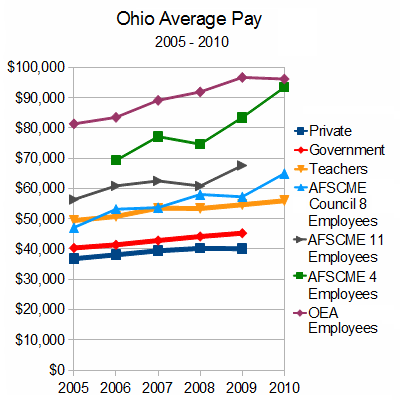
Even under the reforms of State Issue 2, Ohio’s government employees will still receive better pay, better health care and better retirement benefits, on average, than the vast majority of Ohioans who work in the private sector.

There are a number of myths going around about Issue 2, and it’s important to set the record straight, so I’ll do that below.

Ohio Average Pay: Public vs. Private
Ohio Average Pay: Public Unions vs. Private

Myths and truths about Ohio State Issue 2

Here’s a common myth:

State Issue 2 would “cut salaries and benefits.”

The truth:

Issue 2 would not cut salaries or benefits for any government employee. Employees would simply be asked to pay a modest share of their benefits, just like employees in the private sector do. For health care coverage, they would pay at least 15% of their overall plan. (Many local government employees currently pay less than 9% of their health care premium, while the average private sector worker pays upwards of 30%.) In addition, employees would be required to pay their personal share of a retirement plan (only 10%), rather than asking taxpayers to pay that share. That’s not too much to ask at a time when many private sector workers get no retirement benefit at all. Finally, Issue 2 requires that benefits apply equally to all public employees, so no one gets special treatment.

And another common myth:

State Issue 2 will eliminate government employee pensions.

The truth:

Government employees will still get a very generous pension benefit – an annual payment that averages their three highest annual salaries. That’s a pretty nice deal, when many private sector workers get no retirement benefit at all. State Issue 2 only ends a practice where some government union contracts require taxpayers to pick up the tab for BOTH the employer AND employee shares of a required pension contribution. In this economy, it’s simply not right to ask struggling taxpayers to foot the bill so government employees can get a free retirement. Issue 2 simply says government employees should pay their required share (10 percent) and taxpayers will contribute the employer share (14 percent).

Another myth:

State Issue 2 will cut teacher salaries.

The truth:

That’s one of the scare tactics government unions are using to turn people against these reforms. Nothing in Issue 2 determines salary levels. It only ends the practice of handing out automatic pay raises, or “step” increases, and longevity pay – or bonuses just for holding the job for a certain period of time. Issue 2 also asks that performance be added as a factor in teacher compensation, a goal President Barack Obama set out in his national education policy in 2009.

And another myth:

State Issue 2 will cost jobs

The truth:

Just the opposite is true. Ohio’s state and local tax burden ranks among the top third in the nation. As a result, companies large and small have left our state in pursuit of better tax incentives elsewhere, taking hundreds of thousands of jobs with them. If Ohio hopes to compete for new job growth, we have to make our state a more affordable place to live, work and do business. That starts with getting the cost of government under control so we can direct more of our limited resources into economic development, community revitalization and better schools.

More myths about Ohio State Issue 2 are corrected on this page.

Newspaper endorsements

So far, Issue 2 has been endorsed by several Ohio newspapers, including the biggest ones.

The Cleveland Plain Dealer:

The fiscal picture of local governments and school districts, especially, will improve as they are able to right-size their work forces and their expenditures on services. That will happen over time, not overnight, as new contracts are established.

Repeal SB 5, though, and it’s going to be awfully hard for local governments to manage their payrolls without resorting to larger-scale layoffs than would otherwise be necessary. And local governments will continue to be hamstrung by anti-merit seniority rules that lead to worker complacency and protect dead weight and time-servers.

Voting YES on Issue 2 will prevent layoffs by keeping public sector wages and benefits in line with what the private sector can afford to pay.

The Columbus Dispatch:

Despite the insistence of opponents, the effort to reform Ohio’s out-of-balance collective-bargaining law is not an expression of disrespect for or dissatisfaction with Ohio teachers, police officers, firefighters and other government employees. It is a much-needed attempt to restore control over public spending to the public officials elected to exercise that control.

It does not assert that public employees are worth less than the compensation they’re receiving, only that the compensation has grown faster than the public’s ability to pay for it.

[…]With more ability to control the escalation of salary and benefit costs, governments won’t be forced as often to impose layoffs, and might be able to afford to keep even more police and firefighters on the streets.

Again, no one is saying that public sector workers don’t matter – the question is whether we can afford to give them better wages and benefits than the private sector workers who are their customers and their employers. Public sector workers work for the public, and the public can only afford to pay so much.

Conclusion

Government employees are paid 43% more than private sector employees, in salary and benefits:

I think that people who care about the long-term prosperity of Ohio should vote “YES” on Issue 2 to make public and private salaries and benefits MORE EQUAL. Ohio is facing enormous economic pressure from the global recession, and everyone has to make sacrifices. Now is not the time for public sector workers to insist on higher wages and benefits, especially when the private sector workers who pay their salaries don’t make as much money, nor do they get the pensions, nor do they get the better job security. Ohio voters can certainly go back and renegotiate union salaries and benefits when Ohio is out of the recession.

Click here to learn more about Ohio State Issue 2.

Economists: Jobs outlook the worst since January 2010

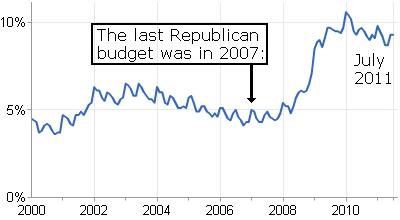
Unemployment Rate (Not seasonally adusted)

From Bloomberg Businessweek.

Excerpt:

U.S. companies’ hiring plans reflect the worst employment outlook since January 2010 as demand slows in the world’s largest economy, a private survey showed.

Fewer companies project payrolls to rise in the next six months compared with a July survey, while more plan to cut workers, the National Association for Business Economics said today in Washington. The share of firms planning to raise prices was the smallest in almost two years.

Businesses are concerned about the European debt crisis, with 30 percent of participants anticipating it will cause a decline in sales through early 2012, the survey showed. While companies said they expect the U.S. will keep expanding, they trimmed projections for the pace of growth and pared capital spending plans, helping explain why the recovery has failed to gain momentum.

“Expectations are muted,” Shawn DuBravac, chief economist at the Consumer Electronics Association in Arlington, Virginia, who analyzed the results, said in a statement. The latest survey’s “respondents remain cautiously confident.”

Within the employment outlook, 29 percent of companies said they would increase hiring, down from 43 percent in July, while 59 percent reported they plan no change in staff, a 10-point jump.

[…]The dimming outlook for employment and investment stems from the slowdown in growth. Eighty-five percent of companies surveyed said that the economy may expand 2 percent or less in the period ending this quarter compared with the final three months of 2010. In the prior survey, just one of every five economists polled predicted growth would be that slow.

The debt crisis in Europe already is hurting U.S. firms and is likely to continue, according to a special question in the latest survey, conducted between Sept. 20 and Oct. 5. Twenty percent of participants reported developments in Europe have led to as much as a 10 percent drop in sales so far this year.

This is not a surprise. Aside from signing the three free trade deals with Colombia, Panama and South Korea, the Obama administration has done everything wrong with respect to stimulating economic growth – the necessary precursor for private sector job creation.