Tag Archives: Dogma

The Becket Fund assesses Obama’s “compromise” on the contraception mandate

Eric Metaxas shared this on Facebook, so here it is.

Full text:

Facing a political firestorm, President Obama today announced his intent to make changes to a controversial rule that would require religious institutions, in violation of their conscience, to pay for contraception, sterilization, and abortifacient drugs. But this “compromise” is an exercise in obfuscation, not a good faith effort to solve the problem. Thousands of churches, religious organizations, businesses, individuals, and others will still be forced to violate their religious beliefs.

For example, the fake compromise will not help the Becket Fund’s clients Belmont Abbey College in North Carolina, Colorado Christian University, and Eternal Word Television Network (EWTN), a Catholic media organization. They will still be forced to pay for insurance that provides contraceptive coverage. The White House’s claim that “the insurance companies will pay for it” is silly. For-profit insurance companies aren’t going to donate contraceptives and abortion drugs to employees; the employer will pay for it one way or the other. More fundamentally, the Becket Fund’s clients still face the same chilling dilemma they did yesterday: choosing between helping their employees buy immoral abortion drugs or paying huge fines.

“This is a false ‘compromise’ designed to protect the President’s re-election chances, not to protect the right of conscience,” says Hannah Smith, Senior Legal Counsel for The Becket Fund. “No one should be fooled by what amounts to an accounting gimmick. Religious employers will still have to violate their religious convictions or pay heavy annual fines to the IRS.”

According to a White House “fact sheet,” some religious employers will no longer be required to provide insurance coverage for contraception, sterilization, and abortion-causing drugs; coverage for those services will instead be provided for free directly by insurance companies. This does not protect anyone’s conscience. First, the problem is helping employees get abortion drugs, not the cost of providing those drugs. Since providing insurance benefits would still help employees get insurance, religious employers still have to choose between providing health benefits that help employees get abortion drugs, and paying annual fines. Second, thousands of religious organizations self insure, meaning that they will be forced to pay directly for these services in violation of their religious beliefs. Third, it is unclear which religious organizations are permitted to claim the new exemption, and whether it will extend to for-profit organizations, individuals, or non-denominational organizations.

“It is especially telling that the details of this fake ‘compromise’ will likely not be announced until after the election,” said Smith. “Religious freedom is not a political football to be kicked around in an election-year. Rather than providing full protection for the right of conscience, President Obama has made a cynical political play that is the antithesis of ‘hope and change.’”

My previous post in which I chastised the Roman Catholic bishops for supporting Obamacare is here.

Obama revises contraception mandate but Catholic groups still pay for abortion drugs

Life News explains.

Excerpt:

The Obama administration has revised its controversial mandate that had forced religious employers to pay for health insurance coverage that includes birth control and drugs like Plan B, the morning after pill, and ella that can cause abortions.

Responding to a firestorm of opposition from pro-life organizations, Catholics groups and even some Democrats, the Obama administration has revised the mandate in a way that pro-life advocates are saying is even worse.

The revised Obama mandate will make religious groups contract with insurers to offer birth control and the potentially abortion-causing drugs to women at no cost. The revised mandate will have religious employers refer women to their insurance company for coverage that still violates their moral and religious beliefs. Under this plan, every insurance company will be obligated to provide coverage at no cost.

Essentially, religious groups will still be mandated to offer plans that cover both birth control and the ella abortion drug.

According to Obama administration officials on a conference call this morning, a woman’s insurance company “will be required to reach out directly and offer her contraceptive care free of charge. The religious institutions will not have to pay for it.”

The birth control and abortion-causing drugs will simply be “part of the bundle of services that all insurance companies are required to offer,” White House officials said.

“We are actually more comfortable having the insurance industry offer and market this to women than religious institutions,” the White House said on the conference call LifeNews listened to because they “understand how contraception works” and it “makes sense financially.”

[…]Republican Study Committee Chairman Jim Jordan told LifeNews in response to the revised mandate that it violates the right to religious freedom guaranteed by the First Amendment to the Constitution.

“This ObamaCare rule still tramples on Americans’ First Amendment right to freedom of religion. It’s a fig leaf, not a compromise. Whether they are affiliated with a church or not, employers will still be forced to pay an insurance company for coverage that includes abortion-inducing drugs,” he said. “This is not just a problem for church-affiliated hospitals and charities. Under these rules, a small business owner with religious objections to abortion-inducing drugs and contraception must either violate his religious beliefs or violate the law.”

“The liberal Obama administration thinks its political goals trump the religious faith of American citizens. That isn’t right, fair, or constitutional,” he said.

The abortions will still be paid for by the religious groups. They are going to pay for the drugs through medical insurance premiums. So religious organizations are still being forced to provide abortions for their workers.

Who is to blame for this? I blame Catholic bishops. Catholic bishops do believe in socialism. They do want a secular government to take money from religious people. And they do want government to hand out medical care to people, instead of letting individuals, businesses and charities provide health care.

Rick Santorum agrees with me on this.

Consider this interview with Rick Santorum in which he reacts Obama’s health care mandate.

Excerpt:

HH: Now I want to talk to you about two substantive issues, Senator Santorum. The first are these new regulations from the Obama administration. I read the letter from Archbishop Olmstead of Phoenix on the air. Archbishop Jose Gomez of Los Angeles has written a new article in First Things. It’s shocking, actually, what’s going on. Should this be a centerpiece of whoever the nominee’s campaign is?

RS: I talked about it in every speech I’ve given today. And here’s what I said, though, Hugh. I said that I took issue with the Catholic Bishops Conference, because Hugh, you may remember, they embraced Obamacare.

HH: Yes.

RS: They embraced it and said…here’s what I said to them. Be careful when you have government saying that they can give you rights, that you have a right to health care, and government’s going to give you something, because once you are now dependant on government, they, not only can they take that right away, they can tell you how to exercise that right, and you can either like it or not. And that’s the problem. That’s what the Catholic Bishops Conference didn’t get, that there’s no free lunch here, folks. If you’re going to give people secular power, then they’re going to use it in a secular fashion. And that’s why, you know, I hate to say it, but you know, you had it coming. And it’s time to wake up and realize that government isn’t the answer to the social ills. It’s people of faith, and it’s families, and it’s communities, and it’s charities that need to do this as it has in America so successfully for so long.

HH: Rick Santorum, what do you advise Catholic hospitals, Catholic colleges, Catholic…the centers of poverty assistance, the adoption agencies? What do you advise them to do in the face of, as Archbishop Olmstead said, we cannot comply with this unjust law?

RS: Civil disobedience. This will not stand. There’s no way they can make this stand. The Supreme Court, eventually, this thing’s going to get to the Supreme Court just like the ministerial hiring issue that was just decided by the Supreme Court the other day. And it was a 9-0 decision that said the Obama administration can’t roll over people of faith when it comes to hiring. Yet in the face of that decision, this radical, secular government of Barack Obama continues to have faith be the least important of the 1st Amendment. And I just think they fight. They fight in the courts, and they fight by civil disobedience, and go to war with the federal government over this one.

Evangelical protestants feel comfortable with Catholics like Rick Santorum. He gets it. If the bishops are wrong on socialized medicine and wrong on the death penalty and wrong on other things, then so much the worse for the bishops.

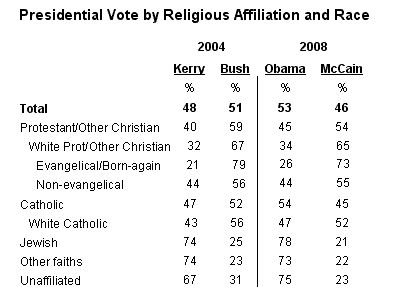
Obama did very well with Catholics in 2008 even though Obama is the most pro-abortion president in the history of the United States. Catholics tend to be more liberal on economic issues than evangelicals, which is why many of them voted for Obama. Evangelicals oppose economic liberalism, because they oppose government taking tax money from workers in order to provide services for other people aren’t trying to be self-sufficient. Evangelicals oppose increasing the dependence of individuals on a secular government. Evangelicals don’t want a secular government to take money from individuals and then use it to push secular leftist ideas like global warming, Darwinism and sex education in government run institutions, e.g. – public schools, public broadcasting, etc. Evangelicals trust individuals to care for the poor, and they don’t want to make it too easy for people to make reckless decisions and then get a check in the mail or a free abortion.

What causes this difference between Catholics and evangelicals? Evangelicals believe in salvation through grace ALONE through faith ALONE in Christ ALONE. Evangelicals put the emphasis on what you believe – it has to be true in order to please God. Catholics, just like Mormons, Jews and other religions, emphasize good works as a requirement for salvation. Many Catholics also support inclusivism, which is the view that you can be saved in other religions like Judaism and Islam. This means that for these Catholics, specific Christian doctrines are not essential for salvation, so long as you have sincerity and good works. On the other hand, evangelicals are exclusivists who emphasize the need for each person to arrive at true beliefs about God in order to be saved, and good works are just natural outworkings of their beliefs.

Evangelicals emphasize the responsibility of the individual to discover truth with their Bibles, reasoning, science and history. This belief in individual responsibility carries over into their approach to charity. Evangelicals believe individuals are responsible for deciding what to do about charity – you earn your own money and then you choose yourself how to share with others. But the responsibility to give away money wisely is an individual responsibility – you share your money in a way that is consistent with your beliefs. Evangelicals don’t generally accept the idea of handing money off to someone else and letting them decide what to do with it. We think that everything is our responsibility, starting with Bible study and theology, and going on through to economics and politics.

And this emphasis on individuals over big government has this effect:
(Source)

Note that this chart puts evangelicals together with born-again Christians. But evangelical Christians differ from born-again Christians, because they are firm on exclusive salvation and evangelism. Evangelicals like to study so that they can discuss their beliefs in public, using reasons and evidence to persuade others. A born-again Christian does not have that same emphasis on study and persuasion, because they don’t focus on evangelism. So, if you separate out the born-agains from that 26%, number for Obama support, then you are likely to get a much lower number for evangelicals who support Obama. We don’t like health care mandates covering abortion. Evangelicals are used to having to puzzle things out for themselves – so they puzzled out what Obama believed and then they voted against him.

MIT physicist explains the challenge of cosmic fine-tuning for naturalism

Here’s the article from Harper’s magazine. The MIT physicist says that the fine-tuning is real, and is best explained by positing the existence of an infinite number of universes that are not fine-tuned – the so-called multiverse.

Excerpt:

While challenging the Platonic dream of theoretical physicists, the multiverse idea does explain one aspect of our universe that has unsettled some scientists for years: according to various calculations, if the values of some of the fundamental parameters of our universe were a little larger or a little smaller, life could not have arisen. For example, if the nuclear force were a few percentage points stronger than it actually is, then all the hydrogen atoms in the infant universe would have fused with other hydrogen atoms to make helium, and there would be no hydrogen left. No hydrogen means no water. Although we are far from certain about what conditions are necessary for life, most biologists believe that water is necessary. On the other hand, if the nuclear force were substantially weaker than what it actually is, then the complex atoms needed for biology could not hold together. As another example, if the relationship between the strengths of the gravitational force and the electromagnetic force were not close to what it is, then the cosmos would not harbor any stars that explode and spew out life-supporting chemical elements into space or any other stars that form planets. Both kinds of stars are required for the emergence of life. The strengths of the basic forces and certain other fundamental parameters in our universe appear to be “fine-tuned” to allow the existence of life. The recognition of this fine­tuning led British physicist Brandon Carter to articulate what he called the anthropic principle, which states that the universe must have the parameters it does because we are here to observe it. Actually, the word anthropic, from the Greek for “man,” is a misnomer: if these fundamental parameters were much different from what they are, it is not only human beings who would not exist. No life of any kind would exist.

If such conclusions are correct, the great question, of course, is why these fundamental parameters happen to lie within the range needed for life. Does the universe care about life? Intelligent design is one answer. Indeed, a fair number of theologians, philosophers, and even some scientists have used fine-tuning and the anthropic principle as evidence of the existence of God. For example, at the 2011 Christian Scholars’ Conference at Pepperdine University, Francis Collins, a leading geneticist and director of the National Institutes of Health, said, “To get our universe, with all of its potential for complexities or any kind of potential for any kind of life-form, everything has to be precisely defined on this knife edge of improbability…. [Y]ou have to see the hands of a creator who set the parameters to be just so because the creator was interested in something a little more complicated than random particles.”

Intelligent design, however, is an answer to fine-tuning that does not appeal to most scientists. The multiverse offers another explanation. If there are countless different universes with different properties—for example, some with nuclear forces much stronger than in our universe and some with nuclear forces much weaker—then some of those universes will allow the emergence of life and some will not. Some of those universes will be dead, lifeless hulks of matter and energy, and others will permit the emergence of cells, plants and animals, minds. From the huge range of possible universes predicted by the theories, the fraction of universes with life is undoubtedly small. But that doesn’t matter. We live in one of the universes that permits life because otherwise we wouldn’t be here to ask the question.

I thought I was going to have to go outside this article to refute the multiverse, but Lightman is honest enough to refute it himself:

The… conjecture that there are many other worlds… [T]here is no way they can prove this conjecture. That same uncertainty disturbs many physicists who are adjusting to the idea of the multiverse. Not only must we accept that basic properties of our universe are accidental and uncalculable. In addition, we must believe in the existence of many other universes. But we have no conceivable way of observing these other universes and cannot prove their existence. Thus, to explain what we see in the world and in our mental deductions, we must believe in what we cannot prove.

Sound familiar? Theologians are accustomed to taking some beliefs on faith. Scientists are not. All we can do is hope that the same theories that predict the multiverse also produce many other predictions that we can test here in our own universe. But the other universes themselves will almost certainly remain a conjecture.

The multiverse is not pure nonsense, it is theoretically possible. The problem is that the multiverse generator itself would require fine-tuning, and, as Lightman indicates, we have no independent experimental evidence for the existence of the multiverse. Atheists just have to take it on faith, and hope that their speculations will be proved right. Meanwhile, the fine-tuning is just as easily explained by postulating God, and we have independent evidence for God’s existence, like from the cosmological argument, the moral argument, and so on.

We need to be frank about atheists and their objections to the progress of science. Within the last 100 years, we have discovered that the physical universe came into being out of nothing 15 billion years ago, and we have discovered that this one universe is fine-tuned for intelligent life. Atheists are 100 years out of date, and they are hoping that all of this 100 years of progress will be overturned, so that they can go back to their comfortable belief that the universe is eternal and that the parameters of this universe are undesigned.

While I was listening the Dennis Prager show, an atheist caller called Prager and asserted that atheism was true because he has a happy life as an atheist. And I think that’s what atheism is. They believe that God, if he exists, should have the goal of making them happy. And if they are already happy, then why would they care about whether there is a God out there who might ask them to do things (like not kill babies) which might make them unhappy?

Atheists don’t care about science as something that determines what they should or should not believe. If science proves that they are accountable to God, then they invent speculations and hope in those speculations against the science – as with the multiverse or the aliens seeding the Earth with life or the unobservable, untestable hyper-universe that spawned this universe.

To see these arguments examined in a debate with a famous atheist, simply watch the debate between William Lane Craig and Christopher Hitchens, and judge which debater is willing to form his beliefs on scientific progress, and which debater is forming his beliefs against the science we have today, and hoping that the good science we have today based on experiments will be overturned by speculative theories at some point in the future. When you watch that debate, it becomes very clear that Christian theists are interested in conforming their beliefs to science, and atheists are very interested in speculating against what science has shown in order to promote their own happiness. Whatever standard of morality they invent for themselves has to be self-made, so that they can satisfy it merely by doing whatever they feel like doing. And if science shows that the universe doesn’t conform to invented morality, because it is designed, then atheists just say “so much the worse for science”.

Just to re-cap, we’ve had peer-reviewed scientific publications in the last month that have made the illusion of naturalism even less likely, in the areas of the fossil record and the origin of life. And we now have the Borde-Vilenkin-Guth theorem, showing that any cosmology that features an expanding universe will have a beginning. The progress of science marches on against atheism, in virtually every area, and all we see from the likes of Richard Dawkins is the complete refusal to engage in debates with theists about the evidence. So who is anti-science now?

Positive arguments for Christian theism