Here’s the article from Harper’s magazine. The MIT physicist says that the fine-tuning is real, and is best explained by positing the existence of an infinite number of universes that are not fine-tuned – the so-called multiverse.
Excerpt:
While challenging the Platonic dream of theoretical physicists, the multiverse idea does explain one aspect of our universe that has unsettled some scientists for years: according to various calculations, if the values of some of the fundamental parameters of our universe were a little larger or a little smaller, life could not have arisen. For example, if the nuclear force were a few percentage points stronger than it actually is, then all the hydrogen atoms in the infant universe would have fused with other hydrogen atoms to make helium, and there would be no hydrogen left. No hydrogen means no water. Although we are far from certain about what conditions are necessary for life, most biologists believe that water is necessary. On the other hand, if the nuclear force were substantially weaker than what it actually is, then the complex atoms needed for biology could not hold together. As another example, if the relationship between the strengths of the gravitational force and the electromagnetic force were not close to what it is, then the cosmos would not harbor any stars that explode and spew out life-supporting chemical elements into space or any other stars that form planets. Both kinds of stars are required for the emergence of life. The strengths of the basic forces and certain other fundamental parameters in our universe appear to be “fine-tuned” to allow the existence of life. The recognition of this finetuning led British physicist Brandon Carter to articulate what he called the anthropic principle, which states that the universe must have the parameters it does because we are here to observe it. Actually, the word anthropic, from the Greek for “man,” is a misnomer: if these fundamental parameters were much different from what they are, it is not only human beings who would not exist. No life of any kind would exist.
If such conclusions are correct, the great question, of course, is why these fundamental parameters happen to lie within the range needed for life. Does the universe care about life? Intelligent design is one answer. Indeed, a fair number of theologians, philosophers, and even some scientists have used fine-tuning and the anthropic principle as evidence of the existence of God. For example, at the 2011 Christian Scholars’ Conference at Pepperdine University, Francis Collins, a leading geneticist and director of the National Institutes of Health, said, “To get our universe, with all of its potential for complexities or any kind of potential for any kind of life-form, everything has to be precisely defined on this knife edge of improbability…. [Y]ou have to see the hands of a creator who set the parameters to be just so because the creator was interested in something a little more complicated than random particles.”
Intelligent design, however, is an answer to fine-tuning that does not appeal to most scientists. The multiverse offers another explanation. If there are countless different universes with different properties—for example, some with nuclear forces much stronger than in our universe and some with nuclear forces much weaker—then some of those universes will allow the emergence of life and some will not. Some of those universes will be dead, lifeless hulks of matter and energy, and others will permit the emergence of cells, plants and animals, minds. From the huge range of possible universes predicted by the theories, the fraction of universes with life is undoubtedly small. But that doesn’t matter. We live in one of the universes that permits life because otherwise we wouldn’t be here to ask the question.
I thought I was going to have to go outside this article to refute the multiverse, but Lightman is honest enough to refute it himself:
The… conjecture that there are many other worlds… [T]here is no way they can prove this conjecture. That same uncertainty disturbs many physicists who are adjusting to the idea of the multiverse. Not only must we accept that basic properties of our universe are accidental and uncalculable. In addition, we must believe in the existence of many other universes. But we have no conceivable way of observing these other universes and cannot prove their existence. Thus, to explain what we see in the world and in our mental deductions, we must believe in what we cannot prove.
Sound familiar? Theologians are accustomed to taking some beliefs on faith. Scientists are not. All we can do is hope that the same theories that predict the multiverse also produce many other predictions that we can test here in our own universe. But the other universes themselves will almost certainly remain a conjecture.
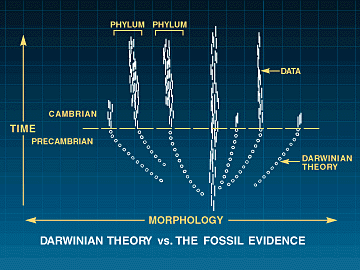
The multiverse is not pure nonsense, it is theoretically possible. The problem is that the multiverse generator itself would require fine-tuning, so the multiverse doesn’t get rid of the problem. And, as Lightman indicates, we have no independent experimental evidence for the existence of the multiverse in any case. Atheists just have to take it on faith, and hope that their speculations will be proved right. Meanwhile, the fine-tuning is just as easily explained by postulating God, and we have independent evidence for God’s existence, like the the origin of biological information, the sudden appearance of animal body plans, the argument from consciousness, and so on. Even if the naturalists could explain the fine-tuning, they would still have a lot of explaining to do. Theism (intelligent causation) is the simplest explanation for all of the things we learn from the progress of science.
We need to be frank about atheists and their objections to the progress of science. Within the last 100 years, we have discovered that the physical universe came into being out of nothing 15 billion years ago, and we have discovered that this one universe is fine-tuned for intelligent life. I don’t think it’s like that the last 100 years of scientific progress on the origins question are going to be overturned so that science once again affirms what atheists believe about the universe. Things are going the wrong way for atheists – at least with respect to science.
See it in action
To see these arguments examined in a debate with a famous atheist, simply watch the debate between William Lane Craig and Christopher Hitchens, and judge which debater is willing to form his beliefs on scientific progress, and which debater is forming his beliefs against the science we have today, and hoping that the good science we have today based on experiments will be overturned by speculative theories at some point in the future. When you watch that debate, it becomes very clear that Christian theists are interested in conforming their beliefs to science, and atheists are very interested in speculating against what science has shown in order to maintain their current pre-scientific view. That’s not what rational people ought to do when confronted with evidence.
Positive arguments for Christian theism
Be effective and influential:

 WINTERY KNIGHT