Tag Archives: Debt

Bank run in socialist Europe begins

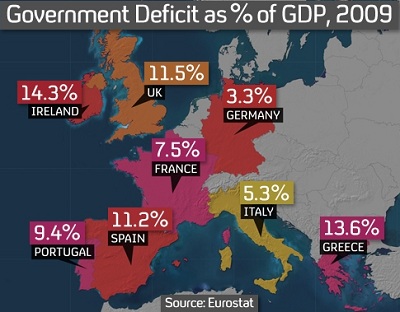
Europe: Annual Budget Deficit as % of GDP

From CNBC.

Excerpt:

Money-market funds in the United States have quite dramatically slammed shut their lending windows to European banks. According to the Economist, Fitch estimates U.S. money market funds have withdrawn 42 percent of their money from European banks in general.

And for France that number is even higher — 69 percent. European money-market funds are also getting in on the act.

Bond issuance by banks has seized up because buyers have gone on strike.

From the Economist’s Free Exchange Blog:

In the third quarter bonds issues by European banks only reached 15 percent of the amount they raised over the same period in the past two years, reckon analysts at Citi Group. It is unlikely that European banks have sold many more bonds since.

Corporate depositors are also pulling their cash.

Free Exchange:

“We are starting to witness signs that corporates are withdrawing deposits from banks in Spain, Italy, France and Belgium,” an analyst at Citi Group wrote in a recent report. “This is a worrying development.”

And there are troubling signs that banks are even running out of collateral to back their borrowings from the European Central Bank .

So far the liquidity of the European Central Bank (ECB) has kept the system alive. Only one large European bank, Dexia, has collapsed because of a funding shortage. Yet what happens if banks run out of collateral to borrow against?

And from the leftist New York Times.

Excerpt:

The flight from European sovereign debt and banks has spanned the globe. European institutions like the Royal Bank of Scotland and pension funds in the Netherlands have been heavy sellers in recent days. And earlier this month, Kokusai Asset Management in Japan unloaded nearly $1 billion in Italian debt.

At the same time, American institutions are pulling back on loans to even the sturdiest banks in Europe. When a $300 million certificate of deposit held by Vanguard’s $114 billion Prime Money Market Fund from Rabobank in the Netherlands came due on Nov. 9, Vanguard decided to let the loan expire and move the money out of Europe. Rabobank enjoys a AAA-credit rating and is considered one of the strongest banks in the world.

American money market funds, long a key supplier of dollars to European banks through short-term loans, have also become nervous. Fund managers have cut their holdings of notes issued by euro zone banks by $261 billion from around its peak in May, a 54 percent drop, according to JPMorgan Chase research.

This is really disturbing. I wonder if any of my economics-minded commenters can explain to me what happens when there is a run on banks. I am guessing that there will be some rioting over benefits as austerity measures are imposed, and interest rates will go up.

Real greed is when adults force children to give them a bailout from debt

This is a must-read by Mark Steyn.

Excerpt:

While President Obama was making his latest pitch for a brand new, even more unsustainable entitlement at the health care “summit,” thousands of Greeks took to the streets to riot. An enterprising cable network might have shown the two scenes on a continuous split screen – because they’re part of the same story. It’s just that Greece is a little further along in the plot: They’re at the point where the canoe is about to plunge over the falls. America is further upstream and can still pull for shore, but has decided instead that what it needs to do is catch up with the Greek canoe. Chapter One (the introduction of unsustainable entitlements) leads eventually to Chapter 20 (total societal collapse): The Greeks are at Chapter 17 or 18.

What’s happening in the developed world today isn’t so very hard to understand: The 20th century Bismarckian welfare state has run out of people to stick it to. In America, the feckless insatiable boobs in Washington, Sacramento, Albany and elsewhere are screwing over our kids and grandkids. In Europe, they’ve reached the next stage in social democratic evolution: There are no kids or grandkids to screw over. The United States has a fertility rate of around 2.1, or just over two kids per couple. Greece has a fertility rate of about 1.3: 10 grandparents have six kids have four grandkids – i.e., the family tree is upside down. Demographers call 1.3 “lowest-low” fertility – the point from which no society has ever recovered. And compared to Spain and Italy, Greece has the least worst fertility rate in Mediterranean Europe.

So you can’t borrow against the future because, in the most basic sense, you don’t have one. Greeks in the public sector retire at 58, which sounds great. But, when 10 grandparents have four grandchildren, who pays for you to spend the last third of your adult life loafing around?

By the way, you don’t have to go to Greece to experience Greek-style retirement: The Athenian “public service” of California has been metaphorically face-down in the ouzo for a generation. Still, America as a whole is not yet Greece. A couple of years ago, when I wrote my book “America Alone,” I put the Social Security debate in a bit of perspective: On 2005 figures, projected public pensions liabilities were expected to rise by 2040 to about 6.8 percent of GDP. In Greece, the figure was 25 percent. In other words, head for the hills, Armageddon, outta here, The End. Since then, the situation has worsened in both countries. And really the comparison is academic: Whereas America still has a choice, Greece isn’t going to have a 2040 – not without a massive shot of Reality Juice.

Is that likely to happen? At such moments, I like to modify Gerald Ford. When seeking to ingratiate himself with conservative audiences, President Ford liked to say: “A government big enough to give you everything you want is big enough to take away everything you have.” Which is true enough. But there’s an intermediate stage: A government big enough to give you everything you want isn’t big enough to get you to give any of it back. That’s the point Greece is at. Its socialist government has been forced into supporting a package of austerity measures. The Greek people’s response is: Nuts to that. Public sector workers have succeeded in redefining time itself: Every year, they receive 14 monthly payments. You do the math. And for about seven months’ work – for many of them the workday ends at 2:30 p.m. When they retire, they get 14 monthly pension payments. In other words: Economic reality is not my problem. I want my benefits. And, if it bankrupts the entire state a generation from now, who cares as long as they keep the checks coming until I croak?

We hard-hearted, small-government guys are often damned as selfish types who care nothing for the general welfare. But, as the Greek protests make plain, nothing makes an individual more selfish than the socially equitable communitarianism of big government. Once a chap’s enjoying the fruits of government health care, government-paid vacation, government-funded early retirement, and all the rest, he couldn’t give a hoot about the general societal interest. He’s got his, and to hell with everyone else. People’s sense of entitlement endures long after the entitlement has ceased to make sense.

The perfect spokesman for the entitlement mentality is the deputy prime minister of Greece. The European Union has concluded that the Greek government’s austerity measures are insufficient and, as a condition of bailout, has demanded something more robust. Greece is no longer a sovereign state: It’s General Motors, and the EU is Washington, and the Greek electorate is happy to play the part of the United Auto Workers – everything’s on the table except anything that would actually make a difference. In practice, because Spain, Portugal, Italy and Ireland are also on the brink of the abyss, a “European” bailout will be paid for by Germany. So the aforementioned Greek deputy prime minister, Theodoros Pangalos, has denounced the conditions of the EU deal on the grounds that the Germans stole all the bullion from the Bank of Greece during the Second World War. Welfare always breeds contempt, in nations as much as inner-city housing projects. How dare you tell us how to live! Just give us your money and push off.

This is the real character of people who avoid having to care about producing goods and services to please customers – people who join public sector unions and work for the government. They elect candidates who will provide them with a standard of living much higher than what they can produce by their own efforts, and pass the bill down to real workers in the private sector, or worse, workers who are not even born. It’s a shame. It’s a shame that parasites should enslave children who are not yet born so that they can have a standard of living they haven’t paid for. And it’s laughable that they impugn the character of productive private sector workers and business owners by talking about “Greed”. The parasites in the public sector unions are the greedy ones. What could be more greedy than intergenerational theft?

Conservatives defeat socialists by a landslide in Spain election

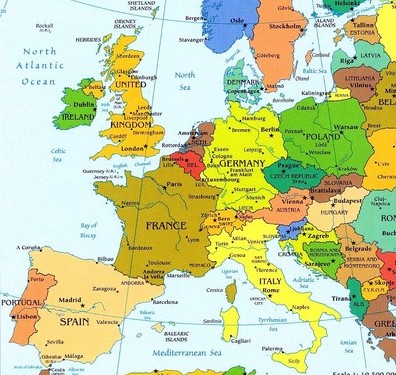
Political Map of Europe

The UK Telegraph explains.

Excerpt:

With almost 98 per cent of the vote counted the Popular Party won 186 seats in the 350 seat congress garnering a strong mandate to push through further austerity measures in an attempt to turn around an economy that risks being engulfed by the sovereign debt crisis.

[…]The socialists suffered their biggest defeat since Spain became a democracy more than 30 years ago, punished by an electorate for their perceived bungling of the economic crisis that has left 5 million unemployed.

[…]Alfredo Perez Rubalcaba, 60, the prime ministerial candidate who took the helm of the PSOE when Jose Luis Rodriguez Zapatero said he would not seek a third term, conceded defeat after the party won just 110 seats down from 169 in 2008.

“The Socialist Party did not have a good result. We clearly lost the elections,” he told party faithful in Madrid.

The conservatives won roughly 44 per cent of the votes and the Socialists took 29 per cent, according to official election results.

The Wall Street Journal analyzes the election result.

Excerpt:

Formerly a solid growth engine for the region’s economy, Spain today is grappling with a burst housing bubble, a 21% unemployment rate and borrowing costs near levels that triggered the international bailouts of several fiscally frail euro-zone peers.

Analysts said the election of Mariano Rajoy, the conservative leader who has committed to austerity and economic overhauls, could help improve investor sentiment toward Spain, but won’t fundamentally change perceptions that Spain and other peripheral nations are risky investments. For that, they said, European Union institutions will have to extend more support, possibly by converting the European Central Bank into a lender of last resort.

[…]The groundswell of support for Mr. Rajoy is chiefly the result of a deep economic crisis that has forced Socialist Prime Minister José Luis Rodríguez Zapatero to make unpopular budget cuts and economic overhauls. Earlier this year, Mr. Zapatero said he wouldn’t seek re-election and his party chose the veteran Mr. Pérez Rubalcaba to succeed him.

Analysts said the fact that change in Spain was coming via the ballot box was another sign of a better track record on governance, which has helped to keep Spanish borrowing costs below those of its fiscally frail peers.

Although Mr. Zapatero lacked a parliamentary majority, he was able to deliver all the measures he promised last year, including a public-sector wage cut, a pension freeze and a labor-market overhaul.

As a result, a clear victory for Mr. Rajoy, who has promised to take overhauls much further than his Socialist rivals, is widely expected to shore up confidence in the Spanish economy inside and outside the country.

Many recall the Popular Party-led governments of José María Aznar of 1996-2004 for their far-reaching moves that helped set the stage for a lengthy economic boom. Mr. Rajoy headed various ministries during that time.

At a polling station in Madrid’s Chamberí district, 18-year-old engineering student Diego Cubero said he had voted for the first time and chosen the Popular Party.

This is the end of a huge mistake made by the Spanish people in 2004 when they elected the socialists. Never, ever, ever elect socialists unless you want your economy to end up like Greece. That’s what socialists do to economies.