Tag Archives: Debt

Obama’s irresponsible student loan policies leave taxpayers with trillion-dollar bubble

President Obama's student loan bubble
President Obama’s student loan bubble

This is from Investors Business Daily.

It says:

In 2010, Obama eliminated the federal guaranteed loan program, which let private lenders offer student loans at low interest rates. Now, the Department of Education is the only place to go for such loans.

Obama sold this government takeover as a way to save money — why bear the costs of guaranteeing private loans, he said, when the government could cut out the middleman and lend the money itself?

The cost savings didn’t happen. In fact, the Congressional Budget Office just increased its 10-year forecast for the loan program’s costs by $27 billion, or 30%.

What did happen was an explosive growth in the amount of federal student loan debt. President Clinton phased in direct federal lending in 1993 as an option, but over the next 15 years the amount of loans was fairly stable. The result of Obama’s action is striking. In each of the past six years, federal direct student loan debt has climbed by more than $100 billion. (See chart.)

And since Obama keeps making it easier and easier to avoid repaying those loans, it’s a problem that taxpayers will eventually have to shoulder.

Through words and actions, Obama has encouraged irresponsibility on the part of student borrowers. He constantly talks as if student debt were an unfair burden they unknowingly had foisted upon them.

At the same time, he’s made it easier and easier to avoid paying back student loans in full. Earlier this year, for example, Obama expanded eligibility for his “pay as you earn” program, which limits loan payments to 10% of income, with any debt left after 20 years forgiven.

Students got the message. The St. Louis Fed reports that 27.3% of student loans in repayment are at least a month behind in payments. That’s a far higher delinquency rate than any other kind of debt, and it’s significantly higher than the delinquency rate 10 years ago.

“This overall level of delinquency is very concerning,” concluded authors Juan Sanchez and Lijin Zhu.

A 2013 Consumer Financial Protection Board report found that less than half of this federal loan money was actually being paid. About 30% was held by borrowers still in school or in a grace period, another chunk in deferment or forbearance, and almost 14% was in default.

The problem here is that whenever the government nationalizes something that the private sector is doing, it always creates a problem. Let me explain. If student loans (or mortgage loans) are run solely by the private sector, then the motivation for lending money out at interest is to make money for the bank’s depositors and investors. In other words, because the bankers are in a free market and have to compete for depositors and investors, they have an interest in making sure that the loans they make get paid back.

But when the government takes over loans, they are not interested in being wise with the money they lend out – it’s not their money. They want to lend out as much as possible today in order to buy votes, and then kick the can down the road on the repayment. So instead of being careful about asking “will this get paid back?” they ask “how can I borrow from the future in order to buy as many votes as I can right now?” And that’s how we got the housing crisis of 2008, as well as this trillion-dollar student loan crisis.

When you take the profit motive out of the lending decision, then money gets lend to people who will never be able to pay it back. No private bank that has to answer to shareholders hands out money to students who want to study underwater basket-weaving. But the government does. They want to buy as many votes as possible. And besides, this is not their money. They are borrowing it from the future earnings of the very students they are giving it to! That’s what happens when you let big government decide everything.

Whenever big government politicians want to buy votes with taxpayer money, they always sell it to the people with sob stories about some poor, helpless group of people will suffer through no fault of their own. There are a lot of voters who will vote for politicians who cry crocodile tears for them, especially ones who don’t understand economics. There is no free lunch – somebody has to pay. Democrats are basically throwing a party for students, and then mailing them the (unexpected) bill for it, with interest.
Is Obama’s economy as good as the mainstream media are telling us?

This article from CNS News was tweeted by GOP presidential candidate Carly Fiorina.

The economy is not good
This economy is not good (click for larger image)

It says:

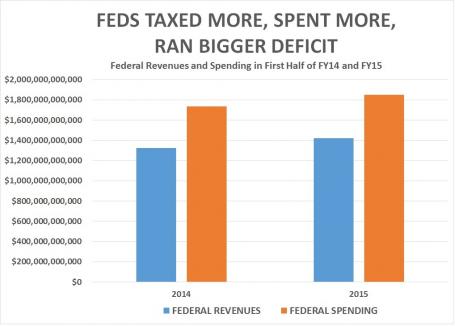
The federal government taxed away more money, spent more money and ran a bigger deficit in the first half of fiscal 2015 than it did in the first half of fiscal 2014, according to the Congressional Budget Office.

“The federal government ran a budget deficit of $430 billion for the first half of fiscal year 2015, CBO estimates–$17 billion more than the shortfall recorded in the same span last year,” the CBO said in its Monthly Budget Review for March 2015, which was published April 8. “Both revenues and outlays were about 7 percent higher than the amounts recorded in the first six months of fiscal year 2014.”

Keep in mind that these deficit numbers are for half a year. In 2007, George W. Bush was running a deficit of $160 billion for an entire year.

And we’re being taxed more, too:

The biggest source of additional tax revenue for the federal government was the individual income tax. In the first six months of fiscal 2014, Americans paid the federal government approximately $585,000,000,000 in individual income taxes. In the first six months of fiscal 2015, Americans paid $642,000,000,000 in individual income taxes—an increase of $57 billion (or 9.7 percent) from fiscal 2014.

What’s the long-term forecast?

The Wall Street Journal has it:

Question: “How close are we from seeing entitlement programs like Medicare, Medicaid, and Social Security come into direct conflict with defense spending priorities? Defense spending is almost 20% of the Fed budget and nearly 60% of discretionary spending. Current cost of health care and an aging population are strong indicators this could happen sooner than later.”

Zumbrun: “I’d say we’re already seeing it now. As Nick noted above, the CBO projects that mandatory spending and spending on interest will climb, but that defense and nondefense discretionary spending will be squeezed. Anyone who doesn’t want to see that happen in the next decade needs some combination of higher revenue, much faster economic growth, or cuts to entitlement programs.

“The budget deal known as sequestration squeezed down both defense and non-defense discretionary spending. If, instead, everyone agreed it was okay to cut entitlements (which they obviously don’t), you wouldn’t have needed to squeeze that down. So I think it’s fair to say these things are already in conflict.”

Question: “Debt as long as partnered with productivity is no problem. From the looks of it, the U.S. might fall as an economy, but is now the time?”

Timiraos: “That’s a good point. One thing that’s a little bit troubling, however, is that estimates of the potential output of the U.S. economy have been revised down. What does that mean exactly? Instead of growing at a 2.7% rate from 2014-18, it now says the economy will grow at a 2.5% rate. That doesn’t sound too bad, but over time, it adds up.”

Question: “The U.S. has so far been capable of keeping its cost of borrowing at a remarkably low level. What about in the long term where it seems likely that servicing the debt will eat up a larger and larger percentage of government expenditures in an age of slowing growth?”

Zumbrun: “There’s actually decent reason to believe that if the economy slows down a lot then interest rates will stay very low. That’s basically the situation in Japan, right? They’re mired in decades of low growth, driven by aging demographics and a central bank that was really timid for a long time, but as a result of their permanently stagnant economy, interest rates are incredibly low. In the U.S., one scenario like this is known as secular stagnation.

Wow, if our economy starts to look like Japan, that will not be good. They have massive deficits, zero economic growth and a looming demographic crisis (few young workers, many older retirees). It’s a very bad situation that’s being masked by low interest rates and massive, massive borrowing.

The Brookings Institute agrees

Lest you think that this is just the conservative take on this, here’s the leftist Brookings Institute, writing about it just last week.

They say:

Debt figures tell part of the story. When the Great Recession hit, the federal debt was equal to about 40 percent of GDP. But to fight the recession, Congress enacted an $800 billion dollar stimulus bill. Stimulus spending, combined with already enacted spending and tax policy, resulted in four years of trillion dollar deficits. As a result, the debt ballooned to 78 percent of GDP in 2013, almost twice the pre-recession level. The annual deficit is now declining at a stately pace, but by 2016 it will begin increasing again, and by 2020 under CBO’s alternative fiscal scenario, we will once again return to annual deficits above a trillion dollars, thereby once again greatly increasing the national debt.

Oh come on – Obama says that he saved the economy, and everyone in the mainstream media agrees.

Did he?

What’s the word for our fiscal situation? Stunning? Shocking? Desperate? In recent testimony before the Senate Budget Committee, Boston University Economics Professor Laurence Kotlikoff, in effect, told the Committee that all of these terms are pathetically inadequate to describe our true fiscal situation. In compelling testimony, Kotlikoff argues that the federal fiscal situation is much worse than the CBO estimates let on. The reason is that CBO’s debt estimates do not take into account the full financial obligations the government is committed to honor, especially for future payments of Social Security, Medicare, and interest on the debt. He asserts that the federal government should help the public understand the nation’s true fiscal situation by using what economists call “the infinite-horizon fiscal gap,” defined as the value of all projected future expenditures minus the value of all projected future receipts using a reasonable discount rate.

If you’re going to be retirement age around 2030, you’d better do two things right now – first, don’t expect any help from the Federal government. I don’t care if you paid into their Ponzi scheme redistribution programs – there is no money for you there. Second, if you’re working till you’re retired, then expect the government to raise taxes even more on you.

Would you expect secularists to care about the next generation when this is the only life they have? I would not. Ideas have consequences.

Tad Hopp accumulates six figures of college debt, wants taxpayer bailout

From: theawkwardyeti.com

Here’s an interesting editorial from a “Christian” left blog. (H/T Acton Institute via Lindsay)

The author, Tad Hopp is graduating a PCUSA seminary – an extremely liberal, left-wing denomination.

He writes:

I graduated college in 2007.

[…] I majored in English, not exactly what most people consider a ‘marketable’ or ‘practical’ degree…

[…]I went to a somewhat expensive private school…

[…]I did what many students in their last year of high school do: I went to the school where I felt I was being called…

[…]I do not regret my four years at my undergraduate institution one bit.

[….]When I graduated college, I owed nearly $50,000 in student loan debt and was unemployed for almost six months before I finally found a low-paying office job.

[…]“Can’t find a job? Well, you should have majored in something more ‘practical’, like economics or business or medicine.” Yeah, that would be great…if those were the subjects where my skills and passions lie. They’re not.

[…]I felt called to go to seminary.

[…]I will graduate seminary with close to six figures worth of student loan debt.

Let’s take stock of what he’s said so far:

  • he studied English, a language that he already spoke, which has one of the lowest employment rates
  • he was warned by people who knew something about earning and saving money not to study English
  • he went to a school he couldn’t afford to go to, and he graduated with $50,000 in debt
  • he went to seminary, another subject that doesn’t pay, and added another $50,000 or so of debt
  • he says that he doesn’t have to study subjects that lead to a career because he isn’t “passionate” about them
  • he “followed his heart” by going to the school that he had mystical, emotional, intuitions about = “calling”

My advice to Tad at this point would be for him to take the Bible seriously when it says this:

2 Thessalonians 3:10:

10 For even when we were with you, we used to give you this order: if anyone is not willing to work, then he is not to eat, either.

And 1 Timothy 5:8:

8 But if anyone does not provide for his own, and especially for those of his household, he has denied the faith and is worse than an unbeliever.

Now, for a Bible-believing Christian, these are inerrant and cannot be denied. But we have to go outside the Bible and learn how the world really works in order to figure out how to achieve those stated goals. Why should anyone hire us? What is working really about?

But even before looking at economics, Tad needs to push away all his friends who tell him to “follow his heart” and stick close by his friends who understand economics, who have jobs already, who have savings already, and so on. Don’t look for advice from dreamers, you look to advice from doers – people who can read the times, run the numbers and who have demonstrated the ability to create plans that work to achieve results that please God. When it comes to planning about the future, look at the past accomplishments. Weaving a happy narrative sounds nice, but judge future predictions based on past performance.

I would recommend that Tad read an economist like Thomas Sowell, especially on work, prices, etc., and realize that work means providing value to others. It then follows that he is obligated by the Bible to NOT “follow his heart”, but to instead do something that offers value to his fellow man. Prices are a way of determining what is most valued by your fellow man. And we know what careers have the highest value:

Petroleum Engineering – Starting Salary: $103,000 / Mid-Career Salary: $160,000
Actuarial Mathematics – Starting Salary: $58,700 / Mid-Career Salary: $120,000
Nuclear Engineering – Starting Salary: $67,600 / Mid-Career Salary: $117,000
Chemical Engineering – Starting Salary: $68,200 / Mid-Career Salary: $115,000
Aerospace Engineering – Starting Salary: $62,800 / Mid-Career Salary: $109,000
Electrical Engineering – Starting Salary: $64,300 / Mid-Career Salary: $106,000
Computer Engineering – Starting Salary: $65,300 / Mid-Career Salary: $106,000
Computer Science – Starting Salary: $59,800 / Mid-Career Salary: $102,000
Physics – Starting Salary: $53,100 / Mid-Career Salary: $101,000
Mechanical Engineering – Starting Salary: $60,900 / Mid-Career Salary: $99,700

English and seminary are dead last on the list – he literally could not have chosen worse than he did. I don’t mind if a woman studies these things, but Tad is a man – he has the Biblical obligation to be the primary provider, as we saw in the verse above.

More Tad:

Is the PCUSA doing anything to address this crisis?

[…]What has our government done to address this issue?

[…]I, like so many in my generation, voted for Obama…

[…]It seems to me that we’ve bought into the lie that student loan debt is brought on by the individual person…

[…]You know what I think might stimulate the economy? Automatically cancelling every single outstanding student loan!

[…]If we can spend $640 billion dollars on defense spending, why can’t we find the money to better support public education?

It’s important to understand that an English degree and a seminary degree do not prepare a person to make statements on economics and government. Tad has never studied these things, has no experience in them. He cannot state what the impact of his suggestions would be to all groups, i.e. – he cannot answer “and then what happens?” for every impacted group. Thinking economically is a valuable skill, but as Tad’s personal life shows, it’s not an area he is really knowledgeable about. But he wants to shift money from defense spending (which he knows nothing about) so that he can have a personal bailout. I personally doubt that taxpayers would be better served by paying for his English degree and liberal seminary degree than they would be if a peace-loving democracy could project power abroad to deter aggression from countries like North Korea, Iran, Russia, China and Syria.

Here is the solution to Tad’s problems:

  • we need to put Tad to work in a minimum wage job and confiscate his entire salary, until his loans are paid off.
  • we need to put Tad on a watch list such that he is never allowed to borrow money from anyone ever again.
  • once Tad’s loans are paid off, he should be taxed on his future earnings at the top tax rate for the rest of his life. The money we tax from him can fund education – that’s what he said he wanted.
  • Tad and his household should all be barred from collecting any money for unemployment, welfare or other social programs.

That’s the only bailout Tad should get. It would actually be in his best interest that he encounter real life as quickly as possible, because the longer he waits, the harder it’s going to be for him to recover to independence. He needs to stop his crazy retreat from adult responsibilities, and start working and saving now. I would say that at this point, marriage and parenting is out of the question for him (in another post, he comes out as gay, so that also complicates things). And he can thank the politics of the secular left for marriage and family being less affordable now, thanks to laws like Obamacare, which raised the cost of health care by thousands of dollars. I found it interesting that he actually did work at some point but he mocked the job as a “dead-end job” – as if it was beneath him.

I know some of you will be thinking, “but God called him things and so of course God is going to bail him out with $100,000 for his student loans”. But the thing is, God doesn’t usually work like that. First, I don’t accept that he is a Christian at all. Second, just because you have feelings that your plan will work, that isn’t a calling. The truth is that you certainly can assess the feasibility of things that you feel “called” to do, and if the plan looks crazy, then don’t do it. If you find yourself at odds with wise, practical people when explaining your calling to them, then you’re probably doing it wrong.