Tag Archives: Debt

Young workers are paying Social Security taxes but will they ever collect benefits?

What if we had no money for anything except entitlement spending?
What if we had no money for anything except interest and entitlements?

The way Social Security taxes work is that you pay 12.4% of your salary, and another 2.9% for Medicare. That’s 15.3%, before any federal, state and local taxes. So, what are you getting for this 12.4% contribution to the Social Security welfare program? You’re supposed to be able to withdraw that money when you retire, but that money isn’t being stored in an account with your name on it. It’s being spent right now on people who are already retired. Will there be money available for you to withdraw when you retire?

If you’re a young person who retires in 2035 or later, the answer is absolutely not.

The Daily Signal has the numbers:

The American people need to know the state of finances of the Social Security program so they can better understand why reform is not only necessary, but absolutely essential. Here are five takeaways from the most recent financial report:

  • $66 Billion Cash-Flow Deficit in 2016

Social Security is still considered solvent and able to pay full benefits because it has accumulated a $2.8 trillion trust fund, but since the entirety of its trust fund consists of IOUs, cash-flow deficits must be financed by general revenue taxes or new public borrowing.

Since 2010, the Old-Age and Survivors Insurance program has taken in less money from payroll tax revenues and the taxation of benefits than it pays out in benefits, generating cash-flow deficits.

  • $14.3 Trillion in Unfunded Obligations

However, this figure assumes that the $2.8 trillion in trust fund reserves are available to be spent. The problem is that these reserves represent liabilities for the U.S. taxpayer. The payroll revenues have been spent and the trust fund was credited with U.S. bonds, which represent claims on the American taxpayer. This is why the actual unfunded obligation is $14.3 trillion.

The trustees report that Social Security’s unfunded obligation has reached $11.5 trillion. That is the difference between what the program is expected to receive in income and what is expected to spend over the 75-year horizon the program’s actuaries consider for projections.

  • Insolvent by 2035

Based on current projections, the Social Security Old-Age and Survivors Insurance trust fund will be depleted by 2035, reducing Social Security’s expenditures automatically to what the program will receive in revenues, regardless of benefits due at that time.

Social Security is only legally permitted to spend funds in excess of its revenues until its trust fund is depleted.

  • 25 Percent Automatic Benefit Cut

What this means for beneficiaries is that in the absence of congressional action, benefits could be delayed or indiscriminately reduced across the board by 25 percent.

Once the Social Security trust fund is depleted, the program will only be able to pay 75 percent of scheduled benefits, based on payroll and other Social Security tax revenues projected at that time.

  • High Costs to Delaying Reform

The trustees highlight that if Congress waits until the trust funds become exhausted, the cost of making the program solvent will be as much as 40 percent higher, meaning significantly greater benefit cuts and/or tax increases for workers and beneficiaries.

There are several key reforms Congress could pursue to preserve benefits for the most vulnerable beneficiaries without increasing the tax or debt burden on younger generations. However, the longer Congress waits the act, the larger the changes that will be necessary to address Social Security’s combined financing shortfall.

Young people working today who retire in 2035 or later will never see a dime of their Social Security contributions. What’s more likely is that the taxes on their income will go even higher. Take a good look at your paycheck, and you will see money being deducted for this entitlement program. This is money you will never see again. It is being used now, to buy the votes of elderly people who vote against reform when they vote Democrat.

The only person to try to do something about these Social Security problems was George W. Bush – a Republican. But his effort to set up private savings accounts was stopped by Democrats, who depend on the votes of the people who collect from Social Security.

These problems are even worse when you realize that Social Security is only one of the entitlement programs that is going bankrupt. There are others – as well as interest on the $20 trillion debt. ($10 trillion of which was added by Obama in his 8 years as Welfare President). Young people: you are paying taxes for programs that will not be there for you when you need them. Stop voting Democrat, because money matters!
Reversing the American trend of borrowing and spending too much

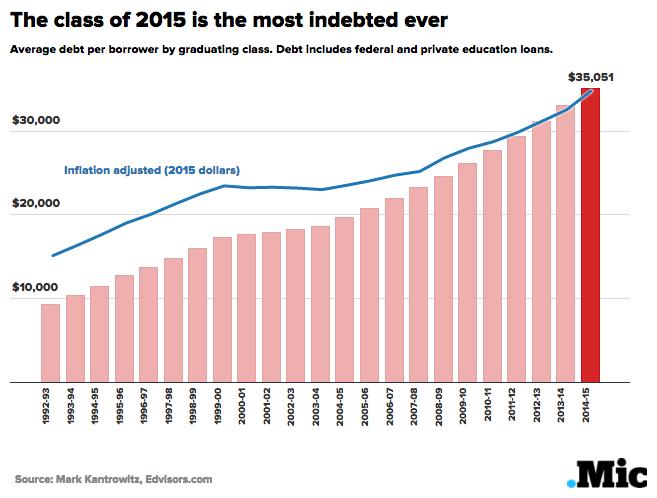
Average college debt is now up to $35,000 and usually for a useless non-STEM degree
Average debt is now up to $35,000, often for a useless non-STEM degree

First, the problem, using this article from New Zealand. It is authored by a self-made millionaire to young people.

Excerpt:

A young property tycoon has hit out at Generation Y claiming they need to stop travelling and spending money on overpriced food if they want to save for their first home.

Tim Gurner, 35, is worth nearly half a billion dollars since buying his first investment property at the age of 19.

The Melbourne millionaire believes it’s time his generation change their spending and lifestyle habits.

“When I was trying to buy my first home, I wasn’t buying smashed avocado for $19 and four coffees at $4 each,” he told Channel Nine’s 60 Minutes program.

“We’re at a point now where the expectations of younger people are very, very high. They want to eat out every day, they want travel to Europe every year.

“This generation is watching the Kardashians and thinking that’s normal – thinking owning a Bentley is normal.”

And how did the millennials respond? With immature, ignorant rebellion:

Gurner’s comments have been met with a backlash on social media will many criticising how he started out in the property – with a loan from his grandfather.

One social media comment read: “Maybe the new home buyers would stand more of a chance if they were given 34K by their grandad… that’s a fair few smashed avos.’

Another added: ‘Nice if you can get it,’ while one commented: ‘Much like Trump’s dad gave him a “small loan of $1Mil.’

Of course, the average college graduate HAS actually borrowed that much money (see graphic above), but they just preferred to blow it all on alcohol, birth control and a degree in English literature.

Speaking of a degree in English literature…

This woman complained to her boss because she wasn’t making enough money. She graduated with a non-STEM degree (English literature), and lives in one of the most expensive cities in America. (The cities that are all run by leftist Democrats who love to spend money on public works and welfare). She didn’t even have roommates to split the rent!

I see this in so many young people – complete disregard for the future in order to have fun, thrills and frivolous travel right now. And all their same-age friends support their decision-making. Young people don’t listen to grown-ups who have experience and real achievements. They listen to their friends. I know one woman who literally flew off to be a missionary in Europe for two years, on the advice of two Christian students, neither of which had ever worked a full-time job or saved money. They were proudly living off their parent’s incomes into their late-20s, and she looked to them for advice on education, career and finances.

Low-income earners can still save money

You don’t have to have a great job to make choices that lead to growing your wealth.

Here is an article from Business Insider about how to build wealth on a minimum wage salary.

Excerpt:

Here are the key expenses that someone on minimum wage can consider cutting, to make an immediate impact:

  • Moving to a more affordable city can cut living expenses considerably. It’s hard to accumulate wealth in Manhattan or San Francisco, but is much more likely in Buffalo or Memphis.
  • Eliminate commuting. Cars are expensive, and it is possible to get a place close enough to work to bike.
  • Cut some wires, particularly cable. After all, it’s 2017 – just go with internet and Netflix.
  • Don’t eat out, unless it’s absolutely necessary.
  • Skip most purchases of new clothes. Instead, make thrift stores your new best friend, and don’t be afraid to mend holes in clothing.
  • Cut expensive activities, and rediscover that the best things in life are free. Playing many sports can be free (or cheap), and public libraries are free (or cheap).

Once that’s done – it’s all about investing in yourself.

The Obama administration set interest rates low for the last eight years, encouraging people to borrow more and more money – money that they could not pay back. Thankfully, the private sector has ways of encouraging people to save money.

This article is from the far-left The Atlantic.

Excerpt:

Late last summer, Dawn Paquin started keeping her money on a prepaid debit card from Walmart instead of in a traditional checking account. The wages from her factory job—she works from 9 p.m. to 5 a.m., inspecting blades on industrial bread-slicing machines—now go directly onto the Visa-branded card, which she can use like a regular debit card, though unlike most debit cards, it is not linked to a checking or savings account.

[…]The card is more convenient, Paquin said, and she doesn’t have to worry about monthly statements; she tracks her money, and pays all her bills, with the card’s associated phone app.

[…]In a 2015 Federal Reserve Board survey, 46 percent of respondents reported that they would have trouble coming up with $400 in an emergency; living paycheck to paycheck is now a commonplace middle-class experience. So while Paquin noticed that her Walmart MoneyCard app asked her from time to time whether she wanted to “stash” some money, she didn’t bother to figure out what that actually meant, let alone respond.

Then, late last year, she got an email saying that a “prize savings” feature had been added to her card. If she kept some of her balance in a virtual “vault,” meaning that it would not show up in her available funds, she would be eligible to win a cash prize in a monthly drawing—up to $1,000. Every dollar in the MoneyCard Vault would equal an entry in that month’s drawing. This caught her interest. A prize would go a long way toward her being able to buy a car. It also made her focus on what all those “stash” requests were about. “Oh, cool, this can work as a savings account, too,” she remembers realizing. So when she got paid, she started setting aside “10 bucks, 20 bucks, whatever I could.”’

[…]The program was launched to a limited number of MoneyCard holders in August, offering 500 prizes a month—one for $1,000, the rest $25 each. In December, the company reported that the number of Vault users had grown more than 130 percent, to more than 100,000, and that the average savings had grown from $413 to $572, a 38 percent increase.

Paquin actually did end up winning the $1000 prize for stashing some of her earnings. And she saved most of it, of course. Because she learned from the incentives.

Millennials who elected Obama will face high taxes, poverty and unemployment

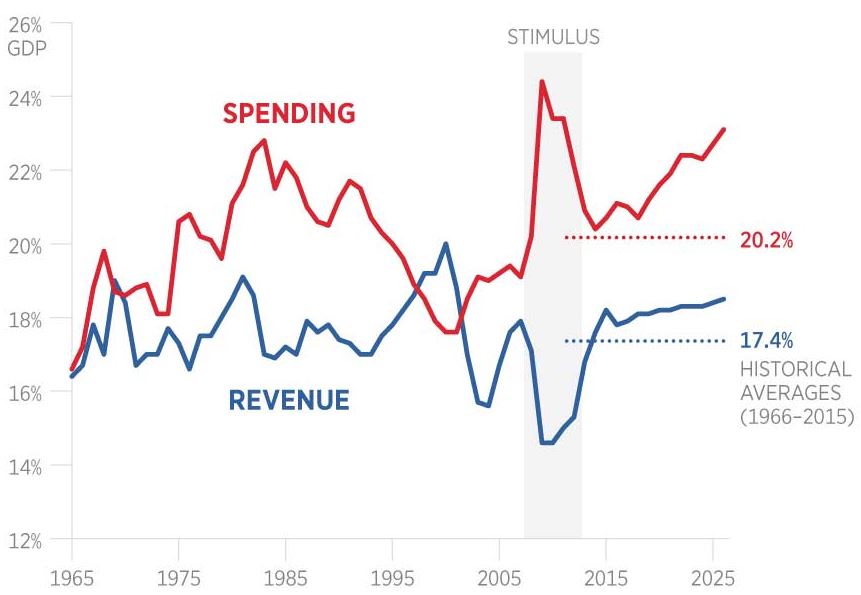
We can't raise taxes enough to fix this overspending
We can’t raise taxes high enough to fix this much overspending

My regular readers have probably noticed that I have stopped blogging about day-to-day politics, ever since the Republican primary candidates with conservative records (Cruz, Jindal, Walker) were eliminated from the GOP primary. I have heard though that the mainstream media is going all in to elect Hillary Clinton. My concern is that many people rely on television news and will never think about two really important issues. First, Obama has been the worst President in the history of the country and has destroyed the economy for decades to come. Second, his disregard for national security and weak foreign policy has emboldened the enemies of Western democracies, e.g.  Russia, Iran, etc. We will see the consequences of this (wars and terrorism) for years to come. Those are the real challenges we face as a nation.

This Hoover Institute article by Victor Davis Hanson explains the big picture that the mainstream media doesn’t care about.

Excerpt:

Consider the $20-trillion national debt. Most Americans accept that current annual $500 billion budget deficits are not sustainable—but they also see them as less extreme than the recently more normal $1 trillion in annual red ink. Americans also accept that the Obama administration doubled the national debt on the expectation of permanent near-zero interest rates, which cannot continue. When interest rates return to more normal historical levels of 4-5% per annum, the costs of servicing the debt—along with unsustainable Social Security and Medicare entitlement costs—will begin to undermine the entire budget.

Count up current local, state and federal income taxes, payroll taxes, property and sales taxes, and new health care taxes, and it will be hard to find the necessary additional revenue from a strapped and overtaxed middle class, much less from the forty-seven percent of Americans who currently pay no federal income taxes. The Obama administration has tried to reduce the budget by issuing defense cuts and tax hikes—but it has refused to touch entitlement spending, where the real gains could be made. The result is more debt, even as, paradoxically, our military was weakened, taxes rose, revenue increased, and economic growth remained anemic at well below 2% per annum.

The national debt is one ticking time bomb, but there are others. Illegal immigration and Muslim refugees create additional financial problems for the next generation of entrepreneurs and workers:

Illegal immigration poses a similar dilemma. No nation can remain stable when 10-20 million foreign nationals have crashed through what has become an open border and reside unlawfully in the United States—any more than a homeowner can have neighbors traipsing through and camping in his unfenced yard.

Likewise, there are few multiracial societies of the past that have avoided descending into destructive ethnic chauvinism and tribalism once assimilation and integration were replaced by salad-bowl identity politics. Common words and phrases such as “illegal alien” or “deportation” are now considered taboo, while “sanctuary city” is a euphemism for a neo-Confederate nullification of federal immigration laws by renegade states and municipalities.

Illegal immigration, like the deficits, must cease, but stopping it would be too politically incorrect and painful even to ponder. The mess in Europe—millions of indigent and illegal immigrants who have fled their own failed states to become dependent on the largess of their generous adopted countries, but without any desire to embrace their hosts’ culture—is apparently America’s future.

Progressive Christians and  left-leaning Republicans join Democrats in imposing costs on the next generation of taxpayers with open borders immigration policies. The bill for importing people who take more in welfare than they pay in taxes has to be paid by someone. Not only will taxes on individuals go up, but taxes on businesses will cause them to create fewer jobs, or move their production to countries that have lower taxes on business.

The rest of the article talks about more ticking time bombs created by young leftist voters. Obama’s anti-police rhetoric has created a crime crisis that will require more police, more incarceration and higher insurance premiums. Obama’s anti-school-choice policies have made it harder for the next generation to get the education they will need to offer value to employers. Without skills, you won’t have a job, and you will be poor – poorer than your parents’ generation.

Although most young leftists are ignorant about foreign policy, that did not stop them from voting to cause crises that will harm our economy, and may also draw us into war. Territorial disputes involving strong countries like Russia and China could easily lead to war. Sponsors of terrorism like North Korea and Iran have gained strength during Obama’s reign of stupidity. Wars that impact trading partners or allies will cost taxpayers money. And millennials are the ones who are going to get the bill for a failed foreign policy.

The article doesn’t mention other crises like the trillion dollar student loan bubble, or the next mortgage lending crisis, or the unfunded pension programs crisis, or Medicare going bankrupt, and then Social Security shortly after, etc. No one in the mainstream media mentions these things, and the millennials aren’t aware of these problems. It’s not in their culture to put financial concerns above having a good time. But closing your eyes doesn’t make a threat disappear. Millennials can’t study English in college, rack up student loans, spend all their money on alcohol, work minimum wage jobs, then travel to Europe in their 20s, and expect everything to work out when they get serious about career and savings at age 30. These crises – which millennials voted for – are going to make their lives harder than their parents’ lives ever were.