Tag Archives: Debate

Tim McGrew debates Peter Boghossian on the definition of faith

I have tried very hard to avoid writing about Peter Boghossian because I kept hoping that someone would speak to him and set him straight before he went too far.

Basically, when you listen to the debate below, you’ll find that Boghossian redefines the word faith so that it basically means “stupidity”, and then he tries to get people of faith to accept that they are stupid according to his new definition of faith. The new definition is not found in any dictionary, and it’s not used commonly, either.

Anyway, here are the details:

This Week on Unbelievable : Peter Boghossian vs Tim McGrew – debate on ‘A Manual For Creating Atheists”

Peter Boghossian teaches philosophy and is the author of ‘A Manual for Creating Atheists’. He believes that faith is a ‘false epistemology’ (way of knowing things) and even describes it as a ‘virus of the mind’. Tim McGrew is a Christian philosophy professor specialising in epistemology. He contests Boghossian’s definition of faith and debates the merits of his recent book. To cast your vote on the definition of faith visit www.facebook.com/unbelievablejb.

The MP3 file is here.

Topics: (I reserve the right to satirize Boghossian in this. Listen to the audio if you want his exact words)

  • PB: My book tries to avoid the “obfuscations” of reputable, credentialed Christian scholars and discusses faith at my intellectual level
  • PB: The goal of the book is to help people abandon the dictionary definition of the word “faith” and accept the definition I invented
  • TM: Defining the word “faith” in the wrong way is not the right way to start an authentic, respectful conversation
  • TM: Faith does not mean “pretending to know things you don’t know” – that is not a standard definition
  • TM: the only people who accept your definition of faith are you and the people who follow you online
  • TM: your whole book is predicated on on a wrong definition of faith
  • PB: that is my definition of faith based on my experience of talking to lots of people
  • TM: He says this is how billions of people define faith – but not in my experience, maybe satirists like Ambrose Bierce and Mark Twain do
  • TM: Your definition of faith is not in the Oxford English Dictionary and that definition is based on common usage of the word faith
  • TM: The New Testament definition of faith “pistis” means trust
  • PB: There are 50-100 people who use the term that way, and only in academia
  • TM: How about “The Good Atheist” who interviewed you? He is not an academic or a theist, but he didn’t accept your definition
  • PB: You are “extraordinarily isolated” from the real definition of faith
  • TM: Faith is not belief without evidence, it is trust based on at least some evidence
  • PB: Christian leaders use the word according my definition, I won’t name any or quote any, though
  • JB: So you are basically saying that Christians are lying when they express their faith, since they know what they are saying isn’t true but they say it anyway
  • PB: What percentage of Christians use the word faith to mean “belief without evidence”
  • TM: Well below 1%. It may be the case that their evidence is not very good, but they do rest their beliefs on evidence
  • TM: Faith is trusting, holding to, and acting on what one has good reasons to believe is true in the face of difficulties
  • PB: That’s not what people mean by faith, they mean my definition
  • JB: What do you mean when you say that faith is a “virus of the mind”, and a “mental illness”? School programs to remove faith?
  • PB: Think about how atheists feel when they are told they will go Hell
  • PB: Christians are hurting people, so that means they have a mental disorder that needs to be cured in a systematic way
  • PB: Faith is an epistemic virus that hijacks the reasoning process

At that point I quit summarizing, because I didn’t think he was worth listening to any more.

He is clearly not aware of how even basic Christian apologetics books that are bestsellers cover evidences like the Big Bang, the cosmic fine-tuning, the origin of life, the Cambrian explosion, galactic habitability, stellar habitability, New Testament reliability, historical Jesus, philosophical arguments for theism, and so on. This is the bottom-shelf of Christian apologetics, widely read by rank-and-file Christians, but Boghossian seems to be completely unaware of it. He needs to get out more and talk to people outside of radical atheist circles. Maybe he needs to pick up a serious book like “Debating Christian Theism” and read it before he opens his mouth on topics he knows nothing about.

But that’s not all. As, I explained before, the concept of faith presented in the Bible agrees with what Dr. McGrew said – faith is trust based on evidence. That is the Biblical view.

And finally, this:

John 10:37-38: [NASB]

37 If I do not do the works of My Father, do not believe Me;

38 but if I do them, though you do not believe Me, believe the works, so that you may know and understand that the Father is in Me, and I in the Father.”

The words of Jesus – he is saying: believe me because of the evidence I provide from miracles that you can see with your own eyes. Period. End of discussion.

So Boghossian’s view of faith is nowhere except in his own mind. Not in the apologetics literature. Not in the writings of any reputable Christian scholar. Not in the Bible. Not in the words of Jesus. It’s enough to make me think that this talk about “mental disorders” and “viruses of the mind” is just projection.

Vote in the poll

Please vote in this poll:

Thank goodness we have debates like this so that we can find out where Christians really come down on faith.
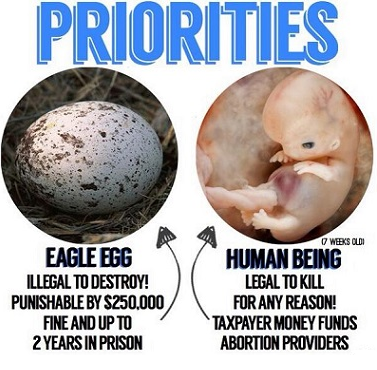
Oxford University shuts down public debate on abortion

Eagle eggs are protected, unborn babies are not

Journalist Tim Stanley writes about his ordeal in the UK Telegraph.

Excerpt:

An attempt to hold a reasonable debate about abortion in Oxford was called off after students threatened to disrupt it. Tim Stanley, one of the debaters, writes that the authoritarian Left has become everything it claims to hate.

I would’ve thought that the one place in Britain where you could agree to disagree amicably would be Oxford University. But I was wrong. For instance, I’ve discovered that you’re only allowed to debate abortion there if a) you’re a woman and b) you’re all for it. Any other approach to the subject is liable to attract a mob…

A few months ago I accepted an invitation by the Oxford Students for Life to debate Brendan O’Neill on the subject “This House believes Britain’s Abortion Culture Hurts Us All”. The setting was Christ Church College and around 60 people signed up to attend on Facebook. To be clear: this wasn’t a pro-life demo and the subject wasn’t whether or not women should have the right to choose abortion. Even though I was speaking for the proposition, my speech would’ve begun with noting that the motion has nothing to do with abortion rights per se and was simply a consideration of how having effective abortion on demand affects wider society. Brendan, speaking for the opposition, would’ve doubtless done a fine job and probably run rings round me. It was a fair and free debate that I half expected to lose.

But someone was outraged that we dared to discuss this issue at all. A protest group of around 300 people called “What the f**k is ‘Abortion Culture’?” appeared on Facebook that promised to “take along some non-destructive but oh so disruptive instruments to help demonstrate to the anti-choicers just what we think of their ‘debate’.” We were guilty of promoting “really sh*tty anti-choice rhetoric and probs some cissexism.” The foul language indicates how sophisticated the protesters were, while the accusation of cissexism had me reaching for my online urban dictionary. Was I being called a sissy by homophobic feminists? Mais non. Apparently a “cis” is someone who identifies with the same gender that they were born with. So that’s a thing now.

The university’s students’ union also issued a statement that took aim at Brendan and me for being so offensively attached to our God-given genitals: “The Women’s Campaign (WomCam) condemn SFL for holding this debate. It is absurd to think we should be listening to two cisgender men debate about what people with uteruses should be doing with their bodies.” Next, the Christ Church Junior Common Room (posh talk for “the committee that run the students’ bar”) passed a motion asking their college to decline to room the debate. Eventually, the college caved-in on the grounds that, “there was insufficient time between today and tomorrow to address some concerns they had about the meeting”. The pro-life society tried to find an alternative venue but everyone else said “no”. I believe that two colleges agreed only to later rescind their invitations. I was sitting in Paddington Station (in a duffel coat and hat!) ready to jump on a train to Oxford at 4.40pm when I was told that the debate was finally, totally called off.

So what do we learn from this?

We learn that feminists on the left are opposed to free speech. Once they decide something, they don’t want to have to consider alternatives or hear evidence contrary to what they feel is right for them. It doesn’t matter what is morally right or respectful of the rights of others – the selfish desire for happiness is absolute, and to help with personal responsibility. And if free speech has to go in order to prevent anyone from harassing them with pesky facts, then so much the worse for free speech.

One thing is for sure, the pro-abortion position is not adopted because of logic or evidence. Being pro-abortion is non-cognitive. It cannot be defended rationally, but survives only by mob threats and raw power. If this were not so, then the feminists would have let the debate go through and their side would have won it on the merits. But they knew they would lose a fair debate, and that’s why they shut the debate down. And yet I’m sure that they would call themselves pro-diversity and open-minded.

Physicist Victor Stenger debates William Lane Craig: Does God Exist?

This debate took place on March 1, 2010 at Oregon State University.

In this debate, Victor Stenger does affirm his belief that the universe could be eternal in his second rebuttal (1:02:30), thus denying the standard Big Bang cosmology. He also denies the law of conservation of energy and asserts that something can come from nothing in his concluding speech (1:33:50). He also caused the audience to start laughing when he said that Jesus was not moral and supported slavery. There is almost no snark in this summary. Instead, I quoted Dr. Stenger verbatim in many places. I still think that it is very entertaining even without the snarky paraphrasing.

The debate includes 30 minutes of Q&A with the students.

Here is the MP3 file for the audio.

Here’s the video of the debate:

Dr. Craig’s opening speech:

  • The ontological argument
  • The contingency argument
  • The cosmological argument
  • The moral argument
  • The resurrection of Jesus (3-fact version)
  • Religious experience

Dr. Stenger’s opening speech:

  • There is no scientific evidence for God’s existence in the textbooks
  • There is no scientific evidence for God acting in the universe
  • God doesn’t talk to people and tell them things they couldn’t possibly know
  • The Bible says that the Earth is flat, etc.
  • There is no scientific evidence that God answers prayers
  • God doesn’t exist because people who believe in him are ignorant
  • Human life is not optimally designed and appears to be the result of a blind, ad hoc evolutionary process
  • The beginning of the universe is not ordered (low entropy) but random and chaotic
  • It’s theoretically possible that quantum tunneling explains the origin of the universe
  • The laws of physics are not objectively real, they are “our inventions”
  • Regarding the beginning of the universe, the explanation is that something came from nothing*
  • Nothing* isn’t really nothing, it is “the total chaos that we project existed just before the big bang”
  • If something has no structure, then “it is as much nothing as nothing can be”
  • Consciousness is explainable solely on the basis of material processes
  • There are well-informed, rational non-believers in the world and God would not allow that

Dr. Craig’s first rebuttal:

Stenger’s argument that there is no objective evidence for God’s existence:

  • First, it is not required that God rely only on objective evidence in order to draw people to himself (Alvin Plantinga)
  • Second, God is not required to provide evidence to everyone, only to the people who he knows would respond to him
  • Third, Craig gave lots of objective evidence, from science, history and philosophy
  • Stenger asks for certain evidence (answered prayers, prophecy, etc.), but Craig presented the evidence we have

Stenger’s argument that the balance of energy is zero so “nothing” exists:

  • if you have the same amount of assets and liabilities, it doesn’t mean that nothing exists – your assets and liabilities exist
  • Christopher Isham says that there needs to be a cause to create the positive and negative energy even if they balance
  • the quantum gravity model contradicts observations
  • the vacuum is not the same as nothing, it contains energy and matter
  • the BVG theorem proves that any universe that is expanding must have a beginning

Stenger’s argument that mental operations can be reduced to physical operations:

  • mental properties are not reducible to physical properties
  • epiphenomenalism: is incompatible with self-identity over time
  • epiphenomenalism: is incompatible with thoughts about other things
  • epiphenomenalism: is incompatible with free will
  • substance dualism (mind/body dualism) is a better explanation for our mental experience
  • God is a soul without a body
Dr. Stenger’s first rebuttal:

Craig’s cosmological argument:

  • Craig’s premise is “everything has a cause”, but quantum mechanics has causeless events
  • There are speculative theories about how something could have come into being uncaused out of nothing
  • “I don’t know of a single working cosmologist today who believes there was a singularity prior to the Big Bang”
  • “If there wasn’t a singularity then there’s no basis for arguing that time began at that point”
  • “There’s no reason from cosmology that we know of that the universe can’t be eternal”
  • “When I talk about an eternal universe, I mean a universe that has no beginning or end”
  • The Hartle-Hawking model doesn’t have a beginning
  • “There was no violation of energy conservation by having a universe coming from nothing”
  • “The universe could have come from a previous universe for example or even just from a region of chaos”
  • The paper by Vilenkin is counteracted by other papers (he doesn’t specify which ones)

Craig’s moral argument:

  • Dr. Craig is arguing from ignorance
  • But morality can be decided by humanity just like governments pass laws, and that’s objective
  • Dr. Craig has too little respect for the human intellect
  • I don’t need to tell me that slavery is wrong
  • The Bible supports slavery
  • Atheists can behave as good as theists
  • Morality just evolved naturally as an aid to survival

Craig’s resurrection argument:

  • No Roman historians wrote about the execution of Jesus but none of them did
  • The empty tomb is doubtful because it is only mentioned in the gospels, not by Paul
  • John Dominic Crossan says there was no empty tomb
  • Christianity only survived because the Roman empire thought that they were useful

Dr. Craig’s second rebuttal:

Craig’s cosmological argument:

  • There is no reason to prefer an indeterministic interpretation of quantum mechanics
  • Dr. Stenger himself wrote that deterministic interpretations of quantum mechanics are possible
  • The vacuum in quantum mechanics is not nothing
  • The quantum vacuum he proposes cannot be eternal
  • The cosmological argument does not require a singularity
  • The Hartle-Hawking model is from 1983
  • Hawking says that there is a beginning of space and time after that model
  • The Hartle-Hawking model does still have a beginning of time – the model is not eternal
  • The BVG theorem that requires a beginning for expanding universes is widely accepted among cosmologists

Craig’s moral argument:

  • Stenger redefined objective to mean that most people agree with it – but that’s not what objective means
  • Objective means right and wrong whether anyone accepts it or not
  • Richard Dawkins himself says that on atheism there is “no evil and no good” – why is he wrong?
  • Even Dr. Stenger says that morality is the same as passing laws – it’s arbitrary and varies by time and place
  • But on his view, right and wrong are the same as deciding which side of the road to drive on
  • But somethings really are right and some things are really wrong

Craig’s resurrection argument:

  • Josephus is a Roman historian and he wrote about Jesus, for example
  • There were four biographies of Jesus are the best sources for his life
  • The scholars that Stenger mentioned are on the radical fringe

Dr. Stenger’s second rebuttal:

Knowledge and the burden of proof:

  • Dr. Craig has to bear the burden of proof, not me – because his claim is more “extravagant”
  • “I don’t have to prove that a God was not necessary to create the universe”
  • “I don’t have to prove that a God did not design the universe and life”
  • “I don’t have to prove that the universe did not have a beginning”
  • “I don’t have to prove that God did not provide us with our moral sense”
  • There are a lot of books written about how morality evolved naturally
  • “I don’t have to prove that the events surrounding the supposed resurrection of Jesus did not take place”
  • Bart Ehrman says that the gospels are generally unreliable (Note: Ehrman accepts all 3 of Craig’s minimal facts)
  • Just because people are willing to die for a cause, does not make their leader God, e.g. – the Emperor of Japan

Aesthetic concerns about the universe:

  • I don’t like dark matter and I wouldn’t have made the universe with dark matter
  • I don’t like the doctrine of penal substitution
  • I don’t like the doctrine of original sin
  • I don’t like the heat death of the universe

Dr. Craig’s conclusion:

The case for atheism:

  • Dr. Stenger had two arguments and he has to support his premises
  • Dr. Craig addressed his two arguments and each premise and Dr. Stenger never came back on it

The contingency argument:

  • Dr. Stenger has dropped the refutation of this argument

The cosmological argument:

  • The theoretical vacuum he proposes cannot be eternal

The moral argument:

  • He asserts that things are wrong, but there is no grounding for that to be objective on atheism

The resurrection of Jesus:

  • There are surveys of scholars on the empty tomb and 75% of them agree with it
  • Bart Ehrman agrees with all 3 of the minimal facts that Dr. Craig presented
  • Ehrman’s objection to the resurrection is not historical: he’s an atheist – he thinks miracles are impossible

Religious experience:

  • No response from Dr. Stenger

Dr. Stenger’s conclusion

The cosmological argument:

  • “I argued that we have very good physical reasons to understand how something can come from nothing”
  • “There is a natural tendency in the universe… to go from.. simpler thing to the more complicated thing”
  • The transition from a vapor to a liquid to ice shows how something could come from nothing
  • “It cannot be proven that the universe had a beginning”

The moral argument:

  • Objective morality, which is independent of what people think, could be developed based on what people think
  • “Jesus himself was not a tremendously moral person… he had no particular regard for the poor… he certainly supported slavery… he was for the subjugation of women” (audience laughter)

The resurrection argument:

  • Bart Ehrman says that the majority of the gospels are unreliable

Religious experience:

  • I don’t see any evidence that there is anything more to religious experience than just stuff in their heads

God’s purpose of the world should be to make people feel happy:

  • God could have made people feel happier
  • God could have made people not die
  • God could could have made the universe smaller: it’s too big
  • God could have made it possible for humans to live anywhere “even in space”