Tag Archives: Debate

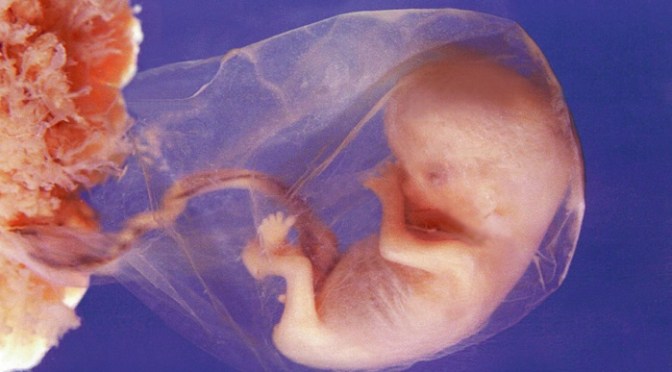
If unborn babies don’t have consciousness or don’t feel pain, may we kill them?

Was having a conversation by e-mail yesterday with a pro-abortion atheist, and he gave two reasons why he supported abortion in the first and second trimester. First, he said that unborn babies can’t feel pain, so it’s OK to kill them. Second, he said that unborn babies don’t have consciousness, so it’s OK to kill them. I thought it might be useful to link to something that answers both of these objections.

Frank Beckwith is the author of “Defending Life: A Moral and Legal Case Against Abortion Choice“, which was published by Cambridge University Press, a top academic press. But before Cambridge University Press, Beckwith wrote four easy-to-understand essays for the Christian Research Journal. Part IV is the one that has the response to the two questions raised by my atheist friend.

Part I. The Appeal to Pity

Part II. Arguments from Pity, Tolerance, and Ad Hominem

Part III. Is The Unborn Human Less Than Human?

Part IV. When Does a Human Become a Person?

Excerpt:

Some ethicists argue that the unborn becomes fully human sometime after brain development has begun, when it becomes sentient: capable of experiencing sensations such as pain. The reason for choosing sentience as the criterion is that a being that cannot experience anything (i.e., a presentient unborn entity) cannot be harmed. Of course, if this position is correct, then the unborn becomes fully human probably during the second trimester and at least by the third trimester. Therefore, one does not violate anyone’s rights when one aborts a nonsentient unborn entity. [13]

There are several problems with this argument. First, it confuses harm with hurt and the experience of harm with the reality of harm. [14] One can be harmed without experiencing the hurt that sometimes follows from that harm, and which we often mistake for the harm itself. For example, a temporarily comatose person who is suffocated to death “experiences no harm,” but he is nevertheless harmed. Hence, one does not have to experience harm, which is sometimes manifested in hurt, in order to be truly harmed.

Second, if sentience is the criterion of full humanness, then the reversibly comatose, the momentarily unconscious, and the sleeping would all have to be declared nonpersons. Like the presentient unborn, these individuals are all at the moment nonsentient though they have the natural inherent capacity to be sentient. Yet to countenance their executions would be morally reprehensible. Therefore, one cannot countenance the execution of some unborn entities simply because they are not currently sentient.

Someone may reply that while these objections make important points, there is a problem of false analogy in the second objection: the reversibly comatose, the momentarily unconscious, and the sleeping once functioned as sentient beings, though they are now in a temporary state of nonsentience. The presentient unborn, on the other hand, were never sentient. Hence, one is fully human if one was sentient “in the past” and will probably become sentient again in the future, but this cannot be said of the presentient unborn.

There are at least three problems with this response. First, to claim that a person can be sentient, become nonsentient, and then return to sentience is to assume there is some underlying personal unity to this individual that enables us to say that the person who has returned to sentience is the same person who was sentient prior to becoming nonsentient. But this would mean that sentience is not a necessary condition for personhood. (Neither is it a sufficient condition, for that matter, since nonhuman animals are sentient.) Consequently, it does not make sense to say that a person comes into existence when sentience arises, but it does make sense to say that a fully human entity is a person who has the natural inherent capacity to give rise to sentience. A presentient unborn human entity does have this capacity. Therefore, an ordinary unborn human entity is a person, and hence, fully human.

Second, Ray points out that this attempt to exclude many of the unborn from the class of the fully human is “ad hoc and counterintuitive.” He asks us to “consider the treatment of comatose patients. We would not discriminate against one merely for rarely or never having been sentient in the past while another otherwise comparable patient had been sentient….In such cases, potential counts for everything.” [15]

Third, why should sentience “in the past” be the decisive factor in deciding whether an entity is fully human when the presentient human being “is one with a natural, inherent capacity for performing personal acts?” [16] Since we have already seen that one does not have to experience harm in order to be harmed, it seems more consistent with our moral sensibilities to assert that what makes it wrong to kill the reversibly comatose, the sleeping, the momentarily unconscious, and the presentient unborn is that they all possess the natural inherent capacity to perform personal acts. And what makes it morally right to kill plants and to pull the plug on the respirator-dependent brain dead, who were sentient “in the past,” is that their deaths cannot deprive them of their natural inherent capacity to function as persons, since they do not possess such a capacity.

These four essays are a very good introduction to common responses to pro-abortion arguments. I recommend that people get familiar with this, as once you look into it, you will see that the abortion issue can be debated with as much confidence as William Lane Craig defends Christian theism. You will have the same access to scientific evidence and rational arguments on this topic, and so you will have the upper hand. And that’s fun.

The best introductory book on the abortion / right to life issue is “The Case for Life” by pro-life debater Scott Klusendorf. The best comprehensive book is a tie between “The Ethics of Abortion” by Christopher Kaczor, and Frank Beckwith’s “Defending Life: A Moral and Legal Case Against Abortion Choice“.

William Lane Craig debates Daniel Came: Does God exist?

Dr. Craig's opening speech summary slide
Dr. Craig’s opening speech summary slide

The video of the debate was posted by ReasonableFaith.org – Dr. Craig’s organization. This debate occurred in March 2017 at the University of Dublin, in Ireland.

The video: (91 minutes)

My non-snarky summary is below.

Dr. Craig’s opening speech

Two claims:

1. There are good reasons to think that theism is true.
2. There are not comparably good reasons to think that atheism is true.

Five reasons for God’s existence:

1. The beginning of the universe
– actual infinite past is mathematically impossible
– BGV theorem: any universe that is on balance expanding in its history (like ours) cannot be past eternal

2. Fine-tuning of cosmic quantities and constants
– slight changes to quantities and constants prevent a universe from supporting complex embodied life
– the multiverse response of atheists conflicts with observations, e.g. the Boltzmann Brains problem

3. Objective moral values
– God’s existence is required to ground objective moral values and duties

4. Minimal facts case for the resurrection of Jesus
– there are good reasons to accept the most widely accepted facts about the historical Jesus (empty tomb, appearances, early widespread belief in the resurrection)
– the best explanation of these minimal facts is that God raised Jesus from the dead

5. Experience God directly
– in the absence of any defeaters to belief in God, a person can experience God directly

Dr. Daniel Came’s opening speech

1. The hiddenness of God
– if God wants a personal relationship with us, and a relationship with God would be the greatest good for us
– God ought to reveal himself to us, but he does not  reveal himself to many people, the “non-resistant non-believers”

2. The inductive problem of evil
– many evil events occur that are pointless – there is no morally sufficient reason why God would allow them to occur
– examples: animal suffering, children born with disease, tsunamis
– the theistic response to this is that humans are not in a position to know whether there are morally sufficient reasons, due to our limitations of knowing the consequences
– but this ripple effect defense has 4 possible outcomes, 3 of which don’t do the job of justifying

Dr. Craig’s first rebuttal

1. The hiddenness of God
– God’s goal is not to make his existence known, but to draw them into a love relationship
– it’s speculative that overt displays of God’s existence would draw people to him in a love relationship, they might resent his bullying
– atheist would have to prove that God could draw more people into a love relationship with him by revealing himself more overtly

2. The inductive problem of evil
– as humans, we are not in a position to know for certain that any apparently pointless evil really is pointless
– William Alston article: 6 limitations of human knowing make it impossible to judge that an evil is actually “pointless”
– Dr. Came says that there are 4 possibilities for the ripple effects, and since 3 are bad, it’s likely that there are not morally sufficient reasons for a apparently pointless evil
– it is logically fallacious to assert probability conclusions without knowing the probabilities of those 4 options
– there is actually an argument from evil: since the problem of evil requires an objective standard of good and evil by which to measure, and God is the only possible ground of objective morality, then pressing the problem of evil actually requires the atheist to assume God, in order to ground this objective moral standard

Dr. Came’s first rebuttal

3. Objective moral values
– there are naturalistic theories of moral realism where objective moral duties and objective moral values exist in a naturalistic universe
– I’m not saying that any of them are correct, but there are many theories about object morality in a naturalistic universe

There are naturalistic theories for all of the 5 arguments that Dr. Craig presented. It is Dr. Craig’s responsibility to present those naturalistic theories and prove that they are not as good as his explanations. I’m not going to defend (or even name!) a single naturalistic theory for any of these 5 arguments by Dr. Craig.

Dr. Craig’s explanations for the 5 evidences he gave can’t be admitted, because we have to know how God did something in naturalistic terms before we can know that God did it supernaturally. Explanations are only valid if they are naturalistic.

1. The beginning of the universe
– naturalism explains how the universe expands after it came into being, so that explains how it came into being
– the God explanation, that God created the universe out of nothing, is not admissible, because it is not naturalistic
– how does God, as an unembodied mind interact with the physical world?
– the only agency that we know about is human agents, and we have bodies, so how could God perform actions without having a body?

The theistic hypothesis does not make any predictions, but naturalism makes lots of testable predictions. God could do anything, so he is not constrained and is therefore untestable. We can’t infer God as an explanation in principle because we can’t predict what is more probable if God exists than if he does not.

2. Fine-tuning of cosmic quantities and constants
– the university was not set up to make embodied intelligence plausible, because the vast majority of the universe is hostile to life
– there are models of the multiverse that escape the Boltzmann Brains problem that Dr. Craig raised

Dr. Craig’s second rebuttal

Some of Dr. Craig’s arguments are deductive (e.g. – the beginning of the universe, objective moral values), so that the conclusion follows from the premises if the premises are true. The resurrection passes the standard tests for historical explanations.

1. The beginning of the universe
– the whole point of the argument is that there is no naturalistic explanation for an ultimate beginning of the universe

2. Fine-tuning of cosmic quantities and constants
– the whole point of the argument is that there is no naturalistic explanation for a design of the universe to support life
– he has to prove that intelligences has to be attached to bodies
– human beings are non-physical minds united to physical bodies
– naturalistic attempts to explain mental operations fail
– the arguments prove that unembodied minds exist
– the vast expanse of the universe is required in order to form the galaxies, stars and heavy elements needed for complex life
– why expect that the entire universe should be small, or that life would be everywhere?
– a non-fine-tuned world is more likely in the multiverse, and in a multiverse, we are more likely to have a Boltzmann brain world than a world with complex, embodied life
– Dr. Came has not advanced any naturalistic explanation for the fine-tuning

3. Objective moral values
– non-theistic ethical theories cannot account for the ontological foundations of objective moral values and duties
– atheistic theories of moral realism simply assume objective moral values out of thin air
– it is especially hard to find any basis for objective moral duties in the absence of God

Dr. Came’s second rebuttal

5. Religious experience
– Dr. Craig should not bring up religious experience in a debate where arguments and evidence are central
– people who have dreams, hallucinations and psychotic delusions could appeal to religious experience
– religious experience is by no means universal, and it is possible to doubt it

3. Objective moral values
– there are lots of atheists who hold to objective moral values
– Dr. Craig has to explain how God grounds objective moral values and duties
– Dr. Craig has to explain why atheist moral realist theories don’t work to ground objective moral values and duties

1. The beginning of the universe
– Dr. Craig claims that something can’t come from nothing, that’s not an argument
– there are numerous models that don’t require an absolute beginning of the universe
– Dr. Craig cites the BGV theorem, but Guth (one of the authors) says that only the inflation has a beginning, not the whole universe

Dr. Craig’s conclusion

1. The beginning of the universe
– on theism, there is an efficient cause, but no material cause, for the origin of the universe
– on atheism, there is neither an efficient cause nor a material cause, for the origin of the universe: that’s worse!
– if he thinks that there are models of the universe that don’t require a beginning, then let him name a viable eternal model of the universe
– he never refuted the mathematical argues against an infinite past

2. Fine-tuning of cosmic quantities and constants
– nothing to refute

3. Objective moral values
– God is a better ground for morality than humans, because he is ultimate, and not contingent and arbitrary
– God is a being who is worthy of worship, and therefore command his creatures with moral duties

4. Minimal facts case for the resurrection of Jesus
– nothing to refute

5. Religious experience
– only justified because there are no defeaters to it

1. The hiddenness of God
– atheist has to show that if God’s existence were more obvious, that it would result in more people being drawn to him

2. The inductive problem of evil
– Dr. Came’s argument was logically fallacious, and makes errors in probability theory

Dr. Came’s conclusion

Sometimes, people can’t prove something, but lack of evidence is a justification for doubting it, e.g. – werewolves.

If none of Craig’s arguments work, then it follows that it is not rational to believe that God exists, and it is rational to believe that God does not exist.

Atheists shouldn’t have a burden of proof for what they know, only theists have a burden of proof for what they know.

My thoughts

One quick point. If life were common everywhere then atheists would infer that God wasn’t involved in it. Period. “Life is everywhere, so it’s common, why do we need a designer?” they’d say. I agree with Dr. Came about denouncing religious experience in a formal debate. I don’t like when Dr. Craig brings this up, but I see why he does it – he’s an evangelist, and that’s a good thing, too. I just worry about how it looks to atheists, although it’s good for sincere seekers. I’m not the one on the stage, though, Dr. Craig is.

I think the point about more overt revealing by God would annoy people and make them turn away. Think of how gay people respond to the suggestion that there is anything wrong with them, with rage, vandalism, threats, coercion, attempts to get you to lose your job and business, and using government as a weapon to fine and imprison you. It’s really obvious to me that more God does not mean more love of God. For those who don’t want God, the hiddenness is respect for their choice to put pleasure above the search for truth. (I mean the gay activists – I have great sympathy for people who struggle with same-sex unwanted attractions because they were impacted by a failed bond with their parent of the same sex as they are).

Whenever I meet people like Dr. Came, I always urge them to keep investigating and pursuing truth, because they will find it if they are sincerely seeking after God. Some atheists do sincerely seek God, but I don’t know any who haven’t found him. I’m not sure if that’s because those atheists who claim to be non-resistant and rational are in fact resistant and non-rational, or what the real reason is. If you believe the Bible, all unbelief is non-rational and resistant (see Romans 1). Regarding the werewolves, we don’t have any good arguments for werewolves, we do have good arguments for God. Dr. Came didn’t refute the arguments that Craig raised, nor did his own arguments for atheism work. And there are many, many more arguments (origin of life, Cambrian explosion, habitability-discoverability, molecular machines) that Craig did not raise, too.

William Lane Craig debates atheist Lawrence Krauss: Does God Exist?

Here is the video from the third debate from Dr. William Lane Craig’s speaking tour in Australia.

Format:

  • William Lane Craig (15 min)
  • Lawrence Krauss (15 min, but was actually 21:40)
  • Moderated discussion
  • Question and answer

Dr. Graham Oppy, the moderator, is a well-known atheist philosopher. He let Dr. Krauss speak for 21 minutes and 40 seconds, which is why my summary of Krauss is so long.

The video:

Summary

After careful consideration, I decided not to be snarky at all in this summary. What you read below is what happened. There may be some small mistakes, but I will fix those if people tell me about them. I also included some quotes and timestamps for the more striking things that Dr. Krauss said.

The debate itself starts at 4:50 with Dr. Craig’s opening speech. He does use slides to show the structure of his arguments.

Dr. Craig’s opening speech. (4:50)

  1. The kalam cosmological argument:
    • God is the best explanation of the origin of the universe
    • The Borde Guth Vilenkin theorem supports the absolute beginning of the universe
    • Even if our universe is part of a multiverse, the multiverse itself would have to have an absolute beginning
    • Speculative cosmologies try to challenge the Big Bang theory, but none of them – even if true – can establish that the past is eternal
    • Only two types of things could explain the origin of spece, time, matter and energy – either abstract objects or minds
    • Abstract objects do not cause effects, but minds do cause effects (we do it ourselves)
    • A mind is the best explanation for the origin of the universe
  2. The unreasonable effectiveness of mathematics:
    • The underlying structure of nature is mathematical – mathematics is applicable to nature
    • Mathematical objects can either be abstract objects or useful fiction
    • Either way, there is no reason to expect that nature should be linked to abstract objects or fictions
    • But a divine mind that wants humans to understand nature is a better explanation for what we see
  3. The cosmic fine-tuning for the existence of intelligent life
    • There are two kinds of finely-tuned initial conditions: 1) cosmological constants and 2) quantities
    • These constants and quantities have to be set within a narrow range in order to permit intelligent life
    • There are three explanations for this observation: law, chance or design
    • Law is rejected because they are put in at the beginning or matter – they don’t emerge from matter
    • Chance must be rejected, because they odds are just too long unless you appeal to a world-ensemble
    • We do not observe what the world ensemble hypothesis predicts that we should observe
    • Design is the best explanation for finely-tuned constants and quantities
  4. The existence of objective moral values and duties
    • Our experience of morality (values and duties) is that it is objectively real and incumbent on us
    • When someone goes into a classroom and shoots at innocent children, that is objectively wrong
    • On naturalism, moral values and moral duties do not exist – they are conventional and variable by time and place
    • The best explanation for the existence of objective moral values and duties is that God exists
  5. The historicity of the resurrection of Jesus
    • There are three widely-accepted facts that are best explained by the resurrection hypothesis
    • 1) the empty tomb, 2) the post-mortem appearances, 3) the early church’s belief in the resurrection
    • Naturalistic attempts to explain these 3 boilerplate facts fail
    • The best explanation of the 3 minimal facts is that God raised Jesus from the dead
  6. The immediate experience of God
    • Belief in God is a “properly basic” belief – rational even without arguments because of experience of God

Dr. Krauss’ opening speech. (21:12)

Slides: (1, 2, 3, 4, 5, 6, 7, 8, 9, 10, 11, 12, 13, 14)

  1. Religious pluralism I
    • There have been lots of different gods created by people through history
    • We’ve gotten rid of all of them by understanding how the universe works by doing science
    • Religion is just stories, and the stories are inconsistent with how the universe works
  2. Progress of naturalistic science I
    • Newtonian physics refutes the idea that angels push planets around
    • Darwinian evolution refutes design arguments, including the one that Dr. Craig presented (24:10)
    • Biochemistry hasn’t explained how life originated, but we will have the solution soon
    • Physics shows us that matter can be created and destroyed without need a God
    • Physics shows us that universes can be created and destroyed “no problem”
  3. Religious pluralism II
    • Since we have been able to disprove all the gods we’ve invented, why hang on to the last one
    • It’s unlikely that the God that Dr. Craig presented exists, because we disproved all the others he didn’t present
  4. Hiddenness of God
    • There is a complete lack of evidence for the other 999 gods, so how likely is it that the God Dr. Craig presented exists
  5. Religious pluralism III
    • There are inconsistencies between various religions, so therefore there can be no religion that is right
  6. Progress of naturalistic science II
    • Peasants had a very low level of knowledge about the world and they believed in God
    • But our level of knowledge has increased over time, so we shouldn’t believe in God now
    • Peasants thought that the Earth orbited the Sun, but this is now known to be false
    • The Scriptures said that the Earth orbited the Sun, but now we know that’s false from science
  7. Christianity plagiarizes from other religions I
    • There is nothing new or special about Jesus
    • He’s just as unpleasant as all the other gods
    • Everything particular to Jesus occurs in other religions
  8. Catholics are inconsistent about what they believe
    • I’ll bet most Catholics don’t really believe in transubstantiation
    • I’ll bet most Catholics don’t really believe in the virgin birth
  9. The resurrection is copied from many other religions
    • Dionysus, Osiris, etc.
  10. There is no evidence for the resurrection
    • The stories about Jesus were written “decades or hundreds of years after the fact”
    • The stories are inconsistent with each other
    • Dr. Craig tells me that historical Jesus scholars all accept that the resurrection happened
    • That’s like saying that all alien abductions experts agree that alien abductions happened
    • It’s unreasonable to think that the resurrection happened because no one saw it happen
    • I accept that people reported on appearances, but hallucination theory can explain that
  11. The timeline for the creation and incarnation are all wrong
    • The creation, planet formation, hominids, incarnation, etc. all take place in the wrong times
    • If God knew what he was doing, he would done everything at better times to be more efficient
  12. David Hume’s argument against miracles is sound
    • Extraordinary claims require extraordinary evidence – nothing wrong with this argument
    • Miracles are really just coincidences
    • Catholic apparitions at Lourdes disprove the historical argument that Dr. Craig made for the resurrection
  13. God is petty and jealous
    • God shouldn’t demand that we trust him, esteem him and consider his character when we make decisions
    • The atoning death of Jesus for the sins of the world also makes no sense
  14. Belief is based on geography
    • What you believe is clearly correlated with where you are born
    • There is even an Islamic clone of Dr. Craig who “uses the exact same arguments” that he does to prove Islam
    • Belief in God is decreasing in the Internet-accessible world
  15. Science can develop morals without God
    • Reason is able to guide our actions to be moral
    • Morality evolves over time, so there is no objective morality
    • Catholicism teaches things that are immoral
    • Some things are prohibited by biological revulsion, such as incest
    • But if a brother and sister have sex using condoms “is that morally wrong? I can’t say it is frankly” (37:24)
  16. Dr. Craig is irrational
    • “I came here convinced based on my past interactions and his writing that Dr. Craig was a dishonest Charlatan”
    • “Any argument that validates God is reasonable to him”
    • “And any argument against it is not only unreasonable but wrong and worth distorting”
    • “Because it must be wrong – he’s decided the answer in advance”
  17. Dr. Craig is immoral
    • Dr. Craig thinks it is OK for God to command that Canaanite children are killed
    • “So in fact if they were Canaanite children in that schoolroom that he talked about then it would be OK”
    • It’s not reasonable to justify genocide in that way, but Dr. Craig is willing to go to those lengths
  18. The cause of the origin of the space time universe need not be God
    • Dr. Craig says that if there is an explanation for the origin or space, time, matter and energy it must be God
    • But it could just as easily be turtles or Zeus
  19. Dr. Craig misrepresents the Borde Guth Vilenkin theorem
    • Alexander Vilenkin wrote me an e-mail that says that the theorem doesn’t work in all cases
    • “Dr. Craig is so convinced that these arguments must be true that he won’t listen to the fact that they’re not”
  20. Darwinian evolution explains the fine-tuning
    • “Life was fine tuned – we got rid of it with Darwin”
    • Mutation and natural selection explain the cosmic fine-tuning argument that Dr. Craig presented
  21. Suboptimal design disproves the fine-tuning argument
    • “We get back aches” therefore “This argument that [the universe] is fine-tuned for life is nonsense”
  22. William Lane Craig can be proven to exhibit homosexual behavior using logical arguments
    • Look, you can construct arguments that are clearly wrong
    • Premise 1: “All mammals exhibit homosexual behavior”
    • Premise 2: “William Lane Craig is a mammal”
    • Seems to be saying that logical arguments can prove false things “it’s nonsense”
  23. Dr. Craig distorted a podcast that some group made on pain receptors
    • Dr. Craig’s faith is so strong that it causes him to distort what this group said

Discussion: (44:35)

I will not be summarizing everything that was said, just a few main points.
The segment from 52:18 to 57:12 about the Vilenkin e-mail on the BVG theorem is a must-see. Krauss is standing up and gesticulating while Craig is calmly trying to quote a paper by Vilenkin that shows that Krauss is misrepresenting Vilenkin. Krauss constantly interrupts him. After a while, when Craig exposes him as having misrepresented Vilenkin and gets him to admit that all current eternal models of the universe are probably wrong, he quietens down and can’t even look at Craig in the face.

Cosmological argument:

  • Craig: The e-mail says any universe that is expanding, on average, requires a beginning
  • Craig: There are two models – Aguirre & Gratton and Carroll & Chen – where there is a period of contraction before the expansion
  • Craig: The two models are the ones cited in the e-mail that Dr. Krauss showed
  • Craig: In the very paper by Vilenkin that I cited, he says that both of those models don’t work
  • Krauss: (agitated and interrupting) Vilenkin said that they have to make an assumption about entropy that they have no rationale for
  • (as Craig starts to talk Krauss makes an exaggerated, disrespectful gesture and sits down in a huff)
  • Craig: Yes, an unwarranted assumption means that they don’t have EVIDENCE for their theories being correct
  • Krauss: (agitated and interrupting) “All the evidence suggests that the universe had a beginning but WE DON’T KNOW!!!!!!!” (raising his voice)
  • Craig: I’m not saying that we know that the universe had a beginning with certainty
  • Craig: I am saying that the beginning of the universe is more probably true than false based on the evidence we have
  • Craig: And you agree with me about that – you think the universe had a beginning
  • Krauss: (agitated and interrupting) (Unintelligible)
  • Moderator: One at a time
  • Craig: In your Vilenkin e-mail slide, at the end of the paragraph where the two models are mentioned that Vilenkin specifically shows…
  • (I am guessing that Craig is going to ask why so much of what Vilenkin wrote has been cut out of the e-mail that Krauss showed)
  • Krauss: (agitated and interrupting) Because it was technical…
  • Moderator: Lawrence! Hang on a sec!
  • Craig: He specifically shows that these models are not past eternal, and that they require a beginning just like the others…
  • Krauss: (agitated and interrupting) We can do the math if you want
  • Craig: Now wait. I couldn’t help notice that there on your slide there was a series of ellipsis points indicating missing text…
  • Krauss: (agitated and interrupting) “Yeah, because it was technical!”
  • Craig: “I wonder what you deleted from the original letter”
  • Krauss: (agitated and interrupting) “I just told you!”
  • Craig: “Now wait. Could it have been something like this: (reads a quote from Vilenkin) ‘You can evade the theorem by postulating that the universe was contracting prior to some time. This sounds as if there is nothing wrong with having contraction prior to expansion. But the problem is that a contracting universe is highly unstable. Small perturbations would cause it to develop all sorts of messy singularities, so it would never make it to the expanding phase.’
  • Craig: “That’s Vilenkin.”
  • Krauss: “In this paper, that’s absolutely right”
  • Krauss: But it’s ok for theories to assume things that we know are wrong – they are still good theories – it’s unknown
  • (Craig turns away and looks through his papers)
  • Craig: “Isn’t it true that the only viable quantum gravity models on order today involve a beginning – have a finite past?”
  • Krauss: “No”
  • Craig: “Well, can you give us one then”
  • Krauss: (talks about a variety of possible eternal models) “In my experience in science, all of them are probably wrong”
  • Krauss: “You know most theories are wrong, which is why, you know, it’s hard”
  • Craig: “Right”

I noticed that a huge number of atheist web sites are taking the Vilenkin quote that Krauss used out of context, like this one and this one. There are probably a lot more of them like that, which I think is interesting. That’s why we have these debates, I guess. To set the record straight about who accuses people of being dishonest, and who is actually dishonest.

Fine-tuning:

  • Krauss tried to argue that he had explained the fine-tuning with the Higgs particle, but Dr. Craig said that only applied to the cosmological constant, not all the other examples of fine-tuning. Krauss said that it wasn’t impressive that this universe permitted life and that “It would have been much more surprising if we evolved in a universe in which we couldn’t live”. Krauss argued the fine-tuning was only for “Life like us”. But Dr. Craig explained that the fine-tuning is what allows us to have the basics of any kind of life, like slow-burning stars, chemical diversity, etc. – things that are required for basic minimal life functions in any living system. Craig said that he was working with the current physical laws of this universe (F = ma, etc.) and that he was looking at what changed if we changed those even slightly. Krauss tried to say that if he changed things like the mass of particles then the strength of forces would change. (But the forces aren’t laws!) Krauss argued that the cosmological constant would be even better for life if it was zero, and Craig said that the life permitting range did include zero, but that the range of life-permitting values was narrow.

Jesus’ existence:

  • Craig reponded to the mystery religions charge, the charge that the evidence for the minimal facts is too late/too weak, the charge that grief visions explained the evidence better, and Hume’s argument against miracles. Craig brought up the early creed from 1 Cor 15:3-7 and explained to Krauss that it was 5 years after the events, and that Jewish standards of oral transmission were strong enough to ensure that the creed was reliable, and most of the eyewitnesses would still have been alive.

Audience Q and A: (1:21:09)

The first topic is the grounding of morality. Krauss agrees that there is no objective morality and no objective moral oughts. He also said that that standards of behavior are arbitrary, and that they change over time and they are adopted for promoting social order. Dr. Craig pressed the point that science itself would collapse without ethical values. It assumes them, but cannot ground them.

The next topic was free will. Krauss is a determinist. Craig asked him how he could reconcile moral responsibility with determinism.

The next topic was the effectiveness of mathematics. Krauss didn’t have an explanation for it and didn’t think it needed one. Then they got into whether the Genesis has been verified by science and whether it is meant to be taken literally.

The next topic was whether philosophy makes any progress. Craig gave the example of verificationism being rejected as too narrow, and self-refuting. Krauss: “I’m going to come to the defense of philosophy for the first time”. Craig: “That’s amazing!” Krauss said that science provides new knowledge. Craig said there were some things that could be known apart from science.