
Tag Archives: Daycare

New study: government run child-care increases negative outcomes for kids

Canada Political Map

I’ve complained before about Quebec, the most liberal and secular province in Canada. Well, one of the things that makes them so crappy is their policy of encouraging women to abandon their young children to strangers in government-run daycare. The government takes a whole lot of taxpayer money, often from traditional single-earner homes, and uses it to subsidize government-run child care. Well, now we have a brand new fresh study to show how wrong this policy has been.

Canada’s radically leftist CTV News reports on the study.

Excerpt:

In a paper released Monday, a group of university researchers say that children exposed to the province’s child-care system were more likely to have higher crime rates, worse health and lower levels of life satisfaction as they have aged than their counterparts in other provinces who didn’t have access to the same type of system.

[…]In their paper made public Monday through the National Bureau of Economic Research, Kevin Milligan from the University of British Columbia, Michael Baker from the University of Toronto, and Jonathan Gruber from MIT in Cambridge, Mass., update work from 2008 to see if children in the Quebec care system kicked their troubling behaviours over time.

To do that, they analyzed four different data sets from Statistics Canada that touched on child outcomes, health and crime rates and scores from standardized tests that are connected to the national Council of Ministers of Education.

What the trio found instead was “striking evidence” that exposure to the program was associated with higher crime rates, with the effects most acutely seen in boys. Boys were more likely to have higher levels of hyperactivity and aggression, the researchers wrote, while girls showed declines in prosocial behaviour, which captures many altruistic activities like donating and volunteering. All of those behaviours fall under the heading of “non-cognitive” abilities, such as impulsiveness and emotional stability.

Exposure to the program was also associated with “worsened health and life satisfaction,” the study says.

There was no such lasting effects on math, science and reading abilities, the researchers write.

By the way, in case you are wondering – yes, that is the same Jonathan Gruber of MIT who was the architect of Obamacare. Surprising that he would be co-author on a study that dings big government.

Are these results unique to Canada? Let’s take a look at a recent study from the UK.

From the UK Telegraph.

Excerpt:

Academics at Oxford University discovered that exposure to some forms of early education contributed to bad behaviour and could be linked to emotional problems.

[…]In the Oxford study, researchers recruited 991 families with children aged three months. Mothers had an average age of 30.

Researchers assessed children at the age of four through questionnaires about their behaviour and emotions completed by teachers and parents. They also observed care provided by mothers and observed non-parental care for at least 90 minutes for those children placed in formal childcare settings.

The report, published in the journal Child: Care, Health and Development, said that “children who spent more time in group care, mainly nursery care, were more likely to have behavioural problems, particularly hyperactivity”.

The study, led by Prof Alan Stein, of Oxford’s Department of Child and Adolescent Psychiatry, found that “spending more time in day care centres, over the total period was a predictor of total problem scores”.

“Children who spent more time in day care centres were more likely to be hyperactive,” it said. “Children receiving more care by childminders were more likely to have peer problems.”

The authors added: “The findings in relation to childminding suggest that it might be out of home care rather than group care that raises the risk of behavioural difficulties.”

Well, that’s only Canada and the UK. Maybe things are better in Sweden?

Here’s a second article from the National Post (one of Canada’s national newspapers) about Sweden’s government-run universal day care system.

Excerpt:

True, parental leave in Sweden is a generous 16 months. There are no babies in daycare. But when parental leave ends, practically the reverse is true: A full 92% of all children aged 18 months to five years are in daycare. Parents pay only a symbolic amount for this; tax subsidies for daycare are $20,000 per child, annually. Swedish taxes are among the highest in the world, and the tax system was designed to make both parents seek employment in the work force.

[…]Then there are the questions about the social toll Sweden’s childcare system is taking. Sweden has offered a comprehensive daycare system since 1975; since the early ‘90s, negative outcomes for children and adolescents are on the rise in areas of health and behaviour. While direct causation has been difficult to prove, many Swedish health-care professionals point to the lack of parent involvement beyond the first 16 months as a primary contributing factor. Psychosomatic disorders and mild psychological problems are escalating among Swedish youth at a faster rate than in any of 11 comparable European countries. Such disorders have tripled among girls over the last 25 years. Education outcomes in Swedish schools have fallen from the top position 30 years ago, to merely average amongst OECD nations today. Behaviour problems in Swedish classrooms are among the worst in Europe.

Now this idea of government taking children away from families is very popular on the left, because they want children to be “equal”, and that means getting them away from their parents so that the government can raise them “equally”. You can even see Hillary Clinton pushing for it when she talks about “universal pre-K”. Well, maybe it’s time that someone showed her the studies. Not that she strikes me as someone who cares a lot about children, given her support for born-alive abortions and organ harvesting.
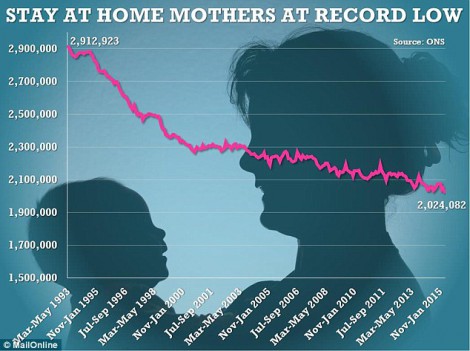
Stay-at-home motherhood falls to record low in the UK

Stay-at-home mothers at a record low in the UK

Dina sent me this article from the UK Daily Mail, and I want to comment on it.

It says:

The number of stay-at-home mothers has hit a record low as more women choose to get a job, new figures reveal.

In the last two decades, the number of women who do not work to look after their home and raise their family has dropped by a third to just over 2million.

[…]The number of stay at home mothers and grandmothers has fallen steadily since records began in 1993.

New official figures show that there are only 2.024 million women out of work to look after a home or family, a 31 per cent fall on 2.913 million in spring 1993.

[…]The sharp turnaround comes after 20 years of social and economic change, with parents increasingly sharing the burden of raising a family and many women reluctant to give up their career once they have children.

In socialist countries like the UK, the majority of the people are so accustomed to big government and dependency that they cannot conceive of shrinking government and letting the private sector and families and churches solve any problem. Right now, the current problem is that they are spending too much on huge numbers of social welfare programs that reward selfish, destructive behavior like men not working, single motherhood by choice, unskilled immigration, welfare that is not means-tested, welfare that is not time-limited, and so on. It is a nanny state, and during election times, all the candidates do is talk about how they want to spend the people’s money to be “nice”. So, you can get breast enlargements, sex-changes and in vitro fertilization (IVF) as part of the country’s bloated “health care” system. So the question is: how will they pay for all this “generosity”? Well, all the political parties agree on the answer: it’s to put in places taxes and policies that make it impossible for women to stay home with their kids instead of working.

More:

David Cameron has promised to double free childcare for three and four-year-olds from 15 hours per week during term time to 30 hours.

The Tories argue the measure will ‘help parents who want to work’.

But critics warn it is discriminating against people who do not want to go back to work.

Claire Paye, spokesman for Mothers At Home Matter, said: ‘The government has set arbitrary targets to get mothers into work and to make sure that they are using government funds to pay to look after those children instead of mothers doing it for free.

‘There is a real concern that the drop in stay at home others is because mothers are being priced out of the home.

‘The government’s only focus is to get mothers into work and they will not support any other family model than two parents working.

‘We are concerned that these figures represent families who are no longer able to choose to look after their own children even if they want to.’

In a House of Lords debate this week, the Bishop of Durham said stay at home parents were made to feel that they are ‘somehow not doing the best for the nation or the child’.

Rt Rev Paul Butler warned of the ‘implicit and not so implicit message that it is better to put your child in childcare and go out to work than stay at home and look after your own children’.

So, we have a couple of points in there. Stay-at-home mothers are shamed for “wasting” their education on raising children. Daycare, which is proven to affect children negatively, especially in the first two years, is set forward as praiseworthy. Tax increases force women out of the home to work, in order to maintain the same-standard of living they had before the higher taxes and big government. And those big social programs almost never go to help married couples – they are primarily there to enable a permanent lifestyle of disfunction.

I thought of a couple more problems. Easily obtainable divorce and sole custody for the mother is a major deterrent to men marrying in the UK. So, of course the marriage rate is in a free fall as men stop trying to get married and settle for stress-free jobs that allow them to scrape by as singles. Why work hard just to support a wife when the whole culture is telling her to divorce you and get alimony and child support for life? And you’ll never see your kids again, either. Easy divorce and easy premarital sex sounded like such a good idea to feminist ears, but they never thought about how men would respond to it. Most men just take the free sex that the feminist Sexual Revolution provides, and decline the responsibility of marriage and fatherhood.

Another problem is that Christian parents these days have a different view of the Christian life than I have. If you look at the shema in Deuteronomy 6:4-9, it’s very clear that parents have a responsibility to teach their kids about God. And that requires a plan to marry well so that the parents have time to teach their kids about God themselves (homeschooling), and put them into schools that will not push secularism on them.

Deut 6:4-7:

4 “Hear, O Israel! The Lord is our God, the Lord is one!

5 You shall love the Lord your God with all your heart and with all your soul and with all your might.

6 These words, which I am commanding you today, shall be on your heart.

7 You shall teach them diligently to your sons and shall talk of them when you sit in your house and when you walk by the way and when you lie down and when you rise up.

Eph 6:4:

4 Fathers, do not provoke your children to anger, but bring them up in the discipline and instruction of the Lord.

Heb 12:9-11:

9 Furthermore, we had earthly fathers to discipline us, and we respected them; shall we not much rather be subject to the Father of spirits, and live?

10 For they disciplined us for a short time as seemed best to them, but He disciplines us for our good, so that we may share His holiness.

11 All discipline for the moment seems not to be joyful, but sorrowful; yet to those who have been trained by it, afterwards it yields the peaceful fruit of righteousness.

As a man, I would of course be delegating a lot of this responsibility to my trusted chief of staff (i.e. – future wife), whose skill in parenting, especially apologetics, would be phenomenal. I would certainly not trust strangers to implement the specification in these Bible verses. If we had to bring in expert Christians – either through Sunday school, lectures, debates and conferences, or through books, DVDs, etc. then we would. But parenting the kids is our responsibility. Secular daycare and secular public schools will not be the main influence on my kids. And I oppose all policies and laws that make the state more influential than us in raising our kids.

Parents have a responsibility to make sure their kids will be Christians into adulthood, and will make a difference for Christ and his Kingdom. But what has happened is that Christianity has become all about me and my feelings. Parents themselves that they don’t have to know whether it’s true, in order to teach it to the children as truth. We think that it just has to make us feel comfortable and peaceful. But that is not the way to raise kids who will make a difference, much less remain Christian in a world like this.

New study: lack of secure attachment during early childhood harms children

This is from the leftist Brookings Institute, a respected think tank I usually disagree with.

They write about a new study:

Attachment theory is founded on the idea that an infant’s early relationship with their caregiver is crucial for social and emotional development. It is an old theory, born during the 1950s. But it can bring fresh light on issues of opportunity and equality today, as a three-decade longitudinal study of low-income children from Alan Sroufe, Byron Egeland, Elizabeth Carlson, and W. A. Collins, all University of Minnesota psychologists, demonstrates.

[…]Small infants are heavily dependent on caregivers, who must respond to their needs. But counter-intuitively, the infants who have a reliable caregiver are also most likely to become self-efficacious later.

Infants (aged 9 to 18 months) with responsive parents learn how their own behavior can impact their environment. This “call and response” process builds the infant’s sense of self-efficacy— one reason parents should pick up the sippy cup, especially for the hundredth time! But this virtuous learning cycle breaks down if the caregiver fails to respond adequately.

Here are the definitions:

  • Secure attachment: When the caregiver (mom, in this study) is present, the infant explores the room and interacts with the experimenter, occasionally returning to the caregiver for support. When the caregiver leaves, the child becomes sad and hesitates to interact with the experimenter, but upon their return, is visibly excited.
  • Anxious/resistant attachment: Regardless of the caregiver’s presence, the infant shows fear of the experimenter and novel situations—these infants cry more and explore the room less. They become upset when the caregiver leaves, and while they approach upon return often resist physical contact, as a form of “punishment”.
  • Anxious/avoidant attachment: No preference is shown between a caregiver and a stranger— infants play normally in the presence of the experimenter and show no sign of distress or interest when their caregiver leaves and returns. The experimenter and the caregiver can comfort the infant equally well.

And here the results:

The Minnesota study found that attachment makes a difference later in life. Without knowing students’ attachment history, preschool teachers judged those who had secure attachments to have higher self-esteem, to be more self-reliant, to be better at managing impulses, and to recover more easily from upsetting events. When teachers were asked which students, among those with serious struggles in class, nonetheless had “a core of inner self-worth, an indication that… maybe they could get better,” they picked students that had secure attachments as infants.

In contrast, children with anxious/resistant attachments:

  • tended to hover near teachers
  • became easily frustrated
  • were more likely to be seen as “dependent” by blinded observers
  • were less competent and patient with puzzles and other cognitive challenges

Children with anxious/avoidant attachments:

  • tended to be apathetic towards other children
  • failed to ask for adult help when stressed
  • were “often self-isolating”

Both groups had higher rates of anxiety and depression as teenagers.

So again, we are seeing that when it comes to parenting, you have to think about what you are doing. That doesn’t mean that you have to be slaves to your kids, or spoil them or hover over them. It means that what you are doing with your kids matters. It means that you need to make a plan to have enough time and money to be able to care for them. I think that the right time to talk about such things is during the courtship.

Also, one more point. If you meet people with some of these short comings, (I had most of the anxious/avoidant ones growing up), then try not to draw lines in the sand where you reject them over these shortcomings. Instead, do what I do. Recognize that these people have value and that if you take responsibility to care for them and supply for their needs, you might be able to guide them to do some pretty amazing things. Don’t be so self-centered that you expect people to be perfect so they don’t need anything from you. Nobody is perfect. Everybody has a story. If you want to be like Jesus, why not start by recognizing the effects of a disrupted childhood through study, and then make a plan to grow people – even difficult ones like me.