Charles Darwin thought that “by far the strongest” evidence that humans and fish are descended from a common ancestor was the striking similarity of their early embryos. According to Darwin, the fact that “the embryos of the most distinct species belonging to the same class are closely similar, but become, when fully developed, widely dissimilar… reveals community of descent.” 2 To illustrate this, German Darwinist Ernst Haeckel made some drawings in the 1860s to show that the embryos of vertebrates (fish, amphibians, reptiles, birds and mammals) look almost identical in their earliest stages.
But Haeckel faked his drawings. Not only do they distort vertebrate embryos by making them appear more similar than they really are (in a way that Stephen Jay Gould wrote “can only be called fraudulent” 3), but they also omit classes and stages that do not fit Darwin’s theory. Most significantly, Haeckel omitted the earliest stages, in which vertebrate embryos are strikingly different from each other. The stage he portrayed as the first is actually midway through development. Yet according to Darwin’s logic, early dis-similarities do not provide evidence for common ancestry.
Haeckel used his faked drawings to support not only Darwinian evolution, but also his own “Biogenetic Law,” which stated that embryos pass through the adult stages of their ancestors in the process of development.
…Haeckel’s drawings were exposed as fakes by his own contemporaries, and his Biogenetic Law was thoroughly discredited by 20th century biologists. It is now generally acknowledged that early embryos never resemble the adults of their supposed ancestors. A modern version of recapitulation claims that early embryos resemble the embryos of their ancestors, but since fossil embryos are extremely rare, this claim is little more than speculation based on the assumption that Darwin’s theory is true.
Now the standard response from Darwinists: no textbooks are still using the fraudulent embryo images.
You can see the actual faked pictures from the modern textbooks here. These textbooks were being produced as late as 2004, even though the fraud was detected in the 1800s! Is this the vaunted self-correction of science, or science being twisted to support social and political goals?
And this excerpt from that article is interesting:
Some Darwinists continue to deny that there has been any misuse of Haeckel in recent times. If that is the case, why did Stephen Jay Gould attack how textbooks use Haeckel in 2000? Gould wrote: “We should… not be surprised that Haeckel’s drawings entered nineteenth-century textbooks. But we do, I think, have the right to be both astonished and ashamed by the century of mindless recycling that has led to the persistence of these drawings in a large number, if not a majority, of modern textbooks!” (emphasis added) Similarly, in 1997, the leading embryologist Michael K. Richardson lamented in the journal Anatomy and Embyology that “Another point to emerge from this study is the considerable inaccuracy of Haeckel’s famous figures. These drawings are still widely reproduced in textbooks and review articles, and continue to exert a significant influence on the development of ideas in this field.” (emphases added)
Here is a link to the peer-reviewed journal Science, where there is an article talking about the fraudulent embryo drawings. Yes – the drawings really are fraudulent.
And finally, Casey Luskin has a new post up at Evolution News that lists all the textbooks that contain the fraudulent drawings. One is dated 2013! The drawings just keep getting recycled over and over as a “proof” of evolution.
I spoke recently to the Faith and Law group on Capitol Hill in D.C., a regular meeting of congressional staffers. At their request, I addressed the topic: “What Should Politicians Say When Asked About Evolution?”
[…]In my talk, I not only gave an answer to the question “What Should Politicians Say When Asked About Evolution?” but I first explained why it is a difficult question for many politicians, especially conservative ones, to answer. There are three main reasons.
I’m only going to give the first reason:
First, the term “evolution” can mean several different things, ranging from (1) the scientifically uncontroversial idea of “change over time” (think of small-scale variations in the shape and size of Galapagos finch beaks) to (2) the more controversial notion of universal common ancestry (think of Darwin’s tree of life) to (3) the increasingly controversial idea that the mechanism of natural selection and random mutation have produced all the forms of life we see today without any guidance or design. The last meaning of “evolution” is what Richard Dawkins calls the “Blind Watchmaker” thesis.
Equivocation in the definition of evolution can make it difficult for a politician to express legitimate skepticism about the controversial meanings of evolution without being presented to the public as being ignorant of established fact, or “anti-science.” In Walker’s recent case, media coverage traded on precisely this ambiguity to present him as being at odds with the majority of the American public, not to mention the scientific establishment. Media outlets repeatedly cited a poll showing that 65 percent of the American people believe that “human beings have changed over time” — i.e., the first and non-controversial meaning of evolution — without mentioning that a huge majority of Americans (and many scientists) reject the third and distinctly controversial meaning of evolution — the idea that the cause of the change over time is an unguided and undirected mechanism.
You can click through and read the other two, but for now, let’s jump to the right way to answer the question:
Most politicians, of course, don’t know about this tumult in the field or of any of the scientific problems with modern Darwinism. They are thus often unnecessarily intimidated by the consensus that supposedly exists in its favor.
In light of all this, any candidate asked about “the theory of evolution” would be well advised to give an answer that affirms the need to teach about contemporary evolutionary theory, but one that also makes clear distinctions between the different meanings of evolution and indicates an awareness of the scientific problems with the standard theory as demonstrated in the scientific literature. And frankly this is not party-specific advice. The scientific literature says what it says, whether consulted by Democrats or Republicans.
Politicians can also say that they think students should learn about those problems since they regard knowledge of the actual status of the theory as a matter of basic scientific literacy. They should not frame the issue as one of “Science versus the Bible,” or answer as if they were being asked about their personal religious beliefs, or as if they think the only alternative to current dogmatic teaching of Darwinian evolution (with its strict insistence on undirected evolution) is to teach Bible-based creationism. They can challenge the dogmatic (and often ideological) way the topic is currently taught and at the same time affirm their commitment to scientific literacy, academic freedom, and critical thinking.
And here’s a sample question and answer:
Reporter: “Do you believe in evolution?”
Candidate: “Of course, I believe that organisms have changed over time. I certainly believe in evolution in that sense. But I am skeptical about unguided evolution — the idea that natural selection and random mutations have produced the major changes in the history of life we observe without any guidance or design. In fact, in peer-reviewed scientific publications, many scientists have expressed doubts about the creative power of natural selection and random mutation. I think that students in learning about the modern version of Darwin’s theory should learn why scientists have these doubts. Understanding the strengths and weaknesses of scientific theories is a matter of basic scientific literacy. And there are scientific weaknesses in modern Darwinian theory.”
This is the right answer because you pull in the majority of people – the young Earth creationists, the intelligent designists and the guided evolutionists. The only people you leave out are the flat-out materialist naturalists, and they are in the minority. So that’s how you answer the question. It would probably help a great deal if you had read both of Meyer’s books on biological evolution, since he writes at the highest level – far higher than left-wing journalists who probably dropped biology because it was too much work.
Dr. Walter L. Bradley (C.V. here) is the Distinguished Professor of Engineering at Baylor.
Here’s a bio:
Walter Bradley (B.S., Ph.D. University of Texas at Austin) is Distinguished Professor of Engineering at Baylor. He comes to Baylor from Texas A&M University where he helped develop a nationally recognized program in polymeric composite materials. At Texas A&M, he served as director of the Polymer Technology Center for 10 years and as Department Head of Mechanical Engineering, a department of 67 professors that was ranked as high as 12th nationally during his tenure. Bradley has authored over 150 refereed research publications including book chapters, articles in archival journals such as the Journal of Material Science, Journal of Reinforced Plastics and Composites, Mechanics of Time-Dependent Materials, Journal of Composites Technology and Research, Composite Science and Technology, Journal of Metals, Polymer Engineering and Science, and Journal of Materials Science, and refereed conference proceedings.
Dr. Bradley has secured over $5.0 million in research funding from NSF grants (15 yrs.), AFOSR (10 years), NASA grants (10 years), and DOE (3 years). He has also received research grants or contracts from many Fortune 500 companies, including Alcoa, Dow Chemical, DuPont, 3M, Shell, Exxon, Boeing, and Phillips.
He co-authored The Mystery of Life Origin: Reassessing Current Theories and has written 10 book chapters dealing with various faith science issues, a topic on which he speaks widely.
He has received 5 research awards at Texas A&M University and 1 national research award. He has also received two teaching awards. He is an Elected Fellow of the American Society for Materials and the American Scientific Affiliation (ASA), the largest organization of Christians in Science and Technology in the world. He is President elect of the ASA and will serve his term in 2008.
Below, I analyze a lecture entitled “Is There Scientific Evidence for an Intelligent Designer?”. Dr. Bradley explains how the progress of science has made the idea of a Creator and Designer of the universe more acceptable than ever before.
1. The correspondence of natural phenomena to mathematical law
All observations of physical phenomena in the universe, such as throwing a ball up in the air, are described by a few simple, elegant mathematical equations.
2. The fine-tuning of physical constants and rations between constants in order to provide a life-permitting universe
Life has certain minimal requirements; long-term stable source of energy, a large number of different chemical elements, an element that can serve as a hub for joining together other elements into compounds, etc.
In order to meet these minimal requirements, the physical constants, (such as the gravitational constant), and the ratios between physical constants, need to be withing a narrow range of values in order to support the minimal requirements for life of any kind.
Slight changes to any of the physical constants, or to the rations between the constants, will result in a universe inhospitable to life.
The range of possible ranges over 70 orders of magnitude.
Although each individual selection of constants and ratios is as unlikely as any other selection, the vast majority of these possibilities do not support the minimal requirements of life of any kind. (In the same way as any hand of 5 cards that is dealt is as likely as any other, but you are overwhelmingly likely NOT to get a royal flush. In our case, a royal flush is a life-permitting universe).
Examples of finely-tuned constants and ratios: (there are more examples in the lecture)
a) The strong force: (the force that binds nucleons (= protons and neutrons) together in nucleus, by means of meson exchange)
if the strong force constant were 2% stronger, there would be no stable hydrogen, no long-lived stars, no hydrogen containing compounds. This is because the single proton in hydrogen would want to stick to something else so badly that there would be no hydrogen left!
if the strong force constant were 5% weaker, there would be no stable stars, few (if any) elements besides hydrogen. This is because you would NOT be able to build up the nuclei of the heavier elements, which contain more than 1 proton.
So, whether you adjust the strong force up or down, you lose stars than can serve as long-term sources of stable energy, or you lose chemical diversity, which is necessary to make beings that can perform the minimal requirements of living beings. (see below)
b) The conversion of beryllium to carbon, and carbon to oxygen
Life requires carbon in order to serve as the hub for complex molecules, but it also requires oxygen in order to create water.
Carbon is like the hub wheel in a tinker toy set: you can bind other elements together to more complicated molecules (e.g. – “carbon-based life), but the bonds are not so tight that they can’t be broken down again later to make something else.
The carbon resonance level is determined by two constants: the strong force and electromagnetic force.
If you mess with these forces even slightly, you either lose the carbon or the oxygen.
3. Fine-tuning to allow a habitable planet
A number of factors must be fine-tuned in order to have a planet that supports life
Initial estimates predicted abundant life in the universe, but revised estimates now predict that life is almost certainly unique in the galaxy, and probably unique in the universe.
Even though there are lots of stars in the universe, the odds are against any of them supporting complex life.
Here are just a few of the minimal requirements for habitability: must be a single star solar system, in order to support stable planetary orbits, the planet must be the right distance from the sun in order to have liquid water at the surface, the planet must sufficient mass in order to retain an atmosphere, etc.
The best non-theistic response to this argument is to postulate a multiverse, but that is very speculative and there is no experimental evidence that supports it.
Evidence #2: The origin of the universe
1. The progress of science has shown that the entire physical universe came into being out of nothing (= “the big bang”). It also shows that the cause of this creation event is non-physical and non-temporal. The cause is supernatural.
Atheism prefers an eternal universe, to get around the problem of a Creator having to create the universe.
Discovery #1: Observations of galaxies moving away from one another confirms that the universe expanded from a single point.
Discovery #2: Measurements of the cosmic background radiation confirms that the universe exploding into being.
Discovery #3: Predictions of elemental abundances prove that the universe is not eternal.
Discovery #4:The atheism-friendly steady-state model and oscillating model were both falsified by the evidence.
And there were other discoveries as well, mentioned in the lecture.
The best non-theistic response to this argument is to postulate a hyper-universe outside of ours, but that is very speculative and there is no experimental evidence that supports it.
Evidence #3: The origin of life
1. The progress of science has shown that the simplest living organism contains huge amounts of biological information, similar to the Java code I write all day at work. This is a problem for atheists, because the sequence of instructions in a living system has to come together all at once, it cannot have evolved by mutation and selection – because there was no replication in place prior to the formation of that first living system!
Living systems must support certain minimum life functions: processing energy, storing information, and replicating.
There needs to be a certain amount of complexity in the living system that can perform these minimum functions.
But on atheism, the living system needs to be simple enough to form by accident in a pre-biotic soup, and in a reasonable amount of time.
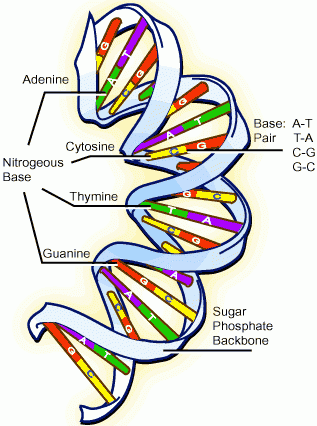
The minimal functionality in a living system is a achieved by DNA, RNA and enzymes. DNA and RNA are composed of sequences of proteins, which are in turn composed of sequences of amino acids.
Consider the problems of building a chain of 100 amino acids
The amino acids must be left-handed only, but left and right kinds are equally abundant in nature. How do you sort out the right-handed ones?
The amino acids must be bound together using peptide bonds. How do you prevent other types of bonds?
Each link of the amino acid chain needs to be carefully chosen such that the completed chain with fold up into a protein. How do you choose the correct amino acid for each link from the pool of 20 different kinds found in living systems?
In every case, a human or other intelligence could solve these problems by doing what intelligent agents do best: making choices.
But who is there to make the choices on atheism?
The best current non-theistic response to this is to speculate that aliens may have seeded the Earth with life at some point in the past.
The problem of the origin of life is not a problem of chemistry, it is a problem of engineering. Every part of car functionality can be understood and described using the laws of physics and chemistry. But an intelligence is still needed in order to assemble the components into a system that has the minimal requirements for a functioning vehicle.



 WINTERY KNIGHT