
Tag Archives: Danger

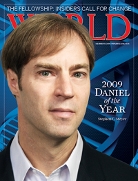
Stephen Meyer is named Daniel of the Year for 2009 by World Magazine

Dr. Stephen C. Meyer

There can be only one. (H/T Evolution News)

Excerpt:

From his office Meyer has ventured forth to debate at least nine prominent Darwinians on CNN, NPR, FOX, the BBC, and other venues. In it he has written numerous newspaper and magazine columns in defense of Intelligent Design (ID), as well as an academic article that became notorious five years ago when Richard Sternberg, a Smithsonian-affiliated scientist, agreed to publish it in the peer-reviewed Proceedings of the Biological Society of Washington.

[…]When Meyer completed his dissertation, “Of Clues and Causes: A Methodological Interpretation of Origin of Life Studies,” the University of Cambridge in 1991 awarded him its prestigious Ph.D. Meyer, having proceeded through questioning and discernment stages, had to decide whether to enter the courage stage. Everyone knows that microevolution—change within species—occurs, but the critical issue is whether the descendants of dinosaurs become birds through natural selection. Denying macroevolution leaves scientists unprotected even at some Christian colleges.

[…]Courage becomes a determinant once we count the cost and see that it’s great. Meyer’s first inkling came when “talking about my ideas to people at Cambridge High Table settings, and getting that sudden social pall.” But the cost was and is more than conversational ease: San Francisco State University in 1992 expelled a professor, Dean Kenyon, who espoused ID, and other job losses have come since.

I met Dr. Meyer for the first time at the Baylor University conference on intelligent design in 2000. He comes across as extremely genuine and approachable. At other conferences, he even remembered my name! I still hold out hope of one day going for a PhD (I even came up with a great idea this week) and it’s largely because of authentic Christian scholars like Dr. Meyer who inspire me with a vision of what is possible.

Understanding the effect of sex on your brain chemistry

This article was sent to me by my friend Andrew. It’s by Marcia Segelstein.

Marcia is trying to make the same point about sex that Miriam Grossmann made in her book “Unprotected”. The point is that although bureaucrats and educrats love to tell people about the riskiness of behaviors like smoking and obesity, they don’t tell people the truth about the dangers of casual sex, because they don’t want to antagonize special interest groups like feminists and gay activists.

In the article, Marcia talks about the mental effects of casual sex. She talks about dopamine first, but the one I want to tell you about is called oxytocin. It is very important that you parents of young ladies understand this and present this evidence to your daughters. (The male version of this phenomenon is also explained in the article, it’s called vasopressin).

Excerpt:

Oxytocin is another important brain chemical we are now learning more about.  Oxytocin helps females, in particular, bond with other people.  When a new mother breastfeeds her infant, for example, oxytocin floods her brain.  The effect is powerful.  She feels a strong desire to be with her baby, and is willing to suffer the sleepless nights and inconveniences that come with having a baby.

Oxytocin also helps females bond with men.  When a woman and man touch each other in a loving way, oxytocin is released in her brain.  It makes her want more of that loving touch, and she begins to feel a bond with her partner.  Sexual intercourse leads to the release of even more oxytocin, a desire to repeat the contact, and even stronger bonding.  But, like dopamine, oxytocin is values-neutral.  It’s a chemical reaction, or, as the authors write: “[I]t is an involuntary process that cannot distinguish between a one-night stand and a lifelong soul mate.  Oxytocin can cause a woman to bond to a man even during what was expected to be a short-term sexual relationship.”  So when that short-term relationship ends, the emotional fallout can be devastating, thanks to oxytocin.

Another significant finding about oxytocin is that it produces feelings of trust.  That can be good or bad, depending on the situation.  “While the hormonal effect of oxytocin is ideal for marriage, it can cause problems for the unmarried woman or girl who is approached by a man desiring sex….[T]he warning is that a woman’s brain can cause her to be blindsided by a bad relationship that she thought was good because of the physical contact and the oxytocin response it generates.”

This is why Dr. Jennifer Roback Morse says that the only smart sex is married sex. Otherwise you are just coarsening your own self. Neil Simpson calls this the duct tape theory of sex. He explains why sex is like duct tape here. Don’t order your children around – give them the data so they understand the why of chastity.