Tag Archives: Culture

Paul Copan explains some responses to postmodernism

Four articles from Paul Copan over at the UK site “BeThinking”. Each article responds to a different slogan that you might hear if you’re dealing with non-Christians on the street.

“That’s just your interpretation!”

Some of his possible responses:

  • Gently ask, ‘Do you mean that your interpretation should be preferred over mine? If so, I’d like to know why you have chosen your interpretation over mine. You must have a good reason.’
  • Remind your friend that you are willing to give reasons for your position and that you are not simply taking a particular viewpoint arbitrarily.
  • Try to discern if people toss out this slogan because they don’t like your interpretation. Remind them that there are many truths we have to accept even if we don’t like them.
  • ‘There are no facts, only interpretations’ is a statement that is presented as a fact. If it is just an interpretation, then there is no reason to take it seriously.

More responses are here.

“You Christians are intolerant!”

Some of his possible responses:

  • If you say that the Christian view is bad because it is exclusive, then you are also at that exact moment doing the very thing that you are saying is bad. You have to be exclusive to say that something is bad, since you exclude it from being good by calling it bad.
  • There is a difference, a clear difference between tolerance and truth. They are often confused. We should hold to what we believe with integrity but also support the rights of others to disagree with our viewpoint.
  • Sincerely believing something doesn’t make it true. You can be sincere, but sincerely wrong. If I get onto a plane and sincerely believe that it won’t crash then it does, then my sincerity is quite hopeless. It won’t change the facts. Our beliefs, regardless of how deeply they are held, have no effect on reality.

More responses are here.

“That’s true for you, but not for me!”

Some of his possible responses:

  • If my belief is only true for me, then why isn’t your belief only true for you? Aren’t you saying you want me to believe the same thing you do?
  • You say that no belief is true for everyone, but you want everyone to believe what you do.
  • You’re making universal claims that relativism is true and absolutism is false. You can’t in the same breath say, ‘Nothing is universally true’ and ‘My view is universally true.’ Relativism falsifies itself. It claims there is one position that is true – relativism!

More responses are here.

“If you were born in India, you’d be a Hindu!”

Some of his possible responses:

  • Just because there are many different religious answers and systems doesn’t automatically mean pluralism is correct.
  • If we are culturally conditioned regarding our religious beliefs, then why should the religious pluralist think his view is less arbitrary or conditioned than the exclusivist’s?
  • If the Christian needs to justify Christianity’s claims, the pluralist’s views need just as much substantiation.

More responses are here.

And a bonus: “How do you know you’re not wrong?“.
Mary Eberstadt: why Christians should promote policies that strengthen marriage

Here’s an interesting post about a new book by Mary Eberstadt. The post is written by historian Benjamin Wiker.

Excerpt:

As the West has become increasingly secularized, the loss of faith has coincided with the destruction of the natural family. The sexual revolution, higher and higher rates of divorce, cohabitation, same-sex marriage—all have combined to make life-long man-woman marital unions an increasing rarity.

Clearly, the rejection of God has led to a rejection, or radical redefinition, of the family.

But in her How the West Really Lost God, Mary Eberstadt bids her readers to look at things from the other end as well. The “decline of the natural family” in the West is not only the effect of the loss of faith, but the cause as well: “the ongoing deterioration of the natural family has both accompanied and accelerated the deterioration in the West of Christian belief.”

Briefly put, “family decline…helps to power religious decline.”

One affects the other because the two go together, argues Eberstadt, like the spiral ladder of the double helix. The fortunes of family and faith correlate, and causation goes both ways. Across the board, regardless of social status or income, the religious tend to have more children than the secular-minded. And the more children a couple has, the more likely they are to go to church.

But that means, of course, that those who are most secular are least likely to have children, and those who are unmarried and/or have no children are least likely to be religious.

That correlation explains the precipitous decline in the birth rate for the most secularized countries of Europe, but allows us to see it in a new light. It is not just that secularization has led to plummeting birth rates in Europe. Europe’s demographic collapse is actually speeding up its secularization.

This is not a correlation that exists only in recent history. The French Revolution gave the West the first self-consciously secular government at the end of the 1700s, and one of its first revolutionary acts was to liberalize its marriage laws. But what people may not realize, was that France was the first country in Europe to experience a decline in fertility rates within marriage, and an increase in cohabitation and illegitimacy, decades before the French Revolution. In the early 1700s, over a half century before the Revolution, illegitimacy was only at 1%, but by the storming of the Bastille, which ushered in the Revolution, France’s illegitimacy rate had climbed to 20% overall, with a 30% rate in the boiling pot of Paris. The French Revolution’s successful attack on Christianity, and the consequent secularization of France, was, in part, the result of the prior erosion of the family.

We see the same pattern in the UK, argues Eberstadt. “In Britain…the decline in births started a century later [than in France] at the very height of Victorian England,…Bit by bit…the same family trends already established in France—fewer births, more divorces, more out-of-wedlock births—also began reshaping the world of Britain. By our own time, over half of all children in Britain are born to unmarried people, and the fertility rate stands at 1.91 children per woman.” Not surprisingly, Britain’s churches are, like those of France, largely empty.

In the Scandinavian countries, like Sweden, where marriage rates are lowest, and divorce, cohabitation, and single-family households, and out-of-wedlock births are the highest, we find the greatest degree of secularization.

The obvious lesson we must draw, says Eberstadt, is “Vibrant families and vibrant religion go hand in hand.”

America is no exception. On the positive side, the baby boom after World War II brought with it a kind of “boom” in religious practice in the US.

But the negative side of the correlation between family and faith is now more evident. Eberstadt quotes the findings of sociologist W. Bradford Wilcox, “The recent history of American religion illuminates what amounts to a sociological law: The fortunes of American religion rise with the fortunes of the intact, married family.”

Now here’s the part that I think is interesting. When you walk into a church, you will find very little, if any, education about the kinds of policies that cause marriages to actually not happen or actually break up.  The trouble is that most pastors are so focused on reading the Bible, and only the Bible, that they have no idea what sorts of policies and incentives cause people to not marry or to not stay married. In order to know that, they would have to be reading outside the Bible, in the scientific literature, and then communicating that knowledge to their flocks to get them to make better decisions and to vote more intelligently.

I think that we need to read more widely in order to know how to reach our goals (promoting marriage, in this case) in a practical way. What can we say to people to show them how to get to marriage? What decisions should they be making now, in order to be ready for marriage later? What policies should we be supporting to nudge people towards marriage? What policies should we be against that make it easier for people to dispense with marriage?

UK survey: nearly 60% of working moms would cut their work hours if they could afford to

Dina tweeted this UK Daily Mail article that made me think about how women vote.

Excerpt:

More than a third of working mothers would like to give up their jobs completely and stay at home with their children, a major Government survey has found.

It showed that millions of mothers of young children who go out to work do so only because they need to work to pay the bills.

The research for the Department for Education found that, far from being anxious to get out of their homes and into employment, the great majority of mothers are only reluctant workers.

Nearly six out of ten of all working mothers would cut down their hours to spend more time with their families if they could afford to, it said.

The yearning among mothers to leave their jobs and look after their children instead is even more pronounced among the highest achieving women, the  survey indicated.

More than two-thirds of those in senior and middle management roles would spend fewer hours in the office and devote more time to their children if they had enough money, it said.

[…]Yesterday’s survey also undermines the claims that prejudice and discrimination against women in male-dominated companies is the reason why women are heavily outnumbered in the boardroom.

Rather, it suggests that many women who could get to the top in business choose instead to put their children before their careers.

The problem is that when government gives people free stuff, people who work have to work more to pay for it. And the strangest thing is that even though women seem to want to stay home with their kids (which is good), when it comes time to vote, they actually vote NOT to stay home with their kids. How? By growing the size of government, which results in higher taxes. To find out what women really think about staying home with their kids, we can look at how they vote. 

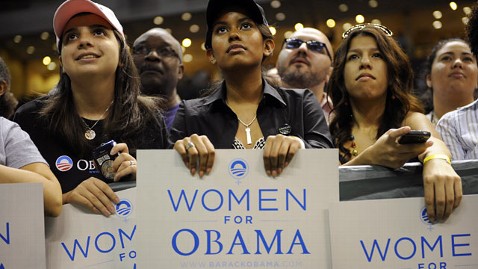
Women voted 55 to 44 for Obama
Women voted 56-44 for more government spending in 2012

CNN reports on how women voted in the 2012 election:

According to CNN’s exit polls, 55% of women and 45% of men voted for Obama and 44% of women and 52% of men voted for Romney. That level of female support for the president made an especially big impact in swing states like Ohio where the gender breakdown mirrored the national figures.

[…]There are some indications that social issues directly impacting women might have helped sway votes in some states.

Tuesday’s early exit polls showed 51% of Missouri voters said they believed abortion should be legal all or most of the time. Of those voters, exit polls showed 76% supported Democratic incumbent Claire McCaskill, who won Tuesday night, while 19% voted for Akin.

Forty-seven percent of Missouri’s voters said abortion should be illegal. Exit polls showed Akin netted 67% of this group’s votes while 27% of people who think abortion should be illegal supported McCaskill.

But much more than social issues, pocketbook economic issues most concerned women voters, exit polling showed.

“Women like all voters felt the economics were most important,” Swers said. “Women tend to be more supportive of government spending… than men are … so they were less responsive to Romney in that way and more responsive to Obama’s message on empathy and helping the middle class.”

Gallup reported that the gender gap in the 2012 election was actually 20 points. That was the largest ever measured in a Presidential election. The actual vote for Obama among women, according to Gallup, was 56-44.

More government means higher taxes
Women are also more pro-abortion more than men

Here is a peer-reviewed research paper that shows the problem that we need to warn women about, so that they vote smarter.

The abstract reads:

This paper examines the growth of government during this century as a result of giving women the right to vote. Using cross‐sectional time‐series data for 1870–1940, we examine state government expenditures and revenue as well as voting by U.S. House and Senate state delegations and the passage of a wide range of different state laws. Suffrage coincided with immediate increases in state government expenditures and revenue and more liberal voting patterns for federal representatives, and these effects continued growing over time as more women took advantage of the franchise. Contrary to many recent suggestions, the gender gap is not something that has arisen since the 1970s, and it helps explain why American government started growing when it did.

When people vote for government to do more for everyone else, then men who work have to pay more in taxes.

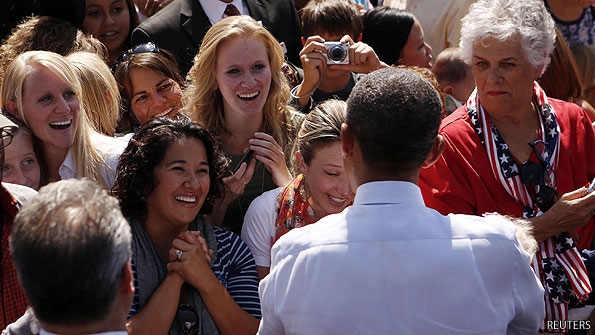
Women for bigger government, higher taxes
Women vote for higher taxes, so they have to work more

If women want to stay home with their children more, then they need to vote for their husbands (present or future) to pay less in taxes when they work. That means voting for smaller government, more liberty and more personal responsibility. Until women get to the point of connecting their future plans (marriage and parenting) for their lives with their current voting, this situation is not going to change. Marriages run on money. It’s no good to urge men to “man-up” and then take away their ability to provide by taxing more of their earnings to pay for Sandra Fluke’s birth control pills and abortions. Keep the money in the family, and then you can stay home with the kids more.