Tag Archives: Conservative

Mitt Romney’s tax returns would make him lose the election to Obama

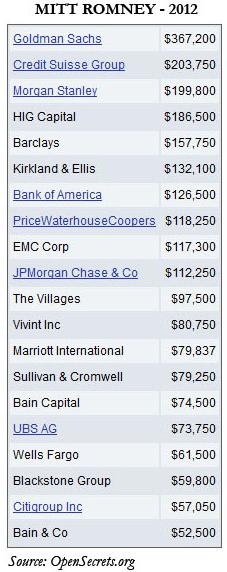
Wall Street Banks contributions to Mitt Romney
Wall Street banks make huge contributions to Mitt Romney

From The Hill. (H/T Riehl Worldview)

Excerpt:

It’s important not to overstate the perils Romney faces. He is still by far the best-funded candidate in the race. He has a state-by-state infrastructure that is the envy of his rivals. Even if he were to lose Saturday’s South Carolina primary, he would  likely remain the overall favorite to clinch the nomination.

But the procession of errors has been striking nonetheless — and it has raised concerns among many in the GOP about his vulnerabilities in a general election contest with President Obama.

Most of Romney’s awkwardness has revolved around questions about his wealth. During a heated exchange during a debate last month, he ill-advisedly offered to bet Perry $10,000 that his own account of what he had written in one of his books was correct. Perry declined, saying he was “not in the betting business,” but the episode heightened perceptions that Romney is out of touch with most Americans.

The same pattern keeps cropping up. Earlier this week, he was asked about the effective tax rate he pays on his income, and managed to injure himself twice in the space of a few sentences. First, he acknowledged that his tax rate was “probably closer to the 15 percent rate than anything.” He then added: “I get speaker’s fees from time to time, but not very much.”

The first claim was almost certainly true. Romney’s income is believed to come chiefly from long-term investments rather than earned income, and that would indeed make him liable for capital gains tax levied at a 15 percent rate. But it still places the multimillionaire in a more lightly taxed band than many voters — something which Newt Gingrich tried to take advantage of with his mocking proposal to introduce a “Mitt Romney 15 percent flat tax.”

Perhaps even worse was Romney’s “not very much” comment. His latest financial disclosure form, which covered the period from February 2010 to February 2011, revealed that he earned $374,327 for speeches. The sum is approximately seven times the median household income in the United States.

Those remarks had been preceded by a televised debate at which he gave a muddled response about whether he would release his tax returns.

Romney flubbed the tax-return question for a second time at a debate last Thursday, eliciting boos from the crowd when he said he would “maybe” follow the example of his late father, former Michigan Gov. George Romney, who released 12 years of tax returns when running for the presidency in 1968.

Romney’s mangled syntax on these occasions seems symptomatic of a wider personal unease in discussing his finances. GOP consultants say he needs to get over that discomfort if he is to prove an effective candidate.

Another concern that I have is that Mitt Romney has $20-100 million dollars in his retirement account.

Excerpt:

Like many Americans, Mitt Romney has an individual retirement account. Unlike most Americans, Mr. Romney has between $20.7 million and $101.6 million in it, a big chunk of his fortune.

Experts on estate planning said it is highly unusual to accumulate such a considerable sum in an IRA, an investment vehicle restricted by annual contribution limits. It appears that Mr. Romney’s grew so large mostly because it holds investments in Bain Capital, the private-equity firm he helped start.

[…]Mr. Romney is one of the richest presidential candidates in decades, and his GOP opponents increasingly are trying to turn wealth into a liability. President Barack Obama is expected to do the same if the former Massachusetts governor wraps up the nomination. Mr. Romney’s tax liability has emerged as a debating point in the GOP nominating contest, a proxy for a bigger argument over who should shoulder the nation’s tax burden.

In recent days, Mr. Romney’s rivals have pressed him to release his tax returns. They have attacked him for his role at Bain Capital, the source of his wealth. When Mr. Romney revealed Tuesday that his effective federal income-tax rate had been about 15% in recent years, both the White House and GOP candidates used the number as a cudgel.

[…]Michael Whitty, a lawyer at Vedder Price in Chicago who advises private-equity executives, said it is impossible to determine from Mr. Romney’s public disclosures how the IRA grew so large. Based on its listed holdings, which include many Bain Capital vehicles, Mr. Whitty theorizes Mr. Romney may have invested in Bain funds through a 401(k)-type plan, or directed some of his Bain holdings into such a plan, which he then rolled into an IRA.

How is he going to explain that? This might be one of the reasons why Romney is not releasing his tax returns. He needs to be pounded on this by Gingrich and Santorum until he drops out – we can’t afford to choose a nominee who has no hope of beating Barack Obama.

Related posts

John Hawkins writes the most scathing anti-Romney column EVER

Quin Hillyer of the American Spectator linked to the Anti-Romney post, and he called it “The Most Scathing Anti-Romney Column, Ever”. The actual title of the post is “Five Ways Conservatives Will Have to Sell Their Souls if Romney Wins”.

Excerpt:

If you were trying to come up with the most atrocious candidate imaginable to go toe-to-toe with Barack Obama in 2012, you couldn’t do much better than Mitt Romney. He was an unpopular moderate governor who lost 2 out of the 3 major elections he’s run in and whose signature issue Romneycare is an enormous failure. Moreover, he’s so uninspiring that he makes Bob Dole look like Ronald Reagan and that’s before you consider his incessant flip-flopping that makes it impossible to really know where he stands on any issue.

Romney’s candidacy also runs counter to almost every political trend in the book right now. He’s the antithesis of everything the Tea Party stands for — a moderate establishment-endorsed, principle-free Rockefeller Republican. On the other hand, he’s like a bad guy straight out of central casting for the Occupy Wall Street crowd, a conscience-free 1 percenter who makes $10,000 bets and lectures the public about how corporations are people — while hordes of poor and middle class Americans that he fired trail in his wake telling tales of woe about how Romney made their lives into a living hell.

At one time, I thought both Gingrich and Perry were more electable than Romney. I have, however, reassessed and now believe Gingrich, Perry, Santorum, and even Huntsman, who just left the race, are ALL more electable than Mitt. It’s also worth noting that all of those candidates, including Huntsman, are more conservative than Romney. It’s mind-boggling to consider the fact that if Romney wins, the conservative base will have chosen the guy behind Romneycare over the man behind the Contract with America, America’s premier social conservative, and the best job-creating governor in America, all of whom would also be more electable.

Here we are in what may be, forgive me for the cliché, the most important election of our lifetimes and the GOP may end up choosing a candidate who’s one part Charlie Crist and one part John Kerry as our nominee. If that’s the case, conservatives should certainly vote for him over Obama. After all, Mitt Romney will undoubtedly often do the wrong thing if he becomes President, but Barack Obama will almost always fail the country. So Romney would definitely be the lesser of two evils.

Yet and still, conservatives will probably have to pay a big price if Romney becomes the nominee. Barring an unforeseen miracle, we’re not going to see someone who was a third rate, unpopular moderate governor become a great, popular, and conservative President. The idea that Republicans in Congress will keep Romney in line isn’t borne out by anything that has happened in the last decade. During the Bush years, time and time again, conservatives in Congress abandoned their principles to follow Bush’s lead. It has been much the same under Obama. Many Democrats were willing to take votes that ended their careers because they felt compelled to stick by Barack. Mitt would have little to fear from the Tea Party or the rest of the conservative base either. After all, his thinking will be, if grassroots conservatives still had any sway in the Republican Party, he wouldn’t be the nominee. What are they going to do after he gets the nomination? Vote for Obama? Same goes if he gets elected. No matter how Nixonian Mitt turns out to be, conservatives will still view our own Massachusetts version of Arnold Schwarzenegger as preferable to whatever socialist the Democrats run against him in 2016.

ANNOUNCEMENT: I am now cross-posting some of my posts at John Hawkins’ Right Wing News, since he gave me permission to guest blog there. Right Wing News is one of the top conservative blogs.

Wall Street Journal: Rick Santorum is a supply-sider for the working man

Just to refresh everyone, a proponent of supply-side economics is someone who believes that economic growth is driven more by innovation and entrepreneurship, and less by consumer spending and government stimulus spending. Supply-siders are all about creating wealth – by letting creative people have the money invent something valuable that consumers will want to buy – like an iPhone or a Kindle. Demand-siders are all about redistributing wealth – by having the government take from one group of people to give it to another group of people – like a Solyndra loan or a Chevy Volt subsidy.

Here’s the Wall Street Journal article about Rick Santorum, and where he fits on the scale.

Excerpt on his economic plan for businesses:

‘I’m someone who believes that making things creates wealth,” says Rick Santorum. It is primary day in New Hampshire, and the former Pennsylvania senator and current presidential candidate is describing his plan to slash corporate tax rates. To encourage companies to make things, he would completely eliminate the federal income tax on manufacturers. For all other businesses, the rate would be cut in half, to 17.5% from 35%.

[…]I ask if his corporate tax plan opens him up to criticism that he and President Obama are both favoring particular sectors of the economy, with Mr. Santorum picking manufacturing while Mr. Obama anoints green energy. “Oh, green energy is not a sector, I mean, come on. It’s like a half-dozen companies,” says Mr. Santorum.

Does this mean the Obama policy would be more legitimate if the president were favoring a larger group of Solyndras?

“He’s talking about handing out tax-free grants and loans,” says Mr. Santorum, who adds that his own plan “is a conservative approach. It’s supply-side. It’s cutting rates. Why are we cutting the corporate rate to 17.5% and making it simple? . . . Because we think it’s what’s necessary to grow the economy. . . . So if what’s necessary to grow the economy in one sector of the economy is different from another, then why should we have the same tax rate?” He argues that manufacturing has been hit particularly hard by the costs of regulation and litigation.

That’s pro-growth – we’re all going to have multiple job offers if he executes this plan – back to 4% unemployment like under Bush.

But what about his economic plan for taxpayers?

Mr. Santorum also believes that making babies creates wealth. It’s very difficult to grow an economy with a shrinking population, he says, pointing to the “demographic winter in Europe” as a cause of that region’s troubles. To help avoid that fate in the U.S., he wants to triple the per-child tax credit and also cut individual tax rates.

[…]On the personal tax side, rewarding child-rearing is consistent with the pro-life views of Mr. Santorum, who has seven children. But the case he makes seems to echo the analysis of some Wall Street economists, who view population growth as a critical advantage the United States will enjoy over China and the euro zone.

Mr. Santorum argues that the cost of Europe’s massive welfare states made it too expensive for young people to have families. He notes that with plummeting birth rates, many European countries have resorted to “baby bonuses” to try to reverse the tide, but the demographic picture remains bleak, while the costs of entitlement programs have exploded.

“Who are benefits promised to, overwhelmingly? Well, they’re promised to older people. And if you have a society like Europe that is upside down where there are a lot more older people than younger people, you have economic calamity,” he says. Asked if giving generous per-child credits will result in an even larger number of households exempt from the income tax and therefore amenable to more spending, he says his plan will drive growth and that, in turn, will bring more people on to the tax rolls. Elimination of deductions might also keep some people paying income taxes. He aims to balance overall taxes and spending at 18% of GDP. Spending has soared to 24% in the Obama era.

In a still-crowded field of non-Romneys trying to compete for the Republican nomination, Mr. Santorum could emerge in the Jan. 21 South Carolina primary as the man who can bring together the old Reagan coalition. A champion of cultural conservatives with a blue-collar background, he is also making the case for deep cuts in federal spending. His credibility on this last issue derives from the political price he paid for being an early promoter of entitlement reform.

And what about his plan for entitlement reform?

To prevent an economic calamity on this side of the Atlantic, he also proposes to cut $5 trillion from federal spending in five years. He calls the plan advanced by House Budget Chairman Paul Ryan “a good starting point,” but he notes that few of the spending cuts happen in the first decade of the plan. Also, Mr. Santorum says that he wants to reform Social Security, not just Medicare and Medicaid. “I like the Ryan plan on the Medicare side. I don’t like waiting 10 years. I don’t like waiting 10 years on anything. I’ve also talked about Social Security.”

Has he ever, going back at least to the 1990s. Says Mr. Santorum, “Some guy just walked up to me at the [New Hampshire campaign] headquarters with a picture of me standing at the presidential podium in Kansas City, Missouri, in April 1998 when I went with Bill Clinton to talk about Social Security reform. I was the Republican lead on the issue,” he recounts, a dangerous proposition for someone representing Pennsylvania, a state with one of the oldest populations in the country. “And I won re-election after that, I might add.”

But after winning that 2000 election—his second Senate victory and his fourth straight win in Democratic territory—Mr. Santorum aggressively backed President George W. Bush’s call for allowing younger workers to own personal accounts.

It’s much easier to contemplate marriage when you 1) have multiple job offers and 2) you are keeping more of what you earn and 3) children are less of a burden on your income and 4) the government is not going to bankrupt those children with out of control entitlements. Marriage-minded men who want to start families will love this plan. It is a signal to men to start working, start marrying and start having children. Men think about these things, you know – losing our jobs, whether our children will be better off than we were, and so on. Santorum gets it – he has a pro-marriage, pro-family economic plan.

Related posts