Canadian police say they have arrested two men and thwarted a plot to carry out a major terrorist attack on a Via passenger train in the Greater Toronto Area.
In a press conference that followed an exclusive report by CBC’s Greg Weston, police named the two accused as Chiheb Esseghaier, 30, of Montreal, and Raed Jaser, 35, from Toronto. They have been charged with conspiracy to carry out a terrorist attack and “conspiring to murder persons unknown for the benefit of, at the direction of, or in association with a terrorist group.”
The two men arrested are not Canadian citizens, police said Monday, but would not provide any details about their nationalities.
The RCMP accused the two men of conspiring to commit an “al-Qaeda-supported” attack.
Police said the two accused were getting “direction and guidance” from al-Qaeda elements in Iran. There was no information to suggest the attacks were state sponsored, police said.
Chief Supt. Jennifer Strachan said the two suspects watched trains and railways in the Greater Toronto Area. There was a specific route targeted, not necessarily a specific train, Strachan said, although she declined to reveal which route was allegedly being targeted.
“We are alleging that these two individuals took steps and conducted activities to initiate a terrorist attack,” she told reporters.
The two men are expected to appear at Old City Hall courthouse in Toronto tomorrow.
With Prime Minister Stephen Harper at the helm, the Conservative Party majority gets the job done again!
Too bad Harper is not in charge down here. Democrats think that only married, Bible-believing small business owning Tea Party conservatives who served in the Armed Forces can be domestic terrorists. They think that William Lane Craig is more likely to be a terrorist than KSM. That’s what they believe.
Blazing Cat Fur is the place to be for the latest news from Canada. Best Canadian blog.
Yeah, I’m pretty sure that the Canadian media will try to blame this on the Amish, or whatever the Canadian equivalent of the Tea Party is. They can’t bring themselves to believe that they made a mistake by ratcheting up unregulated immigration from Muslim countries in order to move their country to the left. Bringing in skilled immigrants who learn English is one thing, but bringing in radical extremists is something else entirely.
Here’s an article from the UK Daily Mail with some more details about her.
Margaret Thatcher stood almost alone in driving through the tough policies now credited with saving the economy, secret papers reveal.
The Tory Premier had to take on her predecessor Harold Macmillan, Bank of England governor Gordon Richardson and even her own Chancellor Geoffrey Howe to push through the policies which pulled Britain back from the brink of economic chaos.
Documents released by the National Archives under the 30-year rule show the pressure Mrs Thatcher faced from the Establishment behind the scenes – and the extent to which she was isolated.
In 1980, the year after becoming Britain’s first female Prime Minister, Margaret Thatcher embarked on a controversial programme to revive the moribund economy through deep public spending cuts and strict control of the money supply, intended to stamp out inflation.
He warned that while her programme of cuts might give a ‘sense of exhilaration’ to her supporters, the country was heading for industrial collapse and ‘dangerous’ levels of unemployment.
Macmillan, then 86, sent the letter following a meeting with the Prime Minister at Chequers in August 1980.
He criticised her for abandoning ‘consensus politics’ to pursue radical reforms and ‘divisive politics’, which he said went against the ‘essence of Tory democracy’.
It was Macmillan who coined the phrase ‘you’ve never had it so good’ in 1957 during the long post-war economic boom.
His brand of consensus politics is now credited with contributing to the economic malaise that brought Britain to its knees in the late 1970s.
Years later, in her memoirs, Mrs Thatcher poured scorn on consensus politics, writing: ‘What great cause would have been fought and won under the banner “I stand for consensus”?.’
[…]In 1981, 365 economists wrote to The Times urging Mrs Thatcher to change course and limit the damage caused by the recession.
But she was unmoved, and her tough stance succeeded in reducing inflation from 27 per cent to four per cent in four years, putting Britain on the road to recovery.
Mrs Thatcher’s economic views were heavily influenced by the right-wing Cabinet minister Sir Keith Joseph, with whom she set up the free market think tank the Centre for Policy Studies in 1974.
Both drew on the work of the influential American economist Milton Friedman whose monetary theories challenged the post-war consensus on economic thinking.
I recommend reading the whole article for some more articles where Lady Thatcher had to stand against everyone and hold onto her convictions in the teeth of the majority.
Here’s an article from Forbes magazine that summarizes her effort to turn Britain around.
Excerpt:
It’s hard to appreciate today how desperate Britain’s condition was before Thatcher took office. Its economy was a laughing stock, the perennial sick man of Europe. Strikes were endemic and union bosses effectively governed the country. Her Conservative Party had long ago made its peace with the welfare state and the ethos of high spending and high taxes. While the previous Tory Prime Minister, Edward Heath, wanted to revive Britain, he hadn’t a clue how to do it. In a make-or-break showdown with the coal miner’s union, Heath called a special election under the banner “Who Governs Britain?” Heath lost and unions’ dominance in Britain seemed secure.
Great leaders have an astute sense of taking advantage of circumstances. Even though Heath had lost two elections, none of the senior party officials would challenge him. At the time, Thatcher was not regarded as one of the party’s major figures. But she was the only Tory who firmly believed in free markets and in Britain’s ability to become again a proud nation based on the principles of liberty. She was a devotee of Friedrich von Hayek and Milton Friedman and of the idea of paring back big government and giving free enterprise room to flourish. Astonishingly she beat Heath in a leadership fight in 1975 and led the Tories to victory in 1979.
Immediately she began slashing income tax rates and reining in galloping spending and fighting inflation. She also exhibited that critical sense of timing. When she took office, she was faced with a potential strike of nurses whose union was demanding huge pay increases. Thatcher compromised in a way that some thought she didn’t have the backbone to turn Britain around. Instead she was exhibiting a great politician’s sense of knowing when to pick a fight. Thatcher eventually pushed through major labor union reforms and made it clear she would not tolerate any union riots or violence. Shortly after Thatcher won reelection, the coal miners union, which had destroyed Heath, decided to take her on. But unlike Heath Thatcher was fully prepared. The big showdown ensued and Thatcher beat the coal miner’s union resoundingly. It never recovered from that defeat.
Thatcher knew the deadweight on the economy of excessive taxation. She cut the top income tax rate from 98% to 40%. She cut the corporate income tax rate from 52% to 35%.
One of Thatcher’s greatest innovations was the systematic selling off of the government’s business assets, dubbed privatization. After World War II Britain nationalized enormous swaths of the economy which actions subsequent Conservative governments left largely untouched. Thatcher sold government companies off and her example has been followed by countless nations around the world.
In the area of privatizations, she did two remarkable things. She sold off much of Britain’s public housing. An enormous number of Britons, far more than in the U.S., lived in these government-owned buildings. Thatcher pushed the sale of these apartments to occupants at low prices and on very advantageous terms. The purpose was to begin to shift the mentality of people and their dependence on government. Her other smart move was in the privatization of government-owned companies: offering a significant number of shares to workers at very low prices. Union leaders hated privatization but their opposition was undermined as their members realized that they could do very well buying cheap shares in these newly-privatized entities. Here again she was changing peoples’ thinking: pro-big government workers now saw themselves as share owners, taking on more of a capitalist mentality.
Before Thatcher, many social observers thought that Britain had an ingrained, unchangeable, anti-commercial culture that would forever stand in the way of the country becoming an economic success. Yet within a decade of her taking office, Britain had the most vibrant, large economy in Europe, one even more dynamic, innovative than that of Germany’s. London became a magnet for entrepreneurs from France, Sweden and elsewhere.
One unchangeable characteristic of a great leader is courage and that means taking career-breaking risks. Thatcher demonstrated her mettle in the Falkland Islands crisis. When the Argentinean military dictatorship seized Britain’s Falkland Islands, most military experts felt the Sceptred Isle simply did not possess the military means to take them back. Defying almost the entire political establishment which was haunted by both Britain’s current weakness and the memory of the Suez Canal debacle in 1956, Thatcher declared that the seizure would not stand and that Britain would go to war to take the Islands back. Thankfully she received critical help from the U.S. thanks to in large part the unrelenting efforts of Defense Secretary Caspar Weinberger (who years later became Publisher and Chairman of Forbes). To the surprise of experts, Britain’s military expedition succeeded. The Argentinean military dictatorship fell and democracy was restored in that country. For Britain the Falklands war was a huge boost to a demoralized nation. To the world it meant that once again tyranny would be resisted.
I recommend reading that whole article. It’s hard not to smile at a woman who clearly loved her country and worked to save it from poverty.
Why good men love Maggie
And now I must offend everyone. See, I have a theory about women. I think that women generally tend to be more beholden to the opinions and fashions of the crowd than men are. It’s not absolute, but it’s maybe two-thirds to one-third, in my experience. I think that it is generally hard for them to hold to their convictions in the face of peer pressure. That’s why so few young, unmarried women are conservative after graduating from college. As soon as they reach college, they are swayed towards liberal views by their need to feel good about themselves and their need to be liked by others. Their views at home were not rooted in real knowledge, they were just fitting in with their families and churches and saying whatever words they were expected to say. And then they go off to college and learn other words to say from another community that uses praise and blame to replace their former convictions with new convictions.
But Maggie Thatcher wasn’t like that. And here’s why:
John Ranelagh writes of Margaret Thatcher’s remark at a Conservative Party policy meeting in the late 1970’s, “Another colleague had also prepared a paper arguing that the middle way was the pragmatic path for the Conservative party to take .. Before he had finished speaking to his paper, the new Party Leader [Margaret Thatcher] reached into her briefcase and took out a book. It was Friedrich von Hayek’s The Constitution of Liberty. Interrupting [the speaker], she held the book up for all of us to see. ‘This’, she said sternly, ‘is what we believe’, and banged Hayek down on the table.” (John Ranelagh, Thatcher’s People: An Insider’s Account of the Politics, the Power, and the Personalities. London: Harper Collins, 1991.)
Policies like unilateral disarmament, wealth redistribution and redefining marriage sound good to many women – especially in college, and especially when only one side is presented and the other side is demonized. The only way to resist ideas that feel good and ideas that get you peer-approval is to have formed your own views through independent study. Lady Thatcher’s economic policies were formed through a study of real economists like Nobel-prize-winning economist F.A. Hayek and Nobel-prize-winning economist Milton Friedman. The reason why she was able to hold to her principles is because she knew what she was talking about, and her opponents did not. She didn’t care about feeling good. She didn’t care about what other people thought of her. She knew was right, and that was enough to sustain her in trying times. She had the knowledge, and her opponents couldn’t change her core convictions by trying to shame her. It didn’t work.
Under plans unveiled in the Budget on Wednesday, families will only benefit from the generous new deal, which will come into force in 2015, if ‘all parents’ have a job. If one parent works but the other stays at home looking after their young children, they will get nothing.
It is the second time in just a few months that the Government has triggered controversy with its changes to the tax and benefit systems, which appear to penalise stay-at-home mothers.
As a result of the recent child benefit changes, a couple can both earn £50,000 and keep their child benefit, worth £1,752 a year for two children.
But a couple where one parent earns £60,000 and the other earns nothing – but have a far lower joint income – do not get a penny.
Again, this week’s initiative favours those couples where both parents go out to work. It will even benefit parents who each earn a salary of £149,999.
Note that this plan is being put forward by socialist Liberal Democrat Party, as well as the “Conservative” Party.
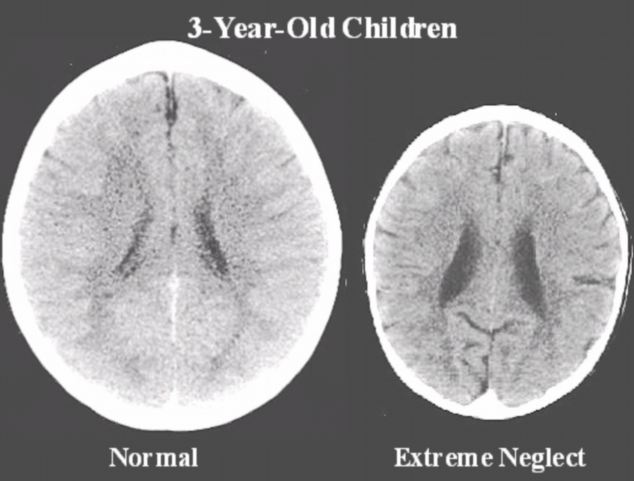
Dina thinks that the science is pretty clear that children suffer if their mothers leave them at a young age. Take a look at the video above, and then the brain scan below.
Brain scans of 3-year old children: normal vs neglected
Here’s the article that goes with the brain scan from the UK Daily Mail.
Excerpt:
Both of these images are brain scans of a two three-year-old children, but the brain on the left is considerably larger, has fewer spots and less dark areas, compared to the one on the right.
According to neurologists this sizeable difference has one primary cause – the way each child was treated by their mothers.
The child with the larger and more fully developed brain was looked after by its mother – she was constantly responsive to her baby, reported The Sunday Telegraph.
But the child with the shrunken brain was the victim of severe neglect and abuse.
According to research reported by the newspaper, the brain on the right worryingly lacks some of the most fundamental areas present in the image on the left.
The consequences of these deficits are pronounced – the child on the left with the larger brain will be more intelligent and more likely to develop the social ability to empathise with others.
But in contrast, the child with the shrunken brain will be more likely to become addicted to drugs and involved in violent crimes, much more likely to be unemployed and to be dependent on state benefits.
The child is also more likely to develop mental and other serious health problems.
Professor Allan Schore, of UCLA, told The Sunday Telegraph that if a baby is not treated properly in the first two years of life, it can have a fundamental impact on development.
He pointed out that the genes for several aspects of brain function, including intelligence, cannot function.
[…]The study correlates with research released earlier this year that found that children who are given love and affection from their mothers early in life are smarter with a better ability to learn.
The study by child psychiatrists and neuroscientists at Washington University School of Medicine in St. Louis, found school-aged children whose mothers nurtured them early in life have brains with a larger hippocampus, a key structure important to learning, memory and response to stress.
The research was the first to show that changes in this critical region of children’s brain anatomy are linked to a mother’s nurturing, Neurosciencenews.com reports.
The research is published online in the Proceedings of the National Academy of Sciences Early Edition.
Lead author Joan L. Luby, MD, professor of child psychiatry, said the study reinforces how important nurturing parents are to a child’s development.
This is why I argue that feminism, which is the ideology that demands that women work outside the home in order to be “equal” to men, is harmful to children. If we really cared about children, then we need to not be subsidizing the child abuse schemes of Liberal Democrats like Nick Clegg. We need to be clear that gender feminism (third-wave feminism) is an anti-child ideology and it should be opposed. The science is settled on this issue. Feminism harms innocent young children. And feminism isn’t just opposed to the rights of born children. They oppose the right to life of unborn children, too.


 WINTERY KNIGHT