
Tag Archives: Competition

Louisiana governor Bobby Jindal delivers effective education reform

Bobby and Supriya Jindal

Looks like Republican governor Bobby Jindal made it into the Wall Street Journal.

Excerpt:

Governors of both parties have promoted education reform, but so far no one has delivered more than Louisiana’s Bobby Jindal. This week he’ll sign two bills that offer a national model for competition and parental choice.

Louisiana’s new laws will essentially give all parents an average of $8,500 to use for their child’s education as they see fit. They can keep their child in their local public school, but they can also try to get Johnny into a more demanding charter school, or a virtual school, or into special language or career-training courses, among other options.

Nearly 400,000 low-income children—a bit more than half of all students—will also be eligible for vouchers to attend private schools. State officials estimate that about 2,000 students will use vouchers this September given private-school capacity limits, but that tens of thousands will do so over time.

Louisiana is also making life easier for charter schools, with new authorizing boards, a fast-track for high-performing networks, and access to facilities equal to that of traditional public schools. The new laws seek to strengthen superintendents and principals over local school boards, which are bastions of bureaucratic and union intransigence.

Nearly as dramatic are reforms in teacher tenure. To earn tenure, teachers will now have to rate in the top 10% (measured in part by student performance) for five of six consecutive years, and any teacher who falls into the bottom 10% loses tenure. No teacher in the bottom 10% can get a raise, while layoffs will no longer hit the junior-most teachers first while ignoring performance.

Mr. Jindal made school reform a second-term priority after winning a landslide re-election last November. By then he had appointed or helped elect reformers to the state superintendent’s office and board of education.

Louisiana voters also had a preview of reform’s potential. Since Hurricane Katrina in 2005, New Orleans schools have become almost exclusively charters—with dramatic academic improvements—and the city has run a small and oversubscribed voucher program since 2008. As for tenure, the reforms attach consequences to a teacher-evaluation system enacted in 2010.

The result: the reforms attracted bipartisan legislative majorities of roughly 60%. Over four votes (two different bills, each having to pass the House and Senate), one-quarter to one-half of Democrats voted for reform, including many black representatives, especially those from New Orleans.

Teachers unions were predictably opposed and even heavier-handed than usual. Michael Walker Jones of the Louisiana Association of Educators dismissed choice on grounds that “If I’m a parent in poverty I have no clue because I’m trying to struggle and live day to day.” Unions pushed principals to cancel school—sometimes giving parents less than 24 hours notice—so teachers could protest at the state Capitol. It was a tired act.

Mr. Jindal joins Indiana’s Mitch Daniels in passing the most far-reaching school reforms, and now they’ll have to follow through to produce better student outcomes. Unions will seize on any troubles as a sign of failure, but success might catalyze similar reforms across the country that could finally improve the life prospects for all American children.

Now is a good time to compare and contrast those reforms with the record of the Obama administration:

The Democrats worked with the teacher unions to kill voucher programs for the poorest students in Washington DC, many of them minority students.

Excerpt:

“House and Senate Appropriators this week ignored the wishes of D.C.’s mayor, D.C.’s public schools chancellor, a majority of D.C.’s city council, and more than 70 percent of D.C. residents and have mandated the slow death of the D.C. Opportunity Scholarship Program. This successful school voucher program–for D.C.’s poorest families–has allowed more than 3,300 children to attend the best schools they have ever known.

The decision to end the program, a decision buried in a thousand-page spending bill and announced right before the holidays, destroys the hopes and dreams of thousands of D.C. families. Parents and children have rallied countless times over the past year in support of reauthorization and in favor of strengthening the OSP.

Yet, despite the clearly positive results and the proven success of this program, Sen. Dick Durbin, Rep. Jose Serrano, Del. Eleanor Holmes Norton, and Secretary Arne Duncan worked together to kill the OSP. Funding the program only for existing children shrinks the program each year, compromises the federal evaluation of the program, denies entry to the siblings of existing participants, and punishes those children waiting in line by sentencing them to failing and often unsafe schools.

What is incredibly disappointing to low-income families in Washington, D.C. has been the silence of President Barack Obama. The President, who benefited from K-12 scholarships himself, worked on behalf of low-income families in Chicago, and exercises school choice as a parent, has stood silently on the sidelines while his Secretary of Education belittled the importance of helping such a small number of children in the nation’s capital.”

Another Wall Street Journal article explains why voucher programs work for children. They don’t work for teacher unions, and that’s why Democrats oppose them.

Excerpt:

In a study published last year, Patrick Wolf of the University of Arkansas found that voucher recipients had graduation rates of 91%. That’s significantly higher than the D.C. public school average (56%) and the graduation rate for students who applied for a D.C. voucher but didn’t win the lottery (70%). In testimony before a Senate subcommittee in February, Mr. Wolf said that “we can be more than 99% confident that access to school choice through the Opportunity Scholarship Program, and not mere statistical noise, was the reason why OSP students graduated at these higher rates.”

The administration downplays these findings. But the students who attend D.C. public schools are overwhelmingly black and poor, and the achievement gap has a particularly devastating impact on their communities. High school dropouts are eight times more likely than someone with a diploma to wind up behind bars. Some 60% of black male high school dropouts in their 30s have prison records. And nearly one in four young black male dropouts is in jail or juvenile detention.

Mr. Obama says he wants to help all students—not just the lucky few who receive vouchers. But that’s an argument for offering more vouchers to those in need, not for reducing school choice. Policies ought to be weighed against available alternatives, not some unattainable ideal. The alternative to a voucher for families in D.C. ghettos and elsewhere is too often a substandard public school.

The positive effects of the D.C. voucher program are not unique. A recent study of Milwaukee’s older and larger voucher program found that 94% of students who stayed in the program throughout high school graduated, versus just 75% of students in Milwaukee’s traditional public schools. And contrary to the claim that vouchers hurt public schools, the report found that students at Milwaukee public schools “are performing at somewhat higher levels as a result of competitive pressure from the school voucher program.” Thus can vouchers benefit even the children that don’t receive them.

Research gathered by Greg Forster of the Foundation for Educational Choice also calls into question the White House assertion that vouchers are ineffective. In a paper released in March, he says that “every empirical study ever conducted in Milwaukee, Florida, Ohio, Texas, Maine and Vermont finds that voucher programs in those places improved public schools.” Mr. Forster surveyed 10 empirical studies that use “random assignment, the gold standard of social science,” to assure that the groups being compared are as similar as possible. “Nine [of the 10] studies find that vouchers improve student outcomes, six that all students benefit and three that some benefit and some are not affected,” he writes. “One study finds no visible impact. None of these studies finds a negative impact.”

Such results might influence the thinking of an objective observer primarily interested in doing right by the nation’s poor children. But they are unlikely to sway a politician focused on getting re-elected with the help of teachers unions.

There is a difference between Demcorats and Republicans, and the difference is that Republicans think that children do better when their parents can choose a school that works for their child. Republicans are the evidence-based party – they do what’s right. But Democrats do whatever it takes to please their special interest groups.
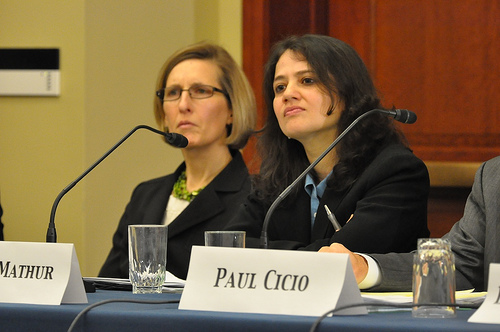
New paper on income inequality: Does taxing the rich hurt the middle class?

Aparna Mathur (right)

Here’s an article by Indian economist Aparna Mathur.

She writes (in part):

In a recent paper that I co-authored with Kevin Hassett, we explored the effect of high corporate taxes on worker wages. The motivation for the paper came from the international tax literature (summarized by Roger Gordon and Jim Hines in a 2002 paper1) that suggested that mobile capital flows from high tax to low tax jurisdictions. In other words, in any set of competing countries, investment flows are determined by relative rates of taxation. The current U.S. headline rate of corporate tax is 35 percent. The combined federal and state statutory rate of 39 percent is second only to Japan in the OECD. With Japan set to lower its statutory rate later this year, the U.S. rate will soon be the highest in the OECD and one of the highest in the world. What effect do these high rates have on worker wages?

When capital flows out of a high tax country, such as the United States, it leads to lower domestic investment, as firms decide against adding a new machine or building a factory. The lower levels of investment affect the productivity of the American worker, because they may not have the best machines or enough machines to work with. This leads to lower wages, as there is a tight link between workers’ productivity and their pay. It could also lead to less demand for workers, since the firms have decided to carry out investment activities elsewhere.

Our paper was one of the first to explore the adverse effect of corporate taxes on worker wages. Using data on more than 100 countries, we found that higher corporate taxes lead to lower wages. In fact, workers shoulder a much larger share of the corporate tax burden (more than 100 percent) than had previously been assumed. The reason the incidence can be higher than 100 percent is neatly explained in a 2006 paper by the famous economist Arnold Harberger.2 Simply put, when taxes are imposed on a corporation, wages are lowered not only for the workers in that firm, but for all workers in the economy since otherwise competition would drive workers away from the low-wage firms. As a result, a $1 corporate income tax on a firm could lead to a $1 loss in wages for workers in that firm, but could also lead to more than a $1 loss overall when we look at the lower wages across all workers.

Following our paper, several academic economists substantiated our results, using different data sets and applying varied econometric modeling and techniques. Some examples of these studies include a 2007 paper by Mihir A. Desai and C. Fritz Foley of Harvard Business School and James Hines Jr. of Michigan University Law School, a 2007 paper by R. Alison Felix of the Federal Reserve Bank of Kansas City, a 2009 paper by Robert Carroll of The Tax Foundation, and a 2010 paper by Wiji Arulampalam of the University of Warwick and Michael Devereux and Giorgia Maffini of Oxford.3 A recent Tax Notes article that I co-authored summarizes these various studies and also the lessons from the theoretical literature on the topic. The general consensus from theory and empirical work is that while we may argue academically about the size of the effect, there is no disagreement among economists that a sizeable burden of the corporate income tax is disproportionately felt by working Americans. On average, a $1 increase in corporate tax revenues could lead to a dollar or more decline in the wage bill.

Conservatives and liberals have the same goal. We both want to help the poor. Liberals think that taking money from the rich and giving it to the poor helps, but all it does it cause the rich to move their capital and jobs elsewhere, leaving the poor poorer. Conservatives let the rich keep their money and encourage them to risk it trying to make more money by engaging in enterprises that create wealth – creating products and services from less valuable raw materials. In a socialist system, the rich get poorer, but so do the poor. In a capitalist system, the rich get very rich, but the poor also gain more wealth. That’s what happens when corporations like Apple make IPads out of junky raw materials. That’s how wealth is created – by letting people who want to make things keep more of what they earn. We all benefit from encouraging people to make new things and provide value for their neighbors.

Related articles

Why social conservatives should support free market capitalism

The free enterprise system should not be adopted simply because it is the best system for creating wealth. The best reason to support free market capitalism is a moral reason. Arthur Brooks, President of the American Enterprise Institute, and a Christian, describes the moral argument for free market capitalism.

Excerpt:

It might seem that the best case for free enterprise is the material one. Free enterprise lets people make more money, buy more and nicer stuff, and have a greater degree of comfort. The freer our economy is, the more competitive the US economy is vis-à-vis the rest of the world. And so on.

But these aren’t our best arguments. There is another reason, a transcendent reason, for which free enterprise matters most—and this is the case we all must be able to make today.

We all learned early on in school that the Declaration of Independence claimed for each of us the unalienable right to “life, liberty, and the pursuit of happiness.” Note that the founders didn’t assert a right to be happy; such is the domain of tinpots and crackpots, of 1984’s “Ministry of Plenty” and Josef Stalin’s aggrandizing self-description as the Soviet Union’s “Constructor of Happiness.” So what, in practice, does this right to pursue happiness mean?

It means the right to define and earn our happiness through our ideas, hard work, and gumption, to earn our success by creating value honestly, in our own lives and in the lives of others. It doesn’t mean the pursuit of a big lottery win or an inheritance. Those bring money, but not happiness. And a mountain of evidence shows that after a fairly low threshold, more money doesn’t make us happier. The best case for free enterprise has nothing at all to do with money or material goods or wealth. Those are just icing on the cake. We must stop talking about free enterprise as just an engine of wealth creation. It’s much more than that.

In short, the secret to the pursuit of happiness is earning our own success; creating value with our lives and in the lives of others. This earned success is the fruit of hard work and just rewards in a system built on merit. Only in a free enterprise system is effort and innovation rewarded over connections and predation. (And this means that we have to draw a distinction between free enterprise, which is based on opportunity and competition between ideas, and corporate cronyism, which is just another form of statism masquerading as free enterprise.)

Here are 3 reasons why I think that social conservatives should support free market capitalism.

1) Right to work

It’s very important for Christians to have an economic system in place that allows them to work without having to promote anti-Christians ideas. But when government gets too big, what happens is that Christians are no longer free to take any job they want, and still keep a clear conscience. In some states, you have to join a union which uses your union dues to elect Democrats, who very often are liberal on social issues. Or, you have big government forcing Christians to perform abortions against their consciences. Or, you have big government forcing Christian organizations to provide health insurance plans that cover abortions and contraceptives. That’s why Christians need to vote against big government regulations on employment – we need the freedom to work at a job that does not violate our consciences.

2) Right to earn

It’s very important for Christians to keep what they earn so that they have the maximum amount of money to make decisions that make sense for them, according to their consciences. Take the example of day care and education. The big government statist is constantly trying to to create more and more government-run day care and public schools. Why? They want to take money away from families so that they cannot afford individualized private and parochial schools, and lump them all into government run schools that are more “equal”. The problem is that this is bad for Christians who want more oversight into what their children learn. For example, what sense does it make for a Christian man to pay for day care and public schools when he marries a teacher who becomes a stay at home homeschooling mother for his children? He has to pay for day care and public schools he will never use, and it eats into the money he has to afford a stay-at-home homeschooling mom. Christians should oppose a day care and education system run by a secular leftist government. They will never reflect the values of Christian parents.

3) Right to spend

It’s very important for Christians to have the freedom to purchase products and services that make sense in their worldview. Take the example of health care. Secular leftists would love to force private medical insurance companies to cover things like abortion and contraception as health care. In some states, these things are specified as mandatory for every health care plan. That means that Christians who purchase health care are being forced to pay for services like abortion which they will never use themselves. This is nothing more than the redistribution of wealth in order to lower the cost of abortions for people, in order to encourage them to be sexually active before they are able to accommodate children. Christians need to oppose this – we do not want to have to pay for things that go against our consciences.

So, in addition to the reasons that Brooks mentioned (the happiness of earning your own way and serving others), it’s important for Christians to understand how free market capitalism fits into their plans. We do not want to support big government, especially when big government so often is not compatible with Judeo-Christian values. In the free market, it is much harder for ALL the businesses to conspire together to block Christians from working, earning and spending according to their consciences. We must resist top-down control of the free market so that we have the liberty to do what we ought to do in order to be virtuous.