
Tag Archives: Christianity

New study: intact heterosexual married home still critical for children’s academic success

Sometimes, when you’re discussing reality with progressives, it helps to have a study. Because although you might think that conservatism is common sense, they think that their feelings are common sense. So you will have to give them evidence, and then call them stupid, until they either accept your evidence or run away screaming back to the New York Times building.

Anyway, here’s the research from the Institute for Family Studies:

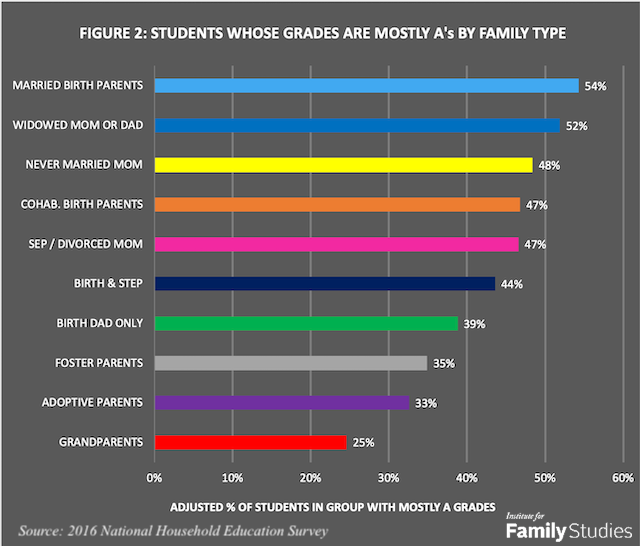
Beginning with the 1966 Coleman Report, a long line of studies have found that students from intact, married families do better in school than those from disrupted or unmarried families.5 My own analysis of data from a longitudinal study conducted by the U.S. Department of Education (the ECLS-K) demonstrated the impact that family transitions, such as parental divorce and remarriage, have on students’ task persistence and eagerness to learn, emotional distress, and misbehavior resulting in school disciplinary actions such as suspension.6 IFS studies of trends in Arizona, Florida, and Ohio indicate that school districts tend to be more successful and safer when more of their families are headed by married parents.7

And there’s a graph to go with it. Actually, several, but I just chose this one.
Why can't non-STEM sociologists use apostrophes properly?
Why can’t non-STEM sociologists use apostrophes properly? It’s As not A’s

And here’s the conclusion:

The analyses showed that schoolchildren who live with both married parents do better on each of the three educational progress indicators. Children from married-couple families did better even after controlling for socioeconomic and demographic correlates of family structure.

They’ve also got graphs for student misbehavior by family type, and student disciplined by family type. Naturally, the traditionally family far outperforms the alternatives.

Now the first thing that a progressive will tell you is that adding more money from government social programs will solve the problem, so we just need to have more communism, and give the children to strangers at earlier ages. But the study corrects for socioeconomic factors. And demographic factors, too. So that deflection isn’t going to work.

J. Warner Wallace: I am not a Christian because it works for me

Some of my favorite Christians are the ones that start out as atheists, and do very well at life, but just change direction because they investigate the evidence. One person who had a fabulous career in law enforcement switched sides because of the evidence: J. Warner Wallace. And in a must-read post from Cold-Case Christianity, he explains his motive.

Excerpt:

Life on this side of my decision hasn’t always been easy. It’s been nearly seventeen years since I first trusted Jesus as Lord and Savior. I still struggle to submit my prideful will to what God would call me to do. Christianity is not easy. It doesn’t always “work” for me. There are times when I think it would be easier to do it the old way; easier to cut a corner or take a short cut. There are many times when doing the right thing means doing the most difficult thing possible. There are also times when it seems like non-Christians have it easier, or seem to be “winning”. It’s in times like these that I have to remind myself that I’m not a Christian because it serves my own selfish purposes. I’m not a Christian because it “works” for me. I had a life prior to Christianity that seemed to be working just fine, and my life as a Christian hasn’t always been easy.

I’m a Christian because it is true. I’m a Christian because I want to live in a way that reflects the truth. I’m a Christian because my high regard for the truth leaves me no alternative.

I think this is important. There are people who I know who claim to be Christian, but they are clearly believing that God is a mystical force who arranges everything in their lives in order to make them happy. They are not Christians because it’s true, but because of things like comfort and community. But people ought to become Christians because they think it’s true.

Truth doesn’t necessarily make you happy, though. Truth can impose intellectual obligations and moral obligations on you. Seeing God as he really is doesn’t help us to “win” at life, as the culture defines winning. But it does offer the opportunity for us to walk a similar path to the one Jesus walked. And that is very appealing for real Christians.

The Bible doesn’t promise that people who become Christians will be happier. Actually, it promises that Christians will suffer for doing the right things. Their autonomy will suffer, as they sacrifice their own interests and happiness in order to make God happy, by serving his interests.

Christianity isn’t something you add on to your before-God life in order to achieve your before-God goals. When you become a Christian, you get a new set of goals, based on God’s character and his design for you. And although you might be very successful in the world as part of serving God, there is no guarantee of that. Christianity is not life enhancement. I do think that Christians do well at not hurting themselves though, but because they eliminate selfish desires, not because God gives them stuff.

By the way, if you’re looking for a great speaker to invite to your university campus, J. Warner Wallace is the best, then Frank Turek is my number two choice. Wallace has the homicide detective background, and Turek is a former naval aviator. Two tough guys who are tough-minded about the Christian faith.

Brian Auten interviews Jay Richards about Christian apologetics

Recently, I picked up the audio book version of “The Privileged Planet”, which is a book by philosopher / economist Jay Richards and astronomer Guillermo Gonzalez. This book is different from books about the origin of the universe and cosmic fine-tuning. It talks about what it takes to make a habitable planet. And it talks about how the habitable places in the universe are also the best places to make scientific discoveries.

Christian scholar Jay Richards was interviewed by Brian Auten of Apologetics 315.

The MP3 file is here.

Topics:

  • What is intelligent design (ID)?
  • Is ID specifically Christian?
  • How does ID helpful to Christian apologetics?
  • What does ID prove?
  • Is it OK to use an argument that doesn’t prove Christianity specifically?
  • What is the difference between deism and theism?
  • Do ID arguments get you to deism or theism?
  • What is materialism, and how can you challenge it?
  • How do opponents of ID define ID?
  • What factors do you need to make a habitable planet?
  • Are habitable planets common or rare in the universe?
  • What is “The Privileged Planet” hypothesis?
  • Is there an overlap between habitability and suitability for making scientific discoveries?
  • What is the “Copernican Principle”?
  • Has the progress of science made Earth seem common and ordinary?
  • What is the most Earth-like planet that we’ve ever discovered?
  • How should ID proponents respond to the objection that creatures aren’t perfect?
  • Does having a big moon make a planet more or less habitable?
  • Does a planet’s distance to the Sun make that planet more or less habitable?
  • How do these two habitability factors affect the observability of solar eclipses?
  • What does co-relation between habitability and “discoverability” tell us about God?
  • How important is training in philosophy to Christian apologetics?
  • What one thing should a Christian apologist work on to be more effective?

If you’d like to learn more about his book “The Privileged Planet”, you can find out more here. I recently bought the audio book version of the book.