Tag Archives: Christianity

Does the church do a good job of equipping Christians to talk to non-Christians?

Most churches these days are not doing a good job of helping Christians to understand how to explain and defend Christianity to non-Christians. They tend to be focused on providing comfort and entertainment, which is why so much of the focus is on compassion, singing and being “nice”. Logical arguments are out. Scientific evidence is out. Historical evidence is out. There is a terrible fear of disagreeing with anyone. Everyone is focused on being “nice” and being “liked” by non-Christians. Instead of teaching people what Christians think is true, we teach people how to recycle cans and how to color pictures of Jesus.

Church is typically a mishmash of mysticism, piety and emotivism. Pastors in particular are often opposed to connecting anything the Bible says to evidence outside the Bible, whether it be research or experiments or philosophical arguments. Even the very best preaching pastors just assert things and then expect people to accept it because “the Bible says so”. It’s almost as if it dirties up Christianity to test it against what we know from other disciplines like cosmology and ancient history. People who are regarded as Christian leaders seem to never get around to explaining why anyone should accept the Bible as true.Accepting the Bible is just left up to your feelings, or maybe whether you think the pastor is “nice”. That’s it.

Now how well does this simple, blind-faith be-nice approach work on a real non-Christian?

Mary sent me this article from the New Statesman that explains how it works.

Excerpt:

It’s 7.30pm on a Tuesday evening and I’m at a small church in East London. A man called Adam* hands me a name label, pours me a plastic cup of squash and says dinner won’t be long. I pull up a seat and introduce myself to ten strangers. It’s all rather awkward.

The reason I’m at church isn’t because I’m religious (I’m not) or because my fridge is empty (it is). It’s because I’ve signed up to Alpha, a weekly course run by churches all over the world in order to spread the Christian message. Although I’m an atheist, I don’t have a problem with people who subscribe to religion. I am, however, wary of brainwashing, I think most religious beliefs are kind of stupid and I strongly suspect that organised religion is a horrible thing.

[…]Adam, the course leader, is wearing a Superdry shirt. After dinner, he explains that it’s customary to sing. Rebecca plays the acoustic guitar and Adam mans the PowerPoint presentation, which would have got an A* if it was a piece of ICT GCSE coursework because the lyrics make noises when they appear on the screen.

Now, why on Earth would you make a non-Christian sing?? That makes no sense. If they don’t accept Christianity, why would they sing about it?

More:

After singing comes talking. Specifically, Adam talking. Over the next six weeks, his talks will cover: “Is there more to life than this?”; “Who is Jesus and why did he die?”; “How can we have faith?”; “How can we read the Bible?”; “Why and how do I pray”; and “What about the Church?”. After each talk, we’ll break off into groups and discuss what we’ve learnt.

The first couple of sessions are similar. They involve Adam handing out copies of the Bible and saying things like, “So let’s assume Jesus does exist and came to Earth to save us…” I’m genuinely the only person who is annoyed that Adam makes no attempt to prove Jesus’s existence.

The first questions to address are thing like “Does God Exist?” and “Did Jesus Rise From the Dead?” and “Why Should People Think the Bible is Historically Reliable?”. But those questions cannot be asked by Christians, because they are totally unaware, thanks to years and years of avoiding apologetics, that those questions come before praise hymns and Bible study and prayer. Christians are so unaware that they don’t even realize how to discuss Christianity with a non-Christian, using authorities like logic, science and history, which non-Christians accept.

More:

Adam’s big points in the first two weeks are that we should love Jesus because he loves us in spite of our tendency to sin and that we should try to emulate his behaviour, because it’s nice to have a role model.

Discussion time isn’t fruitful. Natalie asks me how I’m able to distinguish between moral and immoral behaviour if I don’t base my actions on Jesus’ example. I explain that I work out what makes my peers happy and try to do those things. Everyone laughs, which I find confusing because I’m not joking. I agree that having a role model can be helpful, but ask how they know Jesus is the best one. Anna and Will, who are married, tell me that it’s because the Bible said so. But how do they know the Bible is right? “No offence, Tabatha,” replies Louise, “but the Bible is quite far-fetched. I don’t get why someone would have made that stuff up if it weren’t true.” It sounds like I’m lying, but I’m not.

[…]This week, Adam’s main point is that Christianity isn’t about rules. Fine, but there’s still no attempt to prove God’s existence.

What is going on here? It’s that Christians are basically no different than cultists. We think that it’s our jobs to just tell people things without ever proving anything with science or history. We don’t know how to construct logical arguments. All we do is say what we believe and then hope that the person listening will accept it because “the Bible says so” or maybe because it makes the person feel like a nice person to accept it.

More:

Then we talk about which bits of the Bible we should take literally. Louise tells me I’ll work it out if I read the Bible. I tell her I’ve read it. She says I will never develop a full understanding because I’m not God so I can’t understand everything. This is becoming a recurring theme. These people have answers to some problems, but as soon as they hit a brick wall they settle for not understanding God and refuse to think through alternatives.

Wow, how do Christians handle questions that they don’t know the answer to? By going and finding the answer? NO! We think that it’s not our job to find answers to this skeptic’s questions, it’s the skeptic’s job to find answers. We hand the work to the skeptic to do, instead of doing the work for them. Finding answers is work, and if Christianity is about anything, it’s apparently about avoiding work. That’s what we learn in church, anyway.

More:

This week, Leslie, a priest from the church, speaks about evolution, which has to be our most interesting topic to date. “How do I know evolution isn’t true?” he begins, continuing: “Because God revealed himself to me through scripture.” This annoys me: these people keep saying really obscure things and not explaining them. Leslie explains that scripture is “God-breathed,” so when you read the Bible, God is speaking directly to you. I’m not an idiot but I have absolutely no conception of what that means.

This is pretty much the answer you’re going to get from most pastors and church people, even in a time where we have amazing arguments coming out of the intelligent design community about the origin of life and the Cambrian explosion. And even without talking about evolution, we could be talking about the Big Bang cosmology and the cosmic fine-tuning. But those things can’t be talked about because they are just too “real” and we want to keep religion in the realm of try-it-and-see-if-you-like-it bromides.

More:

Leslie goes on to offer practical Bible-reading advice: you should read it for 15 minutes a day and ask God questions by verbalising your thoughts. By this stage, I’m annoyed. I want to know why we should read the Bible, how they know it’s true, what God sounds like and how He chooses which prayers to listen to. Instead, Leslie says things like, “If we pray, we become trees. Trees grow fruit, so we will live fruitful lives.” This kind of obscure, metaphorical chat is driving me mad.

[…]In discussion time, it becomes clear that although these people are interested in religion, they’re uncritical of it. It’s really starting to bother me that this institution encourages blind faith at the expense of scientific enquiry.

Again, Christians are incapable of understanding that they have to prove claims using arguments and evidence. They just want to state their beliefs, like cultists do when they knock on your door. What exactly is the difference between us and the cults if it’s not that we are able to make a case for our views based on evidence, not feelings?

More:

Adam tells a story about his wedding ring. It’s a more elaborate version of this: Adam went to Costa. He left his wedding ring behind. He realised what he’d done. He said a quick prayer. He went back to Costa. He found his ring. He reckons God answered his prayer.

[…]Louise claims that God once answered her prayer to get her to the airport on time. Alasdair thinks God stopped a wave breaking on him when he went surfing as a teenager. Robin tells us that God warned him to wear a helmet when he snowboards.

[…]“Anyone feel unconvinced by the power of prayer?” Natalie asks. “YES,” I feel like shouting. “YOU’RE IDIOTS. ALL OF THOSE THINGS WERE PROBABLY COINCIDENCES THAT YOU’RE READING TOO MUCH INTO.”

Sigh. Well I hope that this is helpful so that everyone understands what non-Christians really need from us. I think we need to focus on studying apologetics, so that we can answer questions. Instead of focusing on telling people weird things, we should just focus on the basics: God’s existence, the minimal facts case for the resurrection, intelligent design in nature, the moral argument, the problems of evil and suffering. The basics. And stop trying to talk about our own lives or our own weird experiences, because you can’t prove anything by telling stories or mystical experiences or pious feelings. We really need to stop treating religion as something different from practical things. We don’t hire employees or pick stocks or buy medicine on the basis of how we feel about them. We study things carefully, we look at evidence, we use reason. Truth is the point of religion, not feelings, and when we focus on feelings when talking to non-Christians, we look like idiots. And rightly so.

Physicist Michael Strauss discusses Christianity and science at Stanford University

This is one of my favorite lectures, by one of the people I admire the most for his scientific work and robust, evangelical Christian faith.

About Michael Strauss:

His full biography is here. (I removed his links from my excerpt text below)

Excerpt:

I had an interest in science and theology, so in 1977 I chose to go to Biola University where I could study both subjects in detail. I thoroughly enjoyed college and participated in intramural sports, was elected to student government, served as a resident assistant, competed in forensics, and studied a lot. As I neared college graduation my dual interest continued so I applied to seminary and to graduate school. After graduating summa cum laude from Biola, I decided to pursue a graduate degree in physics at UCLA.

During my first few years of graduate school, I developed an increased interest in quantum mechanics and subatomic physics and decided to do research in a field that dealt with these subjects. I joined a High Energy Physics experimental group doing research at the Stanford Linear Accelerator Center (SLAC) and moved to the San Francisco Bay Area to actively participate in research at SLAC. I graduated in 1988 with my Ph.D in High Energy Physics (a.k.a. Elementary Particle Physics). If you would like to know more about High Energy Physics, the Particle Data Group at Lawrence Berkeley Laboratory has a very nice interactive adventure that teaches you all about the subject. My research advisor was professor Charles Buchanan and my disertation was titled “A Study of Lambda Polarization and Phi Spin Alignment in Electron-Positron Annihilation at 29 GeV as a Probe of Color Field Behavior.”

After graduation, I accepted a post-doctoral research position with the University of Massachusetts at Amherst. I continued to do research at SLAC where I joined the SLD experiment. My research interests centered on the SLD silicon pixel vertex detector. I wrote most of the offline software for this device, and did physics analysis which used the vertex detector, including tagging b quark events for flavor specific QCD (Quantum Chromodynamics) analysis. In the seven years I was employed by UMASS, I only spent 3 days on the Amherst campus. The rest of the time was spent in California.

[…]In August 1995, I accepted a job as an Assistant Professor of Physics at the University of Oklahoma (OU) in Norman, Oklahoma. The University of Oklahoma has a vibrant high energy physics research group involved in experiments at the Fermi National Accelerator Center (Fermilab), and CERN. I joined the DØ experiment at Fermilab where I continue to do research in elementary particle physics. As a member of the DØ collaboration I have made contributions to the testing of silicon sensors for the upgraded vertex detector, to the track finding algorithms, to a measurement of the photon production cross section which probes the gluon content of protons, and to other QCD measurements. I am currently studying properties of B mesons that contain a b-quark, the production cross section of jets coming from quarks and gluons, and other QCD analyses. At CERN, I am a collaborator on the ATLAS detector.

I received tenure in 2001 and was promoted to the rank of Professor in the summer of 2010. Most of the time at OU I have taught introductory physics classes to physics majors, engineers, and life science majors. In these classes I have used a number of interactive techniques to facilitate student participation and learning. I have been privileged to win a few awards for my teaching. In 1999, the Associated Students selected me as the Outstanding Professor in the College of Arts and Science, and in 2000 I was awarded the BP AMOCO Foundation Good Teaching Award. In 2002, I was given the Regents Award for Superior Teaching. I received the Carlisle Mabrey and Lurine Mabrey Presidential Professorship in 2006 which is given to “faculty members who excel in all their professional activities and who relate those activities to the students they teach and mentor.”

He seems to have done a fine job of integrating his faith with a solid career in physics research. It would be nice if we were churning out more like him, but that would require the church to get serious about the integration between science and faith.

The lecture:

Dr. Strauss delivered this lecture at Stanford University in 1999. It is fairly easy to understand, and it even includes useful dating tips, one of which I was able to try out recently at IHOP, and it worked.

Here is a clip:

The full video can be watched on Vimeo:

UPDATE: I pulled the MP3 audio from the lecture in case anyone wants just the audio.

Summary:

What does science tell us about God?
– the discoveries of Copernicus made humans less significant in the universe
– the discoveries of Darwin should that humans are an accident
– but this all pre-modern science
– what do the latest findings of science say about God?

Evidence #1: the origin of the universe
– the steady state model supports atheism, but was disproved by the latest discoveries
– the oscillating model supports atheism, but was disproved by the latest discoveries
– the big bang model supports theism, and it is supported by multiple recent discoveries
– the quantum gravity model supports atheism, but it pure theory and has never been tested or confirmed by experiment and observation

Evidence #2: the fine-tuning of physical constants for life
– there are over 100 examples of constants that must be selected within a narrow range in order for the universe to support the minimal requirements for life
– example: mass density
– example: strong nuclear force (what he studies)
– example: carbon formation

Evidence #3: the fine-tuning of our planet for habitability
– the type of galaxy and our location in it
– our solar system and our star
– our planet
– our moon

It’s a good lecture explaining basic arguments for a cosmic Creator and Designer. If you add the origin of life and the Cambrian explosion (Stephen C. Meyer’s arguments), then you will be solid on science apologetics. That’s everything a rank-and-file Christian needs.

Positive arguments for Christian theism

Are Christians responsible for making plans and making good decisions?

Here’s a wonderful post on decision making and the will of God posted on Neil’s blog. Neil links to another post where someone is trying to figure out what God wants him to do.

Excerpt:

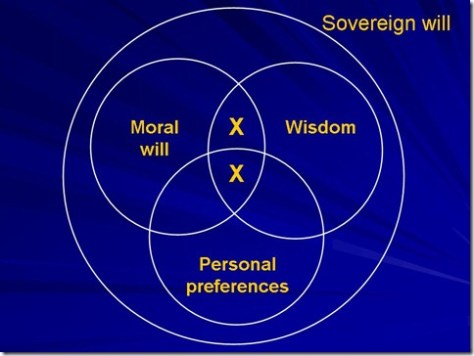
Really short version: Aside from direct and clear personal revelation from God, you don’t have access to his sovereign will when making decisions.  Therefore you must look at other factors.  If it isn’t moral, don’t do it.  If it is moral but not wise, don’t do it.  If it is moral and wise, then use your personal preferences.

Using this model you can end up with a wise and biblical decision, but you have avoided the traps of the “God told me to ____” routine.  People who run around saying that God told them this and that convey a super-spirituality that can leave less mature believers wondering if they really have a relationship with God (i.e., “God doesn’t tell me every little thing to do, so maybe I don’t really know him.”).

He has a helpful picture posted as well:

This is actually a very important topic for me, because I like making plans and making good decisions. I like being the quarterback or squad leader of my own life. I like to pick objectives and then make plans to achieve them. (Nothing too exotic, just simple stuff like saving money or reading more books)

Actually, I really oppose the idea that God has a magical fairy tale will for each person that will make them happy and fulfilled. For me, life isn’t like that. I don’t expect God to lead me along like a child at a scavenger hunt. I expect to survey the battlefield where I am and then do something to make a difference. There are lots of things you can do that will please God. Should you focus on your career and sponsor apologetics conferences? Or should you use your spare time preparing Sunday school lessons? There are lots of good things you could do to please God. Your job is to pick the one that will be the most effective. It doesn’t matter if it makes you happy, it only matters if it’s effective and if you are good at it.

Who is Rifleman Dodd?

A while back, I was busily working my way through the U.S. Marine Corps Official Reading List, and I came across a book by C.S. Forester called Rifleman Dodd, or alternatively titled Death to the French. It’s a work of historical fiction that takes place during the Napoleonic wars. The story is about a British marksman named Dodd, who is cut off from his own lines during a withdrawal maneuver. He is subsequently left to fend for himself behind enemy lines. An ordinary man might be full of despair and forget about his mission entirely. But Dodd is no ordinary man. Not only does he find a way to survive by finding food to eat, water to drink and places to sleep, but he also tries to remember his orders and to think about what he can do to advance the cause of his General, the Duke of Wellington.

Here’s an excerpt from a gritty book review:

It’s about a green-coated British infantry rifleman in the Napoleonic Wars, an age when rifles were a novelty and most of the army was red-coated and carried muskets. Private Matthew Dodd gets separated from his regiment during a retreat and finds himself stranded behind enemy (French) lines in Portugal. With the occasional aid of some natives, but mostly on his own, he harasses the French with his rifle and tries to prevent them from building a bridge across the Tagus River. It’s a remarkable tale of survival and solitary achievement, of a rank-and-file soldier who lives by his wits and slowly learns to make plans without orders, and shows leadership qualities and a knowledge of warfare.

I think we’re in the same situation as Dodd.

There is no point in us looking for breadcrumb trails to happiness at this point. That’s not the point of Christianity. The point of Christianity is friendship with God, imitation of Christ, honoring moral obligations, self-sacrificial love for your neighbor (and even your enemies!), and dedication to the truth – whether anyone else likes you or not. It’s not supposed to make you happy, and it’s not necessarily going to be a normal life like everyone else has. Things may not work out the way you’d like them to.

We seem to be making such a big deal about compassion and forgiveness in the Christian life these days – such a big emphasis on our feelings. Almost like we have forgotten that we have obligations to our friend – and his objectives. A relationship doesn’t mean that one person completely disregards the character and goals of the other person and then is automatically granted forgiveness whenever they want it. That’s not a friendship – that’s using someone else for your own ends. Maybe it’s time to remember what this is all about.