
Tag Archives: Christianity

Walter Bradley asks: what is religion really supposed to be about?

Dr. Walter L. Bradley

This lecture is based on the book “Truth in Religion” by famous philosopher Mortimer J. Adler. At the time of writing the book, he was not a Christian, but there is still a lot of value in the book for Christians who are trying to understand what religion should really be about.

About the speaker

The speaker is one of my top 3 favorite speakers of all time in Christian apologetics, Dr. Walter Bradley. (The other two are Dr. Stephen C. Meyer and Dr. Michael Strauss)

Here’s a biography:

Dr. Bradley received his B.S. in Engineering Science and his Ph.D. in Materials Science from the University of Texas in Austin.

Dr. Bradley taught for eight years at the Colorado School of Mines before assuming a position as Professor of Mechanical Engineering at Texas A&M University (TAMU) in 1976.

During his 24 years at Texas A&M, Dr. Bradley served as Head of the Department of Mechanical Engineering at Texas A&M University and as Director of the Polymer Technology Center, and received five College of Engineering Research Awards. He has received over $4,500,000 in research grants and has published over 140 technical articles and book chapters. He has also co-authored “The Mystery Of Life’s Origin: Reassessing Current Theories. He is a Fellow of the American Society for Materials and of the American Scientific Affiliation and serves as a consultant for many Fortune 500 companies.

You can read more about his recent research on how to use coconuts to make car parts in this article from Science Daily.

The MP3 file is here. (31 minutes + Q&A)

Topics:

  • what is pluralism?
  • what is multiculturalism?
  • what is relativism?
  • some propositions are true culturally – just for certain groups in certain times (cultures)
  • some proposition are true trans-culturally – true independently of what anyone wants or feels
  • Mathematical truth is trans-cultural – it is true regardless of cultural fashions
  • Scientific truth is trans-cultural – it is true regardless of cultural fashions
  • Some truths are not like this – cooking traditions, clothing traditions and greeting traditions
  • These kinds of truths are NOT trans-cultural, they vary by culture
  • The question is – is religion true like math and science, or true depending on the culture
  • Some people think that your religion depends on where you were born or what your family believes
  • Religions make conflicting claims about the way the world really is, so they can’t all be true
  • And these conflicts are at the core of the religions – who God is, how can we be related to him, etc.
  • So if religions convey trans-cultural truth, then either one is true or none are true
  • If they are not trying to convey trans-cultural truth, then they are not like math and science
  • Let’s assume that religion is the same as trans-cultural truth
  • How can we know which religion is true? 1) the laws of logic, 2) empirical testing against reality
  • Logical consistency is needed to make the first cut – self-contradictory claims cannot be true
  • To be true trans-culturally, a proposition must at least NOT break the law of non-contradiction
  • According to Mortimer Adler’s book, only Christianity, Judaism and Islam are not self-contradictory
  • All the others can be excluded on the basis of overt internal contradictions on fundamental questions
  • The others that are self-contradictory can be true culturally, but not trans-culturally
  • The way to proceed forward is to test the three non-contradictory religions against science and history
  • One of these three may be true, or they could all be false
  • We can test the three by evaluating their conflicting truth claims about the historical Jesus
  • Famous skeptics have undertaken studies to undermine the historical Jesus presented in the Bible
  • Lew Wallace, Simon Greenleaf and Frank Morrison assessed the evidence as atheists and became Christians
  • There is a lot of opposition in culture to the idea that one religion might be true
  • But if you take the claims of Jesus at face value, he claims to be the unique revelation of God to mankind
  • Either he was telling the truth about that, or he was lying, or he was crazy
  • So which is it?

Why don’t religious people ask if their religion is true?

People seem to be chicken these days about claiming that their religion is true. It’s easier to say that my religion is true for me, and your religion is true for you – reduce it to personal preferences. So long as everyone is sincere about what they believe, then that’s the most important thing, right?

But it is NOT TRUE that you can believe whatever you want as long as you are sincere – sincerity doesn’t mean that you can’t be mistaken. I can jump off the top of the Sears Tower and be sincere in my belief that I will float down like a feather, but that doesn’t make my belief true. If you want to have a good relationship with God, you have to know things about him, not just have sincere beliefs. You have to know whether he exists and what he is like – really. It’s not enough to have sincere beliefs that are not actually true.

I think that God’s existence and character can be assessed and known based on logic and evidence. I think that God exists independently of whether I want him to or not, and I think that his character and desires are not the same as my character and desires. And I don’t really care what my neighbors think of my disagreeing with them, my goal is not to keep silent and to just get along with them and be happier in my community.

God’s first commandment to us is not to love our neighbor – that’s number two. Number one is to love him. And how can we love him, if we don’t want to know him. And how can we love him, if we don’t tell people the truth about him when they ask us?

That message is not going to win us a lot of friends, but our job as Christians is to tell how and why God stepped into history. Jesus expects us to be his ambassadors and to carry out the task of evangelism faithfully, and to suffer with him and – if necessary – to be rejected like he was rejected.
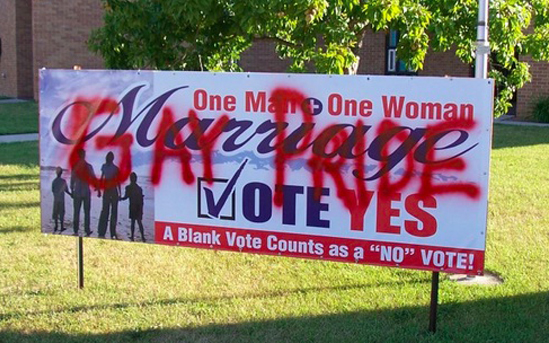

Colorado Court of Appeals rules that Christian must bake cakes for gay wedding

Gay activist vandalizes pro-marriage sign

This is from the Daily Signal.

Excerpt:

A custom cake baker in suburban Denver can’t cite his religious convictions in declining to make a wedding cake for two men, a Colorado appeals court ruled today.

“Cake artist” Jack Phillips said he gladly serves gays and lesbians in his family business. But, Phillips said, he could not in good conscience design a wedding cake for a same-sex couple when, as a Christian, he believes marriage is the union of a man and a woman.

A three-judge panel of the Colorado Court of Appeals ruled that not doing so amounts to illegal discrimination based on sexual orientation, Associated Press reported.

You’ll recall that Colorado is one of the states that does not recognize religious liberty as a human right:

States with non-discrimination laws

If you live in one of the non-gray states, you’re at risk.

What’s troubling to me about this is that Phillips was defended by Jeremy Tedesco of the Alliance Defending Freedom. He is a very capable religious liberty lawyer.

More:

The baker’s lawyer, Jeremy Tedesco, told The Daily Signal that the three judges “got it wrong on all counts” in a unanimous, 65-page opinion.

“He objects to the message, not to their protected status,” Tedesco said of the business owner’s attitude toward Charlie Craig and David Mullins, the two men who wanted him to design a wedding cake. “That’s not discrimination under the law.”

Tedesco, senior legal counsel with Alliance Defending Freedom, added:

Business owners have a right–especially when they’re engaged in expression, as our client is–to run their business in accordance with their beliefs. …When they’re engaged in expression, [they may] decline to create an expression that violates their convictions.

What’s interesting is that after being denied the cake, the gay couple easily went to another shop and got a cake. There was no harm done.

But that was not good enough for them, hence their decision to involve the state, and punish the Christian for choosing not to celebrate something he disagreed with.

Tedesco says that the baker should not be forced to say something that he violates his conscience:

As The Daily Signal reported, Tedesco argued that compelling Phillips to create a cake for the wedding of two men would violate his First Amendment rights not only to freedom of religion but also free speech or expression.

“The other side of the case thinks there are no First Amendment rights in the commercial context and once you open a business, you cede all First Amendment protections,” Tedesco told The Daily Signal after the hearing in Denver.

The ADF intends to appeal the case to the Colorado Supreme Court, and then to the Supreme Court of the United States. Unfortunately, since Obama won in 2008 and 2012, the Supreme Court is likely to rule against religious liberty. We’ll find out, I guess.

You can read more about Jeremy Tedesco here.

Does sex before marriage have any effect on your future relationships?

Is it OK to tell women they are wrong?
Do young people understand the long-term impact of premarital sex?

I’ve posted before about how premarital sex affects the stability of marriages by making divorce more likely. But there has been more research published since. Let’s take a look.

Here a good study on relationship tempo and relationship quality.

Abstract:

Rapid sexual involvement may have adverse long-term implications for relationship quality. This study examined the tempo of sexual intimacy and subsequent relationship quality in a sample of married and cohabiting men and women. Data come from the Marital and Relationship Survey, which provides information on nearly 600 low- to moderate-income couples living with minor children. Over one third of respondents became sexually involved within the first month of the relationship. Bivariate results suggested that delaying sexual involvement was associated with higher relationship quality across several dimensions. The multivariate results indicated that the speed of entry into sexual relationships was negatively associated with marital quality, but only among women. The association between relationship tempo and relationship quality was largely driven by cohabitation. Cohabiting may result in poorer quality relationship because rapid sexual involvement early in the romantic relationship is associated with entrance into shared living.

The authors are from Cornell University and University of Wisconsin – Madison. Prestigious schools, and very far to the left.

Here’s another recent study that shows that if a woman has more partners than just her husband as a premarital sex partner, the risk of divorce increases.

Conclusion:

Using nationally representative data from the 1995 National Survey of Family Growth, I estimate the association between intimate premarital relationships (premarital sex and premarital cohabitation) and subsequent marital dissolution. I extend previous research by considering relationship histories pertaining to both premarital sex and premarital cohabitation. I find that premarital sex or premarital cohabitation that is limited to a woman’s husband is not associated with an elevated risk of marital disruption. However, women who have more than one intimate premarital relationship have an increased risk of marital dissolution.

Here’s another study that makes it even more clear.

Findings:

Data from the 1988 US National Survey of Family Growth (NSFG) were utilized to assess the impact of premarital sexual activity on subsequent marital stability. Among white NSFG subjects first married in 1965-85, virgin brides were significantly less to have become separated or divorced (25%) than women who had not been virgins at marriage (35%).

[…]The lower risk of divorce on the part of white women with no premarital sexual experience persisted even after numerous intervening and background variables were controlled.

And I am going to save the best study for last. This marvelous PDF is from August 2014, and is put out by the National Marriage Project at the University of Virginia. It is comprehensive, and links to many papers from decades ago to the state of the art today. It seems like people are really rushing into sex these days, without much thought. They want to have fun, feel accepted, be like their friends, conform to the culture. But sometimes, it’s better to be practical than to be governed by the desire for fun and thrills. If you want to do something, look at the research and find out what the consequences are before you do it. That’s what a sensible person does.

When it comes to discussing the Bible’s rules on sex, evidence is very important. Evidence is what convinces even non-Chrsitian people to take the Bible seriously when it comes to putting sex in its proper place. That’s why we need to know what the Bible says, and we need to augment that with real-world evidence so that it is applied to our own decision-making, and so that we can be persuasive when discussing it with others.