

Tag Archives: Christian

Book review of R.C. Sproul’s “If there’s a God, why are there atheists?”

I have a key that will unlock a puzzling mystery

Brian Auten has a book review posted up at Apologetics 315.

The book is “If There’s A God, Why Are There Atheists?”, by theologian R.C. Sproul. R.C. Sproul is one of my favorite theologians. The book in question has a very, very special place in my heart, because I think that it is one of the major reasons why I was able to resist pernicious ideas like religious pluralism and postmodernism for so long. Once you put on the glasses of Romans 1 and see for the first time what man is really doing with respect to God, you can never see things the same again. I’ll say more about this at the end, but let’s see what Brian wrote first.

The review

So often, you hear atheists complaining about religion is nothing but wish-fulfillment or some sort of crutch for people who are frightened by a variety of things. They think that God is invented to solve several problems. 1) how does the world work?, 2) is there meaning to suffering and evil?, 3) why should I be moral?, and 4) what will happen to me and my loved ones when I die?. On the atheistic view, God is just a crutch that people cling to out of weakness and ignorance. But is this really the case?

Sproul starts the book by investigating three atheists who sought to explain religious belief as a result of psychological factors.

Brian writes:

Before tackling the psychology of atheism, Sproul spends a chapter on the psychology of theism, from the perspective of Freud’s question “If there is no God, why is there religion?”11 What follows is an overview of various psychological explanations of theistic belief: Feuerbach’s “religion is a dream of the human mind.”12 Marx’s belief that religion is “due to the devious imagination of particular segment of mankind.”13 And Nietzche’s idea that “religion endures because weak men need it.”14 The author properly reiterates: “We must be careful to note that the above arguments can never be used as proof for the nonexistence of God. They can be useful for atheists who hear theists state that the only possible explanation for religion is the existence of God.”15 That being said, Sproul also reveals what these arguments presume:

Their arguments already presupposed the nonexistence of God. They were not dealing with the question, Is there a God? They were dealing with the question, Since there is no God, why is there religion?16

Sproul points out the weaknesses of each of these approaches and says “there are just as many arguments showing that unbelief has its roots in the psychological needs of man.”

Wow, could that really be true? What are the real reasons why people reject God? Does the Bible have anything to say about what those reasons are?

Brian cites Sproul’s contention:

The New Testament maintains that unbelief is generated not so much by intellectual causes as by moral and psychological ones. The problem is not that there is insufficient evidence to convince rational beings that there is a God, but that rational beings have a natural hostility to the being of God.

[…]Man’s desire is not that the omnipotent, personal Judeo-Christian God exist, but that He not exist.

In Romans 1:18-23, the apostle Paul explains what is really going on:

18The wrath of God is being revealed from heaven against all the godlessness and wickedness of men who suppress the truth by their wickedness,

19since what may be known about God is plain to them, because God has made it plain to them.

20For since the creation of the world God’s invisible qualities—his eternal power and divine nature—have been clearly seen, being understood from what has been made, so that men are without excuse.

21For although they knew God, they neither glorified him as God nor gave thanks to him, but their thinking became futile and their foolish hearts were darkened.

22Although they claimed to be wise, they became fools

23and exchanged the glory of the immortal God for images made to look like mortal man and birds and animals and reptiles.

On this blog, I regularly present many, many arguments for theism in general, and Christian theism in particular:

Sproul explains why atheists cannot allow themselves to live according to the evidence that is presented to them:

The cumulative effect of this knowledge that is clearly seen is to leave men ‘without excuse.’ Herein lies the basis of the universal guilt of man. No one can claim ignorance of the knowledge of God. No one can cite insufficient evidence for not believing in God. Though people are not persuaded by the evidence, this does not indicate an insufficiency in the evidence, but rather an insufficiency in man.

[…]The basic stages of man’s reaction to God can be formulated by means of the categories of trauma, repression, and substitution.

[…]If God exists, man cannot be a law unto himself. If God exists, man’s will-to-power is destined to run head-on into the will of God.

And this is the force that is animating atheists today. They don’t want to be accountable to God in a relationship, no matter what the evidence is. They have to deny it, so that they can be free to get the benefits of a universe designed for them, without having to give any recognition or acknowledgement back. If they have to lie to themselves to deny the evidence, they will do it. Anything to insulate themselves from the Creator and Designer who reveals himself in Jesus Christ.

The rest of the book review, and the book, deals with explaining in detail how atheists respond to an all-good, all-powerful, all-knowing Creator/Designer. I encourage you to click through and read the whole book review. You can read the review, and the book, and then investigate for yourself whether atheists really are like that.

My survey of atheists

By the way, did you all see my survey of atheists that I did a while back? It’s relevant because one of the questions I asked to my volunteers was “How you begin to follow Christ if it suddenly became clear to you that Christianity was objectively true?”. I got some very strange responses that dovetail nicely with Sproul’s book.

Here are a few of the responses:

  • I would not follow. My own goals are all that I have, and all that I would continue to have in that unlikely situation. I would not yield my autonomy to anyone no matter what their authority to command me.
  • I would not follow, because God doesn’t want humans to act any particular way, and he doesn’t care what we do.
  • I would not follow. Head is spinning. Would go to physician to find out if hallucinating.
  • I hope I would be courageous enough to dedicate my life to rebellion against God.
  • I would not have to change anything unless forced to and all that would change is my actions not my values.  I would certainly balk at someone trying to force me to change my behavior as would you if you were at the mercy of a moral objectivist who felt that all moral goodness is codified in the Koran.
  • He would have to convince me that what he wants for me is what I want for me.

This is all part of my series discussing whether morality is rationally grounded by atheism.

Well Spent Journey did a similar survey of atheists, inspired by mine, and got this result on the relevant question:

12. How would you begin to follow Jesus if it became clear to you that Christianity was true?

– Would follow (5)
– Wouldn’t follow (6)
Might follow the teachings of Jesus, but that isn’t Christianity (2)
– It would depend on how this truth was revealed (3)
– Christianity can’t be true (3)
– No answer given (4)

…What would be the hardest adjustment you would have to make to live a faithful, public Christian life?

– Adjusting wouldn’t be that difficult; would eagerly welcome knowing that Christianity was true (2)
– Praying, since it seems weird, creepy, and strange
– Trying to figure out how the Bible became so corrupted

– Trying to convince myself that the God of the Bible is deserving of worship (2)
– Don’t think it would be possible to adjust

– No clear response, or not applicable (16)

Yes, they really think like that! Just ask an atheist questions and you’ll see how “objective” they really are. Atheism is entirely psychological. It’s adopted in order to feel sufficient and to operate with autonomy, with the goal of self-centered pleasure-seeking above all. Evidence has nothing to do with it.
Wayne Grudem responds to Christians who think law and policy are less important than piety

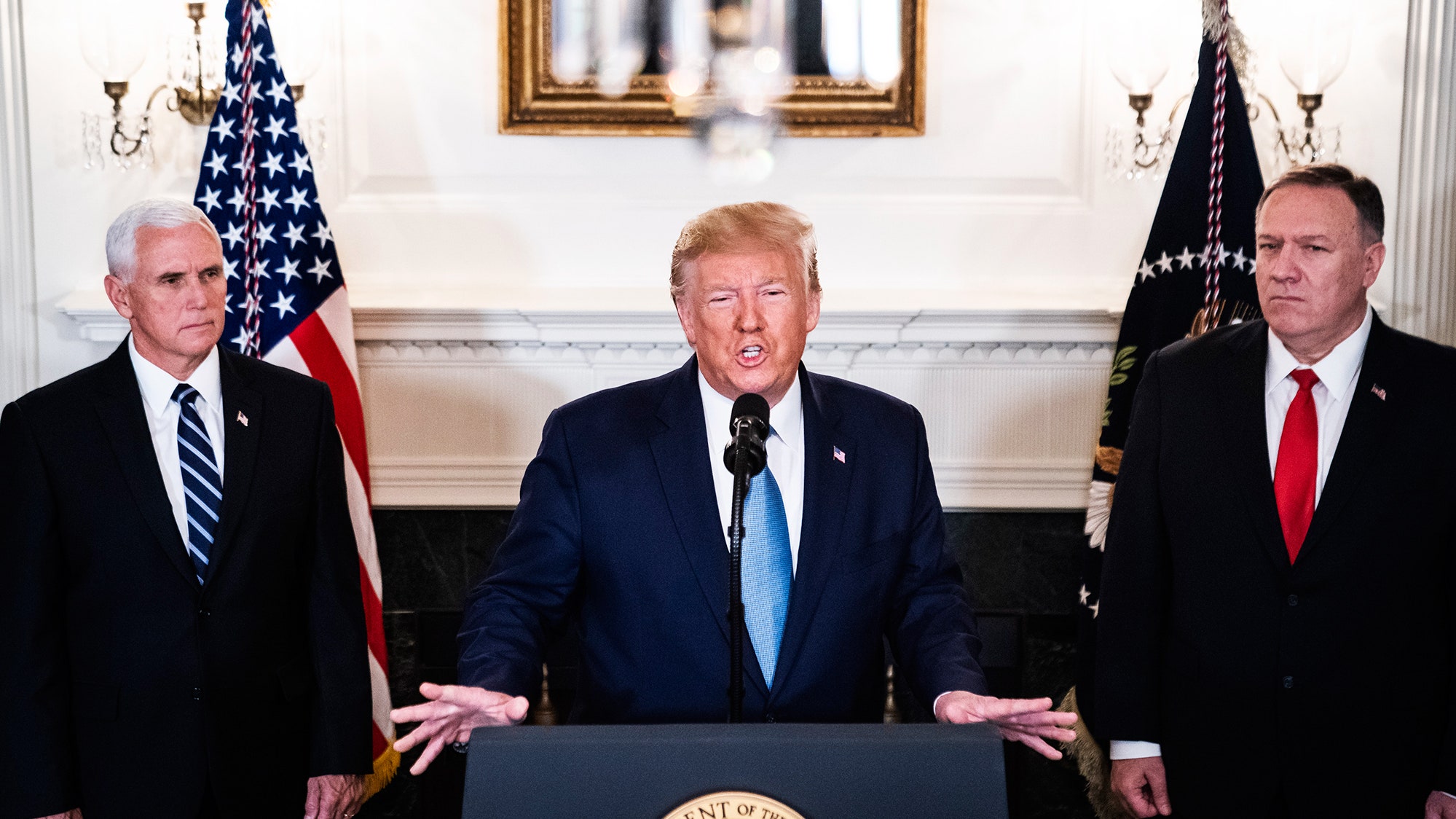
Trump surrounded by prominent evangelicals: Mike Pence and Mike Pompeo
Trump and his evangelicals: VP Mike Pence (L) and Sec. of State Mike Pompeo (R)

Laura send me this amazing article from the Christian Post, written by famous evangelical theologian Dr. Wayne Grudem. He was responding to a blue state pastor named John Piper. Piper has made a name for himself by emphasizing emotions, piety and “Christian hedonism”. Let’s take a look at what Wayne Grudem had to say about Christians who support Joe Biden and Kamala Harris.

Here’s the intro:

[John Piper] and I have reached different conclusions about this year’s presidential election. His October 22 article, “Policies, Persons, and Paths to Ruin,” explained why he thought it would be wrong for him to support either candidate in this election.

Here is Grudem’s summary of Piper’s argument:

1. The personal sins of a leader can be as harmful to persons and to nations as morally evil laws.

2. Christians communicate a falsehood when we act as if policies and laws are more precious than being a certain kind of person.

3. The horrible sin of pride leads people to other sins, including defending abortion, and therefore voting for a clearly boastful candidate might also be indirectly supporting abortion.

4. Voting for either candidate would compromise a person’s Christian witness

I covered point 1 in a previous post. Below, we’ll cover points 2-4.

Here’s part of his response to point 2:

A presidential election is not deciding what is most important in all of life, which is certainly our relationship with Christ. Paul writes, “I count everything as loss because of the surpassing worth of knowing Christ Jesus my Lord. (Phil. 3:8). A presidential election is simply choosing the leaders of our government. In such a situation, the primary purpose is to decide what kind of government we will have, and in that situation policies and laws are not the only consideration, but they are the most important consideration.

Here’s part of his response to point 3:

I do not think that “arrogance and boasting” are the primary motivations that lead people to support abortion rights. I think rather the primary motive is rebellion against God’s commands that forbid sex outside of marriage between a man and woman. The motive is a desire for sexual freedom without the responsibility of raising children. As for doctors who perform abortions, I think the primary motivation is greed.

Piper refers to James 4:1-2 to show that support for his statement that “child-killing” comes from “self-absorbed arrogance and boasting.” But these verses specifically speak about coveting, not boasting, that leads to murder: “You desire and do not have, so you murder” (James 4:2).

Here’s part of his response to point 4:

[I]f all evangelical Christians followed Piper’s example and decided to write in someone else’s name instead of voting for either Trump or Biden. The result would be an overwhelming landslide victory for Biden, because the largest single bloc of Trump supporters is evangelical Christians. In 2016, 80% of white evangelicals voted for Trump, while 16% voted for Clinton and 4% didn’t vote for president or voted for some other candidate. If that 4% of “vote for neither one” evangelical voters had been 5% or 6%, Hillary Clinton would have been president.

So, if Trump loses the evangelical bloc, Biden wins. In fact, if a significant number of Christians decide not to vote for either Trump or Biden, the result will not be some ideal third-party president. It will be a Biden presidency which (in my opinion) will bring great harm to the nation.

This is really important. If you are going to share Grudem’s post on social media, cut and paste this above your link – this is the most important part:

I differ with my friend John Piper about the results of a second term for President Trump. In Trump second term, I look forward to the appointment of more originalist judges (who will interpret the laws and not make new laws on their own), further legal restrictions on abortion, greater protections for religious freedom and freedom of conscience, lower taxes, fewer government regulations, a rapidly growing economy, low unemployment rates (especially significant for ethnic minorities), increased prosperity for people at every income level, additional history-making agreements between Israel and additional Arab nations, a clearheaded recognition of the economic, military, and information threat from China, a high value placed on human freedom and on personal accountability for committing crimes, increasing numbers of children eligible for taxpayer-supported school choice, a secure border followed by a comprehensive reform of our immigration system, and an increase in police presence in high crime neighborhoods, with a resulting decrease in crime.

That seems to me to be likely, given Trump’s first term actions.

More:

On the other hand, if evangelicals stay away from voting for either Biden or Trump, then then under a Biden presidency I would expect the appointment of hundreds of judges who take the law in their own hands and even consider themselves to be above the original meaning of the Constitution, laws that allow abortion up to the moment of birth and even after, the use of tax money to pay for abortions and gender reassignment surgery, the crippling of our economy with ever-increasing government control and ever-increasing taxes, increased unemployment, a weaker military unable to counter the increasing aggressiveness of China in the world’s oceans, a Jimmy Carter-like foreign policy of appeasement, abandoning Israel to fend for itself in the Middle East, adding additional seats to make a liberal majority on the Supreme Court, draconian laws that compel artistic professionals to affirm the validity of same-sex marriage even when contrary to their consciences, a reinstatement of the Obama-era guidelines that required schools to allow biological males to use girls bathrooms, locker rooms and showers and to allow them to compete in women’s sports, a massive increase in energy costs, ever-increasing restrictions on police forces, leading to an increase in crime, and the proliferation of violence and intimidation to nullify freedom of speech (in practice) for those who disagree with the liberal political agenda, open borders, sanctuary cities, and a complete federal takeover of our healthcare system.

I definitely think that Wayne Grudem’s article showed a greater knowledge of what’s going on in the real world than John Piper’s article. We ought to be concerned about what our lives will really be like under the laws and policies of the next president. It doesn’t matter how voting makes us feel, or how voting makes us look to others.

Wayne Grudem responds to Christians who think arrogance is worse than infanticide

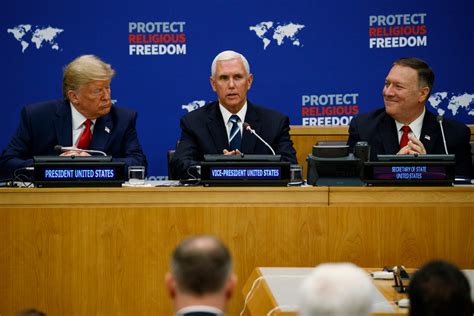
President Donald Trump, Vice President Mike Pence and Secretary of State Mike Pompeo
Trump, Pence and Pompeo champion religious freedom at the United Nations

Laura send me this amazing article from the Christian Post, written by famous evangelical theologian Dr. Wayne Grudem. He was responding to a blue state pastor named John Piper. Piper has made a name for himself by emphasizing emotions, piety and “Christian hedonism”. Let’s take a look at what Wayne Grudem had to say about Christians who support Joe Biden and Kamala Harris.

Here’s the intro:

[John Piper] and I have reached different conclusions about this year’s presidential election. His October 22 article, “Policies, Persons, and Paths to Ruin,” explained why he thought it would be wrong for him to support either candidate in this election.

Here is Grudem’s summary of Piper’s argument:

1. The personal sins of a leader can be as harmful to persons and to nations as morally evil laws.

2. Christians communicate a falsehood when we act as if policies and laws are more precious than being a certain kind of person.

3. The horrible sin of pride leads people to other sins, including defending abortion, and therefore voting for a clearly boastful candidate might also be indirectly supporting abortion.

4. Voting for either candidate would compromise a person’s Christian witness

I have a friend in my office, Scott, who has exactly these views. He is pro-life and pro-family, but he thinks voting for Trump’s policies would be wrong, because of Trump’s past moral failings.

Here’s part of his response to point 1:

Americans are perfectly free to say, “Trump’s boastfulness offends me and I don’t want to act that way myself.” But if laws are passed (and upheld by the courts) that enforce the LGBT agenda, no creative professional like a cake decorator (or photographer or florist) will be free to say, “I believe same-sex marriage is morally wrong, and I won’t use my artistic talent to decorate a cake celebrating same-sex marriage.” No high school girl will be free to say, “I won’t undress and change clothes for my gym class because there are boys in the locker room who claim to be girls.” No Christian adoption agency will be free to say, “We will not place children with same-sex couples.”

And if Democrats gain control of our government and the Supreme Court, and enact their desired policies, no Christian taxpayer will be free to say, “I refuse to pay that portion of my taxes that the government is using to pay for abortions.” No business owner will be free to say, “I will not buy medical insurance for my employees that pays for abortions and sex-change surgeries.” There will be only two choices: violate your conscience or else be driven to bankruptcy or go to jail.

Trump’s first four years not a parade of immoral actions:

[A]fter his nearly four years in office, I would add that he has shown remarkable courage of his convictions, faithfulness to his campaign promises, steadfastness of purpose in spite of an astoundingly hostile press, incredible energy in the performance of his job, dignity and even eloquence in many formal speeches and ceremonies at home and abroad, respect and appreciation for his wife Melania and his sons and daughters, and a wide-ranging understanding of the hundreds of different issues that every president faces. In contrast to his past life, during his term in office there is not been even a hint of any sexual impropriety. He is sometimes boastful but on a number of occasions I have seen him publicly give credit to many other people for things that have been accomplished. And I think he has shown mature and wise judgment in a variety of situations that he has faced as president.

Biden’s character not exemplary:

It is easy to compare President Trump with a hypothetical “perfect” president and to conclude that he falls short, but that is not our choice. If Trump is not reelected, we will have President Biden, with an entirely different set of character flaws. The multiple allegations that Vice President Biden used his government office and influence to enrich members of his own family with millions of dollars from China, Russia, and Ukraine should be of deep concern, because using government power to enrich one’s own family is the consistent characteristic of corrupt leaders in many countries of the world.

Conservative Christians occupy prominent positions in Trump’s Cabinet, and they make many decisions that affect voters:

Donald Trump is not the only person we are voting for. It is remarkable that the Trump administration has elevated so many self-professing evangelical Christians – far more than any in my lifetime – into positions of high influence in our government. They also provide role models for Americans. To vote for Trump as president is also to vote for Mike Pence as vice president, Mike Pompeo as Secretary of State, Ben Carson as Secretary of Housing and Urban Development, Betsy DeVos as Secretary of Education, Russell Vought as director of the Office of Management and Budget, and numerous others. In addition, Trump has appointed numerous deeply committed Roman Catholics to various positions, the most recent being Amy Coney Barrett to the Supreme Court. The character of these leaders is also a role model for the nation.

We will look at responses to the points 2-4 in  another post.

For my part, I think that if Trump’s character was going to be a major factor, it would all have come out in his first term. Instead, we’ve seen him act in a way that is friendly to evangelical Christians. I don’t expect him to write systematic theology or do philosophical apologetics or discover a new example of cosmic fine-tuning. He doesn’t have to be a Christian in order to push for laws and policies that allow me to run my Christian life-plan. I need to be able to earn money without compromising my values, and spend it on the Christian causes I care about. I need to be protected from people like Antifa and gay rights extremists, who don’t seem to be at all concerned about moving from angry words to property damage to actual violence against those who disagree with them.

By the way, if you want a good review of Trump’s achievements in different areas: economy, job creation, immigration, foreign policy, national security, defense, deregulation, agriculture, law and justice, energy and environment, transparency and accountability, health care, social programs, infrastructure and technology, education and veterans, you can find all that right here.

Related posts