Tag Archives: Child Abuse

New study: children who grow up with single parents more likely to see domestic violence

Domestic violence least likely in married homes

This is from Family Studies. (H/T Brad Wilcox)

Excerpt:

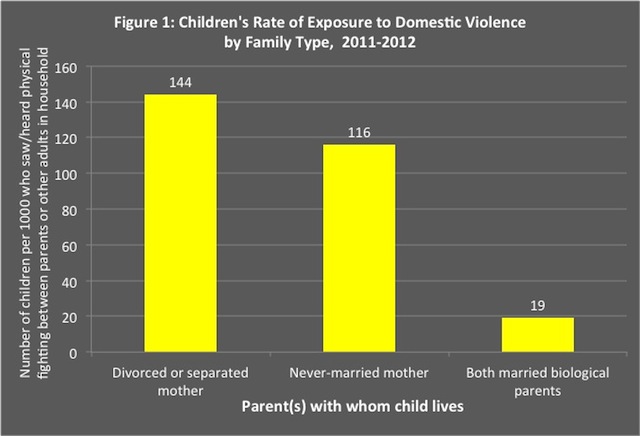
In the 2011-2012 National Survey of Children’s Health, conducted by the U.S. National Center for Health Statistics, parents of 95,677 children aged 17 and under were asked whether their child had ever seen or heard “any parents, guardians, or any other adults in the home slap, hit, kick, punch, or beat each other up.” Among children living with both married biological parents, the rate of exposure to family violence was relatively low: for every 1,000 children in intact families, 19 had witnessed one or more violent struggles between parents or other household members. By comparison, among children living with a divorced or separated mother, the rate of witnessing domestic violence was seven times higher: 144 children per 1,000 had had one or more such experiences. (See Figure 1.) These comparisons are adjusted for differences across groups in the age, sex, and race/ethnicity of the child, family income and poverty status, and the parent’s education level.

One might suppose that women who had never married would be less likely to get into violent arguments with the fathers of their children than separated or divorced mothers. Yet the rate of witnessing domestic violence among children living with never-married mothers was also elevated. It was 116 per 1,000, six times higher than the rate for children in intact families. (Some of these fights involved subsequent partners or boyfriends of the mother, rather than the father of the child.) Even children living with both biological parents who were cohabiting—rather than married—had more than double the risk of domestic violence exposure as those with married birth parents: 45 out of 1,000 of these children had witnessed family fights that became physical. Note also that a child’s family structure was a better predictor of witnessing family violence than was her parents’ education, family income, poverty status, or race.

Experiencing family violence is stressful for children, undercuts their respect and admiration for parents who engage in abusive behavior, and is associated with increased rates of emotional and behavioral problems at home and in school. For example, among children of never-married mothers who had witnessed family violence, 58 percent had conduct or academic problems at school requiring parental contact. The rate of school behavior problems for those who had not been exposed to family fights was significantly lower, though still fairly high (36 percent). Likewise, among children of divorced or separated mothers, nearly half of those exposed to family violence—48 percent—had had conduct or academic problems at school. Even among the small number of children in intact families who had witnessed family violence, just over half—51 percent—presented problems at school. This was twice the rate of school problems among students from intact families who had not witnessed domestic violence. (See Figure 2.) These figures are also adjusted for differences across groups in age, sex, and race/ethnicity of children, family income and poverty, and parent education levels. Children experiencing domestic violence were also more likely to have repeated a grade in school and to have received psychological counseling for emotional or behavioral problems. This was true in intact as well as disrupted families.

A good book to read on this topic is Theodore Dalrymple’s “Life at the Bottom“, which offered this memorable anecdote about about how and why women choose men who abuse them.

Introduction:

The disastrous pattern of human relationships that exists in the underclass is also becoming common higher up the social scale. With increasing frequency I am consulted by nurses, who for the most part come from and were themselves traditionally members of (at least after Florence Nightingale) the respectable lower middle class, who have illegitimate children by men who first abuse and then abandon them. This abuse and later abandonment is usually all too predictable from the man’s previous history and character; but the nurses who have been treated in this way say they refrained from making a judgment about him because it is wrong to make judgments. But if they do not make a judgment about the man with whom they are going to live and by whom they are going to have a child, about what are they ever going to make a judgment?

“It just didn’t work out,” they say, the “it” in question being the relationship that they conceive of having an existence independent of the two people who form it, and that exerts an influence on their on their lives rather like an astral projection. Life is fate.

Chapter one:

All the more surprising is it to me, therefore, that the nurses perceive things differently. They do not see a man’s violence in his face, his gestures, his deportment, and his bodily adornments, even though they have the same experience of the patients as I. They hear the same stories, they see the same signs, but they do not make the same judgments. What’s more, they seem never to learn; for experience—like chance, in the famous dictum of Louis Pasteur—favors only the mind prepared. And when I guess at a glance that a man is an inveterate wife beater (I use the term “wife” loosely), they are appalled at the harshness of my judgment, even when it proves right once more.

This is not a matter of merely theoretical interest to the nurses, for many of them in their private lives have themselves been the compliant victims of violent men. For example, the lover of one of the senior nurses, an attractive and lively young woman, recently held her at gunpoint and threatened her with death, after having repeatedly blacked her eye during the previous months. I met him once when he came looking for her in the hospital: he was just the kind of ferocious young egotist to whom I would give a wide berth in the broadest daylight.

Why are the nurses so reluctant to come to the most inescapable of conclusions? Their training tells them, quite rightly, that it is their duty to care for everyone without regard for personal merit or deserts; but for them, there is no difference between suspending judgment for certain restricted purposes and making no judgment at all in any circumstances whatsoever. It is as if they were more afraid of passing an adverse verdict on someone than of getting a punch in the face—a likely enough consequence, incidentally, of their failure of discernment. Since it is scarcely possible to recognize a wife beater without inwardly condemning him, it is safer not to recognize him as one in the first place.

This failure of recognition is almost universal among my violently abused women patients, but its function for them is somewhat different from what it is for the nurses. The nurses need to retain a certain positive regard for their patients in order to do their job. But for the abused women, the failure to perceive in advance the violence of their chosen men serves to absolve them of all responsibility for whatever happens thereafter, allowing them to think of themselves as victims alone rather than the victims and accomplices they are. Moreover, it licenses them to obey their impulses and whims, allowing them to suppose that sexual attractiveness is the measure of all things and that prudence in the selection of a male companion is neither possible nor desirable.

Often, their imprudence would be laughable, were it not tragic: many times in my ward I’ve watched liaisons form between an abused female patient and an abusing male patient within half an hour of their striking up an acquaintance. By now, I can often predict the formation of such a liaison—and predict that it will as certainly end in violence as that the sun will rise tomorrow.

At first, of course, my female patients deny that the violence of their men was foreseeable. But when I ask them whether they think I would have recognized it in advance, the great majority—nine out of ten—reply, yes, of course. And when asked how they think I would have done so, they enumerate precisely the factors that would have led me to that conclusion. So their blindness is willful.

The blindness is wilful, because the emotions cannot be corrected by evidence. And everything in the culture affirms women in this craziness, even after they fail over and over again with men – cohabitating with the bad ones for years, and then turning away from the good ones. They freely choose the wrong men, and freely pass by the good ones. And almost no one tells them that it’s entirely their fault. Everyone just tells them “follow your heart”. This emotional craziness causes harm to innocent children, and it needs to stop. We have to stop the man-blaming and hold women accountable for making decisions with their emotions and then expecting craziness to “work out”.

You can read the Dalrymple book online for free in this post.

What’s stopping young adults from getting married?

Before we get to the study, I wanted to share something that a Christian male friend shared with me about yesterday’s post on the crazy feminist mommy porn author.

He writes:

I saw your post about the woman who “fell in love” with her fantasy character she created. I’m a victim of this.

My ex-wife is a succeeding indie author. She jets off and hangs with NYT best-selling authors, rubs elbows with a lot of fantasy romance and erotica authors. She reads, oh, roughly 200 +/- smut books per year.

This area is the flip side of the porn coin, and it’s not getting the attention it should. If I told my story and part of the reason for the marriage destruction, it would be an “easy sell” to those who understand that women who fantasize about these fictional characters (even the images on the covers) are doing the exact thing men are doing when they fantasize over airbrushed skin images and other skin porn.

Many will argue it’s not the same thing, but that is preposterous. Husbands are competing with fantasy novel cover art and fantasy characters. It’s every bit the same as wives competing with unreal images or even real ones where they compete with younger, more fit, kinkier, etc., etc.

Men get cheated on all the time. Through this stuff. My ex developed an online romance through it all. Exchanged erotic pictures, emails, texts, Skype, on and on and on.

I discovered travel plans, fake email accounts, it was awful.

This is the third time that I have been sent divorce stories like this by conservative, Christian male apologists on Facebook.

The first time, the wife hit a certain age then just went nuts and started working out a ton and trying to look younger and younger. Then as she got success as a personal trainer and attention for all the photos she posted, she just divorced her husband outright to focus on her business and more glamorous photos. And they had children. The second time, the wife just went nuts into new age beliefs and yoga and divorced her husband, and they had children too. So we are talking real destructive craziness here.

This is why I put so much emphasis on building up a woman first by leading her to learn apologetics, conservative politics and economics, and so on. If she is not willing to learn and grow in things that are good for her and that help her to be a better wife and mother, then you know that her heart is not in the difficult realities of married life and the roles of wife and mother. She will be one of these women who wants to be happy and thinks that happiness means getting rid of family obligations and responsibilities to her man and her kids. Men should ensure that their prospective mates reject the Disney princess perception that relationships should be all about them and their needs – living happily ever after with no hard work or effort. Helping a woman to think logically and argue using evidence is one way to insulate her from the foolish, emotion-driven culture that threatens marriage.

Anyway, with that said, here is the new article from Family Studies.

Here’s the introduction:

In interviews we conducted with working-class young adults, my wife and I were surprised by the strength of their desires to have a long-lasting marriage and stable family life. But many of them were far from realizing those aspirations. Why?  The wide-ranging challenges that frustrate their aspirations, which we must understand in order to find effective solutions, fall into four rough categories: family-of-origin, philosophical, psychological, and financial.

[…]Conflicted about marriage. This crisis of trust, in turn, informs young adults’ conflicted thinking about marriage. As Amber and I described in a previous post, their experiences of family fragmentation sharpen their desire to get and stay married, on the one hand, but on the other hand it also shakes their confidence in the durability of marriage. As a result, many young adults find themselves in tenuous cohabiting relationships, wanting to say “I do” eventually but too uncertain to do so now.

[…]The fixed love mindset. As Amber discussed here, the philosophy of love that young adults inherit from cultural scripts, like Hollywood chick flicks, works against their own aspirations for committed, permanent love. Instead of a “growth mindset” about love that focuses on working through possible differences, these stories about love transmit a “fixed mindset” that focuses on immediate and perpetual compatibility—the absence of which probably indicates that a couple is no longer meant for each other. Young adults with a fixed mindset about love tend to say things like “love is effortless,” or, as one separated spouse put it, “I love him, but I’m not in love with him. I love him as a friend, as the father, but I don’t feel that connection as I used to.”

[…]Extreme individualism. Despite the common challenges that confront working-class young adults, the idea that “my relationship is no one else’s business” prevents them from thinking about marriage and family life as a public issue that demands our common efforts.

For instance, Anthony knows first-hand the painful effects of divorce—his parents divorced when he was ten—and he speaks eloquently about how divorce imposed burdens on him and his other friends from divorced families. So what does he believe we can do about the rising number of children raised in fragmented families?

“I don’t think there’s a thing we can do about it,” Anthony told us. “And that’s kind of the American way—this is a free country, and free this and free that. But it’s your life, and not too many people care about other people’s lives. As long as it’s not theirs, they don’t care.” The result of that attitude, however, is loneliness and helplessness in the face of an urgent social problem.

One of the questions I sometimes discuss with my male friends is “what is the female equivalent of pornography”? It has to be something that teaches women to have unrealistic expectations of men. My answer is that it is this culture that praises irrationality, thrill-seeking, travel and emotionalism over planning, morality and hard work.  Many women today seem to really believe that men are there to provide them with fun, thrills and dreams, instead of with long-term achievements that take planning, sacrifice, problem-solving and hard work. The mommy-porn novels that so many women find attractive just feeds these marriage-destroying delusions. There is even a Christian version of the emotional craziness where women are urged to follow their hearts, and somehow, God will make their bad choices and risky plans work out.

As the story above from my friend shows, mommy porn is also an affair-creator and a marriage-killer. About 70% of divorces are initiated by women, and lesbian couples have the highest rates of relationship breakdown. Feministy women need to be taught (hopefully by their fathers) that entering into a relationship means an opportunity to commit to serve the other person self-sacrificially in order to build something that lasts – it’s not about getting your own way and feeling good. Many women today seem to enjoy choosing the wrong men in their teens and 20s, and then when the right man comes along later, they want to back away from the demands of a serious relationship with him and go on their merry way.

This is why I tell everyone to stay away from premarital sex and cohabitation – it has a huge impact on a person’s willingness to commit. Many women today seem to think that they can choose any man based on superficial criteria (he is fun and handsome and funny) and then make him commit by giving him sex. WRONG. You have to choose the right man by carefully evaluating him for marriage-related responsibilities. A man who can do husband tasks, (e.g. – providing, loving over the long-term, teaching others to defend their faith), is a man who is capable of marriage commitment. The experience of investing in the wrong men and then failing ruins a woman’s ability to trust and commit. They mentally and emotionally check out of subsequent relationships and start looking for excuses to get away from commitment. It creates an attitude of wanting to sabotage the relationship. They focus on scanning for the exits instead of on investing, communicating and problem solving.

UPDATE: The friend who wrote me had this in response to the post:

I carried her physically after her surgery, disciplined her children effectively, managed academics (got one through high school who wouldn’t have made it without me), was at her side for weeks praying for her son who nearly died in an accident, supported her in her accounting career and her writing, served all of her physical needs (yeah, THAT way!), sacrificed rural life and property for the castle she wanted . . .

You get the idea. None of it mattered. What mattered in the end was her chasing a dream.

I’m left with the castle I don’t want or need, and kids I love have been spirited off to a new life.

Sad.

Read Theodore Dalrymple’s “Life at the Bottom” online for free

I want to recommend that you read a book that is available online for free.

The author  is a psychiatrist in a British hospital that deals with a lot of criminals and victims of crime. So he gets to see the worldview of the “underclass” up close, and to understand how the policies of the compassionate secular left are really working at the street level. The theme of the book is that the left advances policies in order to feel good about themselves, even though the policies actually hurt the poor and vulnerable far more than they help them. And the solution of the elites is more of the same.

The whole book is available ONLINE for free! From City Journal!

Table of Contents

The Knife Went In 5
Goodbye, Cruel World 15
Reader, She Married Him–Alas 26
Tough Love 36
It Hurts, Therefore I Am 48
Festivity, and Menace 58
We Don’t Want No Education 68
Uncouth Chic 78
The Heart of a Heartless World 89
There’s No Damned Merit in It 102
Choosing to Fail 114
Free to Choose 124
What Is Poverty? 134
Do Sties Make Pigs? 144
Lost in the Ghetto 155
And Dying Thus Around Us Every Day 167
The Rush from Judgment 181
What Causes Crime? 195
How Criminologists Foster Crime 208
Policemen in Wonderland 221
Zero Intolerance 233
Seeing Is Not Believing 244

Lots more essays are here, all from City Journal.

My favorite passage

The only bad thing about reading it online is that you miss one of the best quotes from the introduction. But I’ll type it out for you.

The disastrous pattern of human relationships that exists in the underclass is also becoming common higher up the social scale. With increasing frequency I am consulted by nurses, who for the most part come from and were themselves traditionally members of (at least after Florence Nightingale) the respectable lower middle class, who have illegitimate children by men who first abuse and then abandon them. This abuse and later abandonment is usually all too predictable from the man’s previous history and character; but the nurses who have been treated in this way say they refrained from making a judgment about him because it is wrong to make judgments. But if they do not make a judgment about the man with whom they are going to live and by whom they are going to have a child, about what are they ever going to make a judgment?

“It just didn’t work out,” they say, the “it” in question being the relationship that they conceive of having an existence independent of the two people who form it, and that exerts an influence on their on their lives rather like an astral projection. Life is fate.

This is something I run into myself. I think that young people today prefer moral relativists as mates, because they are afraid of being judged and rejected by people who are too serious about religion and morality. The problem is that if you choose someone who doesn’t take religion and morality seriously, then you can’t rely on them to behave morally and exercise spiritual leadership when raising children. And being sexually involved with someone who doesn’t take morality seriously causes a lot of damage.

An excerpt

Here’s one of my favorite passages from “Tough Love”, in which he describes how easily he can detect whether a particular man has violent tendencies on sight, whereas female victims of domestic violence – and even the hospital nurses – will not recognize the same signs.

All the more surprising is it to me, therefore, that the nurses perceive things differently. They do not see a man’s violence in his face, his gestures, his deportment, and his bodily adornments, even though they have the same experience of the patients as I. They hear the same stories, they see the same signs, but they do not make the same judgments. What’s more, they seem never to learn; for experience—like chance, in the famous dictum of Louis Pasteur—favors only the mind prepared. And when I guess at a glance that a man is an inveterate wife beater (I use the term “wife” loosely), they are appalled at the harshness of my judgment, even when it proves right once more.

This is not a matter of merely theoretical interest to the nurses, for many of them in their private lives have themselves been the compliant victims of violent men. For example, the lover of one of the senior nurses, an attractive and lively young woman, recently held her at gunpoint and threatened her with death, after having repeatedly blacked her eye during the previous months. I met him once when he came looking for her in the hospital: he was just the kind of ferocious young egotist to whom I would give a wide berth in the broadest daylight.

Why are the nurses so reluctant to come to the most inescapable of conclusions? Their training tells them, quite rightly, that it is their duty to care for everyone without regard for personal merit or deserts; but for them, there is no difference between suspending judgment for certain restricted purposes and making no judgment at all in any circumstances whatsoever. It is as if they were more afraid of passing an adverse verdict on someone than of getting a punch in the face—a likely enough consequence, incidentally, of their failure of discernment. Since it is scarcely possible to recognize a wife beater without inwardly condemning him, it is safer not to recognize him as one in the first place.

This failure of recognition is almost universal among my violently abused women patients, but its function for them is somewhat different from what it is for the nurses. The nurses need to retain a certain positive regard for their patients in order to do their job. But for the abused women, the failure to perceive in advance the violence of their chosen men serves to absolve them of all responsibility for whatever happens thereafter, allowing them to think of themselves as victims alone rather than the victims and accomplices they are. Moreover, it licenses them to obey their impulses and whims, allowing them to suppose that sexual attractiveness is the measure of all things and that prudence in the selection of a male companion is neither possible nor desirable.

Often, their imprudence would be laughable, were it not tragic: many times in my ward I’ve watched liaisons form between an abused female patient and an abusing male patient within half an hour of their striking up an acquaintance. By now, I can often predict the formation of such a liaison—and predict that it will as certainly end in violence as that the sun will rise tomorrow.

At first, of course, my female patients deny that the violence of their men was foreseeable. But when I ask them whether they think I would have recognized it in advance, the great majority—nine out of ten—reply, yes, of course. And when asked how they think I would have done so, they enumerate precisely the factors that would have led me to that conclusion. So their blindness is willful.

Go read the rest!