Tag Archives: Chastity

How parents and churches can make better women than the Bachelorette Hannah Brown

Do young women understand how to get to a stable marriage?

My friend Carla sent me a video from a TV show called the Bachelorette, in which a woman named Hannah Brown explains why she thinks that having recreational premarital sex is compatible with Christianity. In this post, I wanted to explain to Christian parents and churches why serious Christian men do not consider women like Hannah Brown to be appropriate candidates for marriage.

First, if you haven’t seen the clip, you can watch it here:

So I just wanted to go over what I think marriage is for, and then try to judge whether Hannah Brown’s view of men, sex and marriage offers me any value. I think this will be useful for parents and churches, because I think a lot of Christian men see marriage the same way as I do.

So, when I think of marriage, I’m looking for a partner who can help me to achieve goals that are consistent with the character of God revealed in the ministry of his son Jesus. So, what did Jesus do? Jesus demonstrated the existence of God by showing people evidence (miracles). Jesus taught people about what moral choices they should make and how to treat others. Jesus taught people that marriage is for one man and one woman, and that children should not be prevented from knowing God. And Jesus taught that people who sin can be forgiven, but that they should “sin no more”.

So, let’s take a look at what marriage-minded Christian men are looking for, and then decide whether Hannah Brown is doing a good job of preparing herself for marriage.

I’d like to model a successful, fruitful marriage to non-Christians, e.g. college students, neighbors, co-workers

A lot of people these days aspire to be married with children, and I want my marriage to be an advertisement to them for how Christianity provides a moral framework for that. So, a marriage candidate should demonstrate that she is good at making and keeping commitments, and investing in other people’s lives self-sacrificially, with a goal of making them grow in their knowledge and influence as Christians. She should also be good at tasks that are related to being a wife and mother, like cooking, cleaning, caring for children, managing money, and so on. She should be a virgin and demonstrate self-control when it comes to things like drinking alcohol, frivolous travel, and managing money. Regarding sex, men are aware of studies that show that the number of premarital sex partners that a woman has is related to her contentment in her future marriage. The more no-commitment hawt bad boys a woman has sex with before marriage, the less content she will be with the “loser” she has to “settle for” when she hits 30. Marriage-minded men understand that women who “settle” for them later on were never attracted to commitment skills. We don’t want to deal with sex-withholding, porn usage, emotional affairs, adultery, and divorce.

I’d like to facilitate discussions with students and faculty about whether the claims of Christian worldview are true

I would like my wife to be familiar with how to discuss and defend the claims of Christianity using evidence. For example, God’s existence, Jesus’ resurrection, etc. I do not mean that she should share her feelings and experiences with non-Christians. I do not mean that she should give her opinions or quote Bible verses to non-Christians. I mean that she should be able to appeal to mainstream scientific and historical evidence when making her case for the core claims of the Christian worldview. Being familiar with the work of people like William Lane Craig, Lee Strobel, Sean McDowell, J. Warner Wallace, etc. is sufficient. She should also be able to defend against objections to the Christian worldview, e.g. – suffering, hiddenness, pluralism, postmodernism, etc. I’m really looking for evidence that she is aware of areas where the culture is challenging Christianity, e.g. – abortion, natural marriage, socialism, border security, environmental stewardship, etc. and that she is able to be persuasive against the secular left with reasons and evidence.

I’d like to raise many effective and influential children who promote the Christian worldview and conditions that allow the practice of Christianity to flourish to society as a whole

In order to have many children, the woman has to be serious about making herself ready or marriage early, and pursuing marriage-ready men early. She should not be spending her late teens and 20s using her finite supply of youth and beauty trying pursuing temporary relationships with men who have superficial qualities. It eats into the “honeymoon period” that she could be giving her future husband, and it reduces the time available for making more children. Regular sex and emotional support are huge gifts that a woman gives to a man, and they should be reserved for a man who commits to love her, lead her, and provide for her and her children. Since she is busy in her 20s riding the carousel with not-her-husband men, she won’t have any effect on her husband’s early career, which means that her husband will have less money to support having more children later on. I’m also looking for evidence that she is investing in relationships with other people that causes them to be more competent and effective in their Christian lives. For example, she could be getting people to be better with money – leading them by example to study hard STEM subjects, get real jobs in the private sector, avoid student loans. Something that shows that she is able to navigate the real world successfully, and isn’t just wasting her time chasing fun and thrills.

I’d like to have an influence on the laws and policies in my community so that behaving as a consistent Christian is not subject to interference from the secular left

I’d like her to demonstrate that she’s going to keep the Christian worldview that she has in the face of pressures from the secular left culture. So, I’m looking for her to be aware of where Christian values are impacted by laws and policies. And I’m looking for her to have strong convictions herself and also to be persuasive to others in debates and discussions. It’s very easy for women to tell men what they want to hear when it comes to issues like abortion, gay rights, definition of marriage, socialism, environmentalism, border security, national debt, etc. Opinions are easy. What’s not easy is having conversations where arguments are made, and supported by factual evidence. I would definitely want to see her taking pro-marriage and pro-family views in her conversations, but also in her writings, and in her activism. A man needs support and understanding when he is engaged in providing for a family, being a spiritual and moral leader, and protecting his family from outside threats. Many of the laws and policies that young Christian women find attractive are incompatible with what a Christian man does as a father and husband.

Conclusion

So, I think it’s pretty clear when you look at Hannah Brown that she has none of these things. But she is a perfect example of what I see being produced by Christian parents and Christian pastors today. She really is not exceptional in any way, she is the normal Christian woman. On the one hand, she hollers Jesus, reads the Bible, sings praise hymns, attends church, and knows just enough about Christianity to satisfy parents and pastors that she is serious about her faith (until she throws the mask off on the first day of college). But to the Christian men who evaluate her for marriage, she has nothing at all that we want in a wife and mother.

Don’t dismiss best practices for Christian living as “legalism” and “denying grace”

Telling a woman how to make wise decisions protects her

On Sunday, I listened to a very interesting discussion between Sean McDowell and Jessica van der Wyngaard on Justin Brierley’s Unbelievable show. The topic was on the pros and cons of purity culture. I didn’t know a thing about “purity culture”, and had never read any books about it. I didn’t really disagree with anyone on the podcast, but I did want to say something about it in a blog post.

Description:

20 years ago Joshua Harris was the poster boy of the evangelical ‘purity movement’ having authored the bestselling book ‘I Kissed Dating Goodbye’. Today, Harris regrets writing the book, and has also recently changed his mind about Christianity.

Justin is joined by Jessica van der Wyngaard, director of the documentary film ‘I Survived I Kissed Dating Goodbye’, and Christian apologist Sean McDowell, to discuss purity culture, singleness and the Joshua Harris story.

The MP3 file is here.

First, here’s a brief summary of what everyone said on the podcast:

  • JW: the book urged people to give up dating in favor of courting and suggested other rules that would guarantee a successful marriage to your soul-mate
  • JW: some of the rules proposed by the book were not Biblical
  • JW: I’m not a virgin and I’m in early-30s, but I accept that we should teach what the Bible says about abstinence
  • SM: purity culture is the idea that if you remain sexually pure, God will give you a spouse and bless you in the future
  • SM: purity culture is the idea that if you have premarital sex, you will be tainted forever
  • SM: I’m afraid that those reacting against purity culture will build a sexual ethic solely based on their shame, their hurt, their concern about legalism, and this will not help the next generation
  • SM: let’s have a balanced Biblical approach to sexuality instead
  • SM: there is scientific data to back up the Bible’s teaching that marriages work better when sex occurs only within a marriage
  • SM: it’s a mistake to define your spiritual standing based on whether you are a virgin or not
  • SM: following the Bible’s rules for sexuality is an important part of discipleship
  • SM: the Bible is replete with examples of people restoring their standing before God through forgiveness and redemption

Right now, we are living in a secular culture where people are hooking up, having premarital sex, living together, and breaking up far more often than in the past. There is this pattern of choosing partners based on secular criteria: outward appearance and ability to entertain. And this approach to dating – choosing people for the wrong reasons, and trying to force a commitment using premarital sex – is now common practice, even among Christians.

I think people should have a plan to counter this trend that’s realistic and guided by studies and evidence. For example, studies show that people who have no sexual partners before marriage are more likely to still be married 10 years later. Studies show that cohabitation negatively impacts the stability of a future marriage. It’s difficult to accept that this is the way the world is, but if a stable marriage is a goal for you, then you should care about the best practices for having a stable marriage.

Take a different example. Suppose you have a lot of shame and bad feelings over having run up $90,000 of student loans. Now your retirement will be much more difficult. The answer to these feelings of shame is not to say that you can invoke “grace” and that will make everything OK. It won’t. It might help you to make better decisions going forward, but that debt is going to affect your future spouse, your future marriage and your future children.

There are real costs to these behaviors for your future, and being forgiven through Jesus’ atonement isn’t going to instantly make the effects of those choices disappear. It’s good to warn young people about these costs. It’s also good to help people who have made mistakes undo the damage by investing in them. I don’t want us to throw out evidence-based best practices as “legalism”, because they help us to reach the discipleship goals specified for us in the Bible.

The goals of the Bible (e.g. – not aborting, not divorcing) are good goals. If we find out from science that premarital promiscuity or cohabitation reduce our odds of achieving that goal, then it’s a mistake to dismiss that evidence because it make us feel bad about our past. It’s not legalism to investigate evidence and consult wise advisors in order to choose how best to achieve goals like marriage. That’s actually being wise.  Making good decisions doesn’t give you the right to be proud and compare yourself to others, but it is good to make good decisions for yourself, and to share your reasoning with those who ask you.

I agree with the speakers that purity culture is wrong to promise people a happy marriage if they only keep their virginity. That’s just the prosperity gospel, and it really is not a Biblical view of the Christian life.

People who choose to have premarital sex haven’t separated themselves from marriage. But studies indicate that they have damaged the stability of their future marriage if they do nothing to counteract the effects of their choices. And I think there is more to counteracting these bad effects than just stating to your partner “Jesus forgives me, so you can’t judge me”. The focus of the “no-rules because I feel ashamed” crowd doesn’t seem to be on taking the damage seriously and fixing it. Their focus seems to be on not being judged.

I don’t think that a cursory response (“don’t judge me!”) is adequate to undo the damage from premarital sex. But if a person is willing to be honest about their past, and put in the work to understand the effects of premarital sex on their future marriage, renew their minds, and re-establishing their bonding ability, then they should be able to fully counteract the damage. I have met people who have done this, and you can see in their choices and lifestyle that there’s been a complete turning against their former use of sex for fun and attention and self-esteem. It’s not “idolizing virginity and idolizing marriage” to look at the data, and make choices that are likely to lead to a stable marriage.

New study: As Christianity declines, so do stable relationships and marriage

Man and woman working on a computer upgrade
Man and woman working on a computer upgrade together

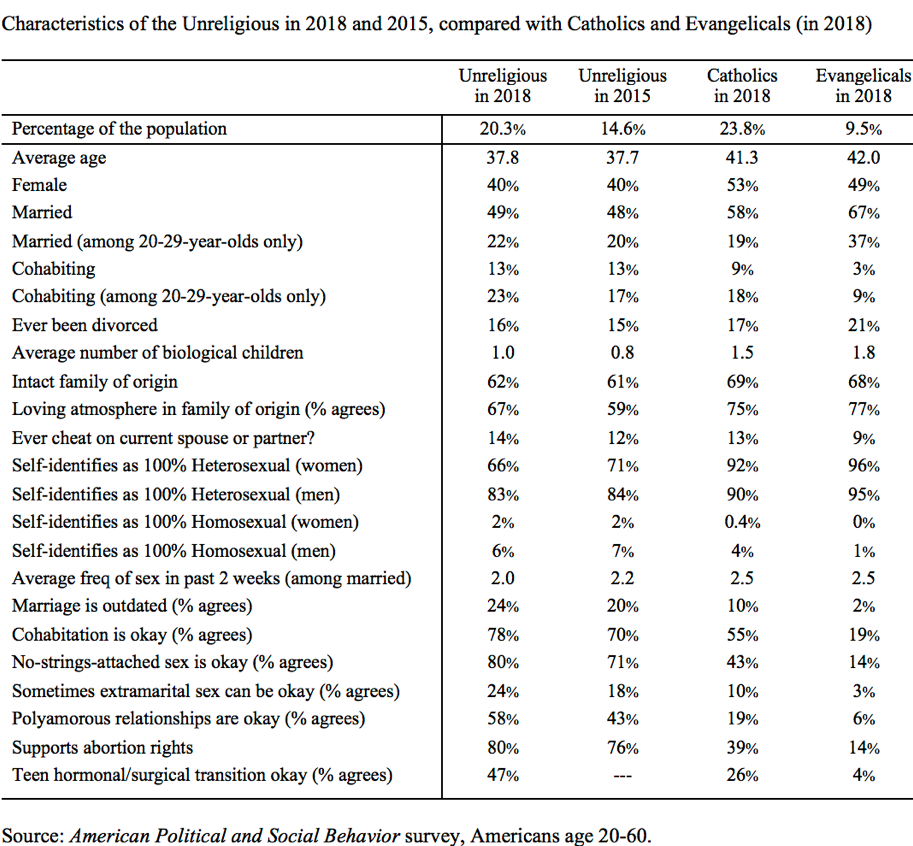
Mark Regnerus is a sociologist at the University of Texas, Austin. He publishes a lot of his books with Oxford University Press. So, his research methods are generally seen as reliable. I noticed that he had done a survey of views on religion, sexuality and marriage in 2018, and he published a popular level article about it earlier this week. I think it’s worth taking a look at his findings.

He writes:

Let me offer a word about the survey. I call it the American Political and Social Behavior survey, which interviewed 5,285 Americans in November 2018, just days after the midterm election. The data collection was conducted by Ipsos… a research firm with a very strong record of generating high-quality data for academic projects.

Here are his findings:

Views of unreligious, Catholic and evangelical Americans
Views of unreligious, Catholic and evangelical Americans (click to expand)

This is interesting:

Even when I limit the group to respondents below age thirty—which is just north of the median age at marriage in the United States—it is notable that 22 percent of the unreligious are married and 23 percent are currently cohabiting, not radically different from the 19 and 18 percent of Catholics that are married and cohabiting, respectively. For comparison, 37 and 9 percent of younger evangelicals are married and cohabiting, respectively. The cohabiting habits of the unreligious, however, have shifted—note the uptick in cohabitation—six percentage points in just under four years. That amounts to a 35 percent increase. Since it’s unlikely that the unreligious have recently changed their minds about the morality or pragmatics of living together, my bet is in the other direction: cohabiting leads many to no longer identify as religious at all.

Got that part in bold? Their attitudes are changing because of their sexual behaviors. So, if you want to reverse the decline of Christianity, we’re going to need to come up with some arguments and evidence to counter the sexual revolution. And on this blog, we’ve done that many times, looking at studies showing the future instability of marriages that occur after cohabitation. I’ve never heard a church preach on that, though. And it’s not something that even many Christian apologists focus on. Most Christian apologists, particularly the women, tend to focus on soft arguments,. They stay away from arguments about morality, because it’s divisive and abrasive to their desired audience. However, if the goal is persuading people that Christianity is a viable worldview, then we need to focus more on sexuality.

More Regnerus:

[O]n each of seven attitude measures I examined, the unreligious are notably more permissive than even the spiritual-but-not-religious (not shown). Nearly 80 percent of unreligious Americans agree (or strongly agree) that cohabitation is okay, no-strings-attached sex is okay, and abortion should be a legal right. This is all unsurprising. But even some of the more radically “progressive” attitudes demonstrate strong support among the unreligious: 24 percent agree that it is “sometimes permissible for a married person to have sex with someone other than his/her spouse.” (I thought perhaps women would differ from men here, but they didn’t—or at least not by much.) Although few Americans are actually in polyamorous living arrangements, the unreligious would support them should someone choose such an arrangement; 58 percent of them agreed that “it is okay for three or more consenting adults to live together in a sexual/romantic relationship,” a percentage that is far more supportive than Catholics or evangelicals. Among the latter, only 6 percent thinks polyamory could be okay.

A more interesting theme, however, is the surge in support for such alternatives. On each statement, note the rise in agreement that has occurred in just under four years. Polyamory tops the list—a 35-percent leap in the share of unreligious who now endorse polyamorous arrangements (from 43 to 58 percent). Even support for extramarital affairs grew by one-third (from 18 to 24 percent). The unreligious aren’t alone here. Catholics, too, have witnessed liberalization in attitudes. Evangelical numbers display a more modest uptick, and from lower starting points.

The non-religious people in my office who were raised Christian like to tell me that the existence of the Christian God isn’t important to them, because they can achieve marriage via cohabitation, and behave like good people without the need for any sort of framework to rationally ground it. They think that you can just pull out God, and the marriage will stay the same. They expect the people they start relationships with to act on Christian morality, even if the worldview was rejected as superstitious nonsense. But as you can see from the data, removing God has an enormous effect on the person’s ability to be stable and faithful.  The truth is that when you take out the vertical relationships with God, then the blueprint for the relationship becomes completely different. Relationships used to be seen as an enterprise where each person’s primary commitment was to lead and protect their spouse before delivering them to God with faith intact. Now, relationships are contingent on continuous happiness.

More Regnerus:

Only 66 percent of unreligious women say they are “100% Despite the permissive reputation of the unreligious, their actual marital sexual frequency is lower than that of Catholic and evangelical couples—at two instances in the past two weeks. As has been documented extensively in the past few years, the frequency of sex among American couples—whether cohabiting or married—has been declining at statistically significant rates. This pattern has not spared the godless.

I think this is interesting. I believe that men are facing an epidemic of sex-withholding from their wives, and I have an idea why that is. Today, women most commonly use sex to “jump start” a relationship with men who they perceive as “high value”, but who refuse to commit to them. This behavior is not focused on men who have commitment abilities, e.g. – provider, moral leader, spiritual leader, accurate worldview rooted in logic and evidence. Instead, most women use sex to get men who have the appearance of high value, e.g. – tall, tattoos, piercings, violent tendencies, exciting, fun, etc. Having established that pattern over and over with no-commitment bad boys, they marry someone who they see as beneath them, and then withhold sex. Commitment isn’t worthy of sex. It’s the man’s appearance and entertainment value that makes him worthy of sex. The comparison of this low-quality man to previous partners makes women more likely to initiate divorce for “unhappiness” later on.