Tag Archives: Cambrian Explosion

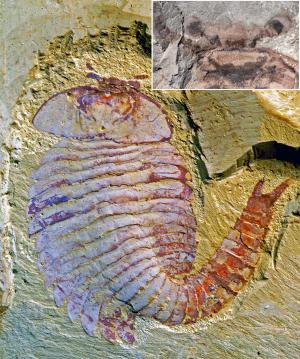
Nature publishes discovery of fossil with complex brain dated just after the Cambrian explosion

New fossil discovery shows advanced brain structures

Casey Luskin writes about it at Uncommon Descent.

Excerpt:

Over at PhysOrg.com, there’s a study being reported highlighting a 520 million year old fossil arthropod with a highly-developed brain. So soon in evolutionary time, and an already developed brain??? (To go beside the very complex eye of the Trilobites)

Here’s what one scientist said:

“No one expected such an advanced brain would have evolved so early in the history of multicellular animals,” said Strausfeld, a Regents Professor in the UA department of neuroscience.

Sorry, Darwinists, but IDers would expect it.

Let’s keep track of the problems that this good scientific discovery creates for naturalists.

Problem #1: Darwinism does not support rapid change from single-celled organisms just before the Cambrian explosion to complex brains just after the Cambrian explosion. Darwinian evolution has to go gradually from simple to complex.

Now for some more:

And, to add insult to injury for our Darwinist brethren, here’s this confirmation of “genetic entropy” and Behe’s QRB “rule”:

“The shape [of the fossilized brain] matches that of a comparable sized modern malacostracan,” the authors write in Nature. They argue the fossil supports the hypothesis that branchiopod brains evolved from a previously complex to a more simple architecture instead of the other way around.

So, that’s another problem.

Problem #2: Darwinism does not support going from more complex to less complex organisms, in general. This is especially true for complex biological systems like brains. Darwnists must explain how complex brains can be built from simpler parts through a long sequence of likely mutations. 

And more:

Here’s how the article ends:

The fossil supports the idea that once a basic brain design had evolved, it changed little over time[Translation: ID is completely correct!!!], he explained. Instead, peripheral components such as the eyes, the antennae and other appendages, sensory organs, etc., underwent great diversification and specialized in different tasks but all plugged into the same basic circuitry. “It is remarkable how constant the ground pattern of the nervous system has remained for probably more than 550 million years,” Strausfeld added. “The basic organization of the computational circuitry that deals, say, with smelling, appears to be the same as the one that deals with vision, or mechanical sensation.”

Yet another problem.

Problem #3: Darwinism does not work if organisms are observed to remain changeless and static over time. Darwinism requires change over time from simple to complex. Backwards change or no change falsifies Darwinism.

Read the whole post.

It’s just another prediction of Darwinian orthodoxy falsified by experimental evidence published in the top scientific peer-reviewed journal. Will this cause Darwinians to revise their theory to fit the evidence? Not likely. Their motivations for clinging to naturalism, the religion that undergirds Darwinism, are entirely beyond correction by evidence.

I wonder what people like P.Z. Myers and Larry Moran do when their religion comes into conflict with scientific evidence? Do they bitterly cling to their mythology from the 19th century? Or do they adjust their worldview to be in line with the progress of science?

Let Richard Dawkins explain evolution and the role of evidence:

“My argument will be that Darwinism is the only known theory that is in principle capable of explaining certain aspects of life. If I am right it means that, even if there were no actual evidence in favour of the Darwinian theory (there is, of course) we should still be justified in preferring it over all rival theories.” — p. 287, Blind Watchmaker” (1986)

Or Richard Lewontin:

“Our willingness to accept [naturalistic]  scientific claims that are against common sense is the key to an understanding of the real struggle between science and the supernatural. We take the side of science in spite of the patent absurdity of some of its constructs, in spite of its failure to fulfill many of its extravagant promises of health and life, in spite of the tolerance of the scientific community for unsubstantiated just-so stories, because we have a prior commitment, a commitment to materialism. It is not that the methods and institutions of science somehow compel us to accept a material explanation of the phenomenal world but, on the contrary, that we are forced by our own a priori adherence to material causes to create an apparatus of investigation and a set of concepts that produce material explanations, not matter how counterintuitive, no matter how mystifying to the uninitiated. Moreover, that materialism is absolute, for we cannot allow a divine foot in the door.” (Richard Lewontin in New York Review of Books, January 9, 1997, p. 28)

Last month, we saw a peer-reviewed published paper that falsified the Darwinian predictions about junk DNA. Recently, the Darwnists were proven wrong again about vestigial organs. Before that, we had another discovery of oxygen on the early Earth’s atmosphere, which blocks naturalistic origin of life scenarios. Did these scientific discoveries stop the worship of the Flying Spaghetti Monster by the Darwinian faithful? Of course not. And they don’t want to debate it with you, either.

Naturalists don’t want to have to explain why they are always believing things that are falsified by the progress of science. Naturalists fought the Big Bang tooth and nail, trying to save their eternal universe from the progress of science. Naturalists invented the now discredited oscillating model of the universe in order to “explain” the evidence for a cosmic beginning. Naturalists invented the unobservable, untestable multiverse to “explain” the cosmic fine-tuning. Unobservable aliens were posited in order to “explain” the origin of life so soon after the cooling of the Earth. Precursor fossils are invented without evidence in order to “explain” the Cambrian era explosion in biological complexity. And so on.

Evidence doesn’t matter to people who are motivated by naturalistic faith. Like belief in a flat-Earth, the delusion of naturalism is not accountable to scientific evidence. They believe what they want to believe. It’s not up for debate. For some people like Richard Dawkins, a prior lifestyle commitment makes theism (and the moral law!) an impossibility a priori. But rational people know that believing something just so that your actions are “justified” doesn’t make what you believe true.

Speaking of Richard Dawkins, if you haven’t seen the video of that coward being “Eastwooded” by William Lane Craig, here’s the link. Dr. Craig has obviously seen a lot of Clint Eastwood movies, and he manages to work in about a half-dozen Clint Eastwood lines into a careful philosophical and scientific refutation of Dawkins’ faith-based atheist delusions. I don’t mind if Dawkins wants to have his religious beliefs for comfort in the privacy of his home or church, but I don’t think that we should be making policy off of his subjective preferences. In the public square we need to be guided by public evidence – like the evidence from science.

Peer-reviewed paper in medical journal challenges Darwinian evolution

Casey Luskin explains over at Evolution News.

Summary: (links removed)

A new article by Dr. Joseph Kuhn of the Department of Surgery at Baylor University Medical Center, appearing in the peer-reviewed journal Baylor University Medical Center Proceedings, poses a number of challenges to both chemical and biological evolution. Titled “Dissecting Darwinism,” the paper begins by recounting some of the arguments raised during the Texas State Board of Education debate that challenged chemical and biological evolution. Those challenges include:

1. Limitations of the chemical origin of life data to explain the origin of DNA
2. Limitations of mutation and natural selection theories to address the irreducible complexity of the cell
3. Limitations of transitional species data to account for the multitude of changes involved in the transition.

(Joseph A. Kuhn, “Dissecting Darwinism,” Baylor University Medical Center Proceedings, Vol. 25(1): 41-47 (2012).)

It’s a good little introduction to where the action is on the origins debate but regular readers will have read it all before.

But there was one thing I found interesting.

The naturalistic response to this paper:  (links removed)

The journal also published a rebuttal to Dr. Kuhn by Charles Stewart Roberts, a cardiovascular surgeon in Virginia. Dr. Roberts’s rebuttal simply asserted, as if it were a truth that required no scientific backing, that all biological features could be produced by evolution:

The notion of “irreducible complexity” in a cell, as an argument against evolution, is beyond my present understanding. Knowing that life has existed on planet earth for billions of years, however, I suspect that there has been time enough for evolution, no matter how complex, with reducibility.

I was having a debate with an atheist on Facebook and this guy did nothing but duck and dodge by citations of peer-reviewed evidence, like the paper from December 2011 on the oxygen in the early Earth’s atmosphere, which destroys naturalistic origin of life scenarios. My favorite of his speculations was when he responded to the Big Bang cosmology by saying “one can easily envision a scenario in which the universe has existed eternally”. Or something like that. Atheists – always easily envisioning things that are falsified by the available experimental evidence.

Casey comments on Roberts’ “rebuttal”: (links removed)

We’ve addressed this sort of unsophisticated and poorly articulated argument in defense of defending Darwinian evolution many times. You can’t just vaguely appeal to vast and unending amounts of time (and other probabilistic resources) and assume that Darwinian evolution can produce anything “no matter how complex.” Rather, you have to demonstrate that sufficient probabilistic resources exist to produce the feature.

Rather than making assumptions, proponents of intelligent design ask what the Darwinian mechanism can, or cannot, do. For example, a 2010 peer-reviewed research paper by pro-ID scientist Doug Axe modeled a population of evolving bacteria, and found that there are severe limits on the ability of Darwinian evolution to produce multi-mutation features. (A multi-mutation feature is one that requires multiple mutations to be present before there is any advantage given to the organism.)

Axe’s research makes assumptions very generously favoring Darwinian evolution. He assumed the existence of a huge population of asexually reproducing bacteria that could replicate quickly — perhaps nearly 3 times per day — over the course of billions of years. But he found that complex adaptations requiring more than six neutral mutations would exhaust the probabilistic resources available over the entire history of the earth.

[…]Axe’s work suggests that we cannot assume, as Roberts does, that sufficient probabilistic resources exist to produce all the features we see in life, “no matter how complex.” Indeed, follow-up research by Axe and Ann Gauger suggests that many features might require more mutations before conferring an advantage than could arise in the history of the earth. Their 2011 study attempted to convert one protein into another, closely related protein — the kind of transformation that evolutionists claim happened easily in the history of life. Through mutational analysis, they found that a minimum of seven independent mutations — and probably many more — would be necessary to convert the protein and its function into that of its allegedly close relative.

Evolutionary theory certainly can explain some things. It works up to a point. But there is only so much time available, so much material to react, and so many reactions per second. Hand-waving is not going to prove the neo-Darwinian hypothesis. It’s going to take published experimental results. Like the results of Doug Axe and Ann Gauger.

Oh by the way, there’s another peer-reviewed article confirming the inability of naturalistic mechanisms to create first life discussed on Evolution News. (David L. Abel, “Is Life Unique?,” Life, Vol. 2:106-134 (2012)). I can’t blog on all of them!

Paul Chien interviewed on the Cambrian era fossils

Cambrian Explosion
Cambrian era fossils: Theory versus Data

From Leadership University. (H/T The Poached Egg)

Excerpt:

Dr. Paul Chien, chairman of the biology department at the University of San Francisco, recently accepted a unique invitation to travel to China to study fossils of the Cambrian era. What Chien found at the Chengjiang site, and what he has since learned about the Cambrian fauna, has changed the focus of his career. Today, Chien concentrates on further exploring and promoting the mysteries of the Cambrian explosion of life. Subsequently, Chien possesses the largest collection of Chinese Cambrian fossils in North America.

Chien attended Mere Creation, a conference last November sponsored by Christian Leadership, which was featured in the previous Real Issue. The following is an interview with Paul Chien.

RI: Dr. Chien, what is your interest in the evolution/creation debate?

Chien: Even before I became a Christian, I had doubts about evolution. During my college years I was really interested in finding answers, but I got very little help. For a while I lost interest because I thought, one way or the other, it wasn’t very important. But since I started teaching, many people ask me about that. In fact, I often speak at churches and youth groups and conferences, and I have been forced back to that question; it’s pretty much my hobby now.

RI: Until recently, you have focused on the effects of pollution on marine organisms. How then did you come to study the Cambrian “explosion of Life”?

Chien: In studying marine organisms, and mainly the invertebrate groups, I have a clear vision of the distinct characteristics of each phyla. The theory of evolution never [seemed to] apply well in my field of marine invertebrates. When the news broke concerning [the discovery of] an explosion of animal life, it really excited me because that [had been] my position for many years. Also, Phil Johnson’s chapter on fossils [Darwin on Trial, Intervarsity Press, 1991] really ignited my interest in that area.

When an opportunity came up to talk with Chinese paleontologists and to visit them and the original site of fossil discovery, it became something I had to do. So last March I organized an international group to make a visit there.

RI: So is the Chengjiang site a primary site for the Cambrian explosion?

Chien: Yes, it’s the site of the first marine animal found in the early Cambrian times we don’t count micro-organisms as animals.

RI: Are there other places in the world where you find the same organisms?

Chien: In some ways there are similarities between the China site and the other famous site, the Burgess Shale fauna in Canada. But it turns out that the China site is much older, and the preservation of the specimens is much, much finer. Even nerves, internal organs and other details can be seen that are not present in fossils in any other place.

RI: And I suppose many of these are probably soft-tissue marine-type animals?

Chien: Yes, including jellyfish-like organisms. They can even see water ducts in the jellyfish. They are all marine. That part of western China was under a shallow sea at the time.

RI: As you became more interested in this and discovered more about it, did you find it really was an “explosion of life”?

Chien: Yes. A simple way of putting it is that currently we have about 38 phyla of different groups of animals, but the total number of phyla discovered during that period of time (including those in China, Canada, and elsewhere) adds up to over 50 phyla. That means [there are] more phyla in the very, very beginning, where we found the first fossils [of animal life], than exist now.

Stephen J. Gould, [a Harvard University evolutionary biologist], has referred to this as the reverse cone of diversity. The theory of evolution implies that things get more and more complex and get more and more diverse from one single origin. But the whole thing turns out to be reversed we have more diverse groups in the very beginning, and in fact more and more of them die off over time, and we have less and less now.

RI: What information is the public hearing or not hearing about the Cambrian explosion?

Chien: The general impression people get is that we began with micro-organisms, then came lowly animals that don’t amount to much, and then came the birds, mammals and man. Scientists were looking at a very small branch of the whole animal kingdom, and they saw more complexity and advanced features in that group. But it turns out that this concept does not apply to the entire spectrum of animals or to the appearance or creation of different groups. Take all the different body plans of roundworms, flatworms, coral, jellyfish and whatever all those appeared at the very first instant.

Most textbooks will show a live tree of evolution with the groups evolving through a long period of time. If you take that tree and chop off 99 percent of it, [what is left] is closer to reality; it’s the true beginning of every group of animals, all represented at the very beginning.

Since the Cambrian period, we have only die-off and no new groups coming about, ever. There’s only one little exception cited the group known as bryozoans, which are found in the fossil record a little later. However, most people think we just haven’t found it yet; that group was probably also present in the Cambrian explosion.

Also, the animal explosion caught people’s attention when the Chinese confirmed they found a genus now called Yunnanzoon that was present in the very beginning. This genus is considered a chordate, and the phylum Chordata includes fish, mammals and man. An evolutionist would say the ancestor of humans was present then. Looked at more objectively, you could say the most complex animal group, the chordates, were represented at the beginning, and they did not go through a slow gradual evolution to become a chordate.

Someone posted an interesting documentary on Youtube about the Cambrian explosion.

Leadership University  is run by CLM, and features solid scholarship on a wide range of issues, including science.