Tag Archives: Brain

How the research of Jeffrey M. Schwartz on mindfulness confirms free will

Here’s a summary of the research of UCLA professor Jeffrey Schwartz which appeared in First Things.

Excerpt:

Schwartz provides a nonmaterialist interpretation of neuroscience and argues that this interpretation is more compelling than the standard materialist interpretation. He arrived at this position as a psychiatrist specializing in the treatment of obsessive-compulsive disorder (OCD). OCD sufferers recognize obsessive-compulsive thoughts and urges as separate from their intrinsic selves. For instance, after a few washings, the compulsive hand-washer realizes that his hands are clean and yet feels driven to keep washing them. It was reflection on this difference between the obvious truth (the hands are clean) and the irrational doubts (they might still be dirty) that prompted Schwartz to reassess the philosophical underpinnings of neuroscience.

From brain scans, Schwartz found that certain regions in the brain of OCD patients (the caudate nucleus in particular) exhibited abnormal patterns of activity. By itself this finding is consistent with a materialist view of mind (if, as materialism requires, the brain enables the mind, then abnormal patterns of brain activity are likely to be correlated with dysfunctional mental states). Nonetheless, having found abnormal patterns of brain activity, Schwartz then had OCD patients engage in intensive mental effort through what he called relabeling, reattributing, refocusing, and revaluing (the 4 Rs). In the case of compulsive hand-washing, this involved a patient acknowledging that his hands were in fact clean (relabeling); attributing anxieties and doubts about his hands being dirty to a misfunctioning brain (reattributing); directing his thoughts and actions away from handwashing and toward productive ends (refocusing); and, lastly, understanding at a deep level the senselessness of OCD messages (revaluing).

Schwartz documents not only that patients who undertook this therapy experienced considerable relief from OCD symptoms, but also that their brain scans indicated a lasting realignment of brain-activity patterns. Thus, without any intervention directly affecting their brains, OCD patients were able to reorganize their brains by intentionally modifying their thoughts and behaviors. The important point for Schwartz here is not simply that modified thoughts and behaviors permanently altered patterns of brain activity, but that such modifications resulted from, as he calls it, “mindful attention”-conscious and purposive thoughts or actions in which the agent adopts the stance of a detached observer.

So mind-brain interaction is not a one-way street. Everyone knows that you can alter your consciousness, beliefs, moods, sensations, etc. by changing your brain. But it turns out that you can also will to focus your thoughts on certain things in order to change your brain chemistry. So the causation is not just bottom-up, but top-down.

Now mindfulness therapies – which are documented in the research papers published by Schwartz (like this one and this one and this one)- assume the existence of free will. Naturalists don’t like these scientific publications because naturalists don’t believe in free will, as the famous naturalist philosopher Alex Rosenberg explained in his debate with William Lane Craig.

This post from Uncommon Descent explains the naturalist conundrum. (H/T J. Warner Wallace tweet)

Excerpt:

The issue, for Schwartz, turns on whether or not there is such a thing as free will. The assumption of free will is critical to mindfulness therapies for practical purposes.

Philosophies and religions have various opinions about ultimate free will. The therapist must ask, is my patient capable of carrying out a program that requires that he choose to focus his attention on A and not B? In practice, this turns out to be true for many patients, which makes the therapy useful. There is neuroscience evidence for brain reorganization as a result, showing that it is not merely an imagined effect.

Now, if someone wishes to claim, as many outspoken advocates of Darwinian evolution have, for example, that free will is impossible, the only thing that a mindfulness therapist can say is, go away. Either they are mistaken or the research results from mindfulness therapies are.

By the way, if you like this topic, and want a resource to show your friends, be sure and get a hold of the debate on mind vs. brain between Jeffrey M. Schwartz and Michael Shermer.
New study: teen pot use could hurt brain and memory

NBC News reports.

Excerpt:

Teenage pot smokers could be damaging brain structures critical to memory and reasoning, according to new research that found changes in the brains of heavy users.

Research released Monday in the journal Schizophrenia Bulletin showed the brains of young heavy marijuana users were altered in so-called sub-cortical regions — primitive structures that are part of the memory and reasoning circuits. And young people with such alterations performed worse on memory tests than non-using controls, despite the fact that the heavy users had not indulged for more than two years, on average, before the testing.

“We see that adolescents are at a very vulnerable stage neurodevelopmentally,” said Matthew Smith, who led the research team at Northwestern University Feinberg School of Medicine in Chicago. “And if you throw stuff into the brain that’s not supposed to be there, there are long-term implications for their development.”

The portion of people ages 12 to 17 who used marijuana during the past month fell to 9.5 percent last year from almost 12 percent in 2002, according to the latest figures from the government’s Substance Abuse and Mental Health Services Administration. But that still represents millions of adolescents and teenagers — and the legalization of marijuana has raised the specter that underage people will have easier access.

Adults who smoked pot regularly as teens were shown to have “neuropsychological decline” and “more cognitive problems” than non-users in a study last year in the Proceedings of the National Academy of Sciences (PNAS). This was true even if users stopped using long before the study.

I think these papers are useful when talking to young people about drugs. You don’t want it to be a situation where you are ordering them around based on nothing more than YOUR needs and YOUR beliefs. Then it turns into a head-butting contest, and you can’t watch them all the time. A better alternative is to produce the studies that show the real effects and then ask them what they have on their side. If they are going to rebel anyway, at least you have tried to persuade them rather than control them, and that’s good parenting.

Related Posts

Study: brain of child neglected by mother is smaller and underdeveloped

Dina sent me this article from the UK Daily Mail.

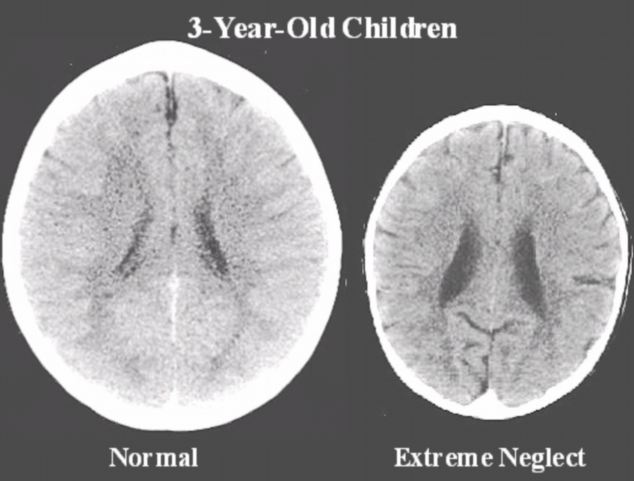
Here is the scan:

Brain scans of 3-year old children: normal vs neglected

Excerpt:

Both of these images are brain scans of a two three-year-old children, but the brain on the left is considerably larger, has fewer spots and less dark areas, compared to the one on the right.

According to neurologists this sizeable difference has one primary cause – the way each child was treated by their mothers.

The child with the larger and more fully developed brain was looked after by its mother – she was constantly responsive to her baby, reported The Sunday Telegraph.

But the child with the shrunken brain was the victim of severe neglect and abuse.

According to research reported by the newspaper, the brain on the right worryingly lacks some of the most fundamental areas present in the image on the left.

The consequences of these deficits are pronounced – the child on the left with the larger brain will be more intelligent and more likely to develop the social ability to empathise with others.

But in contrast, the child with the shrunken brain will be more likely to become addicted to drugs and involved in violent crimes, much more likely to be unemployed and to be dependent on state benefits.

The child is also more likely to develop mental and other serious health problems.

Professor Allan Schore, of UCLA, told The Sunday Telegraph that if a baby is not treated properly in the first two years of life, it can have a fundamental impact on development.

He pointed out that the genes for several aspects of brain function, including intelligence, cannot function.

[…]The study correlates with research released earlier this year that found that children who are given love and affection from their mothers early in life are smarter with a better ability to learn.

The study by child psychiatrists and neuroscientists at Washington University School of Medicine in St. Louis, found school-aged children whose mothers nurtured them early in life have brains with a larger hippocampus, a key structure important to learning, memory and response to stress.

The research was the first to show that changes in this critical region of children’s brain anatomy are linked to a mother’s nurturing, Neurosciencenews.com reports.

The research is published online in the Proceedings of the National Academy of Sciences Early Edition.

Lead author Joan L. Luby, MD, professor of child psychiatry, said the study reinforces how important nurturing parents are to a child’s development.

I have a very good feminist non-Christian friend who sometimes comments here. I once asked her about marriage and she said that her skills would be wasting on raising children. I explained to her my view that a mother needs to stay at home with the children, and that is more important work. I expect my future wife to read all kinds of books on child care and to give the child attention, nutrition, exercise and play so that the child will grow up to be an effective Christian. Maybe I need to be clear. I am not going to spend hundreds of thousands per child with just any woman. I need a woman who can produce influential and effective Christians who will engage in the public square. And we do not entrust that job to just anyone – we want a Michele Bachmann or a Jennifer Roback Morse. Professional women who are willing to be stay-at-home moms when it’s necessary to do that.

I expect the woman I marry (if I marry) to have a college degree, and preferably a graduate degree, and a couple of years of employment. Then she has to stay home and invest in those children through the first five years at least. After that she can stay home or work as much as she thinks is beneficial to the family goals of impacting the university, the church and the public square – as well as continuing to raise those children. It’s not a waste of her talent to make the next William Lane Craig, the next Marsha Blackburn, the next Doug Axe, or the next Edith Jones.