Tag Archives: Book Review

A review of Lawrence Krauss’ book “A Universe From Nothing”

Lawrence Krauss is a physicist who affirms that the entire physical universe appeared out of nothing. How well does his theory hold up?

This review of Krauss’ book was written by a non-theist in the liberal New York Times.

Excerpt:

Lawrence M. Krauss, a well-known cosmologist and prolific popular-science writer, apparently means to announce to the world, in this new book, that the laws of quantum mechanics have in them the makings of a thoroughly scientific and adamantly secular explanation of why there is something rather than nothing.

[…]Never mind. Forget where the laws came from. Have a look instead at what they say. It happens that ever since the scientific revolution of the 17th century, what physics has given us in the way of candidates for the fundamental laws of nature have as a general rule simply taken it for granted that there is, at the bottom of everything, some basic, elementary, eternally persisting, concrete, physical stuff. Newton, for example, took that elementary stuff to consist of material particles. And physicists at the end of the 19th century took that elementary stuff to consist of both material particles and electro­magnetic fields. And so on. And what the fundamental laws of nature are about, and allthe fundamental laws of nature are about, and all there is for the fundamental laws of nature to be about, insofar as physics has ever been able to imagine, is how that elementary stuff is arranged. The fundamental laws of nature generally take the form of rules concerning which arrangements of that stuff are physically possible and which aren’t, or rules connecting the arrangements of that elementary stuff at later times to its arrangement at earlier times, or something like that. But the laws have no bearing whatsoever on questions of where the elementary stuff came from, or of why the world should have consisted of the particular elementary stuff it does, as opposed to something else, or to nothing at all.

The fundamental physical laws that Krauss is talking about in “A Universe From Nothing” — the laws of relativistic quantum field theories — are no exception to this. The particular, eternally persisting, elementary physical stuff of the world, according to the standard presentations of relativistic quantum field theories, consists (unsurprisingly) of relativistic quantum fields. And the fundamental laws of this theory take the form of rules concerning which arrangements of those fields are physically possible and which aren’t, and rules connecting the arrangements of those fields at later times to their arrangements at earlier times, and so on — and they have nothing whatsoever to say on the subject of where those fields came from, or of why the world should have consisted of the particular kinds of fields it does, or of why it should have consisted of fields at all, or of why there should have been a world in the first place. Period. Case closed. End of story.

What does it mean? It means this. Physical laws are merely a description of how physical entities operate. They do not explain where the physical entities being described came from. Physical laws are like traffic laws – they describe how cars are supposed to drive around on roads – but they don’t create the cars!

In any case, if you would like to find out how well Krauss’ ideas hold up in a debate, you can watch him debate William Lane Craig right here:

Or listen to the debate and read my very very snarky summary here.

The debate itself was a slaughter. Krauss was one of the least rational opponents Craig has ever faced.
Book review of “The Cell’s Design” by Fazale Rana

J.W. Wartick reviews “The Cell’s Design” by biochemist Fazale Rana.

Excerpt:

The first line of evidence comes from the machines in the cell. Again, Rana’s approach is analogical, rather than negative. The machine-like nature of the flagellum, along with other motor-like cellular functions presents an argument: “Organisms display design. Therefore, organisms are the product of a creator” (86).

The case doesn’t rest merely upon molecular machines. Rather, that is but one of the many lines of evidence. Rana draws out the implications of several “chicken-and-egg” paradoxes. These include the “mutual interdependence of DNA and proteins” (99), the origin of proteins themselves (100ff), and more (105ff). These systems present a kind of “irreducible complexity in which the system depends on the system to exist” (108).

Other elements of design are present in the cell as well. Aquaporins intricate and detailed workings illustrate the design that is present in the system (111ff). Other detailed, intricate designs (such as collagen, mRNA, and the breakdown of proteins) hint at the need for a designer. But the reasoning is not only supported by the details, it is also bolstered by the structural composition of the cell (126ff). The analogy of cells to machines is strengthened further by the quality control systems within the cell (198ff). Again, the reasoning is analogical–these things are designed, therefore they need a designer.

“Information can’t be separated from the activity of an intelligent agent” (142). The numerous examples of information in the cell lead to the inference of an agent. But it is not only the information’s presence that hints at a designer. Here Rana’s case really builds on and develops the work of other ID theorists. The information alone could be enough to infer an agent, but one must also account for the fact that cellular information follows rules like syntax, semantics, and pragmatics (144ff). It is not merely information, it is the use of that information and the rules governing that use that strengthen the case for an agent behind the information.

It never hurts to know a lot about cosmology and biochemistry, those seem to be the best areas for offensive science apologetics.

I have this book and a later book by Rana called “Creating Life in the Lab” sitting on my ironing board (which is where I put all my to-read books) . Maybe it’s time for me to start reading those and posting book reviews.

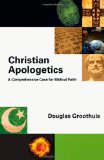
Lee Strobel interviews Douglas Groothuis on his new apologetics book

Christian Apologetics

Mary sent me this article from the BibleGateway site.

Excerpt:

Q. What’s the strongest argument in the arsenal of atheists these days? And why does it fall short?

A. That’s a big question. Different atheists will use different arguments, but they often confront Christians with two things: (1) Darwinism has refuted the idea of Designer and so defeats Christianity (and every other form of theism). They claim that undirected, purely material causes and entities can explain all of biology. (2) The existence of the amount of evil in the world destroys the idea that there is a God who is all-good and all-powerful. No such God would allow this to happen. This is called the problem of evil.

I address (1) in chapters 13 and 14 of Christian Apologetics. To put it into a nutshell: Darwinism is terribly overrated scientifically. Darwinists usually presupposes a materialistic worldview—this is their philosophy, not something derived from science itself—and then interpret everything in biology according to those categories. In other words, “What my net don’t catch, ain’t fish.”

But once we admit intelligent design as a legitimate category of explanation, we find that Darwinism loses its persuasive power as a comprehensive explanation of the biosphere. In fact, Darwinism cannot explain the existence of molecular machines (such as the bacterial flagellum) or the information in DNA code. Nor can it even present a compelling case that all life evolved from a common ancestor.

In addition, my book builds what I hope is a strong cumulative case for Christian theism before addressing the vexing problem of evil in the final chapter. First I consider “dead ends” to explain the fact of evil in the world. Every worldview—and not just Christianity—needs to give an account of the meaning of evil and how to deal with it.

So every worldview has to answer “the problem of evil.” I argue that atheism has no intellectual resources to bring to bear on the problem. It cannot explain the very existence of evil, since it lacks a transcendent and personal standard for good and evil, nor can it give any hope for how to wrestle with evil. This is because all the atheist can say is (to put it politely): “Stuff happens.”

However, Christianity, while challenged by the fact of evil, is not overwhelmed by it. Apart from the problem of evil, we can stand on the foundation of natural theology. There are compelling arguments for, among other things, a First Cause who designed the universe and who is the source of moral law and meaning. Moreover, we find historically reliable documents that speak of Jesus Christ as God incarnate—one who vindicated himself through his matchless life, death, and resurrection. Thus, we do not stand before the problem of evil intellectually naked. Rather, we are girded in strong rational armor.

The Christian answer to the problem of evil is that while God is sovereign, some of God’s creatures (angelic and humans) brought evil into the world through their rebellion. God did not create evil. However, as an all-wise God, God uses evil for greater goods that would not be achievable otherwise. Further, God proves his love and goodness by experiencing the worst possible evil through the crucifixion of Jesus, Christ, God, the Son. Christ’s resurrection three days later stamps history and eternity with the verdict that good (that is, God) wins out over evil in the end.

Q. You offer a compelling case for the resurrection of Jesus. What’s the strongest counter-argument to him rising from the dead? And why does that alternative fail?

A. None of the counter-arguments are as rationally strong as the claim that Jesus left an empty tomb and rose from the dead in space-time actuality. The naturalistic accounts all fail to explain key elements of what we know from history.

However, in recent years, the hallucination theory has generated the most attention, as Gary Habermas has pointed out. This theory affirms that Jesus did not objectively rise from the dead; instead, his followers subjectively hallucinated a resurrection and subsequently built their movement on this delusion. While this counter-argument may be “the best of the bad,” it is still very bad indeed.

First, hallucinations are not group phenomena, but rather individual experiences. But we have well-attested records that many people in their right minds observed the risen Jesus at the same time, as well as other individual appearances (as to Paul).

Second, if many people were deluded about Jesus and began a movement in his name, the Roman government could have put a stop to the young Jesus movement by producing his corpse publicly. They had both the means and the motive to do so. But we have no record of anything like that.

Third, Jesus’ followers did not expect him to rise from the dead. This was not part of their theology and they did not understand Jesus when he made reference to this fact before his resurrection. N.T Wright strongly argues for this. But hallucinations usually involve some form of wish fulfillment: people strongly desire something, and then hallucinate about it. This does not fit the objective historical evidence about Jesus’ followers at all.

I think if you follow apologetics at all, you can see that Doug knows his stuff. But look how precisely he gets the material out – so concisely. I think Doug’s apologetics book and Mike Licona’s resurrection book are the books of the year. But for intermediate to advanced apologists only! Doug and Michael are two of my absolute favorite Christian apologists.