Tag Archives: Birth

The top 5 myths about Christmas

From Take Two Apologetics.  It’s an interview with Krista Bontrager. I removed the links from the excerpt below, so you can click through to their site if you want the links.

Excerpt:

Krista, many of us were taught that Jesus was born in a stable because “there was no room in the inn.” Was He born in a stable?

Probably not. Nowhere in the Bible does it state that Joseph went from home to home looking for a place to stay. That story stems from many translations’ use of the word “inn” in Luke 2:7. From that, we extrapolate a whole slew of events—the innkeeper, innkeeper’s wife, a No Vacancy sign flashing. The problem is that the word used in Luke 2 (kataluma) is not the word for inn—that’s a bad English translation. The word is better translated as “upper room” or “guest room.” In fact, the 2011 translation of NIV makes that correction. Luke 22:11 also uses kataluma to describe the guest room where the last supper took place. In contrast, pandocheion (correctly translated as “inn”) appears inthe parable of the Good Samaritan.

Where was Jesus born, then, if not in a stable?

It’s much more likely He was born in a home. Mary and Joseph were going to their ancestral home, which means they had extended family there. It’s almost inconceivable that their family would not have taken them in considering the cultural practices of that time.

So if Jesus was born in a home, why does the Bible say He was placed in a manger?

That’s an important detail because it tells us what part of the house they were in. In those days, homes had an upper level where the family would sleep and a lower level where animals were kept at night for the animals’ protection and to provide heat. It seems that Jesus was born in that lower level where the animals were kept. And he was placed in a manger (feed trough) because they make for a great little cradle. In fact it reminds me of the makeshift bed my husband and I once made for our daughter when we stayed overnight at a hotel.

What about some of the characters often suggested as being present at Christ’s birth?

The shepherds were present, but the three wise men were not. Matthew’s account apparently takes place during a different time frame than Luke’s. One clue is that the Greek word Matthew used to describe Jesus is a paidion, which can mean anything from an infant to a toddler. This range of definitions would be consistent with King Herod killing all the Jewish  boys ages two and under (Matthew 2). This would mean that Jesus was probably two or younger when He was visited by the wise men.

Okay, so we’ve eliminated the stable and the wise men from the Nativity. What about the date? Was Jesus born on December 25?

Maybe. The standard story is that December 25 was adopted after Constantine’s conversion to Christianity because it was on a pagan holiday and the winter solstice. Christians then co-opted the holiday and Christianized it. What’s interesting is that the early church put almost no emphasis on celebrating the birth of Christ. They were much more concerned with the resurrection. It’s not until AD 200 where possible dates are mentioned for the celebrating of Christ’s birth. By about AD 300 there were two dates: December 25 (for the west) and January 6 (for the east). There does seem to be a tradition of December 25 long before Constantine’s conversion, so that’s why I say maybe. This article from the Biblical Archaeology Review gives a good summary of “How December 25 Became Christmas.”

I found this post over on Apologetics 315. Brian puts up a post with apologetics stories every Friday. There’s more in there – I am listening to the 5 part lecture series on church history right now. (It’s Calvinist, but polite)
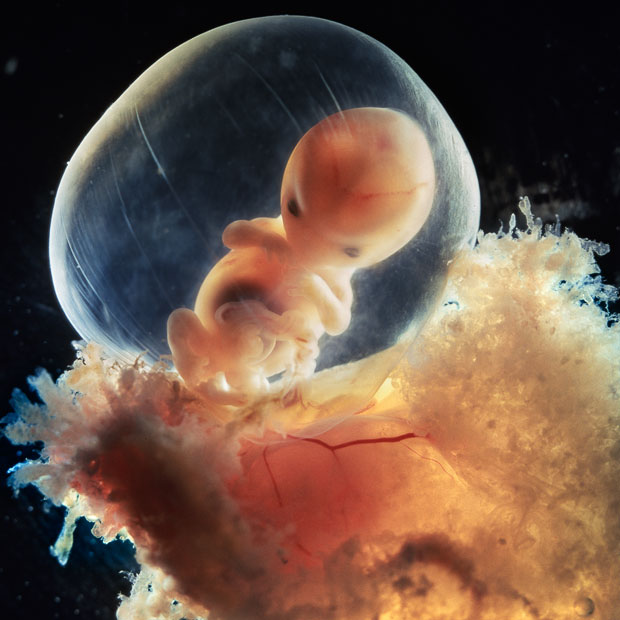
Trent Franks introduces bill to ban sex-selection and race-selection abortions

Scheming unborn baby is pleased with incremental pro-life laws

Life News news reports on the new Prenatal Nondiscrimination Act “PRENDA” bill.

Excerpt:

A U.S. congressman has reintroduced legislation that would ban sex-selection or race-based abortions. Congressman Trent Franks, an Arizona Republican who is a member of the House Judiciary Committee, has brought back the Prenatal Nondiscrimination Act.

The measure would prohibit knowingly performing or financing sex-selection or race-based abortions.

[…]“[T]he Prenatal Nondiscrimination Act, or “PRENDA,” … restricts sex-selection abortion and race-selection abortion, and the coercion of a woman to obtain either. The woman seeking an abortion is exempted from prosecution, while abortion providers are held to account,” wrote Franks in a letter to colleagues on Monday.

“Sex-selection abortion is happening in the United States. A study published in the April 2008 Journal of the National Academy of Sciences shows through U.S. Census data that certain segments of the U.S. population – particularly those coming from countries that practice sex-selection abortion – have unnaturally skewed sex-ratios at birth caused by sex-selection ‘most likely at the prenatal stages,’” Franks added.

Franks also noted that abortion centers are disproportionately placed in African-American communities and he pointed out that Planned Parenthood has come under fire for accepting donations from people claiming to want the abortion business to target blacks.

“Following the unearthing of the nation-wide race-targeted abortion donations, civil rights activists and African-American pastors from across the country protested government acquiescence in race-targeted abortion and the government funding of clinics that they believe are purposefully placed in the inner city and targeted to minority women,” he said.

A few years ago, a national study showed the possibility that the practice of sex-selection abortions has made its way from Asia to the United States. Researchers Douglas Almond and Lena Edlund of the National Academy of Sciences say their analysis of the 2000 Census shows the odds prematurely increasing for Asian-American families from China, Korea and India to have a boy if they already have a girl child.

The data “suggest that in a sub-population with a traditional son preference, the technologies are being used to generate male births when preceding births are female,” they wrote in the paper.

Meanwhile, a 2006 poll showed a majority of Americans would likely support the bill. A 2006 Zogby International poll shows that 86% of the American public desires a law to ban sex selection abortion. The poll surveyed a whopping 30,117 respondents in 48 states.

Democrats favor abortion through all 9 months of pregnancy – for any reason, or no reason. Therefore, Democrats favor killing a baby because it is a girl, and killing a baby because it is black. That’s what it means to be for abortion.

Do people choose their religion based on their country of birth?

This podcast is from Jim W. Wallace of Please Convince Me. (H/T John Barron)

Topic:

Do people choose their religion based on the country of their birth, or based on peer pressure from their local community, or based on pressure from their family?

The MP3 file is here. (31 Mb, 67 minutes)

Summary:

  • people in the early church did not become Christians because of peer pressure
  • Christianity thrived in an environment of hardship and persecution
  • even today, Christianity is thriving in China, in a hostile environment
  • Christianity is actually growing the fastest in non-Christian countries
  • in America, the two fastest growing religions are Islam and “No religion”
  • the entertainment industry, mainstream media and university are anti-Christian
  • many people become Christians on their own, which no family/community pressure

If you listen to his read e-mails, he mentions my post on the hiddenness of God and plugs my blog! Wow!