The White House move this week to torpedo a deal between House Republicans and Senate Democrats to extend dozens of expiring tax breaks suggests that the executive action legalizing 5 million unauthorized immigrants may have been no fluke: Compromise appears to be near the bottom of President Obama’s agenda for his last two years in office.
Despite — or perhaps because of — the Republican wave election that capsized Democrats’ Senate majority, Obama is tugging his party further left, which could make it harder for the GOP to govern effectively. A shift away from the center might seem counterintuitive, but it’s consistent with the Democrats’ post-mortem election analysis that put the blame on the party’s failure to focus enough on its economic agenda.
The White House’s veto threat, which apparently surprised dealmakers, was “really pretty stunning” considering that soon-to-be-demoted Majority Leader Harry Reid was its quarterback, said Chris Krueger, political analyst at Guggenheim Partners’ Washington Research Group.
In blowing apart the deal, estimated to cost $440 billion over 10 years, the White House lined up behind liberal Massachusetts Sen. Elizabeth Warren, who attacked it as “a massive handout to big corporations” that asks “working families to pick up the tab.”
The Obama administration used the same justification in explaining its threat to veto the bill if it reached the president’s desk: “It would provide permanent tax breaks to help well-connected corporations while neglecting working families.”
The centerpiece of the deal is a $160 billion provision to make permanent and expand a research and experimentation tax credit, an idea that the administration has supported. The next two biggest pieces, both about $73 billion over 10 years, would make permanent the American Opportunity tuition tax credit and an allowance for small businesses to write off capital investments permanently.
Individuals would be able permanently to deduct sales taxes instead of income taxes, important for residents of states like Florida and Texas, at a cost of $34 billion. Controversial wind production taxes would be extended but phased out over two years, costing $20 billion.
Other smaller pieces include extending a financial-crisis related provision to shield the value of written-down mortgage principal from taxation; making permanent an expanded deduction for users of mass transit; and making permanent tax-free charitable contributions from tax-protected retirement accounts.
That last point about being able to give away your retirement plan tax-free is huge for me, because that’s what I planned to do with my 401K when I retire, since it doesn’t look like I am going to ever get married. If that tax break on charitable deductions from retirement accounts is ever revoked, it would be bad news for the apologists and Christian scholars I donate to. But it’s in keeping with the leftist idea that individuals like me are only good for earning money, but it takes a big secular government to know how to spend it. They have other plans for my money, like free abortions, IVF and sex changes. Yay, big government!
Have you heard about “The Forgotten 15“? Here’s a news article by the Washington Times that explains it.
Excerpt:
Last week, the House passed a strongly bipartisan bill which would prevent a job-killing 3 percent withholding tax on all government contractors from going into effect. Even though the White House supports the measure, Mr. Reid, a Nevada Democrat, has chosen instead to bring another “small bite” from the president’s failed American Jobs Act to the floor. He wants to hike taxes on business owners so he can blow $60 billion in more stimulus for bike paths, choo-choo trains and bus stops.
Mr. Reid can’t even round up all the Democrats behind his partisan plan, but he continues to drag his feet on items that could pass because the last thing he wants to do is adopt legislation that gives the GOP the chance to take some credit with the public.
The Senate has not been this inactive in at least a quarter-century. As of Tuesday, the Senate had held 194 votes for the year, 54 fewer than at this time last year.
The intransigence has real-world implications. In March, the House passed a strongly bipartisan bill which would have stopped a court order from imposing duplicate and expensive regulations on farmers and ranchers. The Senate never brought the bill up for a vote, and on Monday a key deadline passed, allowing new regulations on pesticide applications to go into effect. That’s bad for jobs.
House Republican leaders want the public to know that they aren’t to blame for the stalemate on Capitol Hill. Speaker John A. Boehner produced a card listing the “forgotten 15” jobs bills that have passed the House but not the Senate. The Ohio Republican gave the card to members, telling them to carry it with them, hold it up at events at home, and flash it during interviews to remind Americans that Republicans are doing everything they can to address the employment situation.
The Democratic strategy is to set up Republicans as a foil for their 2012 re-election bids. Even though the congressional approval rating is down in the single-digits, Mr. Reid wants to draw a distinction between his party and the GOP by only bringing up bills that Republicans will oppose so his caucus can send out accusatory press releases.
The messaging is carefully crafted to fit with Mr. Obama’s latest campaign trail slogans about how “we can’t wait” for Congress to act. He showed his true motives on Tuesday when the president invited congressional Democrats to the White House to ostensibly talk about the jobs agenda. He has no plans to invite Republicans over to chat.
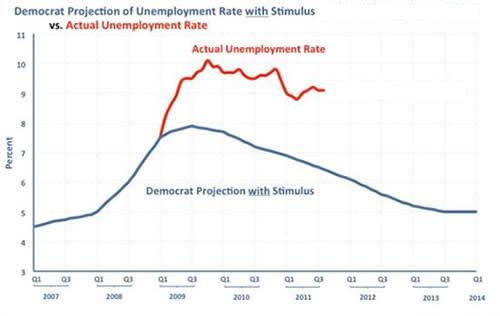
Projected vs Actual Unemployment With Stimulus 2011
Back in 2007, when the Republicans controlled the House and Senate, the unemployment rate was near 4%. FOUR PERCENT. And we had a deficit of $160 billion – NOT 1.6 TRILLION.
Campaigning for another failed stimulus and more job destroying taxes, President Obama has repeatedly—and falsely—asserted that “Congress isn’t willing to move” legislation to facilitate job growth. While the president plays politics, House Republicans have been working and approving legislation to promote economic growth and job creation. The House has approved more than 15 bills that, if enacted, would immediately help to grow the economy without more failed stimulus spending. These bills are currently stalled in the Democrat-controlled Senate and the president has not encouraged the Senate to act.
Here is a sample:
4) H.R. 1230—Restarting American Offshore Leasing Now Act: H.R. 1230 would require the Department of the Interior (DOI) to auction offshore oil and gas leases in the Central and Western Gulf of Mexico, as well as in an area off the coast of Virginia. The bill would help to reduce energy prices and promote job creation by expediting offshore oil and natural gas exploration in the Gulf of Mexico and the Virginia coast.
6) H.R. 1231—Reversing President Obama’s Offshore Moratorium Act: H.R. 1231 would require that each five-year offshore oil and gas leasing program offer leasing in the areas with the most prospective oil and gas resources, and would establish a domestic oil and natural gas production goal. The bill would essentially lift the President’s ban on new offshore drilling by requiring the Administration to move forward on American energy production in areas estimated to contain the most oil and natural gas resources.
7) H.R. 2021—The Jobs and Energy Permitting Act of 2011: H.R. 2021 would eliminate needless permitting delays that have stalled important energy production opportunities off the coast of Alaska. The bill would also eliminate the permitting back-and-forth that occurs between the EPA and its Environmental Appeals Board. Rather than having exploration air permits repeatedly approved and rescinded by the agency and its review board, the EPA will be required to take final action – granting or denying a permit—within six months.
10) H.R. 1938— North American-Made Energy Security Act: H.R. 1938 would direct the President, acting through the Secretary of Energy, to coordinate with all federal agencies responsible for an aspect of the President’s National Interest Determination and Presidential Permit decision regarding construction and operation of Keystone XL, to ensure that all necessary actions are taken on an expedited schedule. The bill would promote job creation and energy security by ending the needless delay of the construction and operation of the Keystone XL pipeline.
16) H.R. 2433—Veterans Opportunity to Work Act: H.R. 2433 would create or modify programs that provide employment and training services to veterans and service members separating from active duty. The bill would also make changes to programs that offer home loan guarantees, ambulance services, and pension payments to qualifying individuals. Among other things, the bill would provide up to 12 months of Veterans Retraining Assistance to no more than 100,000 unemployed veterans that enter education or training programs at community colleges or technical schools to prepare them for employment in an occupational field that is determined by Department of Labor to have significant employment opportunities.
17) H.R. 674—To amend the Internal Revenue Code of 1986 to repeal the imposition of 3 percent withholding on certain payments made to vendors by government entities: H.R. 674 would permanently repeal the imposition of 3 percent withholding on certain payments made to vendors by government entities. Currently, the imposition of the 3 percent withholding is set to take effect on January 1, 2013. If the 3 percent withholding tax were implemented as scheduled, government entities would be required to withhold 3 percent of payments to persons providing property or services to the government. For example, on an invoice for $20,000 the government would pay the business $19,400 and withhold $600 as a preemptive tax. These added costs would almost certainly translate into fewer private-sector jobs and higher costs for the government and taxpayers.
They are actually up to 17 jobs bills now.
And finally, I have to post this funny John Boehner clip:
We need more of that Mr. Boehner. I think that was a good opportunity to say “freaking” as well. Because he should be pissed off with this Solyndra-bailout President.

 WINTERY KNIGHT