
From Evolution News. (H/T Stephen C. Meyer)
Excerpt:
In four television episodes of the John Ankerberg Show broadcast across the US and over 200 nations worldwide, Dr. John Ankerberg interviewed Dr. Stephen C. Meyer, author of the groundbreaking book Signature in the Cell: DNA and the Evidence for Intelligent Design. The series will begin broadcasting on April 3 at 5:30pm EDT on the Daystar Network and on April 10 at 9:30pm EDT on the INSP Network.
In the interviews Dr. Meyer explains how even Charles Darwin, in his book The Origin of Species, admitted he did not know how the first cell came into being, or how life came to be.
Scientists in Darwin’s day thought the cell was a simple glob of plasm, but today we have discovered that the cell is an almost unimaginably complex system of molecular machines and rich in digital code.
Where did this high-tech in low life come from? Ankerberg and Meyer explore the mystery surrounding this question, which Meyer calls the DNA enigma. Click on the links below to watch full episodes of the show online!
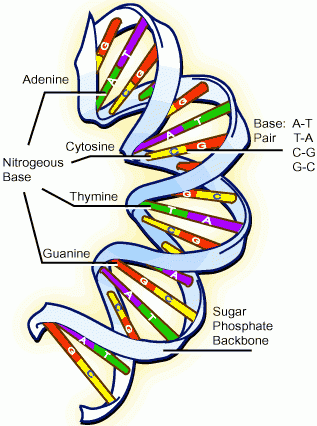
- Week 1: Every person’s body consists of over a trillion cells. Almost every one of these cells includes a DNA molecule. What is DNA? Why is it so special? What does it do? Where did the digital code embedded in DNA originate? Why does the specified information in DNA point to a designing intelligence?
- Week 2: As scientific technology has progressed, scientists have realized the cell is more and more complex. According to Microsoft’s Bill Gates, the DNA within each cell is far more complex than any computer software ever created. Where did the coded information within DNA come from? What naturalistic theories have been proposed? What is the possibility of the precise genetic information in DNA evolving by chance?
- Week 3: In addition to chance, scientists have offered other answers to the origin of the precise genetic information found in DNA. Why is it that natural selection, self-organizing natural laws, or some combination of these with chance cannot explain where the information originated? We’ll also see why DNA exhibits signs of a designing intelligence.
- Week 4: What is the scientific theory of Intelligent Design (ID)? Is ID true science or just religion masquerading as science? We’ll also answer the objections to ID such as, “Is ID just an argument from ignorance?” (“We don’t know what the naturalistic causes are right now for the origin of life.”) We’ll also see why ID is based on scientific reasoning but may have larger religious implications.
And Meyer is not making this up. This is the state of science today.
Excerpt:
As recently as the middle of the 20th century, many scientists thought that the first organisms were made of self-replicating proteins. After Francis Crick and James Watson showed that DNA is the basis for genetic transmission in the 1950s, many researchers began to favor nucleic acids over proteins as the ur-molecules. But there was a major hitch in this scenario. DNA can make neither proteins nor copies of itself without the help of catalytic proteins called enzymes. This fact turned the origin of life into a classic chicken-or-egg puzzle: Which came first, proteins or DNA?
RNA, DNA’s helpmate, remains the most popular answer to this conundrum, just as it was when I wrote “In the Beginning…” Certain forms of RNA can act as their own enzymes, snipping themselves in two and splicing themselves back together again. If RNA could act as an enzyme, then it might be able to replicate itself without help from proteins. RNA could serve as gene and catalyst, egg and chicken.
But the “RNA-world” hypothesis remains problematic. RNA and its components are difficult to synthesize under the best of circumstances, in a laboratory, let alone under plausible prebiotic conditions. Once RNA is synthesized, it can make new copies of itself only with a great deal of chemical coaxing from the scientist. Overbye notes that “even if RNA did appear naturally, the odds that it would happen in the right sequence to drive Darwinian evolution seem small.”
The RNA world is so dissatisfying that some frustrated scientists are resorting to much more far out—literally—speculation. The most startling revelation in Overbye’s article is that scientists have resuscitated a proposal once floated by Crick. Dissatisfied with conventional theories of life’s beginning, Crick conjectured that aliens came to Earth in a spaceship and planted the seeds of life here billions of years ago. This notion is called directed panspermia. In less dramatic versions of panspermia, microbes arrived on our planet via asteroids, comets or meteorites, or drifted down like confetti.
John Horgan is not a Christian, nor even a theist. The origin of life is not explainable on the basis on unintelligent causes. But it is perfectly explainable as the result of intelligent causes. Just like the sequence of letters arranged in this blog post to have meaning are best explained as the result of an intelligence.
 WINTERY KNIGHT