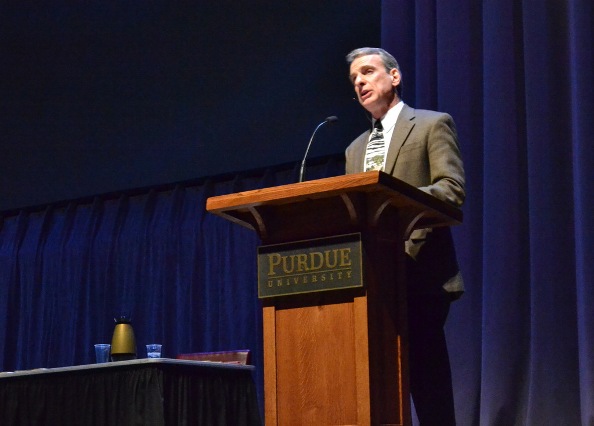
William Lane Craig lecturing to university students
Here’s the lecture, which was given in 2004 at the University of Colorado, Boulder.
This lecture might be a little advanced for beginners, but if you stretch your mind first, you shouldn’t tear anything. (Note: standard disclaimers apply if you do tear something!)
The description of the video states:
This is quite simply one of the best lectures William Lane Craig (a philosopher of science) has given. Craig explores the origins of the universe. He argues for a beginning of the universe, while refuting scientific models like the Steady State Theory, the Oscillating Theory, Quantum Vacuum Fluctuation Model, Chaotic Inflationary Theory, Quantum Gravity Theory, String Theory, M-Theory and Cyclic Ekpyrotic Theory.
A Templeton Foundation lecture at the University of Colorado, Boulder, laying out the case from contemporary cosmology for the beginning of the universe and its theological implications. Includes a lengthy Q & A period which features previous critics and debate opponents of Dr. Craig who were in attendance, including Michael Tooley, Victor Stenger, and Arnold Guminski.
Craig has previously debated famous atheists Stenger and Tooley previously. And they both asked him questions in the Q&A time of this lecture. Imagine – having laid out your entire case to two people who have debated you before and who know your arguments well. What did they ask Craig, and how did he respond?
The scientific evidence
The Big Bang cosmology that Dr. Craig presents is the standard model for how the universe came into being. It is a theory based on six lines of experimental evidence.
Scientific evidence:
Einstein’s theory of general relativity (GTR)
the red-shifting of light from distant galaxies implies an expanding universe
the cosmic background radiation (which also disproves the oscillating model of the universe)
the second law of thermodynamics applied to star formation theory
hydrogen-helium abundance predictions
radioactive element abundance predictions
It’s probably a good idea to be familiar with these if you are presenting this argument, because experimental science is a reliable way of knowing about reality.
Published research paper
This lecture by Dr. Craig is based on a research paper published in an astrophysics journal, and was delivered to an audience of students and faculty, including atheist physicist Victor Stenger and prominent atheist philosopher Michael Tooley, at the University of Colorado at Boulder.
Both cosmology and philosophy trace their roots to the wonder felt by the ancient Greeks as they contemplated the universe. The ultimate question remains why the universe exists rather than nothing. This question led Leibniz to postulate the existence of a metaphysically necessary being, which he identified as God. Leibniz’s critics, however, disputed this identification, claiming that the space-time universe itself may be the metaphysically necessary being. The discovery during this century that the universe began to exist, however, calls into question the universe’s status as metaphysically necessary, since any necessary being must be eternal in its existence. Although various cosmogonic models claiming to avert the beginning of the universe predicted by the standard model have been and continue to be offered, no model involving an eternal universe has proved as plausible as the standard model. Unless we are to assert that the universe simply sprang into being uncaused out of nothing, we are thus led to Leibniz’s conclusion. Several objections to inferring a supernatural cause of the origin of the universe are considered and found to be unsound.
This debate summary is rated M for Moderately Snarky.
Dr. Craig’s opening speech:
Introduction:
Harris and Craig agree on objective morality
What is the foundation of morality?
What makes certain actions right or wrong?
Two claims
if God exists, then we have a sound foundation for objective moral values and duties
if God does not exist, then we do not have a sound foundation for objective moral values and duties
1) Theism grounds morality
Objective moral values
Theism provides sound foundation for objective moral values
– objective moral values are grounded in God
– God is the locus and paradigm of moral value
– God is, by nature, the standard for what is right and wrong
Objective moral duties
Theism provides a sound foundation for objective moral duties
– God’s nature is expressed as commands for us
– God’s commands for us are not arbitrary
– they must be consistent with his own nature
– and they reflect his moral character
– the essence of morality in theism is to love God and also to love your neighbor
2) Atheism does not ground morality
Objective moral values
What is the basis for objective moral values on atheism?
– on atheism, human beings are accidental products of evolution
– on atheism, there is no reason to believe that human well-being is any more important than the well-being of any other animal
– Harris denies that the objective moral value is from Platonic forms
– Harris wants to ground moral values in nature
– but nature is morally neutral
– the “morality” of humans is just a set of evolved customs that help them to survive and reproduce
– this morality is just a set of conventions, it doesn’t refer to anything that has an objective existence
– quotes Michael Ruse: “morality is just an aid to survival, and any deeper meaning is illusory”
– if we were to rewind evolution and start it again, another set of conventions might have evolved
– to say that morality is about human well-being is to commit “speciesism”
– quotes Richard Dawkins: “there is no purpose, no evil, no good, nothing but pointless indifference”
What does Harris say:
– Harris redefines the word “good” to mean the well-being of humans
– Harris “solves” the problem of moral value by just asserting that HUMAN well-being is the good
– Harris isn’t talking about what is good and evil
– Harris only talks about what is conducive to human “flourishing”
Objective moral duties
What is the basis of objective moral duties on atheism?
– first, natural science tells us only what is, not what ought to be
– quotes Jerry Fodor: “science cannot tell us that we have a moral obligation to take actions to increase human flourishing”
– on the naturalistic worldview, humans are animals – and there are no OBJECTIVE moral duties
– where do moral obligations come from on atheism?
– they are just conventions that are ingrained into us by social evolution
– as human societies evolve, certain actions are unfashionable
– people who act “immorally” against their society’s conventions are just being unfashionable
– bad actions like rape and murder happen all the time in the animal kingdom
– second, Harris believes that there is no free will – all human actions are causally determined
– if there is no free will, then there is no moral responsibility
– no one is responsible for the things they do, on atheism
– on atheism, humans have no control over the actions they take, and cannot make moral choices, or be morally responsible
Conclusion:
– Harris and I mostly agree on practical ethics, but only theists have a foundation for objective moral values and duties
Dr. Harris’ opening speech:
God is not needed to ground moral values and moral duties
Good means maximizing human well-being for the largest number of people
Religion is not necessary for a “universal” morality
Religion is a bad foundation for “universal” morality
Facts and values:
Moral values are the products of human evolution
E.g. – Sexual jealousy is the result of biological evolution
And then these ideas of right and wrong are enshrined in cultural institutions like marriage
Religious people insert God in to explain values, when evolution is the real explanation
Moral disagreements:
I personal don’t agree with the ethics of the God of Abraham
I have no basis for an objective moral standard, but the God of Abraham fails to meet my personal preferences
Dr. Craig lies when he quotes me, half his quotes are of other people I quoted, not me
But I’m not going to say which quote he lied about
Goodness is what makes you feel happy:
Questions of right and wrong depend upon brains
Brains are natural entities
Science can measure well-being in brain states
States of affairs in which the majority of brains have high well-being
I’m a good person because I don’t like the Taliban:
The Taliban is bad because the majority of their brains don’t have high well-being
I think throwing battery acid in women’s faces is bad
The Taliban thinks that throwing battery acid in women’s faces is good
What determines right and wrong is brain states of well-being
Insults against religion = Dr. Craig:
religion / Dr. Craig doesn’t value evidence
religion / Dr. Craig doesn’t value logic
religion / Dr. Craig doesn’t value intellectual honesty
Dr. Craig’s first rebuttal:
1) Theism is a good foundation for moral values and duties
Harris says:
– Craig thinks that if God doesn’t exist, then good and evil would have no meaning
Craig says:
– But Craig says that he is not saying that God is required for moral semantics
– He is addressing the question of the ontological grounding
Harris says:
– The God of the Bible is mean
Craig says:
– divine command theory doesn’t require that the Bible be the set of commands
– in any case, the old testament passages can be defended in Paul Copan’s book
Harris says:
– Religion isn’t needed for universal morality
Craig says:
– the issue isn’t universality, because the Nazis could have won, and put in a universal morality
– the issue is if they had won, would there be any standard to condemn them
Harris says:
– Good and evil are related to the number of brain states of well-being
Craig says:
– Harris uses good and evil in non-moral ways
– Harris isn’t talking about moral good and moral evil
– Harris is talking about pleasure and misery
– Harris is equating moral good and moral evil with feelings of pleasure and feelings of misery
– Harris claims that the property of being good is identical with human flourishing
– it is possible that the continuum of human well-being is not identical with the moral landscape
– in order for them to be identical, there cannot be this possibility or it fails the law of identity
– you could have psychopaths with happy brain states that represent a peak in the moral landscape
Harris says:
– If we have a moral duty to do anything, we have a duty to avoid feeling miserable”
Craig:
– moral obligations arise when there is an authority who can issue binding commands
– on atheism, there is no authority who can issue binding commands
– without free will, morality makes no sense since there is no free will
– no free will means no moral duties, and no moral responsibilities
Dr. Harris’ first rebuttal:
I don’t like Hell and I don’t like suffering and I don’t like Christians:
There is no evidence that Hell exists
Think of the parents of the children of people who die in tsunamis
If God allows people to suffer, then he doesn’t exist, because God’s job is to make us not suffer
God can’t exist, because some people are born in the wrong culture, and never hear about Jesus
Some people pray to the Monkey God, why don’t they go to heaven?
What about the people in the Lord of the Rings, are they going to Hell?
What about people who repent just before being executed, are they going to heaven?
God is cruel and unjust because he lets innocent people suffer
God is worse than a psychopath
People who believe in God are evil
People who believe in God are narcissists
God commanded stuff that I don’t like, so he’s evil
Suppose God were evil – then people would have to do evil things
Religious people think that saying Latin phrases turn pancakes into the body of Elvis Presley
The evidence for God is actually not very good, if you avoid read any Christian scholars
Christianity is a cult of human sacrifice
The people who wrote the Bible were really stupid
Christians are psychopaths
Dr. Craig’s second rebuttal:
Sam Harris cannot make any judgments about moral values and moral duties on atheism
On atheism, there is no foundation for making objective moral judgments
Harris didn’t respond to anything Craig said
Harris says that Christians only believe in God to avoid Hell
Red herrings:
Craig says that people who become Christians do it because God is the good
Christians don’t pursue a relationship with God for fire insurance
The problem of evil
– not relevant to the debate topic
The problem of the unevangelized
– not relevant to the debate topic
Evil actually proves that God exists
– if evil exists, then there is an objective moral standard
– if there is an objective moral standard, then God exists
Harris has no foundation for saying that Christian beliefs are morally bad
Harris has no basis for making moral judgments
Harris’ remark that theists are psychopathic
– Harris’ remark is as stupid as it is insulting
Harris says that the Old Testament promoted
– first, there was no slavery in the Old Testament it was indentured servitude
– second, that’s not relevant to the debate topic
Harris mentions the Taliban
– but the response to the Taliban is not to say that God doesn’t exist
– the response to the Taliban is to say that they have the wrong God
– the real God never commanded them to do those things
Dr. Harris’ second rebuttal:
I’m a scientist, Craig is stupid, I’ve meditated with wise yogis and lamas, I don’t like the Taliban:
When I make a scientific case for morality, I didn’t really mean that it was scientific
You just have to assume that misery is morally evil, and happiness is morally good, even if that can’t be proved scientifically
I’m a scientist
Science is great
Dr. Craig is stupid
Dr. Craig is not a scientist
Science is better than religion
You can ground an objective standard of morality and objective moral duties and moral responsibility on arbitrary brain states of accidentally evolved biologically determined monkeys
Dr. Craig’s question for me about my unproven assumptions is a stupid question
I prayed to the Monkey God in a cave and he told me about objective morality
I have spent a lot of time studying meditation with wise yogis and lamas
I consider some people to be spiritual Jesus
I can imagine that Jesus was very spiritual and charismatic
We don’t have to use logic and reason to debate about morality, we can meditate on the Monkey God
i don’t like the Taliban
Dr. Craig’s third rebuttal:
Harris didn’t reply to anything I said
Harris admitted that psychopaths can occupy the peaks of the moral landscape
So on Harris’ view, you can commit unspeakable acts of cruelty and still have a brain state with well-being
Dr. Harris’ third rebuttal:
Dr. Craig is a Muslim, Dr. Craig is the Taliban, Dr. Craig is a Muslim Taliban Muslim Jihadi:
You may have been confronted with the story of the Nazi soldier coming to the door of the family who are hiding some Jewish people in their home and asking them point blankly, “Are there any Jews here?” The person telling the story then asks you, “What would you say?” or more precisely, “What should you say?”
[…]I think for many people the term moral absolutes connotes ideas like inflexibility and rigidity, and that there can never be exemptions. I have also found that many people believe that holding to moral absolutes means that circumstances are not relevant in a moral evaluation and that moral absolutism cannot handle moral dilemmas. But in fact it is possible to believe in moral absolutes, or as I prefer to call them objective moral values, without adhering to these connotations I have mentioned.
For many people to believe in moral absolutes is to believe in rules that no other rules can ever trump. It follows from this that moral absolutes are all equal and there can never be any exemptions. But what if moral absolutes exist in a hierarchy?
We know from experience that very often more than one moral rule applies to a situation. This often leads to moral dilemmas. So in the ‘hiding the Jews example’ the moral rule of telling the truth seems to apply to the situation, but it would seem that the moral rule to protect innocent human life from torture and murder applies also.
If absolutes are all equal there is no way out of the dilemma. You can’t choose one absolute over another because in doing so you would be violating at least one absolute which, in their view, is supposed to be inviolable.
So, in this case, it seems as if the moral absolutist is stuck in a dilemma. If you lie to save the innocent life, then that would be wrong. But if you tell the truth and hand the innocent person over to murderers, then that would be wrong. Does this really disprove objective moral absolutes?
This problem annoys me, because I know this is the kind of objection to objective morality that annoying philosophy lecturers like to push onto freshmen in order to convince them that morality is nonsense. But does the moral dilemma objection really work?
More Horner:
[…][I]f moral absolutes exist in a hierarchy and the circumstances or the situation were relevant in determining which absolute takes precedent, then there may be a solution to the moral dilemma. That is exactly what I think is the case in the example. I for one have no difficulty knowing that the morally right thing to do in that situation is to protect the life of innocent people from torture and murder rather than tell the truth to a person who has torture and murder in their plans. My moral intuitions are very clear about this.
If someone objects and says, “No, you must always tell the truth. After all it is an absolute, and absolutes by definition can never be violated,” I would point out that they are just using a different hierarchy, putting truth telling above protecting the life of innocent people from torture and murder. There is no way to avoid making a judgment like that since more than one absolute does apply to the situation. I would just ask them to think it through again, and once they see that they have to make a judgment based on some sort of hierarchy in that situation, then I think most people’s moral intuitions will affirm that protecting the lives of innocent people from torture and murder, in that situation, trumps truth telling. There is no way to avoid choosing one over the other.
But isn’t this moral relativism? After all, we are deciding what to do based on the situation! It’s relativism, isn’t it?
No, it isn’t, because there is always one right thing to do in every situation. In every situation, you always follow the weightiest moral rule. The right thing to do does not depend on your subjective state of mind. It is an objective moral duty, and it is the same for everyone, across all times and in all places. That’s what objective morality means -what is right and wrong is not determined by personal preferences or cultural conventions, which vary by time and place.
And of course, God is the ground of this hierarchy of objective moral absolutes. They existed through him before human beings even appeared, as part of his design for us, his creatures. How we ought to behave is grounded ontologically in God’s design for us.


 WINTERY KNIGHT