Tag Archives: Atheism

ID critics do not read ID books before reviewing them

From Evolution News.

Excerpt:

As a friend of ours puts it, Jonathan Wells’s The Myth of Junk DNA is in the process of being “Ayala’ed.” To “Ayala” a book is to attack it in review without having bothered to read or even read much about it, simply on the basis of what you think it probably says given your uninformed preconceptions about the author. The term comes from the wonderful instance where distinguished biologist Francisco Ayala pompously “reviewed” Stephen Meyer’s Signature in the Cell for the Biologos Foundation website while giving clear evidence of not having cracked the book open or even looked at the table of contents.

Thus we have several posts from University of Toronto biochemist Larry Moran, criticizing Myth while being totally open about not having read it first. Moran wrote no fewer than four posts on the book in this fashion, claiming as an excuse that Myth would not be published in Canada until May 31. (In fact, the book was available for purchase from Amazon since early May.) And now, as Casey already noted, we have Forbes science writer John Farrell, citing Moran as his source — a “double Ayala,” so to speak, where you attack a book without reading it citing as justification a review by someone else who also hasn’t read it.

Farrell thinks the myth of junk DNA is itself a myth — that “scientists never dismissed junk DNA in the literature.” In other words, Wells has set up a straw man. Of course, not having looked at the book, Farrell can’t have consulted Dr. Wells’s fifty pages of notes documenting his argument. The notes may be downloaded for free here. (Also available in Canada.)

So this is what criticism of intelligent design amounts to… denouncing a book before reading it.

Biophysicist Cornelius Hunter explains why reading the book is not necessary for Darwinists – because Darwinism is impervious to evidential concerns.

Excerpt:

This centuries old framework for naturalism is key to understanding evolution today. Science writers such as Farrell report that scientists have discovered, for instance, “just how not-so-intelligently designed the human genome actually is,” but this is not a scientific conclusion. For unlike the target of his criticism (the ID theory) which refers to complexity rather than goodness of design, evolutionary thought and its underlying naturalism framework refer to the design’s metaphysics. As Farrell explains:

Many mutations are neutral, or can be easily overcome by technology. And some of them cause a great deal of psychological suffering, such as the mutation that causes trimethylaminuria, which is physically harmless but causes the victims to smell like rotten fish no matter how clean they are. But many other mutations are deadly or, worse yet, can cause a person to have a lifetime of suffering. Perhaps the most disturbing mutation is the one that causes Lesch-Nyhan syndrome. This one mutation, of a single amino acid in a protein, causes the victim to have an uncontrollable compulsion for self-mutilation: they chew their own lips and fingers, and find sharp objects to stab their faces and eyes. The victims are fully able to feel their pain and they know what they are doing, but cannot control it.

Obviously to argue such mutations are the product of intentional design is to suggest the deity or intelligence responsible, is something of a monster.

Indeed. Leibniz was concerned about the evil in the world, but he had no idea how deeply it runs. It is truly abominable, and it makes for a moving and powerful argument that no good creator who has the power to create a universe would ever create this one.

Whether by the Epicurean’s swerving atoms, or science’s natural laws, the world must have arisen on its own.

How could anyone deny this obvious conclusion? This and other metaphysical arguments leave no room for debate. Evolution must be true. We may not know how it occurred, but it is a fact.

The powerful theory of evolution hangs on this framework of thought that mandates naturalism. The science is weak but the metaphysics are strong. This is the key to understanding evolutionary thought. The weak arguments are scientific and the strong arguments, though filled with empirical observation and scientific jargon, are metaphysical. The stronger the argument, the more theological or philosophical.

(Emphasis is in the original)

And I recommend you read the whole post, especially if you’ve never read anything by Cornelius Hunter.

So the reason why Darwinists don’t care about evidence is because evidence is irrelevant once you pre-suppose the religion of naturalism. And you presuppose the religion of naturalism because of the problem of evil and suffering. I.e. – “based on my childhood caricature of God as the cosmic Santa Claus, I now see that evolution must be true, because my cosmic Santa Claus God cannot have any purpose for allowing the evil and suffering I see in nature.” Science has nothing to do with it. Nature is not nice, and so God didn’t make nature. And that’s the end of the discussion.

These Darwinian critics of ID are really just close-minded religious fundamentalists whose principal response to experimental science is uninformed religious bluster. You don’t get an education when you take classes from the Darwinbots – you get indoctrinated. And if you dissent you get failed or fired. It’s that simple. They don’t debate you – they censor you. They don’t produce evidence for their views, they insult you. How dare you call their religion into question by appealing to facts? Darwinists don’t like facts. They don’t like evidence.

Related posts

Robin Collins explains two kinds of fine-tuning

About Robin Collins:

Robin Collins (PhD, University of Notre Dame, 1993), is professor of philosophy at Messiah College, Grantham, PA specializing in the area of science and religion.  He has written over twenty-five articles and book chapters on a wide range of topics, such as the fine-tuning of the cosmos as evidence for the existence of God, evolution and original sin, the Doctrine of Atonement, Asian religions and Christianity, and Bohm’s theory of quantum mechanics.  Some of his most recent articles/book chapters are “Philosophy of Science and Religion” in The Oxford Handbook of Science and Religion, “Divine Action and Evolution” in The Oxford Handbook of Philosophical Theology (2009)  “The Multiverse Hypothesis: A Theistic Perspective,” in Universe or Multiverse? (Cambridge University Press), and “God and the Laws of Nature,” in Theism or Naturalism: New Philosophical Perspectives (Oxford University Press, forthcoming).  He recently received a grant from the John Templeton Foundation to finish a book that presents the case for design based on physics and cosmology,  tentatively entitled The Well-Tempered Universe: God, Cosmic Fine-tuning, and the Laws of Nature.

The fine-tuning argument

Here’s a short article where Collins gives TWO examples of the fine-tuning. He is very modest in his argument, merely asserting that the fine-tuning is more compatible with theism than it is with atheism.

Excerpt:

Science is commonly thought to have undercut belief in God. As Nobel Prize winning physicist Steven Weinberg famously remarked, “the more we find out about the universe, the more meaningless it all seems.” Yet, the discoveries of modern physics and cosmology in the last 50 years have shown that the structure of the universe is set in an extraordinarily precise way for the existence of life; if its structure were slightly different, even by an extraordinarily small degree, life would not be possible. In many people’s minds, the most straightforward explanation of this remarkable fine-tuning is some sort of divine purpose behind our universe.

This fine-tuning falls into three categories: the fine-tuning of the laws of nature, the fine-tuning of the constants of physics, and the fine-tuning of the initial conditions of the universe. “Fine-tuning of the laws of nature” refers to the fact that if the universe did not have precisely the right combination of laws, complex intelligent life would be impossible. If there were no universal attractive force (law of gravity), for example, matter would be dispersed throughout the universe and the energy sources (such as stars) needed for life would not exist. Without the strong nuclear force that binds protons and neutrons together in the nucleus, there would not be any atoms with an atomic number greater than hydrogen, and hence no complex molecules needed for life. And without the Pauli-exclusion principle, all electrons would fall to the lowest orbital of an atom, undercutting the kind of complex chemistry that life requires.

Some fundamental physical numbers governing the structure of the universe—called the constants of physics—also must fall into an exceedingly narrow range for life to exist. For example, many have estimated that the cosmological constant—a fundamental number that governs the expansion rate of empty space—must be precisely set to one part in 10120 in order for life to occur; if it were too large, the universe would have expanded too rapidly for galaxies and stars to form, and if it were too small, the universe would have collapsed back on itself. As Stephen Hawking wrote in his book A Brief History of Time, “The remarkable fact is that the values of these numbers [i.e. the constants of physics] seem to have been very finely adjusted to make possible the development of life.” Finally, the initial distribution of mass energy at the time of the big bang must have an enormously special configuration for life to occur, which Cambridge University mathematical physicist Roger Penrose has calculated to be on the order of one part in 1010123. This is an unimaginably small number.

I know what you’re thinking: How do we know that non-Christian scientists acknowledge the fine-tuning of gravity in the way that Collins describes?

Well, the New Scientist actually talks about the fine-tuning of the force of gravity. And they’re not Christians.

Excerpt:

The feebleness of gravity is something we should be grateful for. If it were a tiny bit stronger, none of us would be here to scoff at its puny nature.

The moment of the universe‘s birth created both matter and an expanding space-time in which this matter could exist. While gravity pulled the matter together, the expansion of space drew particles of matter apart – and the further apart they drifted, the weaker their mutual attraction became.

It turns out that the struggle between these two was balanced on a knife-edge. If the expansion of space had overwhelmed the pull of gravity in the newborn universe, stars, galaxies and humans would never have been able to form. If, on the other hand, gravity had been much stronger, stars and galaxies might have formed, but they would have quickly collapsed in on themselves and each other. What’s more, the gravitational distortion of space-time would have folded up the universe in a big crunch. Our cosmic history could have been over by now.

Only the middle ground, where the expansion and the gravitational strength balance to within 1 part in 1015 at 1 second after the big bang, allows life to form.

Here’s a very long paper by Collins on the fine-tuning argument, where he answers several objections to the argument, including the multiverse/many-universe hypothesis. I normally make fun of the multiverse, (= the Flying Spaghetti Monster), but it actually does deserve a reasonable, fair response. (Unless Jerry asks, then it’s Flying Spaghetti Monster all the way).

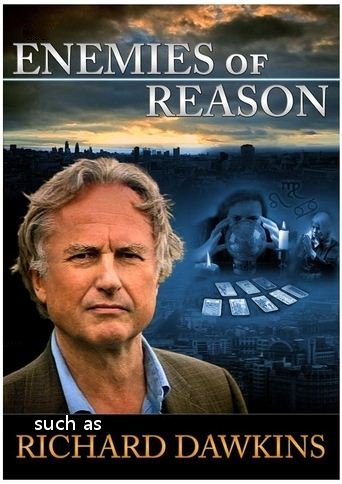
UK Telegraph on Richard Dawkins’ cowardly refusal to debate William Lane Craig

Will Richard Dawkins debate William Lane Craig?

(Image stolen from Glenn Peoples)

Cowardly Richard Dawkins refuses to debate William Lane Craig on this latest UK tour. (H/T Mary)

Excerpt:

Richard Dawkins has made his name as the scourge of organised religion who branded the Roman Catholic Church “evil” and once called the Pope “a leering old villain in a frock”.

But he now stands accused of “cowardice” after refusing four invitations to debate the existence of God with a renowned Christian philosopher.

A war of words has broken out between the best selling author of The God Delusion, and his critics, who see his refusal to take on the American academic, William Lane Craig, as a “glaring” failure and a sign that he may be losing his nerve.

Prof Dawkins maintains that Prof Craig is not a figure worthy of his attention and has reportedly said that such a contest would “look good” on his opponent’s CV but not on his own.

An emeritus fellow of New College, Oxford, Prof Dawkins last year supported a plan to charge Pope Benedict XVI with crimes against humanity for his alleged involvement in the cover-up of sex abuse by Catholic priests.

Prof Craig is a research Professor of Philosophy at Talbot School of Theology, in California, and the author of 30 books and hundreds of scholarly articles on Christianity.

He has debated with leading thinkers including Daniel Dennett, A.C.Grayling, Christopher Hitchens, Lewis Wolpert and Sam Harris.

Prof Craig is due to visit Britain in October this year. Four invitations to take part in public debates were sent to Prof Dawkins from The British Humanist Association, The Cambridge Debating Union, the Oxford Christian Union and Premier Radio.

Prof Dawkins declined them all.

[…]Some of Prof Dawkins’s contemporaries are not impressed. Dr Daniel Came, a philosophy lecturer and fellow atheist, from Worcester College, Oxford, wrote to him urging him to reconsider his refusal to debate the existence of God with Prof Craig.

In a letter to Prof Dawkins, Dr Came said: “The absence of a debate with the foremost apologist for Christian theism is a glaring omission on your CV and is of course apt to be interpreted as cowardice on your part.

“I notice that, by contrast, you are happy to discuss theological matters with television and radio presenters and other intellectual heavyweights like Pastor Ted Haggard of the National Association of Evangelicals and Pastor Keenan Roberts of the Colorado Hell House.”

Prof Craig, however, remains willing to debate with Prof Dawkins. “I am keeping the opportunity open for him to change his mind and debate with me in the Sheldonian Theatre in Oxford” in October, he said.

Read it all. And please forward this to EVERYONE you know.

Dawkins mentions that he “already debated Craig” in that lame, worthless Mexico event where all the speakers got 2 minutes for their speeches, and one minute rebuttals. That was not a formal academic debate, that was a spectacle. I want a formal debate so Craig can put this blowhard in his place like he did with Hitchens, Harris, and Dennett. I want this nonsense about atheism being a  rational, moral worldview to end NOW. And by now, I mean yesterday.

Why won’t Dawkins debate Craig?

Let’s re-cap Dawkins’ reasons in point form: (with my comments in parentheses)

  • Dawkins claims that he is willing to debate high-ranking clergymen (but Craig is a scholar, not a clergyman)
  • Dawkins claims that Craig is a creationist (but Craig supports his kalam cosmological argument with the Big Bang)
  • Dawkins claims that Craig’s only claim to fame is that he is a professional debater (but see Craig’s CV and publications below, which is far more prestigious than Dawkins)
  • Dawkins claims that he’s too busy (busy cowering in fear hugging his Darwin doll for comfort)

Let’s review William Lane Craig’s qualifications:

William Lane Craig is Research Professor of Philosophy at Talbot School of Theology in La Mirada, California.

Dr. Craig pursued his undergraduate studies at Wheaton College (B.A. 1971) and graduate studies at Trinity Evangelical Divinity School (M.A. 1974; M.A. 1975), the University of Birmingham (England) (Ph.D. 1977), and the University of Munich (Germany) (D.Theol. 1984). From 1980-86 he taught Philosophy of Religion at Trinity… In 1987 they moved to Brussels, Belgium, where Dr. Craig pursued research at the University of Louvain until assuming his position at Talbot in 1994.

He has authored or edited over thirty books, including The Kalam Cosmological Argument; Assessing the New Testament Evidence for the Historicity of the Resurrection of Jesus; Divine Foreknowledge and Human Freedom; Theism, Atheism and Big Bang Cosmology; and God, Time and Eternity, as well as over a hundred articles in professional journals of philosophy and theology, including The Journal of Philosophy, New Testament Studies, Journal for the Study of the New Testament, American Philosophical Quarterly, Philosophical Studies, Philosophy, and British Journal for Philosophy of Science.

Craig’s CV is here.

Craig’s list of publications is here.

Here are some of Craig’s most recent publications:

From 2007:

  • Ed. with Quentin Smith. Einstein, Relativity, and Absolute Simultaneity. Routledge Studies in Contemporary Philosophy. London: Routledge, 2007, 302 pp.
  • “Theistic Critiques of Atheism.” In The Cambridge Companion to Atheism, pp. 69-85. Ed. M. Martin. Cambridge Companions to Philosophy. Cambridge University Press, 2007.
  • “The Metaphysics of Special Relativity: Three Views.” In Einstein, Relativity, and Absolute Simultaneity, pp. 11-49. Ed. Wm. L. Craig and Quentin Smith. Routledge Studies in Contemporary Philosophy. London: Routledge, 2007.
  • “Creation and Divine Action.” In The Routledge Companion to Philosophy of Religion, pp. 318-28. Ed. Chad Meister and Paul Copan. London: Routledge, 2007.

From 2008:

  • God and Ethics: A Contemporary Debate. With Paul Kurtz. Ed. Nathan King and Robert Garcia. With responses by Louise Antony, Walter Sinnott-Armstrong, John Hare, Donald Hubin, Stephen Layman, Mark Murphy, and Richard Swinburne. Lanham, Md.: Rowman & Littlefield, 2008.
  • “Time, Eternity, and Eschatology.” In The Oxford Handbook on Eschatology, pp. 596-613. Ed. J. Walls. Oxford: Oxford University Press, 2008.

From 2009:

  • Ed. with J. P. Moreland. Blackwell Companion to Natural Theology. Oxford: Blackwell.
  • “The Kalam Cosmological Argument.” With James Sinclair. In Blackwell Companion to Natural Theology. Ed. Wm. L. Craig and J. P. Moreland. Oxford: Blackwell.
  • “In Defense of Theistic Arguments.” In The Future of Atheism: Alister McGrath and Daniel Dennett in Dialogue. Ed. Robert Stewart. Philadelphia: Fortress Press.

Forthcoming:

  • “The Cosmological Argument.” In Philosophy of Religion: Classic and Contemporary Issues. Ed. Paul Copan and Chad Meister. Cambridge: Blackwell.
  • “Cosmological Argument”; “Middle Knowledge.” In The Cambridge Dictionary of Christian Theology. Ed. G. Fergusson et al. Cambridge: Cambridge University Press.
  • “Divine Eternity.” In Oxford Handbook of Philosophical Theology. Ed. Thomas Flint and Michael Rea. Oxford: Oxford University Press.

Richard Dawkins is eminently qualified to debate uninformed clergymen, but he has too much at stake (in terms of book royalties) to disappoint his loyal horde of foam-flecked fundies by debating a professional scholar who has debated hundreds of times, against the top non-Christian scholars, in hundreds of universities, including Harvard, Cambridge and Oxford.

The Craig-Hitchens debate

This debate was moderated by HUGH HEWITT, host of the nationally-syndicated Hugh Hewitt Show.

This is just an example of what these debates typically look like. No one gets hurt, so what is Dawkins afraid of?

Who is linking to this post?

Related posts