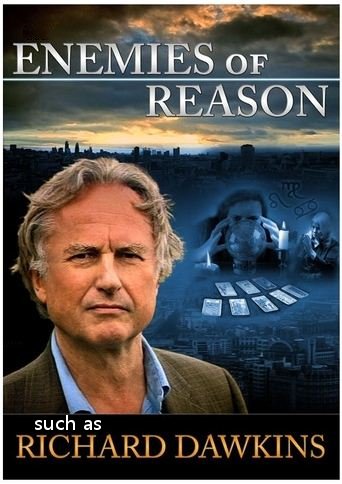
The Free Church of Scotland has challenged Richard Dawkins, the world-famous atheist, to a debate on his next visit to the Outer Hebrides.
Professor Dawkins is headlining Faclan, the Hebridean Book Festival, on the Isle of Lewis where he is scheduled to promote his book the God Delusion on Friday 2 November.
Despite calls of a boycott from a member of the Lord’s Day Observance Society, Stornoway Free Church minister Reverend Iver Martin (pictured below), who is minister of one of the biggest congregations on the island, said he welcomed the visit as an opportunity for debate.
[…]“The Free Church of Scotland endorses freedom of discussion and the exchange of argument.
“However, with Richard Dawkins presenting a particularly one-sided narrative, I would hope that there would be opportunity for fair, even handed, reasoned debate at which both sides of the theistic argument can be heard.”
Would Richard Dawkins, champion of militant fundamentalist atheism, rise to the challenge of debating his views in a public forum?
A Scottish Church leader has labeled evolutionary biologist and famed atheist Richard Dawkins a “snob” over his decision to turn down a debate on religion. Dawkins has refused a debate invitation for the faith-themed Faclan Hebridean Book Festival in Scotland in November.
The Rev David Robertson, a Free Church minister in Dundee, responded to Dawkins’ decision to avoid debate by saying that he does not believe the atheist to be a “coward,” but sees him as a “elitist snob, who once told me he would consider debating with me if I was the Archbishop of Canterbury, the Pope or Chief Rabbi.”
Robertson added: “Dawkins considers, like so many of his fellow new atheists, that there is no debate and they, and they alone, have the truth. Ironically, such arrogance and intolerance of others is the very definition of the fundamentalism that Dawkins professes to hate. I suspect that Richard Dawkins’ problem is that he is not a good debater.”
Yes, that’s it exactly. He cannot bear to hear other viewpoints other than his own. He is not intelligent enough to prove what he asserts in private to a skeptical audience in public. That’s why he doesn’t debate in public. He would prefer to preach in private to those who accept his dogma, and to receive their praise and adulation – and their money!
If Dawkins did agree to have his ideas tested in a debate, it would be a good thing if whoever was doing the testing asked him why he affirms the moral goodness of adultery and infanticide, as well as asking him what he means by his desire to “destroy Christianity“, especially given that he refuses to debate with Christians like William Lane Craig. Does he mean something similar to what his fellow atheists like Stalin and Mao meant, i.e. – mass murder? Or does he mean something else? It would be a good question to ask, anyway.
I don’t want anyone to think that atheism is some sort of immature, non-cognitive tantrum that consists largely of insulting Christians and giggling like children who have discovered a new curse word. There are serious atheistic scholars, and they do debate. Richard Dawkins is not a serious scholar, and he does not debate his views. He is therefore very much like those sweating, foam-flecked televangelists you see bloviating on the telly on Sunday mornings. All bluster, no substance.
Michael Behe and Keith Fox debate evolution and intelligent design. (See below for link to MP3 file)
Details:
Michael Behe is professor of biochemistry at Lehigh University, Pennsylvania and the founder of the modern Intelligent Design movement. His book “Darwin’s Black Box” ignited the controversy 14 years ago when it claimed that certain molecular machines and biological processes are “irreducibly complex” and cannot be explained by Darwinian evolution.
His new book “The Edge of Evolution” takes his conclusions further, arguing that the Darwinian processes of random mutation and natural selection are incapable of producing the variation and complexity we see in most of life.
So can we conclude that life was intelligently designed by a creator?
Keith Fox is Professor of biochemistry at the University of Southampton and chairman of Christians in Science. As a theistic evolutionist he believes that Evolution is the best explanation going for the complexity we see and that ID is a blind scientific alley and theologically unappealing to boot.
They debate whether micromachines in the cell such as the “bacterial flagellum” could have evolved by a Darwinian process of evolution. When inference to design is and isn’t acceptable in science. Whether random mutation can mathematically stack up to complex life, and whether God is reduced to a divine “tinkerer” by ID.
I get the impression that Fox learned everything he knows about ID by reading Darwinists.
People refuse to discuss ID because of personal philosophical assumptions
ID is like the Big Bang – it is based on evidence, but it has broad religious implications
Keith Fox:
ID is not Biblical creationism, but it isn’t science
Michael Behe:
ID is compatible with common descent
ID is only opposed to unplanned, unguided evolution (Darwinism)
ID is not necessarily opposed to long periods of time
Behe’s first book – the bacterial flagellum
Keith Fox:
Here are a couple of papers that show how parts of the flagellum evolved
They are possible pathways
Michael Behe
No, those are studies that show that there are similarities between bacterial flagella in multiple organisms
Similarities of proteins between different organisms do not necessarily imply a developmental pathway
The problem of having the instructions to BUILD the flagellum still remains
Keith Fox:
Maybe parts of the flagellum had other functions before they were used in the flagellum
Maybe you can use the parts of the flagellum for other purposes
Maybe, one can imagine, it’s possible that!
Michael Behe:
No, parts have to be modified and re-purposed in order to be used for other functions
Keith Fox:
But maybe the proteins can be used in other systems for other things
I re-purpose parts from of designed things to other purposes in my house when I do maintenance
Michael Behe
Uh, yeah – but aren’t you an intelligent designer? What does your home maintenance have to do with Darwinian evolution?
Is ID another God-of-the-gaps argument?
Michael Behe:
Well consider the Big Bang… there was a build-up of scientific evidence for that theory
Just because a theory has religious implications, doesn’t mean that it isn’t true
You really have to look at the specific evidence for a theory, and not decide in advance
Keith Fox: (I’m paraphrasing/inventing/mocking from now on)
But the Big Bang is based on discoveries, and intelligent design is based on gaps in our scientific knowledge
What if I did have evidence of a step by step pathway (which I don’t right now)? Then I would win the argument – what would you do then?
Michael Behe:
Well, if tomorrow you do manage to find expiremental evidence of a pathway, which you don’t have today, then I would be wrong
ID is falsifiable by experimental evidence
But what about your your view? Is that falsifiable by experimental evidence?
What if someone goes into a lab (someone like Scott Minnich?) and performs gene knockout experiments, and publishes the results
You knock out a gene from the bacterial flagellum, you wait for a large number of generations, and it never develops the missing gene
You repeat this with every one of the 50 genes in the bacterial flagellum and it never recovers for any of the 50 genes
There is no pathway to build up even one of the 50 genes – according to actual experiments
What do Darwinists do with experimental evidence that falsifies Darwinism?
Keith Fox:
No, I would not accept that experimental evidence could falsify Darwinism
Just because known published experimental evidence that we have today falsifies Darwinism, it doesn’t mean Darwinism is false because it’s not falsifiable
We don’t know how Darwinism even works – it happened so long ago, and it’s not repeatable or testable, so how could lab ,experiments falsify it?
Darwinism is science and intelligent design is faith, though
Lenski has presided over 50,000 generations, (millions of years of evolution)
The bacterium did evolve and they did get better but not by evolving features, but by disabling features
Keith Fox:
But those are just LAB EXPERIMENTS! What do lab experiments prove?
What if? What if? What if? You don’t know, it happened so long ago, and you weren’t there! You weren’t there!
(clutches Flying Spaghetti Monster idol tighter and sobs pitifully)
Michael Behe:
See, the thing is that I have actual experiements, and here’s some more evidence that just got published last week
So I’ve got evidence and then some more evidence and them some other evidence – experimental evidence
And all the evidence shows that adaptation is done losing traits not by gaining traits
And the published observations are what we see in nature as well
Keith Fox:
But doesn’t Darwinism explain some things that we observe?
Michael Behe:
Well, I am not saying that micro-evolution doesn’t explain some things – it explains bacterial resistance, and other micro-evolution
it just doesn’t explain macro-evolution, and that’s what the experiments show
Keith Fox:
But ID is a science stopper! It stops science! You can’t produce experimental evidence to falsify Darwinism – that would stop science!
Michael Behe:
Well, you have to understand that the Big Bang postulated a non-material cause to the entire physical universe and yet the experimental evidence was allowed to stand because it was testable and verifiable evidence, even if the theory does have religious implications
All explanations in science are design to settle a question and it stops rival explanations that are not as good at explaining the observations
Finding the best explanation stops further study because it is better than rival explanations
Keith Fox:
Well you have to come up with a materialist explanation because that’s the only kind that a functional atheist like me will allow
Michael Behe:
Well, what if the best explanation for an observed effect in nature is non-material, as with the Big Bang?
Keith Fox:
But I have to have a material explanation because I am a functional atheist! (i.e. – a theistic evolutionist = functional atheist)
Michael Behe:
Well what about the cosmic fine-tuning argument? Do you accept that?
That’s an inference to design based on the latest scientific discoveries
Keith Fox:
Well I do accept that argument, but I don’t accept design in biology
When you apply it to biology, somehow it’s bad and you can’t do that or you losing research money and get fired
Anyway, your argument is based on a gap in our current knowledge
Michael Behe:
No, back in Darwin’s time we had a gap in our knowledge – we didn’t know what the cell was – we thought it was jello
Now, we know what the cell is really like, it’s irreducibly complex, and you can’t build up those molecular machines in a step-wise manner
The inference to design is based on the progress of science revealing the increasing levels of complexity
In experiments, Darwinian mechanisms cannot build anything useful, instead genes are disabled or dropped
You guys don’t have the evidence to prove your view that naturalistic mechanisms can do the creating
You keep issuing promissory notes
Keith Fox:
Well, you’re just seeing design subjectively, because you are a non-scientist
I’m being objective when I tell you that we will discover a materialist explanation later on – really really soon now, maybe even tomorrow, yeah
You won’t accept my speculations and you insist on these published experiments
You’re subjective and I’m objective
Just give me more research money so I can hide the decline better
Michael Behe:
Uh, you’re the one who is subjective – I cited evidence, and you are the one who is speculating
You have arguments from credulity, and I’ve got the lab experiments
You refuse to be skeptical, I am the one who is being skeptical
Keith Fox:
Maybe, maybe, maybe! Maybe tomorrow! Maybe in a parallel universe! Maybe aliens from Planet X!
Who knows! I certainly don’t know! And that somehow means you don’t know either! See?
Michael Behe:
Well, to prove me wrong, go into the lab, and run experiments and evolve some new genes (using Darwinian mechanisms) that have new useful functionality
Are there limits to what evolution can do?
Michael Behe:
You need multiple changes in the genome to get a new helpful feature (let’s say two specific mutations)
One specific change is possible
the odds are against getting multiple beneficial changes are really really small – you need two SPECIFIC changes to occur in order
Keith Fox:
Well, lots of things are really unlikely – any permutation of dice rolls is as unlikely as any other
Michael Behe:
Well, we are talking about TWO SPECIFIC mutations that are needed to get a beneficial function – lots of other mutations are possible, but we are looking for a specific outcome that requires two SPECIFIC mutations out of the whole genome
You aren’t going to get useful outcomes unless you direct the mutations
I want to raise another question that interests me. Why are we so obsessed with monogamous fidelity in the first place?
[…]The underlying presumption — that a human being has some kind of property rights over another human being’s body — is unspoken because it is assumed to be obvious. But with what justification?
In one of the most disgusting stories to hit the British newspapers last year, the wife of a well-known television personality, Chris Tarrant, hired a private detective to spy on him. The detective reported evidence of adultery and Tarrant’s wife divorced him, in unusually vicious style. But what shocked me was the way public opinion sided with Tarrant’s horrible wife. Far from despising, as I do, anybody who would stoop so low as to hire a detective for such a purpose, large numbers of people, including even Mr. Tarrant himself, seemed to think she was fully justified. Far from concluding, as I would, that he was well rid of her, he was covered with contrition and his unfortunate mistress was ejected, covered with odium. The explanation of all these anomalous behavior patterns is the ingrained assumption of the deep rightness and appropriateness of sexual jealousy. It is manifest all the way from Othello to the French “crime passionnel” law, down to the “love rat” language of tabloid newspapers.
[…]Why should you deny your loved one the pleasure of sexual encounters with others, if he or she is that way inclined?
I, for one, feel drawn to the idea that there is something noble and virtuous in rising above nature in this way.
[…]And why don’t we all admire — as I increasingly do — those rare free spirits confident enough to rise above jealousy, stop fretting about who is “cheating on” whom,
In 1984, Dawkins divorced his wife of 17 years, Marian Stamp; later that same year, he married Eve Barham. Dawkins also divorced Barham, though the precise circumstances of this divorce are unclear. He married science fiction actress Lalla Ward in 1992; at present, the two are still married.
I have been advised that the full article featuring Dawkins’ views is far, far worse that what was excerpted by UD.
What does atheist morality amount to, in practice? It amounts to the strong acting selfishly and allowing the weak to suffer for it. That’s why atheists are almost entirely for abortion and sexual permissiveness – the children are the first to be screwed by the moral relativism of the adults. That’s where abortion, no-fault divorce, fatherlessness, etc. come from – they are crimes committed by selfish adults against vulnerable children – because they can. It’s the strong abusing the weak, exactly as Darwinism would have them do. There are no human rights on atheism, and there is no reason for self-sacrificial moral behavior, either. Do what you want, and don’t get caught. Get them, before they can get you. Don’t let anyone diminish your happiness with their moral rules. That’s “atheist morality”.
This isn’t the first time that we’ve caught a glimpse of Dawkins’ atheist perspective on morality, either.
But the centrepiece of this Christmas edition is the main coup for the New Statesman – an interview by Prof. Dawkins with Christopher Hitchens, the great polymath who today lost his fight against cancer. It’s a fascinating read over three double-page spreads. Not least because Prof. Dawkins reveals a charming humility, allowing Hitchens to show his intellectual superiority at his own expense. Hitchens is thoughtful about CS Lewis and Christianity and rather leaves Prof. Dawkins floundering in his wake, occasionally interjecting little assents to show that he’s still there, as he struggles to keep up.
But one of these interjections is most revealing. About half-way through, the Prof gets this in edgeways: ‘Do you ever worry that if we win and, so to speak, destroy Christianity, that vacuum would be filled by Islam?’
So, ‘if we win…and destroy Christianity’. True, there’s a ‘so to speak’ in there, but it doesn’t do much. Try ‘If we win and, so to speak, kill all the Jews’ as an alternative. Doesn’t really work, does it? And Prof Dawkins can hardly claim that he was misquoted or taken out of context. He was editing the magazine, after all – there’s even a picture of him doing so, pen poised masterfully over page proofs.
Now you might think that Dawkins intends to destroy Christianity in debates, and not in the wars and purges of atheism that occurred last century in North Korea, Cambodia, China, the Soviet Union, and so on. Those atheist regimes caused the deaths of 100 million people, according to Harvard University Press. But Dawkins has refused to debate William Lane Craig on more than one occasion. So whatever he means by “destroy Christianity”, he doesn’t mean “defeat them in rational debate, using superior arguments and evidence”. He had his chance to do that, and he passed on it. So, he must mean something else by “destroying Christianity” other than persuasion.
Let’s find out what Richard Dawkins thinks about morality. Dawkins has previously written this:
The total amount of suffering per year in the natural world is beyond all decent contemplation. During the minute that it takes me to compose this sentence, thousands of animals are being eaten alive, many others are running for their lives, whimpering with fear, others are slowly being devoured from within by rasping parasites, thousands of all kinds are dying of starvation, thirst, and disease. It must be so. If there ever is a time of plenty, this very fact will automatically lead to an increase in the population until the natural state of starvation and misery is restored. In a universe of electrons and selfish genes, blind physical forces and genetic replication, some people are going to get hurt, other people are going to get lucky, and you won’t find any rhyme or reason in it, nor any justice. The universe that we observe has precisely the properties we should expect if there is, at bottom, no design, no purpose, no evil, no good, nothing but pitiless indifference.
(“God’s Utility Function,” Scientific American, November, 1995, p. 85)
Dawkins’ view is that nothing is really good or bad objectively. Cultures just evolve certain conventions, and those conventions vary arbitrarily by time and place. I think we need to interpret his goal of destroying Christianity against the backdrop of his nihilism. 50 million unborn children have been killed in the United States since 1973 alone. That’s 50 million people with distinct genetic codes different from their mothers or their fathers, who will never grow up to achieve their potential.
Dawkins himself is in favor of infanticide:
So what might destroying Christianity look like to an atheist?
A Christian woman accused of distributing the Bible, a book banned in communist North Korea, was publicly executed last month for the crime, South Korean activists said Friday.
The 33-year-old mother of three, Ri Hyon Ok, also was accused of spying for South Korea and the United States, and of organizing dissidents, a rights group said in Seoul, citing documents obtained from the North.
The Investigative Commission on Crime Against Humanity report included a copy of Ri’s government-issued photo ID and said her husband, children and parents were sent to a political prison the day after her June 16 execution.
That’s what Kim Jong Il means by “destroy Christianity”. What does Dawkins mean by it?

 WINTERY KNIGHT