Tag Archives: Atheism

Atheist morality: Seattle’s gay Democrat mayor resigns after child sex abuse allegations

Young people seem to like gay marriage more than they like individual liberties

The main thing I remember about this man is that he strongly pushed for gay marriage in the state of Washington, and that he was celebrated by atheists when gay marriage became the law in Washington. Everyone was proud of him, proud of gay marriage, and proud of their state, because this is the kind of morality that atheists champion.

The far-left New York Times reports:

The mayor of Seattle, Ed Murray, said on Tuesday that he would resign after announcing in May that he would not seek a second term. Several men have comeforward to accuse Mr. Murray of sexually abusing them decades ago, when they were underage.

The announcement came just hours after The Seattle Times published a story with an account by a fifth man, Mr. Murray’s cousin, who said Mr. Murray had abused him in the 1970s.

[..]Mr. Murray, 62, a Democrat, is the city’s first openly gay mayor, and had served in the State Legislature for many years before being elected in 2013.

[…]The liberal Mr. Murray is generally considered a father of Washington’s same-sex marriage law, which he pressed in the State Legislature for years.

The radically-leftist New York Times isn’t about to tell you what this Democrat gay-marriage activist actually did – that’s not news that’s fit to print. For that you have to go to Life Site News.
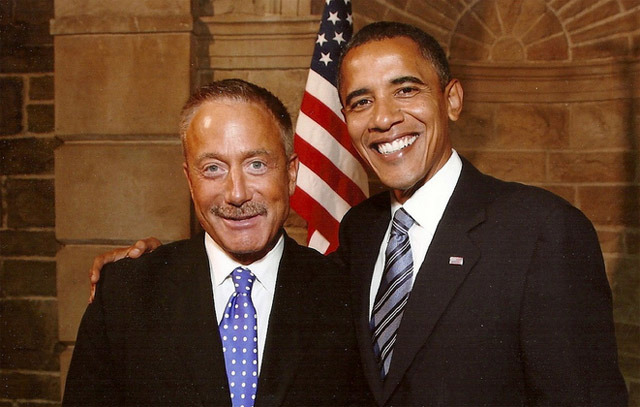
Gay activist Terry Bean and Barack Obama

Not the first time

Here’s some Democrat concern for the chldren, reported in the far-left CNN, of all places. Headline: “Obama backer, Democratic fundraiser Terry Bean charged in sexual abuse case”.

Excerpt:

A prominent supporter of President Barack Obama and co-founder of the Human Rights Campaign was arrested last week on charges of sodomy and sexual abuse related to what authorities said was an encounter with a juvenile male.

Terrence Bean, 66, a major Democratic donor and a celebrated gay-rights activist, was indicted on two felony charges of sodomy and a misdemeanor count of sexual abuse by a grand jury and arrested in Oregon Wednesday, according to a statement from the Portland Police Bureau.

[…]The charges relate to an alleged encounter the two had with a 15-year-old boy in Oregon last year, The Oregonian reported. Bean’s attorney has denied the charges and said in a statement that Bean is the “victim of an extortion ring.” CNN is not naming the alleged victim because the network does not identify minors or victims of sexual assaults.

[…]Bean, a real-estate developer and co-founder of the Gay and Lesbian Victory Fund and the Human Rights Campaign, is a powerful figure in Democratic politics.

The Oregonian reported that he helped raise more than half a million dollars for Obama’s 2012 re-election campaign, and Federal Election Commission records show he’s contributed thousands to Democrats, including former Secretary of State Hillary Clinton, Senate Majority Leader Harry Reid and others.

Photos posted online show him with the Obamas, House Minority Leader Nancy Pelosi and aboard Air Force One with the President.

In remarks at a 2009 Human Rights Campaign dinner, President Obama thanked Bean, calling him a “great friend and supporter.”

This goes right to the top of the Democrat party. Gay activists are connected to people at the top of the Democrat party. When a person votes Democrat, they’re either pedophiles themselves or they are (effectively) voting for increased normalization of pedophilia.

Pedophilia is nothing but the elevation of the desires of selfish adults over the protection of children. And we already know where the Democrats stand on that – we just have to look at how they reconcile irresponsible recreational sex with the right to life of the unborn. This is the party of adult selfishness. They don’t care about the needs of children at all. They see children as commodities, instead of people made in the image of God in order to know God.

Objective morality for atheists

I have a friend who is an atheist who tells me that he doesn’t need God to ground objective moral values. He is a good person, he says. He supports gay marriage. He was proud when the Seattle mayor got gay marriage passed in his state. He says that objective moral values are easily grounded on atheism.

Let’s review what objective morality (moral realism) really means in practice for atheists:

In a universe of electrons and selfish genes, blind physical forces and genetic replication, some people are going to get hurt, other people are going to get lucky, and you won’t find any rhyme or reason in it, nor any justice. The universe that we observe has precisely the properties we should expect if there is, at bottom, no design, no purpose, no evil, no good, nothing but pitiless indifference.

(Richard Dawkins, “God’s Utility Function,” Scientific American, November, 1995, p. 85)

Whatever morality atheists try to claim, the truth is that their worldview cannot ground it rationally. This universe is an accident. There are no objective human rights. There is no objective morality. There is no free will nor moral agency. There is no judge of our actions when we die. Other human beings are just lumps of matter to be used for our own pleasure, as long as we are powerful enough to escape the disapproval of those accursed Bible-believers. Assume that every atheist is either like the Seattle mayor or is proud of what he is doing. That’s what atheists vote for, after all. This is the world they want to actualize through their voting. The whole point of atheism is to get rid of moral restraints on the pursuit of pleasure. The great virtue that motivates young atheists to turn away from the Bible is just “I want to get drunk and have premarital sex without consequences”. End of story. It’s not intellectual.

More atheism objective morality:

Related posts

Democrat senators attack judicial nominee for her Catholic faith

This is from National Review.

Excerpt:

This afternoon, during a confirmation hearing for 7th Circuit Court of Appeals nominee Amy Coney Barrett, Democratic senator Dianne Feinstein attacked the nominee for her Roman Catholic faith.

Barrett is a law professor at the University of Notre Dame who has written about the role of religion in public life and delivered academic lectures to Christian legal groups. Drawing on some of these materials, Feinstein launched a thinly veiled attack on Barrett’s Catholic faith, asserting that her religious views will prevent her from judging fairly.

“When you read your speeches, the conclusion one draws is that the dogma lives loudly within you,” Feinstein said. “And that’s of concern when you come to big issues that large numbers of people have fought for for years in this country.” Feinstein is clearly hinting here at the Supreme Court decision in Roe v. Wade, a ruling that Feinstein supports so vociferously that she has even called it a “super-precedent.”

[…]Other Democratic senators took issue with Barrett over her faith as well. Senate minority whip Dick Durbin criticized Barrett’s use of the term “orthodox Catholic,” insisting that it unfairly maligns Catholics who do not hold certain positions about abortion or the death penalty. (Durbin himself is a Catholic who abandoned his previous pro-life position.) “Do you consider yourself an orthodox Catholic?” he later asked Barrett point blank.

And Hawaii senator Mazie Hirono snarked, “I think your article is very plain in your perspective about the role of religion for judges, and particularly with regard to Catholic judges.”

It was reported that Feinstein actually said “The dogma lives loudly within you, and that’s of concern“. Think about that.

To me, the more important thing about this story is how comfortable secular people are about forcing their secular convictions down the throats of others. What they’re essentially saying is this: “I can use power to push my worldview onto you, and I can use power to stop you from living according to your convictions”. You can be certain that Diane Feinstein has answers to all of the same big questions that theists have answers to: “does God exist?” “did Jesus rise from the dead?” “is there a purpose to suffering and evil?” “is there life after death?”, etc. She has different answers to those same questions, but she wouldn’t accuse herself of having dogma. She feels very comfortable pushing her worldview through political power, but doesn’t think that theists ought to be able to do the same.

And this provides an interesting lesson for Christians: how did it come to be the case that Christian convictions are automatically perceived by secular leftist elites to be irrational and dangerous? Why is it that Christians shouldn’t be allowed to participate in politics, but atheists should, since they answer the same big questions with their respective worldviews? The answer is simple. Atheists perceive Christians as having a worldview that is not based on fact. And they perceive themselves as having a worldview that is based on fact. How did this happen?

Well, simply put, Christian leaders made it happen, by refusing to focus on apologetics and evangelism. For better or worse, Christian churches (from fundamentalist Pentecostal to conservative Presbyterian) have decided that evangelism and apologetics are not important enough to focus on at church. And the result of this is that as non-Christians work their way through school and into the workplace, they never encounter any intelligent Christians who have reasons and evidence for their beliefs. Not just Christian beliefs, but policy beliefs, too. The church has failed to teach their members and adherents the importance of having answers, and this (along with the Sexual Revolution) is one of the main reasons why America has gone secular.

Even if you spend your childhood and teen years in church, you will never hear serious discussion of whether God really exists or whether the Bible is historically reliable. These things will be assumed to be true. You will be shamed if you ask questions, and you will even be shamed if you study apologetics to know how to answer these questions. This is considered pious by most church leaders, no matter what denomination you’re in. Atheists are not blind to the fact that most people who profess Christ are ignorant of competing views, and cannot explain why they hold their views using reason and evidence. And this is where the perception that Christians are too dangerous to be allowed to participate in politics comes from.

This past week, I had a conversation with a senior engineer about his beliefs. He had attended Christian schools K through 12, and Christian churches his entire life. It all ended for him the minute he hit college. I perceived that he had questions that had gone unanswered, and asked him if he had ever seen any formal debates on Christianity. His answer? “I did not know that such a thing even existed”. I sent him a couple of debates to watch, and we are going to have lunch to discuss his background, because he was open to a rational discussion of the evidence. It doesn’t matter what church you are in, you will almost certainly never see a formal debate on Christianity. Because of this lack of emphasis on open debate, we lose a lot of intelligent people the minute they hit the university campus.

Things have gotten so bad, that it is now dangerous to even come out as a Christian in the education system, although there is still space to do it in the workplace, if you are careful who you speak to, and when. Most Christians I know, though, have no interest in jeopardizing their careers by being perceived as stupid at work. And yet there is this tremendous need for every Christian to reset the perceptions on ultimate questions. We must do this, or we are finished.

Anyway, it’s interesting to take a look at two of the nominees that Democrat senators opposed. Are they even qualified? Or are they anti-intellectual dingbats with no experience at all?

The Daily Signal has a helpful article about them. It turns out that they are exquisitely well-educated and have solid resumes, as well. That’s something else that Christians should not neglect if we want to be respected by secular elites.

We should all be very serious about our educations, careers and finances. Finances are important because it is an immediate signal to others that you have a wisdom about how to live. If we marry, then our marriage and children also sends a signal about competence. My view is that Christians should be learning much more than just the Bible in church. A little basic economics, basic apologetics, basic New Testament, and basic philosophy of religion would definitely help to correct the perceptions that others have of Christianity. And the study of those areas would make the average rank-and-file Christian much more confident about discussing those things in school and at work.

Positive arguments for Christian theism

MIT physicist Alan Lightman on fine-tuning and the multiverse

Christianity and the progress of science

Here’s the article from Harper’s magazine.

The MIT physicist says that the fine-tuning is real, and is best explained by positing the existence of an infinite number of universes that are not fine-tuned – the so-called multiverse.

Excerpt:

While challenging the Platonic dream of theoretical physicists, the multiverse idea does explain one aspect of our universe that has unsettled some scientists for years: according to various calculations, if the values of some of the fundamental parameters of our universe were a little larger or a little smaller, life could not have arisen. For example, if the nuclear force were a few percentage points stronger than it actually is, then all the hydrogen atoms in the infant universe would have fused with other hydrogen atoms to make helium, and there would be no hydrogen left. No hydrogen means no water. Although we are far from certain about what conditions are necessary for life, most biologists believe that water is necessary. On the other hand, if the nuclear force were substantially weaker than what it actually is, then the complex atoms needed for biology could not hold together. As another example, if the relationship between the strengths of the gravitational force and the electromagnetic force were not close to what it is, then the cosmos would not harbor any stars that explode and spew out life-supporting chemical elements into space or any other stars that form planets. Both kinds of stars are required for the emergence of life. The strengths of the basic forces and certain other fundamental parameters in our universe appear to be “fine-tuned” to allow the existence of life. The recognition of this fine-­tuning led British physicist Brandon Carter to articulate what he called the anthropic principle, which states that the universe must have the parameters it does because we are here to observe it. Actually, the word anthropic, from the Greek for “man,” is a misnomer: if these fundamental parameters were much different from what they are, it is not only human beings who would not exist. No life of any kind would exist.

If such conclusions are correct, the great question, of course, is why these fundamental parameters happen to lie within the range needed for life. Does the universe care about life? Intelligent design is one answer. Indeed, a fair number of theologians, philosophers, and even some scientists have used fine-tuning and the anthropic principle as evidence of the existence of God. For example, at the 2011 Christian Scholars’ Conference at Pepperdine University, Francis Collins, a leading geneticist and director of the National Institutes of Health, said, “To get our universe, with all of its potential for complexities or any kind of potential for any kind of life-form, everything has to be precisely defined on this knife edge of improbability…. [Y]ou have to see the hands of a creator who set the parameters to be just so because the creator was interested in something a little more complicated than random particles.”

Intelligent design, however, is an answer to fine-tuning that does not appeal to most scientists. The multiverse offers another explanation. If there are countless different universes with different properties—for example, some with nuclear forces much stronger than in our universe and some with nuclear forces much weaker—then some of those universes will allow the emergence of life and some will not. Some of those universes will be dead, lifeless hulks of matter and energy, and others will permit the emergence of cells, plants and animals, minds. From the huge range of possible universes predicted by the theories, the fraction of universes with life is undoubtedly small. But that doesn’t matter. We live in one of the universes that permits life because otherwise we wouldn’t be here to ask the question.

I thought I was going to have to go outside this article to refute the multiverse, but Lightman is honest enough to refute it himself:

The… conjecture that there are many other worlds… [T]here is no way they can prove this conjecture. That same uncertainty disturbs many physicists who are adjusting to the idea of the multiverse. Not only must we accept that basic properties of our universe are accidental and uncalculable. In addition, we must believe in the existence of many other universes. But we have no conceivable way of observing these other universes and cannot prove their existence. Thus, to explain what we see in the world and in our mental deductions, we must believe in what we cannot prove.

Sound familiar? Theologians are accustomed to taking some beliefs on faith. Scientists are not. All we can do is hope that the same theories that predict the multiverse also produce many other predictions that we can test here in our own universe. But the other universes themselves will almost certainly remain a conjecture.

The multiverse is not pure nonsense, it is theoretically possible. The problem is that the multiverse generator itself would require fine-tuning, so the multiverse doesn’t get rid of the problem. And, as Lightman indicates, we have no independent experimental evidence for the existence of the multiverse in any case. Atheists just have to take it on faith, and hope that their speculations will be proved right. Meanwhile, the fine-tuning is just as easily explained by postulating God, and we have independent evidence for God’s existence, like the the origin of biological information, the sudden appearance of animal body plans, the argument from consciousness, and so on. Even if the naturalists could explain the fine-tuning, they would still have a lot of explaining to do. Theism (intelligent causation) is the simplest explanation for all of the things we learn from the progress of science.

We need to be frank about atheists and their objections to the progress of science. Within the last 100 years, we have discovered that the physical universe came into being out of nothing 15 billion years ago, and we have discovered that this one universe is fine-tuned for intelligent life. I don’t think it’s like that the last 100 years of scientific progress on the origins question are going to be overturned so that science once again affirms what atheists believe about the universe. Things are going the wrong way for atheists – at least with respect to science.

See it in action

To see these arguments examined in a debate with a famous atheist, simply watch the debate between William Lane Craig and Christopher Hitchens, and judge which debater is willing to form his beliefs on scientific progress, and which debater is forming his beliefs against the science we have today, and hoping that the good science we have today based on experiments will be overturned by speculative theories at some point in the future. When you watch that debate, it becomes very clear that Christian theists are interested in conforming their beliefs to science, and atheists are very interested in speculating against what science has shown in order to maintain their current pre-scientific view. That’s not what rational people ought to do when confronted with evidence.

Positive arguments for Christian theism