
Tag Archives: Astrobiology

New study on tidal heating strengthens stellar habitability argument

Circumstellar Habitable Zone

Note: If you need a refresher on the habitability argument, click here.

Here’s an article entitled “Tidal heating shrinks the ‘goldilocks zone’: Overlooked factor suggests fewer habitable planets than thought”. It appeared in Nature, the most prestigious peer-reviewed science journal.

The gist of it is that tidal forces can alter orbits so that planets don’t spend all of their orbit in the habitable zone. If planets go outside the habitable zone, it damages their supply of liquid water, and any life chemistry going on in there is disrupted.

Excerpt:

A previously little-considered heating effect could shrink estimates of the habitable zone of the Milky Way’s most numerous class of stars — ‘M’ or red dwarfs — by up to one half, says Rory Barnes, an astrobiologist at the University of Washington in Seattle. That factor — gravitational heating via tides — suggests a menagerie of previously undreamt-of planets, on which tidal heating is a major source of internal heat. Barnes presented the work yesterday at a meeting of the American Astronomical Society’s Division on Dynamical Astronomy in Timberline Lodge, Oregon.

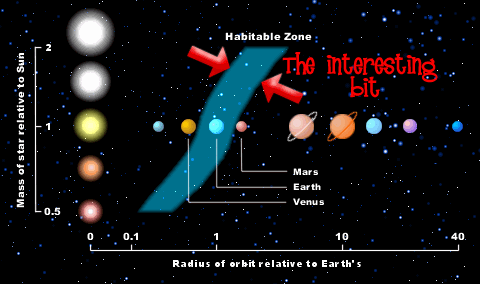
The habitable zone is the orbital region close enough to a star for a planet to have liquid water, but not so close that all of the water evaporates. For our Sun, the zone extends roughly from the inner edge of the orbit of Mars to the outer edge of that of Venus. For smaller, cooler stars, such as M-class dwarfs, the zone can be considerably closer to the star than Mercury is to the Sun. And because close-in planets are easier to spot than more distant ones, such stars have been a major target for planet hunters seeking Earth-like worlds.

There’s just one problem with finding habitable planets around such stars, says Barnes. Because tidal forces vary dramatically with the distance between a planet and its star, closer orbits also result in massively larger tidal forces.

Since planets do not have perfectly circular orbits, these tidal forces cause the planet to flex and unflex each time it moves closer to or further from its star; kneading its interior to produce massive quantities of frictional heat. Substantial heat can be produced, he added, with even slight deviations from a perfectly circular orbit. And, Barnes notes, other factors — such as the rate of the planet’s rotation and its axial tilt — can also influence heat production.

A similar tidal process makes Jupiter’s moon Io the most volcanic body in the Solar System. “I’m just scaling that Io–Jupiter system up by a factor of 1,000 in mass,” Barnes said at the meeting. “It’s the same process, on steroids.”

So, stars that are smaller and cooler will have a habitable zone that is closer to the star, exposing them to more tidal forces. More tidal forces makes their orbits less likely to stay circular – within the habitable zone around the star. These variations cause an increase in heat production on the planet. Too much heat means that the planet is unable to support liquid water on the surface, making it inhospitable for life. Therefore, solar systems with less massive stars can be ruled out as possible sites for life, because of these tidal forces.

What conditions support the minimum requirements for complex life?

The Circumstellar Habitable Zone (CHZ)

What do you need in order to have a planet that supports complex life? First, you need liquid water at the surface of the planet. But there is only a narrow range of temperatures that can support liquid water. It turns out that the size of the star that your planet orbits around has a lot to do with whether you get liquid water or not. A heavy, metal-rich star allows you to have a habitable planet far enough from the star so  the planet can support liquid water on the planet’s surface while still being able to spin on its axis. The zone where a planet can have liquid water at the surface is called the circumstellar habitable zone (CHZ). A metal-rich star like our Sun is very massive, which moves the habitable zone out further away from the star. If our star were smaller, we would have to orbit much closer to the star in order to have liquid water at the surface. Unfortunately, if you go too close to the star, then your planet becomes tidally locked, like the moon is tidally locked to Earth. Tidally locked planets are inhospitable to life.

Circumstellar Habitable Zone

Here, watch a clip from The Privileged Planet: (Clip 4 of 12, full playlist here)

But there’s more.

The Galactic Habitable Zone (GHZ)

So, where do you get the heavy elements you need for your heavy metal-rich star?

You have to get the heavy elements for your star from supernova explosions – explosions that occur when certain types of stars die. That’s where heavy elements come from. But you can’t be TOO CLOSE to the dying stars, because you will get hit by nasty radiation and explosions. So to get the heavy elements from the dying stars, your solar system needs to be in the galactic habitable zone (GHZ) – the zone where you can pickup the heavy elements you need but not get hit by radiation and explosions. The GHZ lies between the spiral arms of a spiral galaxy. Not only do you have to be in between the arms of the spiral galaxy, but you also cannot be too close to the center of the galaxy. The center of the galaxy is too dense and you will get hit with massive radiation that will break down your life chemistry. But you also can’t be too far from the center, because you won’t get enough heavy elements because there are fewer dying stars the further out you go. You need to be in between the spiral arms, a medium distance from the center of the galaxy.

Like this:

Galactic Habitable Zone
Galactic Habitable Zone and Solar Habitable Zone

Here, watch a clip from The Privileged Planet: (Clip 10 of 12, full playlist here)

The GHZ is based on a discovery made by astronomer Guillermo Gonzalez, which made the front cover of Scientific American in 2001. That’s right, the cover of Scientific American. I actually stole the image above of the GHZ and CHZ (aka solar habitable zone) from his Scientific American article (linked above).

These are just a few of the things you need in order to get a planet that supports life.

Here are a few of the more well-known ones:

  • a solar system with a single massive Sun than can serve as a long-lived, stable source of energy
  • a terrestrial planet (non-gaseous)
  • the planet must be the right distance from the sun in order to preserve liquid water at the surface – if it’s too close, the water is burnt off in a runaway greenhouse effect, if it’s too far, the water is permanently frozen in a runaway glaciation
  • the solar system must be placed at the right place in the galaxy – not too near dangerous radiation, but close enough to other stars to be able to absorb heavy elements after neighboring stars die
  • a moon of sufficient mass to stabilize the tilt of the planet’s rotation
  • plate tectonics
  • an oxygen-rich atmosphere
  • a sweeper planet to deflect comets, etc.
  • planetary neighbors must have non-eccentric orbits

By the way, you can watch a lecture with Guillermo Gonzalez explaining his ideas further. This lecture was delivered at UC Davis in 2007. That link has a link to the playlist of the lecture, a bio of the speaker, and a summary of all the topics he discussed in the lecture. An excellent place to learn the requirements for a suitable habitat for life.

Is the taxpayer-funded scientific bureaucracy self-correcting?

Consider this post from Evolution News which talks about a paper in the prestigious pro-naturalism journal Science that is drawing a lot of criticisms. (H/T Melissa, Jonathan)

Excerpt:

Last December we reported on a controversial paper published in Science which claimed to have discovered bacteria that feed on arsenic instead of phosphorous. According to NASA, this research promised to provide “an astrobiology finding that will impact the search for evidence of extraterrestrial life.” At that time the media reported things like:

  • scientists discovered “a bacteria whose DNA is completely alien to what we know today” (Wired)
  • the “bacteria is made of arsenic” (Wired)
  • the bacteria is “capable of using arsenic to build its DNA, RNA, proteins, and cell membranes” (Gizmodo)
  • the paper had reported “arsenic-based life” which is “very alien in terms of how it’s put together” and “NASA has, in a very real sense, discovered a form of alien life” (io9)
  • “you can potentially cross phosphorus off the list of elements required for life” (Nature)

But soon after the original Science paper was published, credible scientists began critiquing the paper’s claims. In the June 3, 2011 issue of Science, several of those scientists have published comments critiquing the original paper. Many of their criticisms focus on the claim that the original paper did not establish or rule out the possibility that the bacteria are not still living off of phosphorous.

So you have a paper being published that everyone is excited about because it helps the naturalists to close gaps in their worldview. But was it good science? The Evolution News piece goes on to list the criticisms of the paper.

And here is the result:

Of course the authors of the original paper, including lead-author Felisa Wolf-Simon, co-authored a reply to the criticisms which should also be read. But critics remain unconvinced. Nature news recently quoted Barry Rosen of Florida International University stating, “I have not found anybody outside of [Wolfe-Simon’s] laboratory who supports the work.” Likewise, Rosie Redfield observes:

“With so many mistakes pointed out, there should be at least some where the authors say, ‘you’re right, we should have done that but we didn’t’,” Redfield says. “This as an entirely a ‘we were right’ response, and that’s a bad sign in science.”

Despite the high levels of skepticism of claims of arsenophilic bacteria, Nature reports that few scientists have taken the initiative to attempt to experimentally reproduce the claims made in the original paper:

However, most labs seem too busy to spend time replicating work that they feel is fundamentally flawed and is not likely to be published in high-impact journals. So principal investigators are reluctant to spend their resources, and their students’ time, replicating the work. “If you extended the results to show there is no detectable arsenic, where could you publish that?” asks Simon Silver of the University of Illinois at Chicago, who critiqued the work in FEMS Microbiology Letters in January and on 24 May at the annual meeting of the American Society for Microbiology in New Orleans. “How could the young person who was asked to do that work ever get a job?” Refuting another scientist’s work also takes time that scientists could be spending on their own research. For instance, Helmann says he is installing a highly sensitive mass spectrometer that can measure trace amounts of elements. But, he says, “I’ve got my own science to do.”

Such admissions do not bode well for those who blindly believe in the perfectly objective, self-correcting nature of science. In this case, it seems safe to experimentally critique these claims since so many respected scientists have already expressed vocal skepticism. Yet experiments are apparently not yet forthcoming. What about areas of science where scientists are not able to express their dissent freely? For example, who would take time to experimentally critique claims that are central to neo-Darwinian theory, especially if it’s dangerous to one’s career? One hopes that science will become more self-correcting when it comes to claims made in support of materialism.

In light of what we now know about global warming research, shouldn’t we be a little more welcoming of whistleblowers and critics? Shouldn’t we be a little more careful about hastily approving research that agrees with the religion of naturalism, instead of checking it over thoroughly to make sure that it really is good science?