Tag Archives: Arizona

Ted Cruz raised $12 million dollars last month alone

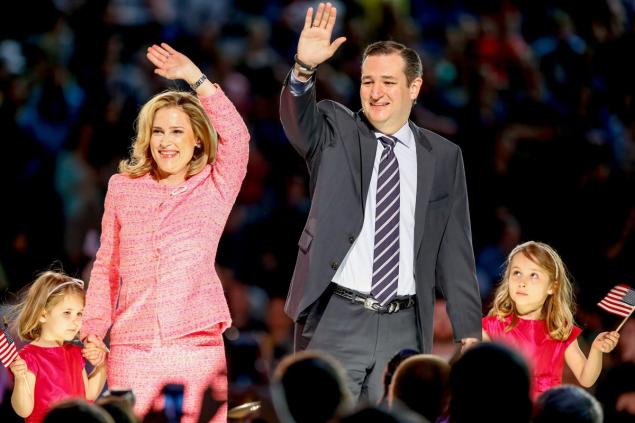
Texas senator Ted Cruz, his wife Heidi Cruz and their two daughters

This article from the left-leaning Houston Chronicle has some amazing news about Cruz’s fundraising.

It says:

Big money flew through the checking account of Texas Sen. Ted Cruz’s presidential campaign in February, when it reported its highest monthly income and expenditures to date, soaring above the GOP pack. And for the first time, the Cruz campaign spent more than it took in.

Fresh federal filings posted Sunday show a dramatic uptick in campaign costs and contributions for the period that spanned from Cruz’s unexpected win in Iowa, the nation’s first primary contest, to the day before his momentum seemed to fall behind frontrunner Donald Trump in a string of Super Tuesday votes on March 1.

Cruz’s Houston-based campaign took in $12 million in February, according to Federal Elections Commission records, compared in $7.6 million in January and $20.5 million in the last three months of 2015 combined.

The article also notes that Trump is lying about his campaign being self-funded – he takes donations, just like all the other candidates:

Trump has collected $7.7 million in contributions since he launched his campaign in June, in spite of his repeated assertion that he self-funds the operation. He has lent his campaign $17.5 million.

I don’t think it’s a good idea to support a candidate who says things that are not true, then has to back away from them after. If he lies about silly stuff like this, then what will happen when he has to tell the truth about something important?

It’s a good thing that Cruz is surging, because the polls show that Trump cannot beat Hillary Clinton:

Latest polls show Trump losing to Clinton, but Cruz ties Clinton
Latest polls show Trump losing to Clinton head-to-head, but Cruz ties with Clinton

I’m really hoping that Cruz can pull off a winner-take-all victory in Utah, which he will if he gets over 50% of the vote. And if Cruz wins in Arizona, that could mean that he will have more delegates than Trump at the time of the GOP convention.

Related posts

New poll: Ted Cruz poised to sweep Utah delegates, leading with 53%

Ted Cruz meets the voters at a campaign stop

The Salt Lake City Tribune reports:

Texas Sen. Ted Cruz has zoomed to a commanding lead in Utah’s GOP caucuses, according to a new poll released Saturday. It also gave a glimpse into how frustrated the state’s Republicans are with Donald Trump’s candidacy.

The Y2 Analytics survey shows Cruz with 53 percent support among likely Republican caucus-goes and if that matches Tuesday’s caucus vote, he’d win all of the state’s 40 GOP delegates.

Coming in second is Ohio Gov. John Kasich with 29 percent, while Trump, the national front-runner, was a distant third at 11 percent.

The Y2 Analytics poll was conducted from Thursday to Saturday and included 500 respondents, capturing some of the reaction from public events held by all three of the Republican candidates. Cruz held three public events in Utah on Saturday with Sen. Mike Lee, R-Utah, commentator Glenn Beck and former presidential candidate Carly Fiorina. Kasich and Trump held events on Friday.

[…]This is the first poll released in the state in over a month, and the only one since the field narrowed to just three candidates.

It showed that Cruz performed even better among “very likely” caucus attendees, coming in at 57 percent.

Scott Riding with Y2 Analytics said it appears that a bulk of Florida Sen. Marco Rubio’s supporters went to Cruz after he dropped out earlier this week.

“It is fascinating to see how close Cruz is to wrapping it up,” he said. “It is also surprising how discouraged Republicans are with the direction of the national party.”

Time to review Cruz’s achievements to see why he’s the best candidate still running.

Ted Cruz’s record of conservative achievements

Ted Cruz is also the most qualified candidate running.

Young Conservatives explains his achievements:

  • Graduated valedictorian in 1988 from Second Baptist High School
  • Graduated cum laude from Princeton University in 1992
  • Graduated magna cum laude from Harvard Law School in 1995
  • 1992 U.S. National Debate Champion representing Princeton
  • 1995 World Debating Championship semi-finalist representing Harvard
  • Served a law clerk to Chief Justice William Rehnquist, making him the first Hispanic ever to clerk for a Chief Justice of the United States
  • Served as Solicitor General of Texas from 2003 to 2008, making him the first Hispanic Solicitor General in Texas, the youngest Solicitor General in the entire country and the longest tenure in Texas history
  • Partner at the law firm Morgan, Lewis & Bockius, where he led the firm’s U.S. Supreme Court and national appellate litigation practice
  • Authored over 80 SCOTUS briefs and presented over 40 oral arguments before The Court
  • Adjunct Professor of Law at the University of Texas School of Law in Austin, where he taught U.S. Supreme Court litigation

Smart guy.

Here are the specifically conservative achievements:

  • In the landmark case of District of Columbia v. Heller, Cruz assembled a coalition of 31 states in defense of the principle that the 2nd Amendment guarantees an individual right to keep and bear arms
  • Presented oral arguments before the United States Court of Appeals for the District of Columbia Circuit
  • Defended the Ten Commandments monument on the Texas State Capitol grounds,
  • Defended the recitation of the Pledge of Allegiance in public schools
  • Defended the State of Texas against an attempt by the International Court of Justice to re-open the criminal convictions of 51 murderers on death row throughout the United States

He’s 5 for 9 arguing cases before the Supreme Court. Cruz knows how to convince liberal scholars to come over to his side. That’s what he enjoys – persuading people who disagree with him.

Here’s some of the legislation he introduced:

  • ObamaCare Repeal Act
  • Disarm Criminals and Protect Communities Act
  • Defund Obamacare Act of 2013
  • A bill to amend the National Voter Registration Act of 1993 to permit States to require proof of citizenship for registration to vote in elections for Federal office
  • State Marriage Defense Act of 2014
  • A bill to amend title 18, United States Code, to prohibit the intentional discrimination of a person or organization by an employee of the Internal Revenue Service
  • A bill to prohibit the Department of the Treasury from assigning tax statuses to organizations based on their political beliefs and activities
  • American Energy Renaissance Act of 2014
  • A bill to deny admission to the United States to any representative to the United Nations who has been found to have been engaged in espionage activities or a terrorist activity against the United States and poses a threat to United States national security interests
  • SuperPAC Elimination Act of 2014
  • Free All Speech Act of 2014
  • A bill to prevent the expansion of the Deferred Action for Childhood Arrivals program unlawfully created by Executive memorandum on August 15, 2012
  • Sanction Iran, Safeguard America Act of 2014

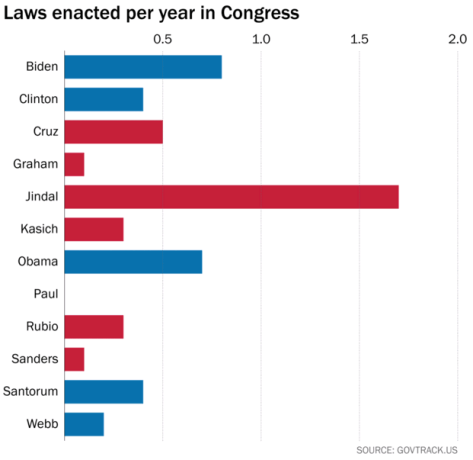
And he has gotten more legislation passed than Marco Rubio in the Senate:

Laws enacted per year in Congress

He has done something to address so many of the things I’ve been writing about on this blog – voter fraud, IRS discriminating against conservatives, etc. I am a Cruz supporter because I like Cruz, not because I oppose Trump and Rubio.

Related posts

All the Arizone SB 1062 bill did was allow religious liberty to be raised as a defense

The Weekly Standard posted a letter by a group of law professors from various universities, including Harvard and Stanford, to explain what the Arizona religious liberty bill did. It turns out that all the Arizona bill did was specify how religious liberty protections apply within the state, using a federal standard that was already passed nearly unanimously by Congress during the presidency of Bill Clinton.

Here’s what the professors said about the Arizona bill:

The federal government and eighteen states have Religious Freedom Restoration Acts (RFRAs). Another twelve or thirteen states interpret their state constitutions to provide similar protections. These laws enact a uniform standard to be interpreted and applied to individual cases by courts. They say that before the government can burden a person’s religious exercise, the government has to show a compelling justification.

That standard makes sense. We should not punish people for practicing their religions unless we have a very good reason. Arizona has had a RFRA for nearly fifteen years now; the federal government has had one since 1993; and RFRA’s standard was the constitutional standard for the entire country from 1963 to 1990. There have been relatively few cases; if you knew little about the Arizona RFRA until the current controversy, that is because it has had no disruptive effect in Arizona. Few people had heard of the federal RFRA before the current litigation over contraception and the Affordable Care Act.

SB1062 would amend the Arizona RFRA to address two ambiguities that have been the subject of litigation under other RFRAs. It would provide that people are covered when state or local government requires them to violate their religion in the conduct of their business, and it would provide that people are covered when sued by a private citizen invoking state or local law to demand that they violate their religion.

But nothing in the amendment would say who wins in either of these cases. The person invoking RFRA would still have to prove that he had a sincere religious belief and that state or local government was imposing a substantial burden on his exercise of that religious belief. And the government, or the person on the other side of the lawsuit, could still show that compliance with the law was necessary to serve a compelling government interest. As a business gets bigger and more impersonal, courts will become more skeptical about claims of substantial burden on the owner’s exercise of religion. And as a business gets bigger, the government’s claim of compelling interest will become stronger.

So basically, businesses have the same religious liberty right as individuals AND individuals can use religious liberty as a defense in a civil suit. That’s it. No one is being licensed to discriminate indiscriminately. The bill did not say that the defense could be used in every case, it just said that religious liberty could be used by businesses as a defense (more likely to be accepted by small businesses), and that religious liberty could be used as a defense in civil suits. Whether the defense would be effective would still be decided by the courts.

Even the libertarian Cato Institute‘s Ilya Shapiro, who favors gay marriage, thought the bill was FINE:

Even though I’m for marriage equality – next week I’ll be filing a brief supporting the challenge to the marriage laws of Oklahoma and Utah in the U.S. Court of Appeals for the Tenth Circuit – I have no problem with Arizona’s SB 1062.

SB 1062 does nothing more than align state law with the federal Religious Freedom Restoration Act (which passed the House unanimously, the Senate 97-3, and was signed by President Clinton in 1993). That is, no government action can “substantially burden” religious exercise unless the government uses “the least restrictive means” to further a “compelling interest.” This doesn’t mean that people can “do whatever they want” – laws against murder would still trump religious human sacrifice – but it would prevent the government from forcing people to violate their religion if that can at all be avoided. Moreover, there’s no mention of sexual orientation (or any other class or category).

The prototypical scenario that SB 1062 is meant to prevent is the case of the New Mexicowedding photographer who was fined for declining to work a same-sex commitment ceremony. This photographer doesn’t refuse to provide services to gay clients, but felt that she couldn’t participate in the celebration of a gay wedding. There’s also the Oregon bakerythat closed rather than having to provide wedding cakes for same-sex ceremonies. Why should these people be forced to engage in activity that violates their religious beliefs?

That’s a libertarian speaking, there, and they are not social conservatives.

An article tweeted by Ryan T. Anderson from The Federalist asserts that the real lesson of the loss for religious liberty in Arizona is how easily the Republican Party will capitulate to pressure even when the truth is on their side. They just don’t care about religious liberty enough to defend it.