Tag Archives: Apologetics

Christian philosopher (Craig) vs atheist scientist (Atkins) debate: Does God Exist?

I found a video of a debate from the Reasonable Faith speaking tour in the UK, between Christian philosopher Dr. William Lane Craig and atheist chemist Dr. Peter Atkins.

Here is the video:

This is a must-see debate. It was extremely fun to watch, and I have a snarky summary of the opening speeches below.

Details:

On Wednesday 26th October 2011 William Lane Craig debated Peter Atkins on the topic: Does God Exist? This debate took place at the University of Manchester  as part of the UK Reasonable Faith Tour with William Lane Craig. The debate was chaired by Christopher Whitehead, Head of Chemistry School at the University. Post-debate discussion was moderated by Peter S Williams, Philosopher in Residence at the Damaris Trust, UK.

Dr. William Lane Craig:

William Lane Craig (born August 23, 1949) is an American analytic philosopher, philosophical theologian, and Christian apologist. He is known for his work on the philosophy of time and the philosophy of religion, specifically the existence of God and the defense of Christian theism. He has authored or edited over 30 books including The Kalam Cosmological Argument (1979), Theism, Atheism and Big Bang Cosmology(co-authored with Quentin Smith, 1993), Time and Eternity: Exploring God’s Relationship to Time (2001), and Einstein, Relativity and Absolute Simultaneity (co-edited with Quentin Smith, 2007).

Craig received a Bachelor of Arts degree in communications from Wheaton College, Illinois, in 1971 and two summa cum laudemaster’s degrees from Trinity Evangelical Divinity School in Deerfield, Illinois, in 1975, in philosophy of religion and ecclesiastical history. He earned a Ph.D. in philosophy under John Hick at the University of Birmingham, England in 1977 and a Th.D. underWolfhart Pannenberg at the University of Munich in 1984.

Dr. Peter Atkins:

Peter William Atkins (born 10 August 1940) is a British chemist and former Professor of Chemistry at the University of Oxford and a Fellow of Lincoln College. He is a prolific writer of popular chemistry textbooks, including Physical ChemistryInorganic Chemistry, and Molecular Quantum Mechanics. Atkins is also the author of a number of science books for the general public, including Atkins’ Molecules and Galileo’s Finger: The Ten Great Ideas of Science.

Atkins studied chemistry at the University of Leicester, obtaining a bachelor’s degree in chemistry, and – in 1964 – a PhD for research into electron spin resonance spectroscopy, and other aspects of theoretical chemistry. Atkins then took a postdoctoral position at the UCLA as aHarkness Fellow of the Commonwealth fund. He returned to Oxford in 1965 as fellow and tutor of Lincoln College, and lecturer in physical chemistry (later, professor of physical chemistry).

I am happy when debates like this come out. I have friends who are Christians who doubt the importance of apologetics in evangelism, because they don’t think that apologists can prove anything or win arguments. I have friends who are skeptical of using arguments that assume a 14-billion year old universe, because they think that the Big Bang is compatible with atheism (!). I have friends who think that philosophical arguments have no persuasive force. I have friends who think that nothing can be proven from history, beyond a reasonable doubt. I have co-workers who ask me whether anyone wins these debates. I think that this debate answers all of those questions.

This debate clearly shows why Christians should not shy away from studying science, philosophy and history. We will not discover anything that harms Christian theism by thinking logically and by looking at the evidence. To the contrary, it is the atheist who makes war on the progress of science, and who is forced to resist the clear experimental evidence, and to resort to baseless speculations and blind faith. If you want to see a good debate with an intelligent atheist, I recommend watching the debate between William Lane Craig and Peter Millican instead. But if you want to see a really, really overwhelming defeat for atheism, watch this debate. It is very clear at the end of this debate why Richard Dawkins refused to debate William Lane Craig at Oxford.

SUMMARY OF THE OPENING SPEECHES

I only had time to summarize the first two speeches. Keep in mind that Dr. Craig always shines in his rebuttals, and this debate is no different. So you’ll want to watch those rebuttals. Dr. Atkins literally says in this debate in his first rebuttal “There was nothing here originally. There is nothing here now. But it is an interesting form of nothing which seems to be something.” And the audience laughs nervously. This debate is like that. You will see a clear winner and clear loser in this debate. This fight is decided by knockout.

William Lane Craig opening speech:

1. the origin of the universe
2. the moral argument
3. the resurrection of Jesus

Peter Atkins opening speech:

1. Dr. Craig is stupid, lazy and evil:
– Dr. Craig’s arguments are old: from the 11th century! Old arguments can’t be true
– Dr. Craig is just asserting that “God did it” because he is lazy
– Dr. Craig feels pressured to agree with the theistic majority
– Dr. Craig needs a psychological crutch to comfort him
– Dr. Craig is fearful of death
– Dr. Craig is just wishing for an eternal life of bliss
– Dr. Craig is driven by his heart, and not by his head

2. Origin of the universe:
– Maybe the universe is eternal and has no beginning – we don’t know
– Maybe mommy universes can give birth to daughter universes
– It is naive to think that a cause is needed to cause the creation of the universe from nothing
– Science is just about to show how it is possible that something appears out of nothing without cause
– Some scientists have already begun to speculate about about how something can come into being out of nothing
– Maybe nothing is not really nothing, but it is actually something
– It would be admitting defeat to say that God created the universe out of nothing

3. Fine-Tuning:
– It could be the case that the fundamental constants are not variable
– It could be the case that the fine-tuning of the cosmic constants is a happy accident
– It could be the case that there are billions of billions of unobservable universes that are not fine tuned
– It could be the case that the cosmic constants in these billions and billions of unobservable universes are all random so that some are fine-tuned
– Anyone who infers that an intelligence is the best explanation of a finely-tuned set of life-permitting cosmic constants is lazy

4. Purpose:
– Philosophers and theologians are stupid
– I don’t think that there is purpose in the universe
– I think that the universe is more grand if there is no purpose, so there is no purpose

5. Miracles:
– I don’t think that miracles happen
– The resurrection is a fabrication
– It could be the case that Jesus didn’t exist
– It could be the case that Jesus wasn’t really crucified
– It could be the case that Jesus didn’t  really die after being crucified
– It could be the case that the disciples stole his body
– It could be the case that the women went to the wrong hole in the ground
– the gospels are political propaganda written long after the events they are reporting on

6. Theodicy:
– God has no morally sufficient reason for allowing humans to perform actions that result in suffering
– God has no morally sufficient reason for allowing nature to cause suffering

7. Morality:
–  customs and conventions emerges arbitrarily in different times and places based on an awareness of the consequences of actions, as well as various anecdotes and experiences
–  these customs and conventions are decided based on the goal for survival, in much the same way as politeness and manners emerge for decorum and to avoid offense
– it is childish to presume that there is an umpire God who decides moral values and duties

8. Religious believers are stupid, lazy and evil:
– the notion of God has arisen because people are stupid and want to be comforted
– there are no arguments or evidences for belief in God
– people who believe in God do not think, but instead take refuge in incomprehensible nonsense

Self-refuting statements defined and some common examples

A conflict of worldviews

A common thing that I see is people trying to wall off arguments they don’t like by stating a slogan, like “you shouldn’t push your moral rules on other people” or “that’s true for you, but not for me”. Those slogans are meant to get the person out of having to be reasonable about respecting moral obligations, or having to consider how the world really works when choosing what to do.

Here is a fine article by Aaron, who writes at Apologetics Junkie.

Excerpt:

A self-defeating (or self-refuting) statement is one that fails to meet its own standard. In other words, it is a statement that cannot live up to its own criteria. Imagine if I were to say,

I cannot speak a word in English.

You intuitively see a problem here. I told you in English that I cannot speak a word in English. This statement is self-refuting. It does not meet its own standard or criteria. It self-destructs.

The important thing to remember with self-defeating statements is that they are necessarily false. In other words, there is no possible way for them to be true. This is because they violate a very fundamental law of logic, the law of non-contradiction. This law states that A and non-A cannot both be true at the same time and in the same sense. For example, it is not possible for God to exist and not exist at the same time and in the same sense. This would violate the law of non-contradiction. So if I were to say, “God told me He doesn’t exist” you would see intuitively the obvious self-refuting nature of this statement.

Aaron goes on to explain how to deal with self-refuting statements in the article.

Here are 20 examples of self-refutation, just to encourage you to click through and read it:

1. There is no truth.

2. You can’t know truth.

3. No one has the truth.

4. All truth is relative.

5. It’s true for you but not for me.

6. There are no absolutes.

7. No one can know any truth about religion.

8. You can’t know anything for sure.

9. You should doubt everything.

10. Only science can give us truth.

11. You can only know truth through experience.

12. All truth depends on your perspective.

13. You shouldn’t judge.

14. You shouldn’t force your morality on people.

15. You should live and let live.

16. God doesn’t take sides.

17. You shouldn’t try to convert people.

18. That’s just your view.

19. You should be tolerant of all views.

20. It is arrogant to claim to have the truth.

Have you ever heard any of those? It’s amazing how often I hear statements like that when discussing interesting things like moral issues and politics with young people. The trick to being prepared to answer these is to learn lots of them. Then you recognize them when you hear them.

Add yours in the comments!

Guest post: Fred Rogers, the patron saint of niceness

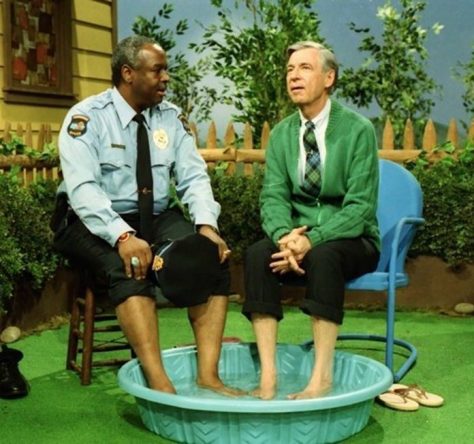
Fred Rogers and Francois Clemmons on the Mr. Rogers show

The following is a guest post by a friend who wants to remain anonymous. He is a Christian apologist who works in the software industry.


The marketing machine for the latest Tom Hanks movie portrayal of Mister Rogers is in full swing. And they’re trying hard to sell the movie to the Christian community. A recent Christian Post article claims:

‘Mister Rogers’ Neighborhood’ was Fred Rogers’ mission field, wife Joanne says

“One of the most important things we accept and know is that Fred was first and foremost a minister in the Presbyterian Church,” Joanne Rogers told The Christian Post.

The trouble with this is that if the show was Fred Roger’s mission field, he failed because people know him more for being nice than for preaching Jesus.

It’s telling that one of the most common “surprising facts” shared about Mr Rogers is that he was a Presbyterian minister. If we hadn’t been told this, we wouldn’t know it based on his work and legacy.

A commenter on Facebook writes:

His job was to do a kids show not to proselytize. Did Jesus go around preaching when He was called to be a carpenter? No He did His job.

I’m sure people asked Mr. Rogers what his motivation was and there’s nothing wrong with having private conversations about it and not using the television to preach. People don’t watch kids shows to be preached at. That would be a misuse of his platform! 😒

Is that true? Let’s take the case of Fred Rogers’s longtime friend and frequent show guest, Francois Clemmons. In addition to being a talented broadway actor, Francois Clemmons is proudly gay. And there’s no indication that Fred Rogers pressed Francois Clemmons to repent and turn to Jesus.

“He says he’ll never forget the day Rogers wrapped up the program, as he always did, by hanging up his sweater and saying, “You make every day a special day just by being you, and I like you just the way you are.” This time in particular, Rogers had been looking right at Clemmons, and after they wrapped, he walked over.

Clemmons asked him, “Fred, were you talking to me?”

“Yes, I have been talking to you for years,” Rogers said, as Clemmons recalls. “But you heard me today.”

“It was like telling me I’m OK as a human being,” Clemmons says. “That was one of the most meaningful experiences I’d ever had.””

Which is even more sad when you consider that Fred Rogers took a brave stand against racism

He found racism to be an important enough subject to import the foot washing example of Jesus but there’s no indication that he called Francois Clemmons to repent for his sinful lifestyle choice.

“But did Mr. Rogers ever condemn you?

No. He said, “Sometimes people do get married and they settle down, they live a different life. You can’t go to the those [gay] clubs. . .That may not be the answer for you, Franc; you have to consider something else. What, I’m not sure. But that may not be the route for you.””

I don’t expect, nor would I advocate for, Fred Rogers to do nothing but condemn Francois Clemmons. But it’s pretty telling that in all of their years working together, with Fred knowing Francois’s sexual orientation, that Fred never saw fit to tell him where his sinful lifestyle would eventually lead according to Scripture and plead with him to repent.

Fred Rogers is being lionized by popular media. You have to ask yourself why. Especially in a culture that still condemns Chick-fil-A for what its founder’s son said nearly a decade ago. The reason is not because Fred Rogers looked like Jesus. Quite the contrary. It’s because Fred Rogers was soft and effeminate. Fred Rogers is what the world wants Christians to look and act like so they can more easily push around and otherwise mold Christians.

Again, our commenter on Facebook responds:

A children’s show on a public network is no place to be preaching the gospel. Should a flight attendant spend all their time preaching and trying to convert people!? They have a job to do. If the Holy Spirit moves them to say something then fine but you’re going to turn people off if you’re acting like a salesperson and not doing your actual job! I am dead serious. The workplace is to be professional and do your job. If you want to preach be a preacher. Otherwise be careful how and when you bring it up. You have a whole private personal life on your time off to get involved in that kind of stuff!

Do we expect Christians to be sharing their faith all the time they are at work? No. Like every other profession the flight attendant has certain required duties to perform. But we are told to work as if for the glory of God (Colossians 3:23). At the very least that means that there is a mode of working that marks us as Christians. Part of that is the joy and peace that Fred Rogers displayed, yes, but that inevitably leads to others wondering about the source of that joy and peace (1 Peter 3:15). And that’s when an opportunity arises to explain to nonbelievers who Jesus is and why we should _want_ to pay the greatest price (Matthew 13:45-46) of giving up our own lives, characterized by sin (2 Timothy 2:25), to follow him.

If Francois Clemmons never felt judged by Fred Rogers then that is a serious condemnation on the ministry of Fred Rogers. It means, at the very least, that Fred Rogers was not doing his job in calling Francois to repentance so that he could come to a knowledge of the truth. The only truth that has any hope in saving anyone.