

Tag Archives: Apologetics

Should Christians be motivated by the fear of missing out (FOMO)?

Bible study that hits the spot

My best friend Dina and I recently spent some time talking over some articles that we found on the culture. We specifically talked about what is motivating young people, so I wanted to write something about that.

FOMO: Fear Of Missing Out

Here’s a leftist New York Times article explaining where FOMO comes from:

It’s known as FOMO, or “fear of missing out,” and refers to the blend of anxiety, inadequacy and irritation that can flare up while skimming social media like Facebook, Twitter, Foursquare and Instagram. Billions of Twitter messages, status updates and photographs provide thrilling glimpses of the daily lives and activities of friends, “frenemies,” co-workers and peers.

[…]When we scroll through pictures and status updates, the worry that tugs at the corners of our minds is set off by the fear of regret, according to Dan Ariely, author of “Predictably Irrational” and a professor of psychology and behavioral economics at Duke University. He says we become afraid that we’ve made the wrong decision about how to spend our time.

[…]A friend who works in advertising told me that she felt fine about her life — until she opened Facebook. “Then I’m thinking, ‘I am 28, with three roommates, and oh, it looks like you have a precious baby and a mortgage,’ ” she said. “And then I wanna die.”

It’s like they want to run a race to do fun and exotic things with their peers, and not finish last.

Anyway, I want to begin this post with examples of FOMO behavior I have personally encountered.

FOMO Travel

Dina and I read and discussed this article by Alain de Botton in The European – notice the emphasis on travel and having fun, sophisticated experiences:

We’re continually being bombarded with suggestions about what we might do (go jet skiing, study in Colorado, visit the Maldives or see the Pyramids). We’re always hearing of the amazing things friends have done or are going to do: ‘there was this great bar we all went to …’; ‘she’s getting married in a little country church, then we’re having a picnic…’; ‘the sun was glinting on Sydney Harbour…’ There are endless hints of the allure of life in other places: an article about family-friendly restaurants in Brooklyn, a crime novel set in Trieste, the departure board at the airport with its list of places only a plane trip away: Moscow, Bangkok, Addis Ababa… The modern world makes sure we know at all times just how much we’re missing. It is a culture in which intense and painful doses of FOMO (Fear Of Missing Out) are almost inevitable.

What’s interesting is this – how does FOMO travel affect young, unmarried Christians?

Travel through missions work seems to be the FOMO activity of choice for at least a few young, unmarried Christians. One of my best friends who is married to another of my best friends told me about her missions trip to a European country. I asked her why she did it, since it meant lost savings, lost earnings, lost work experience, etc. (She gave up a year of earnings, and she had a great job in engineering). Her answer was that she did it for the adventure. I have a hard time hearing Jesus say that he was going to do something because he was bored and wanted an adventure. Especially when it’s $30,000 in costs, $60,000 of lost income, and lost work experience – per year. This was before the time of the Internet, though, when missionary work actually made sense. I just don’t think it’s worth spending that kind of money for the impact you make. The people I know who went on missionary trips just wanted to feel spiritual, look spiritual, and have a fun “life experience” vacation. One missionary told me that she was desperate to get away from her boring mid-Western roots.

If you really want to share Christ effectively with people in other countries, then you can start a blog and pay the tiny costs for it out of your earnings from your day job – that’s what I do. I get more people from Europe reading my blog than I could contact in a year of missionary work. I Skype with the people who are interested in Christianity from these countries (Scotland, Northern Ireland, England, Canada, etc.), as well. Meanwhile, I keep working my not-exciting job, so my savings increase, and my resume remains gap-less. This is good stewardship of finances, and self-denial prepares your character for the hard work of marriage and parenting. The Bible says that those who do not work should not eat. And Paul says that he built tents so that no one could accuse him of taking on missionary work for financial gain.

You can tell whether a person is sincere in their missionary intentions by looking at how responsible they’ve been in their decision-making. If a person has gone into debt paying for fun, thrilling activities like skydiving, ziplining, surfing, etc., then it’s FOMO travel. We must look past the spiritual smokescreen, and tell young people to grow up.

After all, if defending God’s honor was the missionary’s main goal, then the real battlefield would be the university.

Bill Craig puts it best:
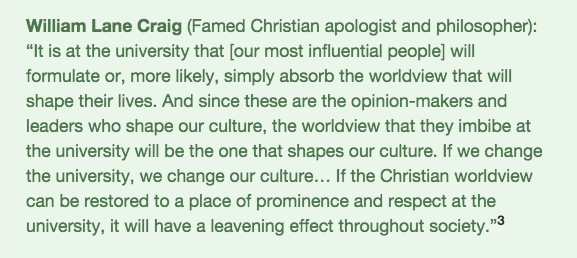
If serving God is your goal, look to the university

There is already a perfectly fine university right next door – no need to fly to Europe to find one! Remember, the university that took your faith away, or maybe the faith of someone you cared about? Yeah, it’s still sitting there in your home town! And it’s still ruining the lives of thousands of young people, by peer-pressuring them into secular, liberal views – and behaviors. It seems to me that it’s better stewardship to stay here and work, then give money to groups like Reasonable Faith. And you can start a blog, teach in church and invite scholars to the local university, too. That costs almost nothing, and it produces better results.

What about Jesus?

Sometimes, it’s a good idea to look beyond the words of the Bible and reflect on the overall message of it at a higher level. When I look in the Bible, I see that Jesus went through a lot of suffering in obedience to God in order to secure the salvation of people who did not even like him. And it’s from this sacrifice on our behalf that his claim on our obedience comes. There are things that I don’t like to do that I do anyway because they work to serve God. Jesus life’s ambition was not to do things that were easy, or that made him happy. Experienced Christians do things that are not fun, because these things are right and because they solve the real problem.

William Lane Craig on the unexpected applicability of mathematics to nature

Christianity and the progress of science

You might remember that Dr. Craig used a new argument in his debate with Lawrence Krauss in Melbourne, Australia.

My notes on the debate record it thus:

The unreasonable effectiveness of mathematics:

  • The underlying structure of nature is mathematical – mathematics is applicable to nature
  • Mathematical objects can either be abstract objects or useful fiction
  • Either way, there is no reason to expect that nature should be linked to abstract objects or fictions
  • But a divine mind that wants humans to understand nature is a better explanation for what we see

And now Dr. Craig has expanded on it in the Q&A section of his Reasonable Faith web site.

The question:

Dear Dr Craig

Firstly can I thank you for all your work. My faith in Christ has been enormously strengthened through studying your work in apologetics in particular and I have grown in confidence in my Christian witness.

My question relates to numbers and mathematics as a whole. On the Defenders podcast you state that as God is the only self-existent, necessary being, numbers and mathematical objects, whilst being useful, don’t actually exist as these too would exist necessarily and independently of God. If this is the case, how can it be that mathematics is so easily applied to the natural world? Surely if mathematics only existed in our minds, we would expect to see no correlation between it and how the physical world actually is?

Michael

United Kingdom

Excerpt from the answer:

As philosopher of mathematics Mary Leng points out, for the non-theistic realist, the fact that physical reality behaves in line with the dictates of acausal mathematical entities existing beyond space and time is “a happy coincidence” (Mathematics and Reality [Oxford: Oxford University Press, 2010], p. 239). Think about it: If, per impossibile, all the abstract objects in the mathematical realm were to disappear overnight, there would be no effect on the physical world. This is simply to reiterate that abstract objects are causally inert. The idea that realism somehow accounts for the applicability of mathematics “is actually very counterintuitive,” muses Mark Balaguer, a philosopher of mathematics. “The idea here is that in order to believe that the physical world has the nature that empirical science assigns to it, I have to believe that there are causally inert mathematical objects, existing outside of spacetime,” an idea which is inherently implausible (Platonism and Anti-Platonism in Mathematics [New York: Oxford University Press, 1998], p. 136).

By contrast, the theistic realist can argue that God has fashioned the world on the structure of the mathematical objects. This is essentially what Plato believed. The world has mathematical structure as a result.

This argument was also made by mechanical engineering professor Walter Bradley in a lecture he gave on scientific evidence for an intelligent designer. You can read an essay that covers some of the material in that lecture at Leadership University.

Excerpt:

The physical universe is surprising in the simple mathematical form it assumes. All the basic laws of physics and fundamental relationships can be described on one side of one sheet of paper because they are so few in number and so simple in form (see table 1.1).

[…]It has been widely recognized for some time that nature assumes a form that is elegantly described by a relatively small number of simple, mathematical relationships, as previously noted in table 1.1. None of the various proposals presented later in this chapter to explain the complexity of the universe address this issue. Albert Einstein in a letter to a friend expressed his amazement that the universe takes such a form (Einstein 1956), saying:

You find it strange that I consider the comprehensibility of the world to the degree that we may speak of such comprehensibility as a miracle or an eternal mystery. Well, a priori one should expect a chaotic world which cannot be in any way grasped through thought. . . . The kind of order created, for example, by Newton’s theory of gravity is of quite a different kind. Even if the axioms of the theory are posited by a human being, the success of such an enterprise presupposes an order in the objective world of a high degree which one has no a priori right to expect. That is the “miracle” which grows increasingly persuasive with the increasing development of knowledge.

Alexander Polykov (1986), one of the top physicists in Russia, commenting on the mathematical character of the universe, said: “We know that nature is described by the best of all possible mathematics because God created it.” Paul Davies, an astrophysicist from England, says, “The equations of physics have in them incredible simplicity, elegance and beauty. That in itself is sufficient to prove to me that there must be a God who is responsible for these laws and responsible for the universe” (Davies 1984). Successful development of a unified field theory in the future would only add to this remarkable situation, further reducing the number of equations required to describe nature, indicating even further unity and integration in the natural phenomena than have been observed to date.

The whole paper that started this off is called “The Unreasonable Effectiveness of Mathematics”, and it is a must read for advanced Christian defenders. You can read the whole thing here.

How to respond to an atheist who complains about slavery in the Bible

Lets take a closer look at a puzzle

I often hear atheists going on and on about how the Bible has this evil and that evil. Their favorite one seems to be slavery. Here are three things I say to atheists when they push this objection.

The Bible and slavery

First, you should explain to them what the Bible actually says about slavery. And then tell them about the person responsible for stopping slavery in the UK: a devout evangelical named William Wilberforce.

Here’s an article that works.

Excerpt:

We should compare Hebrew debt-servanthood (many translations render this “slavery”) more fairly to apprentice-like positions to pay off debts — much like the indentured servitude during America’s founding when people worked for approximately 7 years to pay off the debt for their passage to the New World. Then they became free.

In most cases, servanthood was more like a live-inemployee, temporarily embedded within the employer’s household. Even today, teams trade sports players to another team that has an owner, and these players belong to a franchise. This language hardly suggests slavery, but rather a formal contractual agreement to be fulfilled — like in the Old Testament.3

Second, inform them that moral values are not rationally grounded on atheism. In an accidental universe, there is no way we ought to be. There is no design for humans that we have to comply with. There are no objective human rights, like the right to liberty (that would block slavery) or the right to life (that would block  abortion). Although you may find that most atheists act nicely, the ones who really understand what atheism means and live it out consistently are not so nice.

Atheism and moral judgments

Second, inform them that moral values are not rationally grounded on atheism. In an accidental universe, there is no way we ought to be. There is no design for humans that we have to comply with. There are no objective human rights, like the right to liberty (that would block slavery) or the right to life (that would block  abortion). Although you may find that most atheists act nicely, the ones who really understand what atheism means and live it out consistently are not so nice.

Dawkins has previously written this:

The total amount of suffering per year in the natural world is beyond all decent contemplation. During the minute that it takes me to compose this sentence, thousands of animals are being eaten alive, many others are running for their lives, whimpering with fear, others are slowly being devoured from within by rasping parasites, thousands of all kinds are dying of starvation, thirst, and disease. It must be so. If there ever is a time of plenty, this very fact will automatically lead to an increase in the population until the natural state of starvation and misery is restored. In a universe of electrons and selfish genes, blind physical forces and genetic replication, some people are going to get hurt, other people are going to get lucky, and you won’t find any rhyme or reason in it, nor any justice. The universe that we observe has precisely the properties we should expect if there is, at bottom, no design, no purpose, no evil, no good, nothing but pitiless indifference.

(“God’s Utility Function,” Scientific American, November, 1995, p. 85)

When people like Dawkins talk about morality, you have to understand that they are pretending. To them, morality is just about personal preferences and cultural conventions. They just think that questions of right and wrong are arbitrary. Things that are wrong in one time and place are right in another. Every view is as right as any other, depending on the time and place. That’s atheist morality.

What’s worse than slavery? Abortion!

Third, you should ask the atheist what he has done to oppose abortion. Abortion is worse than slavery, so if they are sincere in thinking that slavery is wrong, then they ought to think that abortion is wrong even more. So ask them what they’ve done to oppose the practice of abortion. That will tell you how sincere they are about slavery.

Here’s Richard Dawkins explaining what he’s done to stop abortion:

That’s right. The head atheist supports killing born children.