
Tag Archives: Apologetics

Does archaeological evidence confirm names, dates and places in the Bible?

Sherlock Holmes and John Watson: let's take a look at the facts
Sherlock Holmes and John Watson: let’s take a look at the facts

I spotted this post on Be Thinking by UK apologist Peter S. Williams. (H/T Eric Chabot at Think Apologetics)

So let me pick the ones I liked most for this post.

Here’s a good one:

Jerusalem and The Pool of Bethesda

John 5:1-15 describes a pool in Jerusalem, near the Sheep Gate, called Bethesda, surrounded by five covered colonnades. Until the 19th century, there was no evidence outside of John for the existence of this pool and John’s unusual description “caused bible scholars to doubt the reliability of John’s account, but the pool was duly uncovered in the 1930s – with four colonnades around its edges and one across its middle.”[38] Ian Wilson reports: “Exhaustive excavations by Israeli archaeologist Professor Joachim Jeremias have brought to light precisely such a building, still including two huge, deep-cut cisterns, in the environs of Jerusalem’s Crusader Church of St Anne.”[39]

And this one:

Jerusalem and The Pool of Siloam

In the 400s AD, a church was built above a pool attached to Hezekiah’s water tunnel to commemorate the healing of a blind man reported in John 9:1-7. Until recently, this was considered to be the Pool of Siloam from the time of Christ. However, during sewerage works in June 2004 engineers stumbled upon a 1stcentury ritual pool when they uncovered some ancient steps during pipe maintenance near the mouth of Hezekiah’s tunnel. By the summer of 2005, archaeologists had revealed what was “without doubt the missing pool of Siloam.”[40] Mark D. Roberts reports that: “In the plaster of this pool were found coins that establish the date of the pool to the years before and after Jesus. There is little question that this is in fact the pool of Siloam, to which Jesus sent the blind man in John 9.”[41]

I just read this one because I am working my way through John. In case you haven’t read John, you really should it’s my favorite gospel.

Here’s another one:

Herod the Great

We have a bronze coin minted by Herod the Great. On the obverse side (i.e. the bottom) is a tripod and ceremonial bowl with the inscription ‘Herod king’ and the year the coin was struck, ‘year 3’ (of Herod’s reign), or 37 BC.

In 1996 Israeli Professor of Archaeology Ehud Netzer discovered in Masada a piece of broken pottery with an inscription, called an ostracon. This piece had Herod’s name on it and was part of an amphora used for transportation (probably wine), dated to c. 19 BC. The inscription is in Latin and reads, “Herod the Great King of the Jews (or Judea)”, the first such that mentions the full title of King Herod.

Herodium is a man-made mountain in the Judean wilderness rising over 2,475 feet above sea level. In 23 BC Herod the Great built a palace fortress here on top of a natural hill. Seven stories of living rooms, storage areas, cisterns, a bathhouse, and a courtyard filled with bushes and flowering plants were constructed. The whole complex was surrounded and partly buried by a sloping fill of earth and gravel. Herod’s tomb and sarcophagus were discovered at the base of Herodium by archaeologist Ehud Netzer in 2007.

And one more:

The ‘James, son of Joseph, brother of Jesus’ Ossuary

James, the brother of Jesus, was martyred in AD 62. A mid-1st century AD chalk ossuary discovered in 2002 bears the inscription “James, son of Joseph, brother of Jesus” ( ‘Ya’akov bar Yosef akhui di Yeshua’). Historian Paul L. Maier states thatthere is strong (though not absolutely conclusive) evidence that, yes, the ossuary and its inscription are not only authentic, but that the inscribed names are the New Testament personalities.[68] New Testament scholar Ben Witherington states that:“If, as seems probable, the ossuary found in the vicinity of Jerusalem and dated to about AD 63 is indeed the burial box of James, the brother of Jesus, this inscription is the most important extra-biblical evidence of its kind.”[69] According to Hershel Shanks, editor in chief of the Biblical Archaeological Review: “this box is [more] likely the ossuary of James, the brother of Jesus of Nazareth, than not. In my opinion … it is likely that this inscription does mention the James and Joseph and Jesus of the New Testament.”

And finally one short one:

Tiberius Caesar

The Denarius coin, 14-37 AD, is commonly referred to as the ‘Tribute Penny’ from the Bible. The coin shows a portrait of Tiberius Caesar. Craig L. Blomberg comments: “Jesus’ famous saying about giving to Caesar what was his and to God what his (Mark 12:17 and parallels) makes even more sense when one discovers that most of the Roman coins in use at the time had images of Caesar on them.”[48]

This is a good article to bookmark in case you are ever looking for a quick, searchable reference on archaeology and the Bible. There are many more examples in that post.

Now some people might be wondering why archaeology doesn’t confirm every detail in the New Testament. And here’s what J. Warner Wallace has to say about that:

But what are we to say to those who argue the Biblical archeological record is incomplete? The answer is best delivered by another expert witness in the field, Dr. Edwin Yamauchi, historian and Professor Emeritus at Miami University. Yamauchi wrote a book entitled, The Stones and the Scripture, where he rightly noted that archaeological evidence is a matter of “fractions”:

Only a fraction of the world’s archaeological evidence still survives in the ground.

Only a fraction of the possible archaeological sites have been discovered.

Only a fraction have been excavated, and those only partially.

Only a fraction of those partial excavations have been thoroughly examined and published.

Only a fraction of what has been examined and published has anything to do with the claims of the Bible!

See the problem? In spite of these limits, we still have a robust collection of archaeological evidences confirming the narratives of the New Testament (both in the gospel accounts and in the Book of Acts). We shouldn’t hesitate to use what we do know archaeologically in combination with other lines of evidence. Archaeology may not be able to tell us everything, but it can help us fill in the circumstantial case as we corroborate the gospel record.

I think you can form an opinion about the whole New Testament based on the record of confirmations. The verdict is in: the New Testament should be presumed trustworthy.
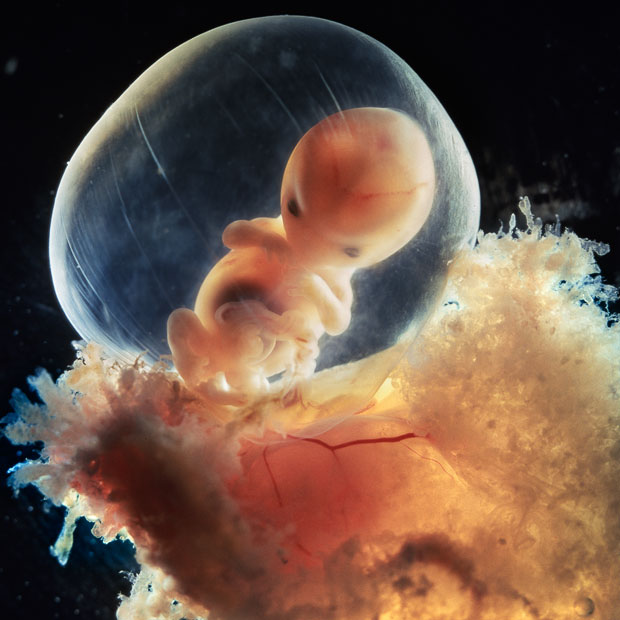

If unborn babies don’t have consciousness or don’t feel pain, may we kill them?

Unborn baby scheming about pro-life apologetics

Was having a conversation by e-mail yesterday with a pro-abortion atheist, and he gave two reasons why he supported abortion in the first and second trimester. First, he said that unborn babies can’t feel pain, so it’s OK to kill them. Second, he said that unborn babies don’t have consciousness, so it’s OK to kill them. I thought it might be useful to link to something that answers both of these objections.

Frank Beckwith is the author of “Defending Life: A Moral and Legal Case Against Abortion Choice“, which was published by Cambridge University Press, a top academic press. But before Cambridge University Press, Beckwith wrote four easy-to-understand essays for the Christian Research Journal. Part IV is the one that has the response to the two questions raised by my atheist friend.

Part I. The Appeal to Pity

Part II. Arguments from Pity, Tolerance, and Ad Hominem

Part III. Is The Unborn Human Less Than Human?

Part IV. When Does a Human Become a Person?

Excerpt:

Some ethicists argue that the unborn becomes fully human sometime after brain development has begun, when it becomes sentient: capable of experiencing sensations such as pain. The reason for choosing sentience as the criterion is that a being that cannot experience anything (i.e., a presentient unborn entity) cannot be harmed. Of course, if this position is correct, then the unborn becomes fully human probably during the second trimester and at least by the third trimester. Therefore, one does not violate anyone’s rights when one aborts a nonsentient unborn entity. [13]

There are several problems with this argument. First, it confuses harm with hurt and the experience of harm with the reality of harm. [14] One can be harmed without experiencing the hurt that sometimes follows from that harm, and which we often mistake for the harm itself. For example, a temporarily comatose person who is suffocated to death “experiences no harm,” but he is nevertheless harmed. Hence, one does not have to experience harm, which is sometimes manifested in hurt, in order to be truly harmed.

Second, if sentience is the criterion of full humanness, then the reversibly comatose, the momentarily unconscious, and the sleeping would all have to be declared nonpersons. Like the presentient unborn, these individuals are all at the moment nonsentient though they have the natural inherent capacity to be sentient. Yet to countenance their executions would be morally reprehensible. Therefore, one cannot countenance the execution of some unborn entities simply because they are not currently sentient.

Someone may reply that while these objections make important points, there is a problem of false analogy in the second objection: the reversibly comatose, the momentarily unconscious, and the sleeping once functioned as sentient beings, though they are now in a temporary state of nonsentience. The presentient unborn, on the other hand, were never sentient. Hence, one is fully human if one was sentient “in the past” and will probably become sentient again in the future, but this cannot be said of the presentient unborn.

There are at least three problems with this response. First, to claim that a person can be sentient, become nonsentient, and then return to sentience is to assume there is some underlying personal unity to this individual that enables us to say that the person who has returned to sentience is the same person who was sentient prior to becoming nonsentient. But this would mean that sentience is not a necessary condition for personhood. (Neither is it a sufficient condition, for that matter, since nonhuman animals are sentient.) Consequently, it does not make sense to say that a person comes into existence when sentience arises, but it does make sense to say that a fully human entity is a person who has the natural inherent capacity to give rise to sentience. A presentient unborn human entity does have this capacity. Therefore, an ordinary unborn human entity is a person, and hence, fully human.

Second, Ray points out that this attempt to exclude many of the unborn from the class of the fully human is “ad hoc and counterintuitive.” He asks us to “consider the treatment of comatose patients. We would not discriminate against one merely for rarely or never having been sentient in the past while another otherwise comparable patient had been sentient….In such cases, potential counts for everything.” [15]

Third, why should sentience “in the past” be the decisive factor in deciding whether an entity is fully human when the presentient human being “is one with a natural, inherent capacity for performing personal acts?” [16] Since we have already seen that one does not have to experience harm in order to be harmed, it seems more consistent with our moral sensibilities to assert that what makes it wrong to kill the reversibly comatose, the sleeping, the momentarily unconscious, and the presentient unborn is that they all possess the natural inherent capacity to perform personal acts. And what makes it morally right to kill plants and to pull the plug on the respirator-dependent brain dead, who were sentient “in the past,” is that their deaths cannot deprive them of their natural inherent capacity to function as persons, since they do not possess such a capacity.

These four essays are a very good introduction to common responses to pro-abortion arguments. I recommend that people get familiar with this, as once you look into it, you will see that the abortion issue can be debated with as much confidence as William Lane Craig defends Christian theism. You will have the same access to scientific evidence and rational arguments on this topic, and so you will have the upper hand. And that’s fun.

The best introductory book on the abortion / right to life issue is “The Case for Life” by pro-life debater Scott Klusendorf. The best comprehensive book is a tie between “The Ethics of Abortion” by Christopher Kaczor, and Frank Beckwith’s “Defending Life: A Moral and Legal Case Against Abortion Choice“.

Don’t dismiss best practices for Christian living as “legalism” and “denying grace”

Telling a woman how to make wise decisions protects her

On Sunday, I listened to a very interesting discussion between Sean McDowell and Jessica van der Wyngaard on Justin Brierley’s Unbelievable show. The topic was on the pros and cons of purity culture. I didn’t know a thing about “purity culture”, and had never read any books about it. I didn’t really disagree with anyone on the podcast, but I did want to say something about it in a blog post.

Description:

20 years ago Joshua Harris was the poster boy of the evangelical ‘purity movement’ having authored the bestselling book ‘I Kissed Dating Goodbye’. Today, Harris regrets writing the book, and has also recently changed his mind about Christianity.

Justin is joined by Jessica van der Wyngaard, director of the documentary film ‘I Survived I Kissed Dating Goodbye’, and Christian apologist Sean McDowell, to discuss purity culture, singleness and the Joshua Harris story.

The MP3 file is here.

First, here’s a brief summary of what everyone said on the podcast:

  • JW: the book urged people to give up dating in favor of courting and suggested other rules that would guarantee a successful marriage to your soul-mate
  • JW: some of the rules proposed by the book were not Biblical
  • JW: I’m not a virgin and I’m in early-30s, but I accept that we should teach what the Bible says about abstinence
  • SM: purity culture is the idea that if you remain sexually pure, God will give you a spouse and bless you in the future
  • SM: purity culture is the idea that if you have premarital sex, you will be tainted forever
  • SM: I’m afraid that those reacting against purity culture will build a sexual ethic solely based on their shame, their hurt, their concern about legalism, and this will not help the next generation
  • SM: let’s have a balanced Biblical approach to sexuality instead
  • SM: there is scientific data to back up the Bible’s teaching that marriages work better when sex occurs only within a marriage
  • SM: it’s a mistake to define your spiritual standing based on whether you are a virgin or not
  • SM: following the Bible’s rules for sexuality is an important part of discipleship
  • SM: the Bible is replete with examples of people restoring their standing before God through forgiveness and redemption

Right now, we are living in a secular culture where people are hooking up, having premarital sex, living together, and breaking up far more often than in the past. There is this pattern of choosing partners based on secular criteria: outward appearance and ability to entertain. And this approach to dating – choosing people for the wrong reasons, and trying to force a commitment using premarital sex – is now common practice, even among Christians.

I think people should have a plan to counter this trend that’s realistic and guided by studies and evidence. For example, studies show that people who have no sexual partners before marriage are more likely to still be married 10 years later. Studies show that cohabitation negatively impacts the stability of a future marriage. It’s difficult to accept that this is the way the world is, but if a stable marriage is a goal for you, then you should care about the best practices for having a stable marriage.

Take a different example. Suppose you have a lot of shame and bad feelings over having run up $90,000 of student loans. Now your retirement will be much more difficult. The answer to these feelings of shame is not to say that you can invoke “grace” and that will make everything OK. It won’t. It might help you to make better decisions going forward, but that debt is going to affect your future spouse, your future marriage and your future children.

There are real costs to these behaviors for your future, and being forgiven through Jesus’ atonement isn’t going to instantly make the effects of those choices disappear. It’s good to warn young people about these costs. It’s also good to help people who have made mistakes undo the damage by investing in them. I don’t want us to throw out evidence-based best practices as “legalism”, because they help us to reach the discipleship goals specified for us in the Bible.

The goals of the Bible (e.g. – not aborting, not divorcing) are good goals. If we find out from science that premarital promiscuity or cohabitation reduce our odds of achieving that goal, then it’s a mistake to dismiss that evidence because it make us feel bad about our past. It’s not legalism to investigate evidence and consult wise advisors in order to choose how best to achieve goals like marriage. That’s actually being wise.  Making good decisions doesn’t give you the right to be proud and compare yourself to others, but it is good to make good decisions for yourself, and to share your reasoning with those who ask you.

I agree with the speakers that purity culture is wrong to promise people a happy marriage if they only keep their virginity. That’s just the prosperity gospel, and it really is not a Biblical view of the Christian life.

People who choose to have premarital sex haven’t separated themselves from marriage. But studies indicate that they have damaged the stability of their future marriage if they do nothing to counteract the effects of their choices. And I think there is more to counteracting these bad effects than just stating to your partner “Jesus forgives me, so you can’t judge me”. The focus of the “no-rules because I feel ashamed” crowd doesn’t seem to be on taking the damage seriously and fixing it. Their focus seems to be on not being judged.

I don’t think that a cursory response (“don’t judge me!”) is adequate to undo the damage from premarital sex. But if a person is willing to be honest about their past, and put in the work to understand the effects of premarital sex on their future marriage, renew their minds, and re-establishing their bonding ability, then they should be able to fully counteract the damage. I have met people who have done this, and you can see in their choices and lifestyle that there’s been a complete turning against their former use of sex for fun and attention and self-esteem. It’s not “idolizing virginity and idolizing marriage” to look at the data, and make choices that are likely to lead to a stable marriage.