Tag Archives: Apologetics

Video: William Lane Craig and Peter Millican debate “Does God Exist?”

From Justin Brierley and the Reasonable Faith UK Tour:

The debate was held at the University of Birmingham, England in 2011. I would put this debate in the top 3 Craig debates ever, along with his debates against Austin Dacey and Walter Sinnott-Armstrong.

My summary of the Craig-Millican is below. This debate is really meant for advanced students, but if you read my post “What you need to know about the BVG Theorem” before watching the debate, it should help you to follow along.

Dr. Craig’s opening speech:

There are good reasons to believe that God exists.

There are no good reasons to believe that God does not exist.

A1) The origin of the universe

  1. The universe began to exist
  2. If the universe began to exist, then the universe has a transcendent cause.
  3. The universe has a transcendent cause.

The origin of the universe is confirmed by philosophical arguments and scientific evidence.

There cannot be an actual infinite number of past events, because mathematical operations like subtraction and division cannot be applied to actual infinities.

The Borde-Guth-Vilenkin (BGV) proof shows that every universe that expands must have a space-time boundary in the past. That means that no expanding universe, no matter what the model, cannot be eternal into the past.

Even speculative alternative cosmologies do not escape the need for a beginning.

The cause of the universe must be transcendent and supernatural. It must be uncaused, because there cannot be an infinite regress of causes. It must be eternal, because it created time. It must be non-physical, because it created space. There are only two possibilities for such a cause. It could be an abstract object or an agent. Abstract objects cannot cause effects. Therefore, the cause is an agent.

A2) The fine-tuning of the universe

  1. The fine-tuning of the universe is either due to law, chance or design.
  2. It is not due to law or chance.
  3. Therefore, it is due to design.

The progress of science has revealed that the Big Bang was fine-tuned to allow for the existence of intelligent life.

Type 1: Constants like the gravitational constant are finely-tuned, and are not dependent on the laws of physics.

Type 2: Quantities like the amount of entropy in the universe, are not dependent on the laws of physics.

The range of life-permitting values is incredibly small compared to the possible values of the constants and quantities. (Like having a lottery with a million black balls and one white ball, and you pick the white ball. Even though each individual ball has the same tiny chance of being picked, but the odds are overwhelming that the whichever ball you pick will be black, and not white).

Not only are the numbers not due to laws, but they are not due to chance either. It’s not just that the settings are unlikely, it’s that they are unlikely and they conform to an independent pattern – namely, the ability to support complex life.

A3) The moral argument

  1. If God does not exist, then objective moral values do not exist.
  2. Objective morality does exist.
  3. Therefore, God exists.

Objective moral values are values that exist independently of whether any humans believe them or not.

Michael Ruse, an atheist philosopher agrees that if God does not exist, then there is only a “herd morality” that is determined by biological evolution and social evolution. There no objective moral standard, just different customs and conventions that vary by time and place. Anyone who acts against the herd morality is merely being unfashionable and unconventional. On the atheistic view, there is nothing objective and binding about this evolved “herd morality”. However, people do experience objective moral values, and these cannot be grounded on atheism.

Furthermore, God must exist in order to argue that there is evil in the world. In order to be able to make a distinction between good and evil that is objective, there has to be a God to determine a standard of good and evil that is binding regardless of the varying customs and conventions of different people groups. Even when a person argues against God’s existence by pointing to the “evil” in the world, they must assume objective moral values, and a God who grounds those objective moral values.

A4) The resurrection of Jesus.

  1. There are certain minimal facts that are admitted by the majority of historians, across the ideological spectrum: the empty tomb, the appearances and the early belief in the resurrection.
  2. Naturalistic attempts to explain these minimal facts fail.
  3. The best explanation of these facts is that Jesus rose from the dead.

A5) Religious experience

People can know that God exists through experience. In the absence of defeaters for these experiences, these experiences constitute evidence for God’s existence.

Dr. Millican’s opening speech:

Dr. Craig has the burden of proof because he claims that God exists.

The Christian God hypothesis:

  1. An omnipotent, omniscient, omnibenevolent God created the universe.
  2. This God cares about humans.
  3. This God has acted in history though the life of Jesus of Nazareth.

This is a factual claim, and we are discussing the evidence for whether these claims are true or false. We are not interested in religious practice, or the consolation of religious belief, nor any other religions.

A1) Religious pluralism and epistemology

Human beings are purpose-finding creatures – we are prone to prefer explanations that involve purpose.

Human beings are pattern-finding animals – we tend to find designs in states of affairs.

Human beings have an interest in maintaining religious hierarchies because of the power it gives them.

Religious beliefs are not determined by rational considerations, but are determined by geographic location.

The same non-scientific method of generating religious beliefs (purpose-finding, pattern-finding, geographic location, parental teaching, charismatic speakers, praise songs and worship, religious education, ancient holy books) is being used in several religions, and it leads to different, contradictory truth claims. So at least some of those conflicting claims are false. And if the method is generating some false claims, then it’s not a good method, and it undermines all the religions that use those methods.

A2) Absence of evidence is evidence of absence

There is no scientific evidence for God.

A3) Mental processes depend on physical systems

There is no scientific evidence for a disembodied intelligence.

Our universal human experience is that intelligence and mental operations require a physical brain.

The quality of our thinking depends on physical conditions, like being tired or on drugs.

But Christian theists believe that mental processes can exist independently of an underlying physical reality, unimpaired by the death of the physical body and the brain.

R.A1) The origin of the universe

1. There is no evidence that whatever begins to exist requires a cause. All the evidence we have of things beginning to exist are when something is created from rearrangements of other things that already existed.

The closest analog we have to something coming into being from nothing is quantum particles coming into being from nothing, and that causation is random.

There is no evidence that thoughts can bring about physical effects, and Bill is arguing for a mental cause to the origin of the universe.

Even if things that begin to exist IN the universe have causes, it doesn’t hold for the universe as a whole. Bill is committing the fallacy of composition.

Time begins with the universe, but our experience of causation is that it is a temporal process. So if there is no time “prior to” the universe’s beginning, then how can there be a cause to the universe?

It’s possible that there could be something outside our universe that is eternal.

It’s also possible that the Big Bang could be wrong, and this universe could oscillate eternally and not require a beginning.

2. There are cosmological theories that avoid the beginning of the universe by positing a prior period of contraction prior to the Big Bang.

The beginning of this universe depends on general relativity, and that theory breaks down at the level of quantum mechanics.

3. There is no evidence that minds can exist without an underlying physical system. So even if there is a cause of the universe, then it is neither an abstract object nor a mind. It would have to be something else, and not something we are familiar with – we are just not in a position to speculate of what it could be.

R.A3) The moral argument

Atheists do believe in a standard of morality that is not based on what groups of humans believe.

Utilitarians think there is a standard of moral values that is objective, because the measure of human happiness (for the greatest number) is objective, even if people are mistaken about what promotes that happiness.

Kantians have a rational process for determining which moral imperatives should be universalized.

Humeans have a system that is rooted in natural human sentiment.

Dr. Craig’s first rebuttal:

I do not have the only burden of proof. The topic is “Does God Exist?”. If Dr. Millican answers “no” then he has a burden of proof, otherwise we are left with agnosticism.

R.A1) Religious pluralism and epistemology

First, there is no single common method of adopting a religion.

Second, MY method this evening is logic and evidence and personal experience – which is the same as his method. So his comments about how people in different religions adopt their religion through parents, church, singing, etc. have no bearing on the arguments I will be making.

R.A2) Absence of evidence is evidence of absence

Absence of evidence is only evidence of absence if we can reasonably expect that there should be some evidence that is not present. He would have to show that there should be more evidence for God’s existence that the 5 arguments that I already presented – something that we should expect to see that we don’t see.

R.A3) Mental processes depend on physical systems

No response by Dr. Craig. (but see below)

A1) The origin of the universe

1. He says that there are speculative cosmologies like the multiverse that escape the need for a beginning, but that’s false, the BGV proof applies to them, and they do need a beginning.

He says that you can escape BGV by positing a contraction prior to the expansion. However Vilenkin says that any contraction phase is unstable and would introduce additional singularities that would hamper any later expansion phase.

He  says that we need a theory of quantum gravity in order to describe the early universe. But Vilenkin says that the BGV proof is independent of gravity as defined by general relativity.

He did not respond to the philosophical arguments for a beginning of the universe.

2. He says that we don’t have experience of things coming into being except from material causes. However, it would be even more difficult to explain the universe coming into being on atheism since you can’t appeal to a material cause nor to an efficient cause. Even Hume recognizes that things can’t pop into being without causes.

He talks about how in quantum physics virtual particles appear out of nothing. But that’s false, because the quantum vacuum in which virtual particles appear is not nothing, it is a sea of subatomic particles and energy. Quantum physics is not an exception to the idea that things that come into being require a cause.

He mentions the fallacy of composition. But I am not saying that everything in the universe has a cause, therefore the universe as a whole has a cause. I am saying that non-being has no capacity to bring something into being. Non-Being doesn’t even have the potential to bring something into being.

3. He says that there are no unembodied minds, so the cause of the universe can’t be an unembodied mind. But the argument concludes that there is a non-material cause, and it can’t be an abstract object, so it would have to be a mind.

In addition, we ourselves are unembodied minds.  This is because physical objects cannot have the properties that minds have, like the property of having feelings.

Material conceptions of mind don’t explain identity over time.

Material conceptions of mind don’t explain free will.

Material conceptions of mind don’t explain intentional states (thinking about something).

Material conceptions of mind don’t explain mental causation.

The best explanation for our own first person experience of the mental realm is a substance dualism. We are non-material minds, and we can cause effects in the physical world. And God does the same thing. He is a mind, and he causes physical effects.

A2) He gave no response.

A3) He says that there are atheistic theories of morality that don’t depend on the opinions of groups. But these theories all depend on the idea that human beings have instrinsic value – that they are the sorts of things to which moral considerations apply. Naturalism cannot ground this moral value – human beings are no more valuable any other animal.

Also, there are no objective moral obligations in naturalist systems of morality, because there is no one in authority to command them. Moral prescriptions require moral prescribers.

A4) He gave no response.

A5) He gave no response.

Dr. Millican’s first rebuttal:

R.A2) The fine-tuning argument

We have to be careful not to judge what counts as finely-tuned through our intuitions.

We have to be careful about reasoning for a sample size of this one observable universe.

We don’t really know about the full range of possibilities for these constants and quantities.

There might be other universes that we can’t observe that aren’t fine-tuned, and we just happen to be in the one that is fine-tuned.

The fine-tuning might be solved by future discoveries, like the inflationary cosmology removed some of the fine-tuning.

There might be a multiverse that we don’t have evidence for right now.

We need to be careful about using science to prove God because science might change in the future.

The universe is very big and mysterious.

This argument doesn’t prove that God is good. He could be evil = anti-God.

God created the universe inefficiently if his goal was to produce life.

God created the universe too big.

God created the universe too old.

God created too many galaxies and stars that are not hospitable to life.

If the universe were fine-tuned for life, then there should be more aliens.

If the universe were fine-tuned for life, then there are probably lots of alien civilizations. But then Jesus would have to appear to all of the aliens too.

R.A1) The origin of the universe

2. It’s not a big deal that you can get multiple solutions to equations involving subtraction of actual infinities. For example, the equation 0 x y = 0 has many solutions for y, but that doesn’t mean that multiplication doesn’t work in the real world.

A2) Absence of evidence is evidence of absence

I would expect that there would be more evidence than there is.

R.A1) The origin of the universe

2. The BVG proof might be overturned by future scientific discoveries. We have no reason to be confident in current physics.

I agree that the quantum vacuum is something and not nothing, but it’s similar to nothing.

We don’t have any reason to believe that things that come into being require causes – except for our universal experience that this is always the case.

3. As to the cause of the universe coming into being, you said that it could only be an abstract object or a mind, and it can’t be an abstract object because they don’t cause effects, so it must be a mind. But there are all sorts of things we’ve never thought of that it could be other than a mind.

I agree that mental properties are not physical properties and that epiphenomenalism is incorrect. Physical objects can have “algorithmic properties” as well as physical properties, it doesn’t mean that computers have minds.

Dr. Craig’s second rebuttal:

R.A2) Absence of evidence is evidence of absence

He expressed his personal opinion that there should be more evidence, but that’s not an argument.

God knows how people will respond to getting more evidence or less evidence and he has to be careful not to take away their free will to disbelieve by piling them up with coercive evidence. God’s goal is not just to convince people that he exists. God’s goal is to have people respond to him and pursue him.

A1) The origin of the universe

2. He said that multiple answers to equations are no problem. But the problem is that you can’t translate multiple answers into a real world context.

The problem is that you are subtracting an identical number from an identical number and getting contradictory results, and that cannot be translated into the real world, where subtraction always gives a definite single result.

He talks about how you can get multiple answers with multiplication by 0. But 0 is not a real quantity, it is just the absence of something, and that cannot translate into the real world, because it has no being.

He says that I am only using evidence from current physics. But that is the point – the evidence of current physics and cosmology supports the beginning of the universe.

3. He said that an umembodied mind can’t be the cause, but we are minds and we cause effects on our physical bodies.

In addition, the design argument supports the idea that the cause of the universe is intelligent.

A2) The fine-tuning of the universe

He says we should be cautious. Of course.

He says the probabilities can’t be assessed. But you can just take the current value and perturb it and see that the resulting universe loses its ability to support life, and you can test an entire range around the current value to see that that vast majority of values in the range don’t permit life.

He says that the current physics is not well-established, but there are so many examples of fine-tuning across so many different areas of science that it is not likely that all of them will be overturned, and the number of finely-tuned constants and quantities has been growing, not shrinking.

He says it doesn’t prove that God is good, and he’s right – that’s what the moral argument is for.

He says that God isn’t efficient enough, but efficiency is only important for those who have limited time and/or limited resources. But God has unlimited time and resources.

He says that the universe is too old, but the large age of the universe is a requirement to support intelligent life – (i.e. – you need third generation stars to provide a stable source of energy to planets, and those stars require that two generations of stars are born and die).

He said what about aliens, and theists are open to that, and God can certainly provide for the salvation of those beings, if they have fallen into sin.

Dr. Millican’s second rebuttal:

R.A1) The origin of the universe

3. Just because epiphenominalism is false, it doesn’t mean that substance dualism is true.

The majority of philosophers of mind do not accept substance dualism.

R.A3) The moral argument

The majority of philosophers are moral realists, but a minority of philosophers are theists. So that means that there must be some way of justifying morality on atheism, which I will not describe right now.

Atheists can express their opinion that humans have intrinsic moral value.

He grants that atheists can perceive moral values. But if atheists can perceive moral values, then why is God needed to enable that?

Atheists can express their opinion that humans are special. We can be rational, and that makes us special.

Atheists can express their opinion that it is good to care about other humans because they are of the same species.

R.A4) The resurrection of Jesus

We don’t have any reasons to believe i the supernatural.

The gospels are written late for the purposes of evangelism.

The gospels are not independent, e.g. Matthew and Luke depend on Q.

John is the latest gospel, and the Christology of John is the highest of all.

The four gospels agree because the early church rejected other (unnamed) gospels that didn’t agree.

Matthew 27 – the earthquake and the raised saints – is not recorded in any other contemporary non-Christian source.

Dr. Craig’s final rebuttal:

A3) The moral argument

He says that human beings are rational, and that gives them value. But atheists like Sam Harris prefer the flourishing of sentient life. He includes non-rational animals as having moral value. So without God, we see that the choice of who or what has moral value is arbitrary. And where would objective moral duties come from if there is no moral lawgiver?

The fact that most atheists accept objective moral values doesn’t mean that they can rationally ground those values on their atheistic worldview. You can’t provide a basis for moral values on atheism by counting the number of atheists who accept objective morality. It’s not surprising that atheists can perceive objective moral values IF they are living in auniverse created by God who grounds these objective moral values and duties that atheists perceive.

A4) The resurrection of Jesus

He cites Geza Vermes and Bart Ehrman as authorities on the historical Jesus, but both of them accept all three of the facts that I presented as minimal facts. Ehrman doesn’t accept the resurrection of Jesus because he presupposes naturalism. He rejects the resurrection on philosophical grounds, not historical grounds.

Dr. Millican’s final rebuttal:

R.A5) Religious experience

Religious experience is an unreliable way to test the claims of a religion, because lots of religions have them and they make contradictory truth claims. In the future, we may discover naturalistic ways of explaining religious experience.

R.A4) The resurrection of Jesus

Even if you can make a case for the resurrection based on these3  minimal facts, there are other stories in the New Testament like Matthew 27 that are quite weird and they undermine the 3 minimal facts that even Geza Vermes and Bart Ehrman accept.

R.A1) The origin of the universe

Bill hasn’t shown that there is any reason for thinking that things don’t come into being, uncaused, out of nothing.

A4) The problem of evil

Theists can’t explain what God’s specific morally sufficient reasons are for permitting the apparently gratuitous evil that we see.
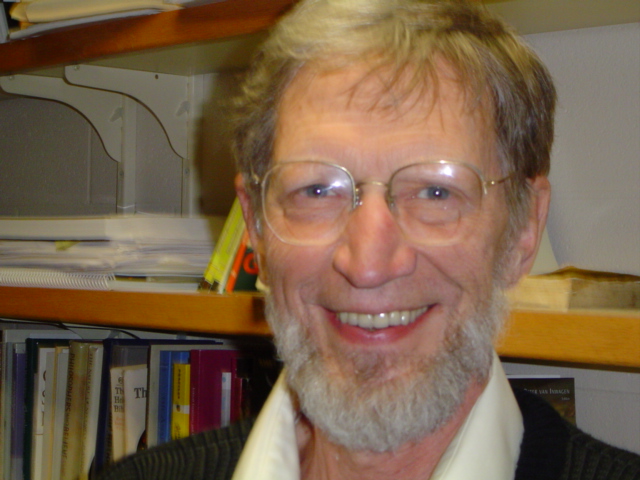

New York Times profiles philosopher Alvin Plantinga and discusses his new book

Christian philosopher Alvin Plantinga

Alvin Plantinga is widely regarded as the top Christian philosopher in the world, and a former head of the largest professional association of philosophers – the American Philosophical Association (APA).

 Mary sent me this article from the New York Times about Alvin Plantinga and his new book, published by Oxford University Press – the top academic press in the world.

Excerpt:

From Calvin [College], and later from the University of Notre Dame, Mr. Plantinga has led a movement of unapologetically Christian philosophers who, if they haven’t succeeded in persuading their still overwhelmingly unbelieving colleagues, have at least made theism philosophically respectable.

“There are vastly more Christian philosophers and vastly more visible or assertive Christian philosophy now than when I left graduate school,” Mr. Plantinga said in a recent telephone interview from his home in Grand Rapids, adding, with characteristic modesty, “I have no idea how it happened.”

Mr. Plantinga retired from full-time teaching last year, with more than a dozen books and a past presidency of the American Philosophical Association to his name. But he’s hardly resting on those laurels. Having made philosophy safe for theism, he’s now turning to a harder task: making theism safe for science.

For too long, Mr. Plantinga contends in a new book, theists have been on the defensive, merely rebutting the charge that their beliefs are irrational. It’s time for believers in the old-fashioned creator God of the Bible to go on the offensive, he argues, and he has some sports metaphors at the ready. (Not for nothing did he spend two decades at Notre Dame.)

In “Where the Conflict Really Lies: Science, Religion and Naturalism,” published last week by Oxford University Press, he unleashes a blitz of densely reasoned argument against “the touchdown twins of current academic atheism,” the zoologist Richard Dawkins and the philosopher Daniel C. Dennett, spiced up with some trash talk of his own.

[…] Longtime readers of Mr. Plantinga, who was raised as a Presbyterian and who embraced the Calvinism of the Christian Reformed Church as a young man, are used to such invocations of theological concepts. And even philosophers who reject his theism say his arguments for the basic rationality of belief, laid out in books like “Warranted Christian Belief” and “God and Other Minds,” constitute an important contribution that every student of epistemology would be expected to know.

But Mr. Plantinga’s steadfast defense of the biochemist and intelligent-design advocate Michael Behe, the subject of a long chapter in the new book, is apparently another matter.

“I think deep down inside he really isn’t a friend of science,” Michael Ruse, a philosopher of science at Florida State University, said of Mr. Plantinga. “I’m not objecting to him wanting to defend theism. But I think he gets his victory at the level of gelding or significantly altering modern science in unacceptable ways.”

Mr. Dennett was even harsher, calling Mr. Plantinga “Exhibit A of how religious beliefs can damage or hinder or disable a philosopher,” not to mention a poor student of biology. Evolution is a random, unguided process, he said, and Mr. Plantinga’s effort to leave room for divine intervention is simply wishful thinking.

“It’s just become more and more transparent that he’s an apologist more than a serious, straight-ahead philosopher,” Mr. Dennett said.

When Mr. Plantinga and Mr. Dennett (who said he has not read Mr. Plantinga’s new book) faced off over these questions before a standing-room-only crowd at a 2009 meeting of the American Philosophical Association, the event prompted ardent online debate over who had landed better punches, or simply been more condescending. (A transcript of the proceedings was published last year as “Science and Religion: Are They Compatible?”)

Mr. Plantinga, who recalled the event as “polite but not cordial,” allowed that he didn’t think much of Mr. Dennett’s line of reasoning. “He didn’t want to argue,” Mr. Plantinga said. “It was more like he wanted to make assertions and tell stories.”

Would you like to know how well Daniel Dennett can debate the naturalism/theism dispute? First of all, Plantinga has debated Dennett, and you can find the audio for it at Apologetics 315.

William Lane Craig also presented several arguments against naturalism to Daniel Dennett in 2007, and Dennett responded by calling it a “first-rate piece of philosophical reasoning”. I link to the exchange and complain about Dennett’s weak response to Craig’s arguments in a previous post.

You may also find this recent interview with Alvin Plantinga, conducted by Brian Auten, informative.

The resurgence of Christian theism in analytical philosophy

Now let’s move from the specific to the aggregate. What is going on with these Christian philosophers?

Well, you can read an excellent article about the resurgence of Christian theism in philosophy departments in the peer-reviewed philosophy journal Philo, which, in my opinion, is the best journal for atheists and agnostic philosophers. The article is authored by the well-known atheist Quentin Smith.

He writes:

THE DESECULARIZATION OF ACADEMIA THAT EVOLVED IN PHILOSOPHY DEPARTMENTS SINCE THE LATE 1960s

By the second half of the twentieth century, universities and colleges had been become in the main secularized. The standard (if not exceptionless) position in each field, from physics to psychology, assumed or involved arguments for a naturalist world-view; departments of theology or religion aimed to understand the meaning and origins of religious writings, not to develop arguments against naturalism. Analytic philosophers (in the mainstream of analytic philosophy) treated theism as an antirealist or non-cognitivist world-view, requiring the reality, not of a deity, but merely of emotive expressions or certain “forms of life” (of course there were a few exceptions, e.g., Ewing, Ross, Hartshorne, etc., but I am discussing the mainstream view).

[…]The secularization of mainstream academia began to quickly unravel upon the publication of Plantinga’s influential book on realist theism, God and Other Minds, in 1967. It became apparent to the philosophical profession that this book displayed that realist theists were not outmatched by naturalists in terms of the most valued standards of analytic philosophy: conceptual precision, rigor of argumentation, technical erudition, and an in-depth defense of an original world-view. This book, followed seven years later by Plantinga’s even more impressive book, The Nature of Necessity, made it manifest that a realist theist was writing at the highest qualitative level of analytic philosophy, on the same playing field as Carnap, Russell, Moore, Grünbaum, and other naturalists. Realist theists, whom hitherto had segregated their academic lives from their private lives, increasingly came to believe (and came to be increasingly accepted or respected for believing) that arguing for realist theism in scholarly publications could no longer be justifiably regarded as engaging in an “academically unrespectable” scholarly pursuit.

Naturalists passively watched as realist versions of theism, most influenced by Plantinga’s writings, began to sweep through the philosophical community, until today perhaps one-quarter or one-third of philosophy professors are theists, with most being orthodox Christians. Although many theists do not work in the area of the philosophy of religion, so many of them do work in this area that there are now over five philosophy journals devoted to theism or the philosophy of religion, such as Faith and Philosophy, Religious Studies, International Journal of the Philosophy of Religion, Sophia, Philosophia Christi, etc. Philosophia Christi began in the late 1990s and already is overflowing with submissions from leading philosophers. Can you imagine a sizeable portion of the articles in contemporary physics journals suddenly presenting arguments that space and time are God’s sensorium (Newton’s view) or biology journals becoming filled with theories defending élan vital or a guiding intelligence? Of course, some professors in these other, non-philosophical, fields are theists; for example, a recent study indicated that seven percent of the top scientists are theists.1 However, theists in other fields tend to compartmentalize their theistic beliefs from their scholarly work; they rarely assume and never argue for theism in their scholarly work. If they did, they would be committing academic suicide or, more exactly, their articles would quickly be rejected, requiring them to write secular articles if they wanted to be published. If a scientist did argue for theism in professional academic journals, such as Michael Behe in biology, the arguments are not published in scholarly journals in his field (e.g., biology), but in philosophy journals (e.g., Philosophy of Science and Philo, in Behe’s case). But in philosophy, it became, almost overnight, “academically respectable” to argue for theism, making philosophy a favored field of entry for the most intelligent and talented theists entering academia today. A count would show that in Oxford University Press’ 2000–2001 catalogue, there are 96 recently published books on the philosophy of religion (94 advancing theism and 2 presenting “both sides”). By contrast, there are 28 books in this catalogue on the philosophy of language, 23 on epistemology (including religious epistemology, such as Plantinga’s Warranted Christian Belief), 14 on metaphysics, 61 books on the philosophy of mind, and 51 books on the philosophy of science.

And how have naturalist philosophers reacted to what some committed naturalists might consider as “the embarrassment” of belonging to the only academic field that has allowed itself to lose the secularization it once had? Some naturalists wish to leave the field, considering themselves as no longer doing “philosophy of mind,” for example, but instead “cognitive science.” But the great majority of naturalist philosophers react by publicly ignoring the increasing desecularizing of philosophy (while privately disparaging theism, without really knowing anything about contemporary analytic philosophy of religion) and proceeding to work in their own area of specialization as if theism, the view of approximately one-quarter or one-third of their field, did not exist. (The numbers “one-quarter” and “one-third” are not the result of any poll, but rather are the exceptionless, educated guesses of every atheist and theist philosophy professor I have asked [the answers varied between “one-quarter” and “one-third”]). Quickly, naturalists found themselves a mere bare majority, with many of the leading thinkers in the various disciplines of philosophy, ranging from philosophy of science (e.g., Van Fraassen) to epistemology (e.g., Moser), being theists. The predicament of naturalist philosophers is not just due to the influx of talented theists, but is due to the lack of counter-activity of naturalist philosophers themselves. God is not “dead” in academia; he returned to life in the late 1960s and is now alive and well in his last academic stronghold, philosophy departments.

Quentin Smith is a good friend of William Lane Craig, who is a philosopher/theologian and the top Christian defender in the world, and probably of all time. Smith is the co-author, with William Lane Craig, of the book “Theism, Atheism, and Big Bang Cosmology“, also published by Oxford University Press. Craig and Smith debated at Harvard University in 2003, and I transcribed the debate for posterity. If some of you are looking for a way to help promote Christian apologetics, you should pick a debate that hasn’t been transcribed and transcribe it. A lot of people read these debate transcripts. I had them printed out in my binder when I was an undergraduate student, in case my professors got boring! I like a good fight.

On a lighter note, my office plant is named Alvin Plantinga. It was grown in water and then given to me by an atheist with whom I work. We discuss these interesting topics over lunch every few months. And so should you. Why not send the New York Times article and the Philo article to an atheist in your office and get the conversation started? There’s enough in this post alone to help you sound like Alvin Plantinga!

Meet Rick Schenker, head of Ratio Christi, a pro-apologetics campus ministry

Rick Schenker president of Ratio Christi

Here’s an interview with the founder of Ratio Christi, Rick Schenker.

About Rick:

Rick Schenker is president of Ratio Christi, a campus-based, Christian apologetics organization, which he joined in February, 2011. Rick has a visionary leadership style, and has experience in business, government, public and media relations, fundraising, and non-profit management. He has a bachelor’s degree in Bible from Central Bible College, and has done graduate work in public policy at Regent University, along with additional postgraduate work in leadership and public administration. Rick has extensive experience in grass-roots political organization and campaigns in the state of Pennsylvania. As the chief elected official of the County government in Erie, Pennsylvania, he oversaw 1,100 employees and a $300 million budget.

Excerpt:

TBS: Thank you for allowing us to interview you for TheBestSchools.org. Please give our readers an overview of Ratio Christi? What is it? How did it get started? What are its goals?

RS: Ratio Christi is a global movement that equips university students and faculty to give historical, philosophical, and scientific reasons for following Jesus Christ. Ratio Christi (Latin for “The Reason of Christ”) is placing Christian apologetics clubs at universities both nationally and internationally. Bringing together faith and reason in order to establish the intellectual voice of Christ in the University, Ratio Christi is engaging in the battle for the mind of Christians and skeptics alike. We unashamedly defend the veracity of God, the Bible, and Christ’s resurrection. Ratio Christ started three and a half years ago as a ministry of Southern Evangelical Seminary and became an independent non-profit organization in early 2011. Since that time, Ratio Christi has developed strong partnerships with many other seminaries and organizations, focusing on Christian apologetics and worldview issues. By working together, we now have approximately 60 clubs in various stages of development in universities across the country and around the world.

TBS: Please give us a bit of background about yourself. What were some of the things you were doing before assuming the helm of Ratio Christi? How did the opportunity to head up Ratio Christi present itself?

RS: I am a grass-roots political organizer. I was an elected official, and decided to leave politics to pursue work within Christian ministry. Unfortunately, even though I had run a few nonprofits, and a government with a $300 million budget, I couldn’t find a job. Sometime in 2010, I was considering getting a master’s degree in apologetics, and ran into the Ratio Christi web site. It was a student-run ministry at Southern Evangelical Seminary. In politics, I had become used to spotting trends that could turn into mass movements. As soon as I saw Ratio Christi, I knew it was a mass movement waiting to happen. I called them up and asked them to let me run it. Based on our 500% growth in the last six months, it is apparent that this is something that was not only needed, but ready and waiting to happen in God’s timing.

Here’s more:

TBS: One of the striking claims you make on your web site is that “you are not building an organization, you are building a movement”? Could you please expand on what you see as the difference between the two? What would a Ratio Christi movement look like?

RS: First, Ratio Christi is not the movement. We are simply a grass-roots organization for a greater movement. A movement is usually something that grows beyond the efforts or abilities of the leaders involved in starting it. Ratio Christi is involved in a movement in which apologetics is sweeping through the culture. Because of the rapid growth of neo-atheism in the university, Christian students are under attack. When confronted with intellectual challenges to Christianity, many Christian college students will abandon their faith. You can’t blame them. If the faith of their parents is irrational, then it should be abandoned. In many cases, Christian students are ridiculed and openly humiliated by fellow students and sometimes faculty, for believing in God, the Bible, and Jesus Christ. Then along comes some good apologetics training, and suddenly the students realize that their faith can stand up to intellectual scrutiny. They see that the scientific, historical, and philosophical evidence is on the side of Christianity. They get pumped up about that. The same is true for adults and high school students. Most people didn’t know there was so much evidence that supports the Christian worldview. Ratio Christi wants to help propogate the message that Christianity is not only good, it is true. We want to get the word out, organize cooperation with like-minded ministries, put people and resources in universities and communities, and generally help facilitate what we see as a broader work of God.

TBS: You also say on your web site that you are not in competition with other “full-service” campus ministries, because Ratio Christi is more narrowly focused on “the battle of ideas that permeates the university.” That seems like an admirable goal. But by placing so much emphasis on reasoned discourse, are you concerned at all that Ratio Christi may be raising the bar too high for a truly broad-based campus ministry? After all, you wouldn’t want it seem like undergraduates needed to be philosophy majors in order to participate effectively in their local Ratio Christi chapter, would you?

RS: We do exactly what we say. We go onto a campus to support other Christian ministries. A highly trained apologist is placed on a campus to meet weekly with a small group of students that want to go deeper into the study of the intellectual framework of the Christian faith. RC offers to do training for other student ministries and extends the offer to Christian faculty members. The bar is not too high; this is stuff high school students could and should be learning. Yes, it takes hard work, but loving God with all our mind is part of what it means to be a disciple of Jesus Christ. There is a full range of students involved, from those who have already studied these things deeply to those with no previous exposure. Atheists, agnostics, and those of other belief systems are encouraged to attend. This is a safe place where you can bring your questions. And we do encourage all students to get involved with other campus ministries that do more Bible studies, have worship services, and other fellowship opportunities. RC is simply there to help them deal with the tough questions. Does God exist? Doesn’t science disprove God? Did Jesus really rise from the dead? If God is good and all powerful, why is there evil and suffering? These are the hard questions, and that is what an apologist is trained to handle. Students love it. They love learning the critical-thinking skills necessary to analyze competing worldviews through logical discourse.

TBS: What has been your experience, so far, with the reception of your local Ratio Christi chapters on mainstream secular campuses? Has it been hard to get them recognized? Have there been any noteworthy cases of backlash against students on secular campuses for getting involved with their local Ratio Christi chapter?

RS: Actually it has been surprisingly easy. Since most universities are theoretically all about academic freedom, we approach it from this angle. They should welcome the opportunity to discuss these issues as long as it is done in a civil format. It helps that current case law supports the right of free association on campus. We have been blessed to have the expertise of the Alliance Defense Fund helping guide us in understanding the legal obligations that the universities are under. Since secular thought dominates most educational institutions, the backlash against Christianity is already there. We just try to even the playing field by giving a sound intellectual defense of the faith. Our arguments are appealing to those that are intellectually honest, so there is no need to back down in the face of opposition.

And more:

TBS: One of the most striking things you say on your web site is that you want to make your local Ratio Christi campus chapters welcoming to agnostics and atheists. We certainly see the point of trying to provide a structure for believers and nonbelievers to meet with each other and get to know each other as people, in a nonthreatening environment. But we wonder, given the tensions that exist on college campuses and in American culture generally today, how much success you’ve had so far in this endeavor. Have the chapters had much luck in really engaging with agnostic and atheist students in a constructive way? If not, do you have any thoughts about how you might achieve a better result with this distinctive and important dimension of your work?

RS: Actually, it is fairly normal for our chapters to engage with agnostic and atheist individuals, both in the meetings and around the campus. There has also been a lot of interaction with skeptic/atheist groups, such as co-sponsoring events or setting up discussion forums. Clubs representing other world religions have also been interested in engaging in discussion with our clubs. These interactions are very civil discussions, and our apologists teach Christian students to follow the advice of I Peter 3:15–16, to “always be prepared to give an answer to everyone who asks you to give the reason for the hope that you have. But do this with gentleness and respect, keeping a clear conscience, so that those who speak maliciously against your good behavior in Christ may be ashamed of their slander.” It is easier to do this with gentleness and respect when you are confident in your answers. We have found the reception to a reasoned approach to faith to be quite positive. On the other hand, there are many students among the neo-atheists that have picked up on the tactics of Dawkins and others by practicing a lot of ad hominem arguments against Christians. This is usually some kind of generalized attack like “All Christians are stupid because of X,” but the majority of the discourse on campus is usually quite civil.

Reading this interview was a real encouragement to me. I was very excited by what they are doing on these campuses.

I was in IVCF as an undergraduate and Campus Crusade as a graduate student, and we never did anything with apologetics. Not one thing in six years! They actually blocked every suggestion that the other students and I had to bring in speakers, show debate and lecture DVDs, and organize debates. I didn’t learn one useful thing in 6 years. Everything was always about people sharing their feelings, prayer walks and testimonies. And lots of singing. I know that other IVCF and Crusade groups are different, because I know that some of them do support apologetics, but the ones I attended were really dead set against apologetics.

If any of you are thinking about getting me a Christmas gift because you like the blog, just make a donation to Ratio Christi. Any amount would be great. They take PayPal! (At least – they took my donation through PayPal)

In case you are wondering what they do, here is a sample debate, featuring William Lane Craig and Michael Tooley:

That debate took place at the University of North Carolina.

You can watch another full debate they did (William Lane Craig vs Lawrence Krauss) with this Youtube playlist. That one occurred at North Carolina State University.

Here’s my snarky summary of that debate, in case you don’t want to watch it. The audio is not the best.